Key Takeaways of Scope Creep in Agile Scope creep in Agile refers to uncontrolled changes or additions to a sprint without proper alignment or approval It differs from scope change, which is intentional, structured, and value-driven Common causes include poor backlog ownership, weak user stories, and stakeholder pressure Early signals include burndown spikes, velocity inconsistency, and mid-sprint additions Prevent scope creep using strict backlog refinement, sprint boundaries, and governance mechanisms At scale, controlling scope requires program-level alignment (e.g., PI Planning) Scope creep is not a process failure; it’s a discipline and decision-making problem Introduction Agile was designed to embrace change, but in many organizations, it has unintentionally made scope creep easier, faster, and harder to detect.
Where scope creep actually enters Agile systems? How to detect it early using real delivery signals? And how high-performing teams prevent it without slowing innovation? What Is Scope Creep in Agile? Definition and How It Differs from Scope Change? Scope creep in Agile is the uncontrolled expansion of work within a sprint or release without proper evaluation, prioritization, or team alignment.
Good Scope Change vs. Bad Scope Creep Dimension Good Scope Change Scope Creep Origin Business-driven Ad hoc requests Process Evaluated & prioritized Informal, reactive Impact Improves value delivery Disrupts sprint goals Visibility Transparent Often hidden Result Aligned execution Missed commitments
Where Scope Creep Typically Enters a Sprint? Scope creep doesn’t start mid-sprint; it starts earlier:
Most scope creep is injected, not requested, it enters silently through gaps in clarity and alignment. An often-overlooked entry point is pre-commitment ambiguity . When backlog items are “good enough” rather than truly ready, teams unknowingly accept variable scope. What appears as scope creep during the sprint is frequently the delayed clarification of poorly defined work. In this sense, scope creep is often a symptom of deferred decision-making , not mid-sprint disruption.
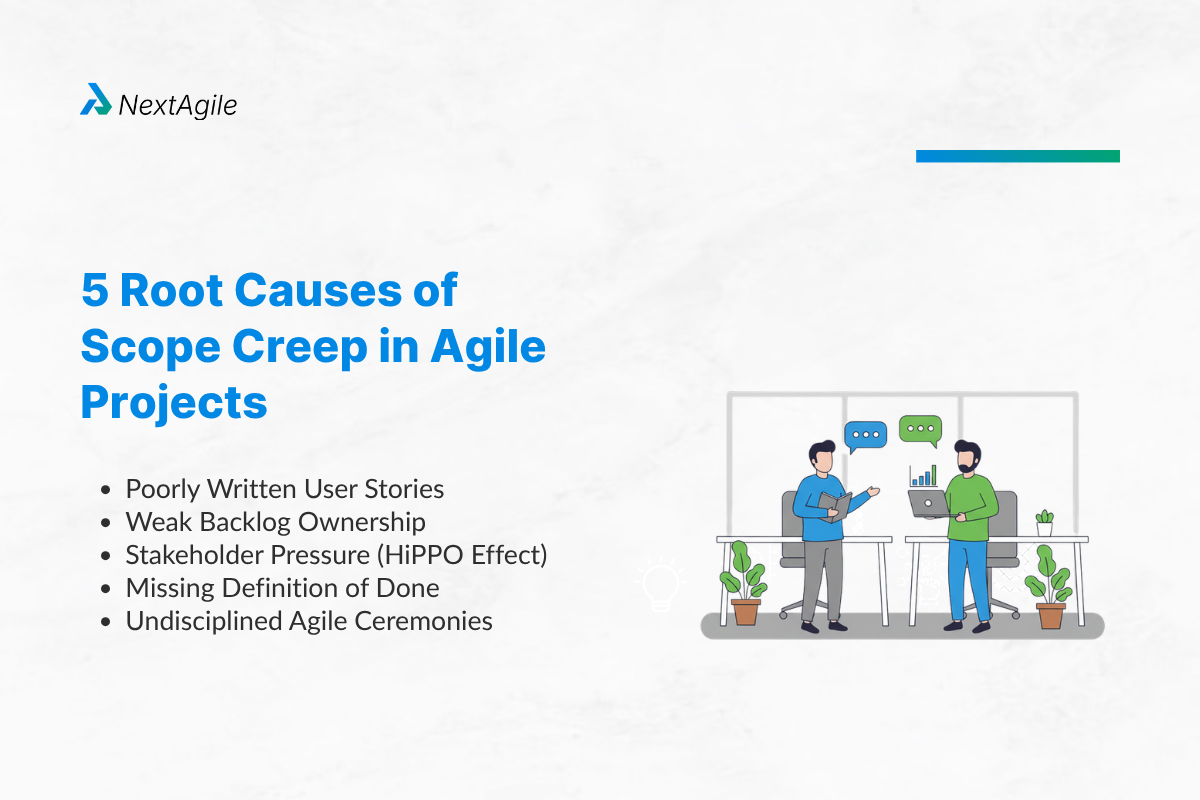
5 Root Causes of Scope Creep in Agile Projects
When user stories lack clear acceptance criteria, teams interpret them differently.Real example:
2. Weak Backlog Ownership When Product Owners are unavailable or unclear:
Teams make assumptions Stakeholders bypass prioritization This creates uncontrolled scope expansion.
3. Stakeholder Pressure (HiPPO Effect) The Highest Paid Person’s Opinion often overrides sprint discipline.Example: A senior executive pushes a feature mid-sprint for a demo, team accepts it without trade-offs → sprint goal fails.incentive misalignment . Stakeholders are rewarded for pushing priority work forward, while teams are measured on delivery commitments. This creates a structural tension where introducing new scope carries no immediate cost for requestors but creates downstream delivery risk for teams. Without shared accountability, scope control becomes unsustainable.
Without a clear DoD:
Teams keep adding “just one more improvement” Scope keeps expanding under the label of quality 5. Undisciplined Agile Ceremonies Skipping retrospectives or rushing planning leads to:
Poor alignment Repeated scope drift Agile ceremonies are not rituals, they are control mechanisms. Another hidden driver is ceremonial compliance without decision rigor . Teams may conduct all Agile ceremonies but still allow scope drift because decisions within those ceremonies lack enforcement. For example, sprint planning may define scope, but without a clear enforcement mechanism, that scope remains negotiable under pressure.
How to Identify Scope Creep in Agile: Early Warning Signals Beyond metrics, scope creep can be identified through behavioral signals within teams. Frequent re-discussions of “what exactly are we building,” increased dependency clarifications mid-sprint, and rising reliance on informal communication channels (messages, calls) instead of backlog updates are early indicators that scope is evolving outside formal control systems.
Burndown Chart Patterns Watch for:
Flat progress followed by sudden spikes Increasing scope line mid-sprint These indicate new work being added after commitment.
Tracking Sprint Progress & Velocity Trends Frequent spillovers Declining predictability Velocity fluctuations These are not estimation issues; they’re scope control issues.
Detecting Scope Creep in Large Agile Programs In scaled environments:
Cross-team dependencies introduce hidden work Scope leaks across teams Example: scope diffusion rather than direct addition . Instead of one team adding work, multiple teams incrementally adjust their scope in response to each other’s changes. This creates a cascading effect where no single change appears significant, but the aggregate impact is substantial. Managing this requires system-level visibility, not just team-level discipline.
7 Proven Ways to Prevent Scope Creep in Agile Preventing scope creep is less about restricting change and more about making change expensive in terms of decision visibility . High-performing teams do not block new requests; they ensure every request triggers a conscious trade-off discussion. This shifts the focus from control to accountability.
1. Write User Stories with Strict Acceptance Criteria (INVEST ) Define boundaries clearly Avoid ambiguous scope Clarity prevents mid-sprint surprises.
Treat Product Backlog Refinement as a decision checkpoint, not a routine meeting.
Validate scope Remove ambiguity Align stakeholders 3. Enforce a Sprint Freeze Policy No new work after early sprint stages unless:
Something is removed Team capacity allows Flexibility without boundaries is not Agile, it’s chaos. A more evolved approach than a strict freeze is a controlled swap mechanism , where any new addition must be explicitly balanced by removing or deferring an equivalent scope item. This preserves flexibility while maintaining commitment integrity, ensuring that change does not inflate workload silently.
4. Align Scope Using SAFe PI Planning Use SAFe PI Planning
Align cross-team scope Identify dependencies early Prevents scope surprises at the program level.
5. Introduce a Change Control Board (CCB) For enterprise teams:
Evaluate any mid-sprint change Force trade-off decisions Adds governance without slowing agility. In modern Agile enterprises, lightweight governance models are replacing traditional CCBs with real-time decision forums . Instead of periodic reviews, teams and stakeholders evaluate scope changes immediately with full visibility of impact. This reduces delays while still enforcing disciplined decision-making.
6. Visualize Scope Impact Use burndown and release charts:
Track scope changes Make impact visible Visibility drives accountability.
7. Run Retrospectives Focused on Scope Drift Ask:
What changed mid-sprint? Why did it happen? How can we prevent it? Continuous learning reduces recurrence.
Real-World Scenario: How a Team Reduced Scope Creep by 40%? A product team faced:
Frequent sprint spillovers Missed deadlines Stakeholder dissatisfaction What they changed:
Strengthened backlog refinement Introduced sprint freeze rule Added scope tracking via burndown Results in 3 months:
Sprint predictability improved by 35% Spillover reduced by 40% Team confidence increased significantly Scope control directly improved delivery outcomes. A critical insight from such improvements is that scope reduction rarely requires saying “no” more often . Instead, it requires saying “not now” with clarity and confidence. Teams that master deferral are better able to maintain both stakeholder trust and delivery discipline.
Managing Capacity vs Scope Allocate buffers for uncertainty Map dependencies across teams Using PI Objectives to Control Scope Define committed vs stretch goals Align business priorities early Enterprise success depends on alignment, not flexibility alone. In scaled Agile systems, scope control increasingly depends on synchronization points rather than continuous negotiation . Events like PI Planning act as alignment anchors where scope is intentionally expanded or adjusted. Outside these anchors, stability is preserved. Without such synchronization, continuous change creates systemic instability.
Scope Creep vs Product Evolution: How Experienced Teams Tell the Difference Scope Creep Product Evolution Reactive Strategic Unplanned Intentional Disruptive Value-driven
Decision questions:
Does it align with the roadmap? Can we trade off existing work? Is impact visible to all stakeholders? Mature teams don’t avoid change; they control it deliberately.
Decision Framework: Should You Accept Scope Change Mid-Sprint? Before accepting:
Is it critical to business value? Can something else be removed? Does capacity allow it? Will it impact the sprint goal? If answers are unclear, defer the change. An additional lens to evaluate scope change is reversibility . If a change is easily reversible or low-risk, it may be acceptable within a sprint. However, irreversible changes that introduce dependencies, architectural impact, or stakeholder commitments should be deferred to structured planning cycles.tension between urgency and discipline . Organizations that over-index on responsiveness sacrifice predictability, while those that over-index on control lose adaptability. The goal is not to eliminate this tension, but to manage it through clear decision systems.
Conclusion Scope creep is not an Agile flaw, it’s a leadership and discipline challenge.agile consulting company , we at NextAgile believe uncontrolled scope rarely comes from teams alone. It emerges when organizations lack clarity in backlog ownership, decision-making boundaries, and accountability.consult@nextagile.ai
Frequently Asked Questions Q1: Who is responsible for preventing scope creep in Scrum? Primarily the Product Owner and Scrum Master, but it’s a shared responsibility across the team and stakeholders.
Q2: How does SAFe handle scope creep at the program level? Through PI Planning, dependency alignment, and committed objectives that control scope changes.
Q3: What is the difference between scope creep and scope change in Agile? Scope change is structured and intentional; scope creep is uncontrolled and disruptive.
Q4: Can AI tools help detect scope creep early? Yes, by analyzing sprint data, velocity trends, and backlog changes but human judgment is still critical. However, Some forms of scope creep are absorbed through team effort, overtime, or hidden work, making them invisible in standard metrics while still impacting team health and long-term predictability.
Q5: How do you communicate scope changes to stakeholders? By clearly showing trade-offs, impact on timelines, and alignment with business priorities.
Q6: How does technical debt contribute to scope creep? Technical debt introduces unplanned work that often surfaces mid-sprint. When not explicitly tracked, it expands scope silently under the guise of necessary fixes or improvements.
Anuj Ojha is Co-Founder & Consulting Head at NextAgile. Anuj has designed & led multiple turnkey transformation journeys across industries, domains & geographies and has 16+ years of experience as an agile practitioner. He has worked with CXOs, CTOs & Key Leaders to translate their business objectives on the ground, contextualizing org transformations and creating buy-in across level, leading a team of coaches/consultants to implement agility across 150+ teams & trained more than 12k team members. Anuj’s core area of interest is business agility & working with leaders & teams to achieve long term sustainable, Agile culture & mindset.
 Skip to content