What is Design Thinking? Purpose, Process, and Why It Matters
Sujith G
Talk to Expert for Free
Table of Contents
Today, we are living in a BANI world Brittle, Anxious, Nonlinear, and Incomprehensible. The BANI model describes a new world in which the old values and rules no longer apply. This is a shift post COVID-19 from the existing VUCA (Volatile, Uncertain, Complex, Ambiguous) environment. Many frameworks helped guide organizations through the VUCA world. However, the COVID-19 pandemic introduced a scenario that made even VUCA seem less relevant or contextual. In this new reality, a new term emerged BANI highlighting the heightened fragility and the overwhelming complexity of information we face today.
In this context of uncertainty and fragility, organizations need to adapt and grow by developing solutions and products which are actually valuable to their customers. One of the best ways to do this is by encouraging collective thinking and collaboration, and investing in human centered problem solving approaches like design thinking. Design thinking helps organizations stay resilient, ahead of the competition and equips them to solve complex, seemingly unfathomable problems.
Design thinking is a powerful framework that focuses on understanding what the end user or customer wants and developing innovative solutions which solve their real world problems or add true value to them. It is a collaborative way of working which promotes empathy and experimentation to create customer centric solutions. It helps teams to come up with all perspectives for common end user/customer pain points and build the best possible solution. However, why is design thinking important? Here are a few reasons:
Enhances business relevance – Unlike conventional methods, design thinking promotes brainstorming, empathy, prototyping, collaborative thinking to solve problems. Design thinking in Business ensures innovation helping businesses to be competitive and staying relevant to their users/customers
Focusses on User centric solutions – Design thinking puts people or user needs at the center. One of the core principles of design thinking is to empathise with the user’s pain points, their needs. When designing a product or service, design thinking helps teams to take user perspective into account ensuring teams develop user centric, intuitive products thereby increasing customer satisfaction
Promotes multiple perspectives and Collaboration – Another significant benefit is collaboration. Unlike traditional siloed thinking, design thinking focuses on collaborative and collective thinking. This principle brings in divergent thinking which generates many ideas which would not have been thought before otherwise, bringing fresh perspectives and new opportunities for product development
Faster Prototypingand Course Correction – Prototyping is the core phase of design thinking. Prototyping enables teams to build and test things faster by collecting feedback from the user early in the development process. This allows faster course corrections thereby reducing the risk of launching wrong or less beneficial products in the market
Reduces wastage – With rapid prototyping, design thinking helps teams take the best possible solution to the users to seek feedback which in turn helps teams and companies invest in the right solutions and products resulting in wastage and risk reduction
Design thinking is all about empathising with the end user, coming up with multiple out of the box solutions, experimentation, continuous learning from the feedback and using all of these to build the right fit solution for the end user. The whole approach is mainly human centered, iterative and focused on solving real world problems. Below are a few characteristics of design thinking:
Design thinking concept is a human centered, people centric approach – In other words, solutioning is done with customers or people at the center by empathising with their needs. This makes solutions or products more impactful
Iterative development – Teams gather data, refine it, convert it into insights, build prototypes and test them. This process is not linear, activities are tweaked, revisited for better insights based on the prototype testing to improve them. This continuous refinement of data, iterative approach to development of solution based on the results of the prototype is very typical to design thinking methodology
Collaboration – A trait which is central to design thinking. Group thinking and co-creation of solutions drive innovation and effective problem solving
Innovative problem solving – Design thinking encourages new ways of thinking in problem solving. It incorporates systems thinking, holistic thinking and divergent thinking to solve problems from all possible angles
Early validation of DVF (Desirability, Viability and Feasibility) – Design thinking and its practices of taking the end user feedback, prototyping and iterative solution building ensures that the product/solution is both business friendly and user friendly
What Is The Purpose Of Design Thinking?
A well-known quote states that “every problem has in it the seeds of its own solution,” meaning that people with the problem often hold the key to the solution. By working closely with individuals who are facing challenges and understanding their needs, pains, gains and behaviors, teams can develop effective and impactful solutions
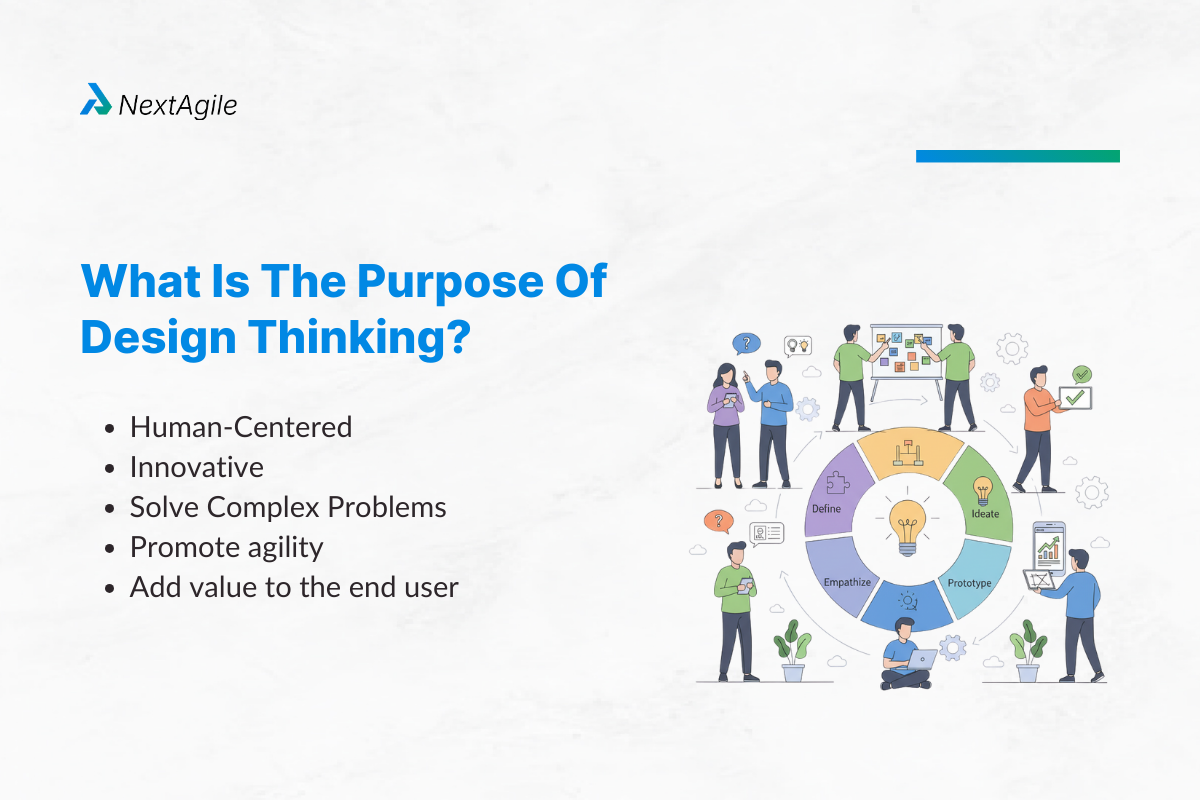
The main purpose of design thinking is to build solutions that are:
Human Centered – Design thinking promotes understanding the needs, desires and pain points of the end users which helps teams to build relevant solutions
Innovative – Design thinking activities like divergent thinking, rapid prototyping etc helps teams to come up with solutions that are new experimental which builds the core for innovation
Solve Complex Problems – Design thinking helps with a structured approach to tackle challenges by breaking them into manageable components
Promote agility – Design thinking can introduce agility into project management practices. By focusing on iterative development and continuous feedback, teams can respond to change and embrace it well (See – Design Thinking & Agile)
Add value to the end user – From the initial phase there is an opportunity to engage with the customers very closely . This allows the customers to experience the product even before the entire product is completed
Where Does The Design Thinking Process Come From?
Design thinking principles were seen as early as the 1950s and 1960s, particularly in engineering practices, where attempts were made to make design more scientific. Here is a peek at how it came became a powerful approach for many companies:
 Skip to content