Introduction About AI Product Owner Insight-Driven Guide by NextAgile – Business Agility Experts
In today’s AI-enabled business landscape, organizations are rapidly shifting towards more intelligent product delivery. With AI adoption accelerating across industries, the role of AI Product Owner has emerged as a strategic backbone of successful AI product initiatives.
Why has AI Product Ownership has become a distinct role?
They learn, drift, and evolve, making ownership a continuous responsibility rather than a one-time delivery role.
This blog explores what an AI Product Owner does, the spectrum of responsibilities across Agile teams and AI lifecycles, key skills and competencies, comparisons with adjacent roles, career progression, and proven best practices. It also highlights how NextAgile can support organizations in bridging gaps around AI product ownership and lifecycle execution.
What Does an AI Product Owner Do? At its core, an AI Product Owner is responsible for defining, prioritizing, and steering AI-driven products from conception to operational maturity. Unlike traditional product roles, this position requires a deep interplay between Agile delivery frameworks and the technical nuances of AI development, including data pipelines, model evaluation, monitoring, and value delivery alignment. Traditional product ownership optimizes features. AI product ownership optimizes learning systems that must continuously deliver value under uncertainty.
The AI Product Owner ensures that AI initiatives:
Deliver real business value , not just technical novelty Align with long-term organizational strategy Integrate stakeholder expectations with technical feasibility and risk management The AI Product owner role enforced the outcome focus around:
Business value Model reliability Trustworthiness Scalability These outcomes guide every prioritization decision.
AI Product Owners act as the bridge between business strategy, data science teams, engineering, and user outcomes, thus shaping the product vision, history, and future roadmap in a way that optimizes both business impact and ethical AI maturity.
The role of the AI Product owner is not limited to product backlog management but extends into AI product strategy, governance, and lifecycle management.
What makes this role strategically critical?
AI initiatives fail not because of algorithms but because strategy, data, delivery, and governance move out of sync. The AI Product Owner keeps them aligned.
Without clear AI product ownership, organizations often experience:
Models that perform technically but fail commercially Backlogs driven by experimentation rather than outcomes Accountability gaps across data, delivery, and ethics The AI Product Owner closes these gaps.
AI Product Owner Roles and Responsibilities
For AI products, delivery is inseparable from data readiness, model performance, and post-deployment monitoring. In Agile delivery and Scrum contexts, the AI Product Owner plays a central role in orchestrating cross-functional collaboration and steering the execution of work that delivers value in iterative increments.
Responsibilities in Agile and Scrum Teams The AI Product Owner serves as the voice of the customer and the business within Agile teams. They act as a steward of the product vision and a decision-maker on feature prioritization. AI Product Owners must make irreversible trade-offs early, especially around data scope, model complexity, and acceptable risk.
Key AI product owner responsibilities in Scrum and Agile teams include:
Defining product vision and goals that align with business outcomes Representing stakeholders’ and customers’ needs in sprint planning and backlog refinement Making trade-off decisions to balance urgency, value, and risk Backlogs are no longer feature-only. They increasingly include:
Data acquisition work Model improvement stories Monitoring and governance tasks This aligns with core AI product owner roles and responsibilities, ensuring that the AI product backlog reflects evolving priorities based on evolving data insights, user feedback, and strategic shifts.
Backlog Prioritization and Product Roadmap Planning A critical duty of the AI Product Owner is AI product owner backlog prioritization, ranking user stories, features, and technical work according to business value, impact on model performance, and feasibility.
What prioritization looks like in AI?
Value is assessed not just by user impact but by:
Data availability Model confidence Operational feasibility They work with cross-functional teams to:
Organize a product backlog that reflects real user needs and strategic goals. Craft a roadmap that sequences AI initiatives for sustained delivery and business value. Effective AI product roadmap planning also accommodates model iteration cycles, data acquisition challenges, and necessary compliance or governance milestones. Roadmaps must breathe. AI roadmaps are hypothesis-driven, not fixed plans. They evolve as models learn and as data reveals constraints.
Stakeholder Management and Collaboration with Data Science Teams Why is stakeholder alignment harder in AI?
AI stakeholders speak different languages like business, data science, engineering, compliance. Misalignment here compounds risk rapidly.
A hallmark of the AI Product Owner role is product owner collaboration with data science teams. Unlike traditional software products, AI products require deep coordination between product, data engineering, data science, and MLOps teams.
This means:
Facilitating clear communication among stakeholders with diverse technical and business perspectives Managing expectations around timelines, data dependencies, and experimental outcomesEnsuring alignment between the strategic vision and technical feasibility through regular touchpoints and decision checkpoints The AI Product Owner translates uncertainty into confidence without overselling certainty.
Stakeholder engagement is critical, balancing input from business sponsors, end users, compliance and risk teams, and technical contributors while driving toward a shared AI vision.
AI Product Owner Responsibilities Across the AI Lifecycle Lifecycle ownership is non-negotiable.
In AI, value delivery does not end at deployment, it begins there. The AI Product Owner’s scope extends beyond sprint rituals into the end-to-end AI lifecycle, from data readiness, through model development and deployment, to ongoing monitoring, feedback loops, and governance.
AI Product Development and Model Monitoring As part of AI product development, the role involves:
Collaborating with data scientists to define problem statements and KPIs Prioritizing data features and model improvements based on user impact and business risk Ensuring iterations of model development are aligned with practical deployment considerations What changes after deployment? Once live, priorities often shift from innovation to:
Stability Trust Continuous improvement Once models are in production, ai product owner ai model monitoring becomes essential. This includes:
Setting up and reviewing model performance dashboards. Monitoring data drift, accuracy metrics, and ethical compliance indicators. Coordinating with engineering to schedule model retraining or rollback when necessary. Monitoring is product work. Model drift, bias signals, and performance decay are not technical afterthoughts, they are product risks. The AI Product Owner ensures that product delivery aligns with measurable outcomes and that lifecycle activities remain transparent across the organization.
Ethical AI and Data-Driven Decision Making Responsible AI is now a core accountability for product leaders. Ethics as a delivery constraint. Responsible AI is not optional governance, it directly affects adoption, reputation, and regulatory exposure.
AI product owner ethical ai responsibilities encompasses evaluating:
Fairness and bias mitigation Explainability and transparency in predictions Compliance with privacy regulations and governance frameworks Ethical thresholds must be explicit, measurable, and enforceable otherwise they remain aspirational.
Additionally, the AI Product Owner champions data driven decision making, leveraging data insights to prioritize initiatives, guide product experimentation, and validate outcomes. They help define acceptable thresholds for risk and alignment with organizational ethics frameworks, ensuring AI initiatives are both effective and responsible.
AI Product Owner Skills and Competencies AI Product Owners don’t need to build models but they must understand their implications. To succeed, AI Product Owners must blend product leadership with domain knowledge in AI and Agile execution.
Covers: AI Product Owner Skills Key AI product owner skills include:
Strategic and analytical thinking: Ability to prioritize competing roadmaps with a focus on maximizing ROITechnical fluency: Understanding data science methodologies, machine learning concepts, and MLOps workflowsAgile expertise: Deep knowledge of Scrum principles and iterative product deliveryCommunication and leadership: Guiding cross-functional teams and facilitating consensusStakeholder management: Engaging executives, domain experts, and technical teams to align product outcomes What strong AI Product Owners consistently demonstrate?
Judgment under uncertainty Fluency across domains Comfort with experimentation These traits differentiate effective practitioners. These competencies enable the AI Product Owner to convert data insights into structured product decisions, manage the AI lifecycle, and instill trust across stakeholders.
To execute effectively, AI Product Owners also rely on specialized AI product owner tools
AI Product Owner Duties vs Traditional Product Roles AI Product Owner roles diverge in meaningful ways from traditional product positions each with unique focus areas, accountability, and required expertise.
AI Product Owner vs Product Owner While both roles share foundational Agile responsibilities, such as backlog ownership and sprint planning the AI product owner has additional responsibilities tied to the AI domain:
Aspect Traditional Product Owner AI Product Owner Focus Feature delivery and customer value AI model impact and predictive outcomes Prioritization User stories and product features Data quality, model performance, and business value Collaboration Design and engineering Data science, analytics, MLOps, and compliance teams Risk Management Functional ; technical risk Algorithmic bias, data governance, ethical risks
Why is the gap widening?
As AI products scale, the cost of poor data decisions far outweighs feature misalignment. AI Product Owners balance traditional product duties with the complexities of AI development, monitoring, and ethical maturity.
AI Product Owner vs AI Product Manager The AI product manager and the AI product owner both work on AI products but from different scopes:
Aspect AI Product Manager AI Product Owner Strategic scope Vision, business model, market positioning Delivery, execution, value realization Focus Market opportunity and strategy Backlog prioritization and sprint outcomes Stakeholder engagement External and executive leadership Internal Agile teams and cross-functional execution Career emphasis Business growth Delivery excellence and model performance
Organizations need both:
Strategy ownership (AI Product Manager) Execution ownership (AI Product Owner) Conflating the two creates delivery friction. While experiences may overlap, the AI Product Manager often operates at a higher strategic business level, whereas the AI Product Owner ensures incremental value delivery and operational success. This distinction resonates with those exploring an AI product manager career versus deep execution roles.
AI Product Owner Career Path and Growth Opportunities Why does this career path accelerate?
AI Product Owners gain exposure to strategy, data, technology, and governance, making them uniquely positioned for leadership. The AI product owner career path is dynamic and expanding as organizations invest in intelligent products.
Career progression typically includes:
AI Product Owner (Entry / Mid-Level): Focused on backlog management, stakeholder coordination, and Agile deliverySenior AI Product Owner: Leading larger AI portfolios, defining AI best practices, and mentoring teamsAI Product Manager: Evolving into broader strategy, product growth, and market engagementHead of AI Product / Director: Driving AI product strategy across business units and portfoliosChief Product Officer / VP of Product: Executive leadership in product and AI strategy Many senior AI product leaders started by mastering delivery complexity and not strategy decks. This pathway blends business acumen with technical experience and offers immense opportunities for cross-disciplinary leadership.
How to Become an AI Product Owner? Becoming an AI Product Owner requires a strategic blend of education, hands-on experience, and Agile certification.
Certification and Learning Paths
Helpful credentials include:
Certified Scrum Product Owner (CSPO) or PSPO Agile certifications (e.g., PMI-ACP, SAFe PO) AI and data analytics courses from recognized providers (Coursera, MIT, Stanford, etc.) Specialized AI delivery and MLOps workshops Learning priority order:
Agile fundamentals → AI literacy → Lifecycle governance → Ethical decision-making
Sequence matters more than credentials. Building foundational understanding in Agile frameworks, AI lifecycle management, and stakeholder engagement equips aspirants for how to become an AI product owner.
For professionals looking to accelerate their journey, structured learning programs like a Product Owner masterclass workshop
AI Product Owner Best Practices
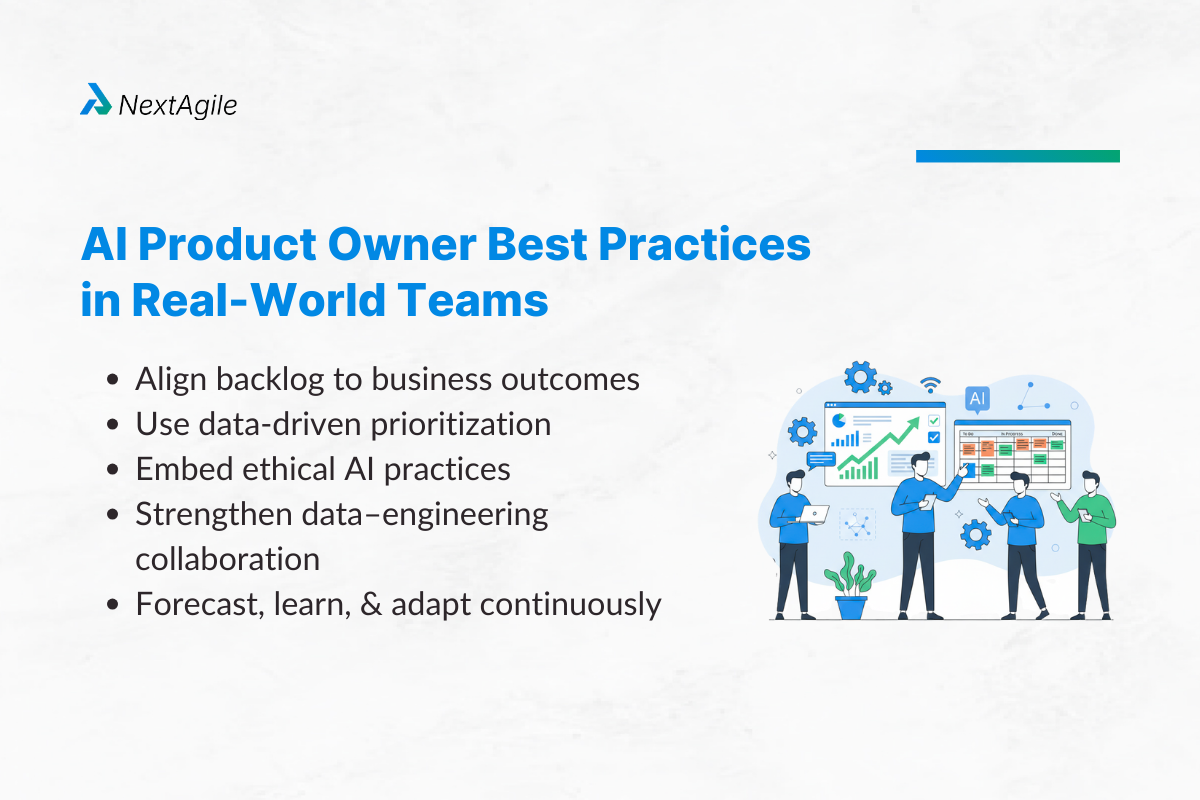
Successful product owners incorporate a blend of proven AI product owner best practices:
Align product backlog to measurable business outcomes Leverage data insights for backlog decisions Prioritize ethical AI excellence Collaborate deeply with data science and engineering Use Agile forecasting and continuous learning loops What separates high-performing teams?
Consistency. Best practices fail when applied selectively rather than systemically.
By applying these practices consistently, teams improve delivery quality, reduce risk, and achieve faster feedback-driven improvements.
How NextAgile Helps Enterprises Build AI Product Ownership Where do organizations typically struggle while adopting AI in their traditional Product ownership roles?
Role clarity Backlog ownership Data accountability Ethical governance These gaps slow AI value realization.
Enterprises often struggle to define and implement AI product ownership due to complexity across strategy, delivery, data governance, and cross-functional collaboration. An Agile Consulting company like NextAgile helps organizations bridge this gap end-to-end.
Here’s how we help:
1. AI Product Strategy and Roadmap Planning : We work with leadership to define value-driven AI strategies and scalable roadmaps, translating AI goals into executable Agile deliverables. Roadmaps are framed around measurable impact and not technology adoption milestones
2. Agile Implementation for AI Projects : NextAgile embeds Agile ways of working with MLOps and model delivery frameworks, ensuring reliable execution cadence and incremental value. Check our blog on 50 most frequently asked question for organization starting their Agile Transformation journey – 50 FAQs on Agile Transformation
3. Backlog Prioritization and Stakeholder Alignment : We facilitate backlog workshops, clarify product goals, and reconcile competing priorities across business, engineering, and data teams
4. Collaboration with Data Science and Engineering Teams : Our consultants enable a shared language and execution model that aligns data science experimentation with product delivery timelines
5. AI Lifecycle Management and Ethical AI Governance : We help build frameworks that monitor models, manage data drift, and ensure ethical AI governance enabling sustainable and responsible product delivery. Governance accelerates delivery, clear guardrails reduce rework, escalation, and reputational risk, speeding decision-making
Benefits to Organizations Partnering with NextAgile yields measurable outcomes:
Faster time-to-market with AI solutions Enhanced alignment between strategy, delivery & execution Stronger data-driven decisions Reduced risk through ethical and responsible AI governance A scalable model for AI product ownership excellence Organizations move from experimenting with AI to operating AI at scale. By combining Agile expertise with AI insights, we help organizations maximize the business value of AI initiatives.
If your organisation is facing agile transformation challenges and struggling with clarity on roles like AI Product owner, NextAgile consulting can help you diagnose the real bottlenecks and co‑create a practical transformation roadmap with clearly defined roles, responsibilities, milestones and agile leadership metrics to track. Reach out to us consult@nextagile.ai for a quick discussion to explore how we can help.
FAQs 1. What does an AI Product Owner do in Agile teams? An AI Product Owner leads the product vision, manages the backlog, prioritizes AI-related work, and ensures that Agile delivery aligns with strategic business outcomes across sprints and releases.
2. How is an AI Product Owner different from an AI Product Manager? The AI Product Owner focuses on execution, backlog prioritization, and delivery within Agile teams, while the AI Product Manager typically shapes overall product strategy, market alignment, and high level decision making.
3. What skills are required to become an AI Product Owner? Critical skills include Agile expertise, strategic planning, stakeholder management, technical fluency in AI concepts, and data-driven decision-making.
4. How does an AI Product Owner work with data science teams? They coordinate on problem definition, validation metrics, feature prioritization, data readiness, and deployment timelines, ensuring clear communication and alignment of outcomes.
5. How can NextAgile help organizations without a dedicated AI Product Owner? NextAgile provides end-to-end consulting, from strategy to execution, enabling organizations to build AI product ownership capabilities, align cross-functional teams, and deliver value efficiently.
Anuj Ojha is Co-Founder & Consulting Head at NextAgile. Anuj has designed & led multiple turnkey transformation journeys across industries, domains & geographies and has 16+ years of experience as an agile practitioner. He has worked with CXOs, CTOs & Key Leaders to translate their business objectives on the ground, contextualizing org transformations and creating buy-in across level, leading a team of coaches/consultants to implement agility across 150+ teams & trained more than 12k team members. Anuj’s core area of interest is business agility & working with leaders & teams to achieve long term sustainable, Agile culture & mindset.
 Skip to content