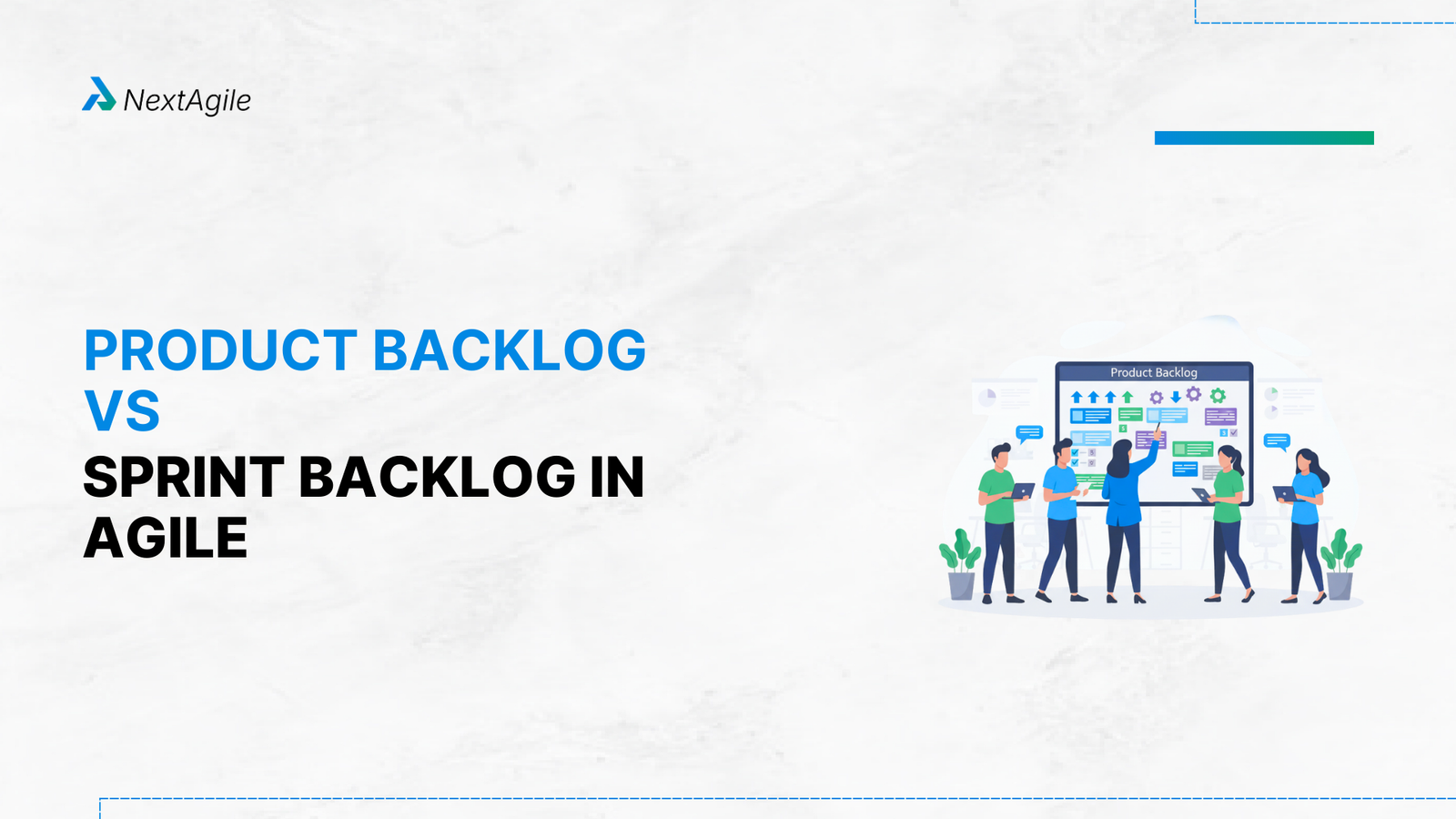
In agile ways of working, backlogs play a crucial role in organizing the work and prioritizing tasks. Backlogs are the only source of truth that helps the development team understand the list of activities / work that it needs to undertake for successful delivery of the project. Backlogs provide the direction towards which the team aims at working and assures teams efficiency and clarity.
There are two types of backlogs in Agile: the Product Backlog and the Sprint Backlog. Understanding the differences, purposes, and management of these backlogs is essential for any Agile team to deliver value consistently i.e. in iteration and frequently. This blog will delve into the relationship and difference between the Product Backlog vs Sprint Backlog, providing examples, comparisons, and insights into their effective management.
We will explore these below pointers and more in this blog:
We will understand what is a backlog
Interdependence between product vs sprint backlog
Difference between sprint and product backlog
Effective product vs sprint backlog practices
How to ensure that sprint vs product backlog interdependence is properly managed
Who is responsible for sprint vs product backlog management
Few tools to help product vs sprint backlog management
What is a Backlog?
Let us first try to get an understanding of what is a backlog, what it comprises and how and when it is derived.
In Agile terminologies, backlogs are lists of tasks that help teams manage their work and prioritize what needs to be done. A backlog is always constructed in a way that high priority items appear on top of the list and low priority on bottom. Backlogs are dynamic in nature meaning they evolve with time and as the team gets more clarity about the product, or the market changes, or the customer expectation evolves or because of any other reason.
A Backlog consists of epics, stories, features, enhancements, a specific request from customer, a feedback from the customer, a request from sales, any R&D initiative, any new idea to be implemented, support / production issues, internal bugs raised by tester.
At the end of the discovery session, where all the stakeholders, product owner and development team (developers and testers) discuss and identify the what’s and why’s of the product, the team comes out with the list of ideas regarding the product/ service to be developed. The team looks at this list as the source of requirements and direction towards developing the product and hence calls it product backlog. This list usually consists of big actionable items, which cannot be picked as is and delivered in an iteration (ideally in 2-3 weeks). The development team (SM, Product Owner and developers and testers) then breaks those ideas into doable/ actionable items which can potentially be developed and delivered to the customer for their feedback in one iteration, and calls it a sprint backlog.
Now, let’s dive deep and understand each of these backlogs better and list down interdependency and differences between product backlog vs sprint backlog..
Product Backlog
Product Backlog is a comprehensive list of features, enhancements, bug fixes, tasks and requirements for the entire product, with focus on the vision of the product. This list is generally raw and not too detailed. It is arranged in a high to low priority manner i.e. the highest priority work/ item is on the top of the list and the one with least priority at the bottom. It is dynamic in nature and evolves as the product grows and market demands change. It is owned and controlled by the Product Owner, meaning any changes to product backlog including its content, availability, and ordering is done by the product owner.
Let’s take a few Product Backlog examples –
Imagine you are developing a new e-commerce platform. The Product Backlog might include items such as:
User login and authentication
Product search functionality
Shopping cart implementation
Payment gateway integration
User reviews and ratings
Return / Replacement tracking
Mobile app development
Each item in the Product Backlog is referred to as a Product Backlog Item (PBI). These items are prioritized based on business value, user needs, dependencies, complexity, market fit and uniqueness it offers and many other factors. This is again decided by the product owner.
Sprint Backlog
Spring Backlog is derived from the Product Backlog by breaking the big ideas in to doable items that the team commits to completing within a specific sprint / iteration. The items in the sprint backlog are more focused and detailed, outlining the actual tasks and work items that need to be picked for achieving the sprint goal.
While the way product backlogs reflect the vision of the product, sprint backlog works on the sprint goals (goal should be different for each sprint), focusing on completing one or more tasks (based on the team’s capacity) with highest priority in the product backlog.
 Skip to content