Skip to content



Key Takeaways of Leadership Plateau
- A leadership plateau occurs when impact stops scaling despite experience
- High performers plateau by overusing past success behaviors
- Leadership requires shifting from execution to system-level thinking
- Common signals include dependency, misalignment, and reduced leverage
- Breaking the plateau requires an identity shift from expert to enabler
- The PLATEAU Model provides a structured path to scale leadership impact
- The plateau leads to reduced influence and not immediate failure
- Coaching accelerates leadership transformation
Leadership plateau is caused by over-reliance on past success patterns.
Scaling leadership requires system thinking, not increased effort.
Ownership, alignment, and influence are core drivers of leadership impact.
Introduction
Some of the most capable professionals don’t fail when they step into leadership.
They stall.
They were high performers, decisive, reliable, and consistently delivering results. But as they move into Director and VP roles, something shifts:
- Their impact stops scaling
- Decisions feel heavier
- Teams don’t move as fast as expected
The issue isn’t capability. It’s that the environment has changed, but their leadership model hasn’t. That’s where the breakdown begins, when capability stays constant but context becomes more complex. This is the leadership plateau.
And it doesn’t look like failure. It looks like being busy, involved, and respected, yet increasingly less influential where it matters most.
A leadership plateau is not a performance issue; it is a scaling failure of the leadership operating model. As complexity increases, success depends less on individual capability and more on how effectively leaders create alignment, distribute ownership, and enable decision-making across the system.
What Is a Leadership Plateau and Why Does It Happen?
A leadership plateau is a stage where your effectiveness stops compounding, even though your experience continues to grow.
You’re still delivering. Still solving problems. Still seen as capable. But your impact is no longer expanding across the system. That’s the early signal that your leadership model hasn’t evolved with your role.
The leadership plateau begins before it becomes visible.
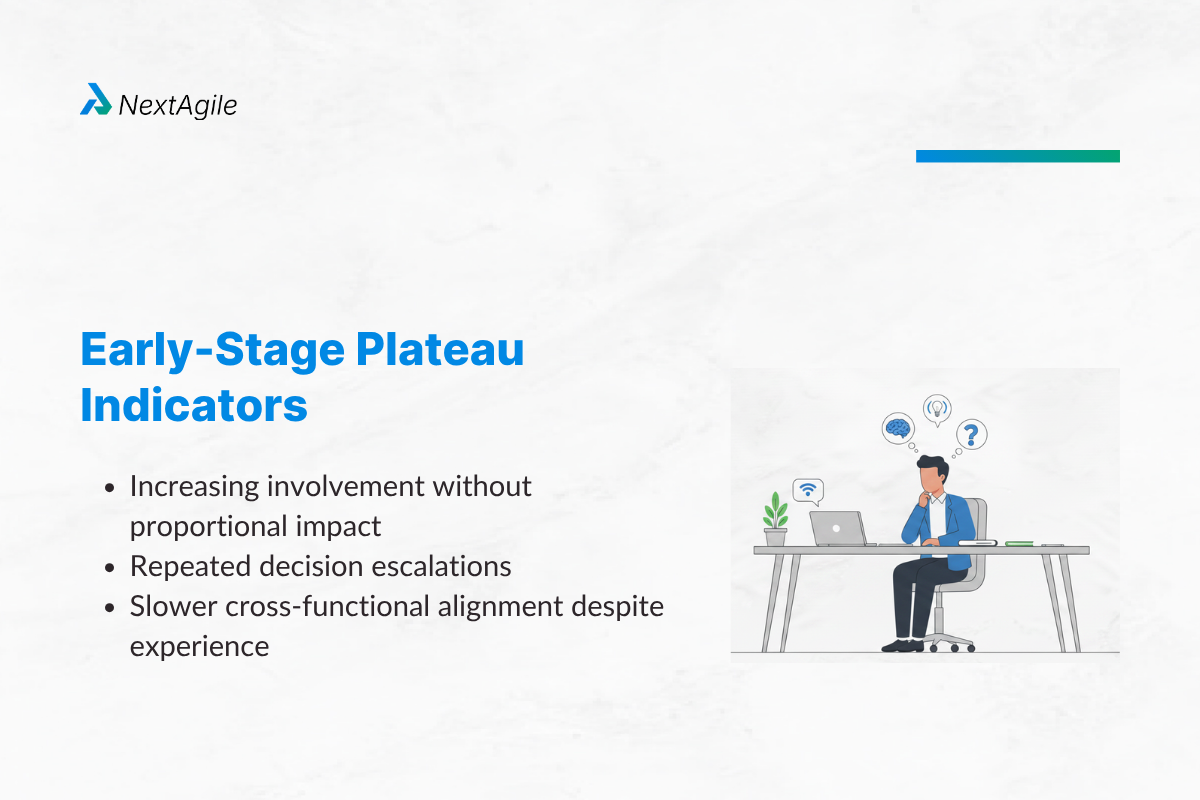
Early-stage plateau indicators include:
- Increasing involvement without proportional impact
- Repeated decision escalations
- Slower cross-functional alignment despite experience
The individual contributor identity trap
High performers are conditioned to:
- Solve problems quickly
- Take ownership
- Ensure quality personally
These behaviors become default patterns. But at leadership levels, those same patterns create dependency.
Example: A Director steps into execution to ensure quality. Short-term, results improve.
Long-term, the team stops taking ownership. The leader becomes the bottleneck.
Strengths become constraints at scale.
Behaviors that once created success:
- Owning outcomes directly
- Stepping in to fix issues
- Maintaining high personal standards
At scale, these create:
- Team dependency
- Decision bottlenecks
- Reduced leadership leverage
Why does high performance not guarantee leadership readiness?
High performance optimizes for:
- Speed
- Accuracy
- Individual output
Leadership requires:
- Alignment
- Leverage
- System-level outcomes
Without this shift, leaders don’t fail; they stall at scale.
Leadership requires a different success equation.
- Individual success = Output × Speed
- Leadership success = Alignment × Ownership × Influence
Without this shift, performance remains constant but impacts the plateau.
What Changes at Director and VP Level?
Leadership at this level is not about doing more. It’s about changing how work flows through the organization. Complexity shifts from tasks to systems.
At senior levels:
- Problems are interconnected, not isolated
- Decisions have multi-team impact
- Misalignment compounds faster than execution errors
A real leadership breakdown moment.
A cross-functional initiative is behind schedule.
- Product wants speed
- Engineering wants stability
- Sales is escalating pressure
The leader steps in, solves the issue, and pushes execution forward.
But within weeks:
- Misalignment returns
- Teams depend on the leader again
- Progress slows
Why? Because three critical shifts didn’t happen. Solving problems is not the same as scaling solutions.
When leaders repeatedly step in:
- Issues get resolved temporarily
- Root causes remain unaddressed
- Dependency cycles get reinforced
What critical shifts needed to happen?
From doing to enabling
Leaders must move from solving problems to building systems that solve problems.
From being right to creating alignment
Correct decisions don’t scale. Aligned decisions do.
From speed to influence
Fast decisions create movement. Influential decisions create sustained execution.
Leadership leverage is created through systems, not intervention.
Scalable leaders:
- Design decision frameworks
- Enable ownership at the right levels
- Reduce reliance on escalation paths
Signs You Have Hit a Leadership Plateau
Behavioral indicators
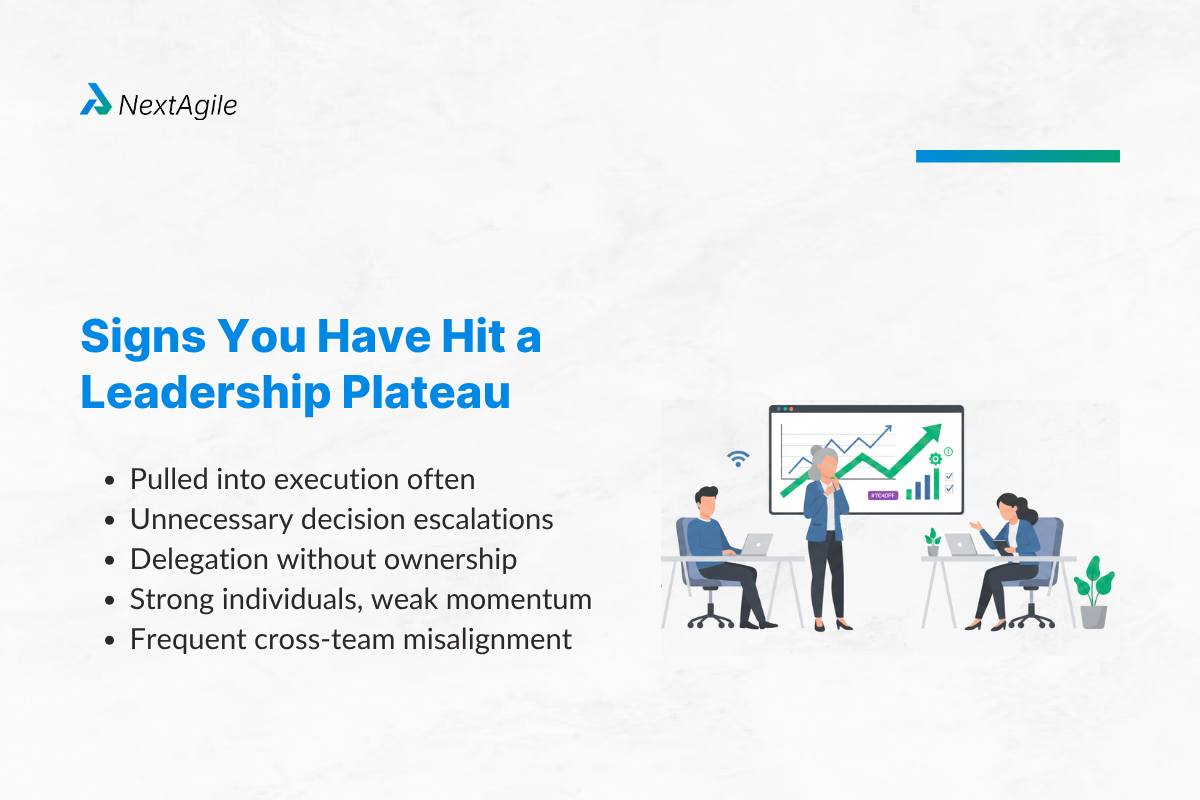
- You are pulled into execution frequently
- Decisions escalate to you unnecessarily
- You feel busy but not strategically impactful
- Delegation exists, but ownership doesn’t transfer
Team-level signals
- Strong individuals, weak team momentum
- Repeated misalignment across functions
- Teams wait instead of acting
- Work gets redone or corrected often
These are not execution problems. They are leadership scaling problems. Plateau is a system signal, not an individual weakness.
These patterns indicate:
- Misaligned decision ownership
- Lack of clarity in roles and expectations
- Over-centralization of authority
Quick Diagnostic: Are You on a Leadership Plateau?
Ask yourself:
- Do decisions repeatedly come back to you?
- Are you more involved in execution than strategy?
- Does your team rely on you to move forward?
- Are alignment issues recurring despite interventions?
If yes, you are likely experiencing a leadership plateau.
Frequency of dependency is the strongest indicator.
If teams repeatedly:
- Seek validation before acting
- Escalate solvable problems
- Wait for direction
Leadership scale is already constrained.
What It Takes to Break Through a Leadership Plateau?
Breaking through requires more than effort. It requires a shift in leadership identity.
And that shift is uncomfortable because it requires giving up the very behaviors that built your credibility.
Breaking the plateau requires unlearning, not just learning.
Leaders must intentionally:
- Reduce direct control
- Shift from problem-solving to system design
- Accept short-term discomfort for long-term scale
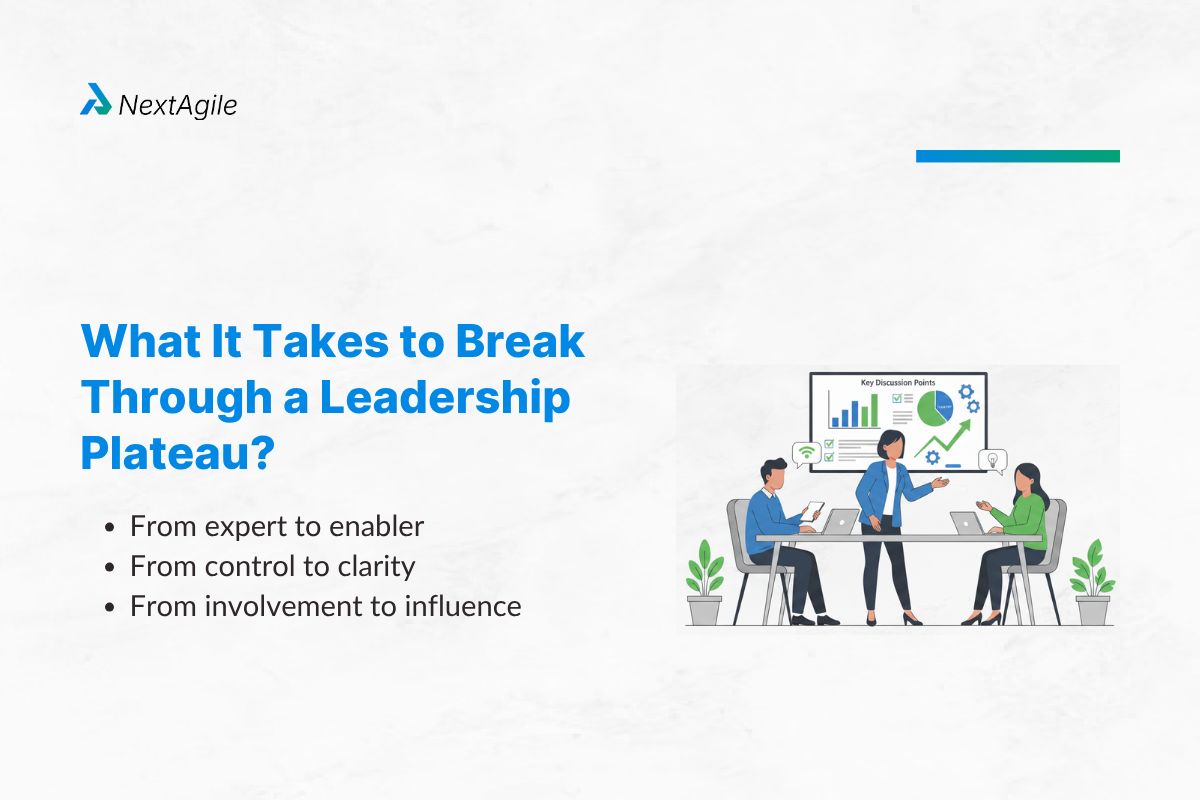
1. From expert to enabler
Your value is no longer in solving problems.
It is in ensuring problems get solved without dependency on you.
Ownership transfer is the core leadership multiplier.
Effective ownership transfer requires:
- Clear decision boundaries
- Defined accountability
- Support without takeover
This transition often reflects principles explained in our transformational leadership guide for scaling executive impact.
2. From control to clarity
Delegation alone doesn’t scale leadership.
Clarity does:
- Clear ownership
- Clear decisions
- Clear expectations
Clarity reduces the need for control.
When clarity is high:
- Decisions move faster
- Teams act with confidence
- Escalations reduce naturally
3. From involvement to influence
Presence in every decision limits scale.
Influence enables:
- Faster alignment
- Independent execution
- Sustainable performance
Influence scales leadership beyond presence.
Leaders create influence by:
- Aligning stakeholders early
- Communicating decision intent clearly
- Reinforcing priorities consistently
The PLATEAU Model (Practical Application)
A structured approach to breaking leadership stagnation:
- P – Pause default behavior
- L – Look at the system, not the task
- A – Assess team dependency
- T – Transfer ownership clearly
- E – Expand stakeholder alignment
- A – Adjust through feedback loops
- U – Upgrade leadership identity
This model shifts leadership from:
- Execution → Enablement
- Control → Alignment
- Activity → Impact
Frameworks only work when applied consistently in real scenarios.
Effective application requires:
- Use during high-stakes decisions
- Reflection after key interactions
- Continuous adjustment based on outcomes
The Cost of Staying on a Plateau
A leadership plateau doesn’t create immediate failure. It creates gradual loss of influence.
Over time:
- You are seen as operational, not strategic
- You are excluded from critical decisions
- Your impact stops scaling
- Your role becomes execution-heavy
At senior levels, the risk is not failure. It is being quietly bypassed. Loss of influence is gradual but irreversible if ignored.
Over time, plateau leads to:
- Reduced strategic visibility
- Lower decision authority
- Limited leadership growth opportunities
How Leadership Coaching Accelerates Breakthrough?
Leadership plateaus persist because they are driven by invisible behavioral patterns.
Patterns that feel like strengths. Many senior leaders accelerate change faster with the support of an experienced leadership coaching who helps break invisible behavioral patterns.
Coaching helps leaders:
- Identify blind spots quickly
- Challenge default behaviors
- Build new leadership patterns in real scenarios
- Create accountability for sustained change
Most programs add skills. Plateau recovery requires behavioral rewiring. The plateau persists because it is self-reinforcing.
Without intervention:
- Leaders continue default behaviors
- Teams adapt around those behaviors
- System inefficiencies become normalized
Conclusion: What Actually Changes When You Break the Plateau?
Breaking a leadership plateau is not about becoming better at what you already do.
It’s about changing how you define your role entirely.
At senior levels:
- Your value is not in solving problems
- Your value is in ensuring problems don’t depend on you
- Your impact is not measured by activity
- Your impact is measured by system performance
- Your effectiveness is not about being right
- It is about creating alignment that sustains execution
The leaders who break through understand one critical shift: They stop being the center of execution and become the force that enables it. That is the difference between a high performer and a scalable leader. And that is what ultimately defines leadership at the highest levels.
Continue Reading (Pillar Blogs)
- Reaction vs Response in Leadership
- Leadership Mindset Shift: You Don’t Need More Skills
- Psychological Safety Without Losing Accountability
- Leadership Skills – A complete guide to become an effective leader
- Emotional Intelligence for Leaders
Leadership Plateau Playbook
Download the Leadership Plateau Playbook:
- Self-assessment toolkit
- Real-world leadership scenarios
- PLATEAU Model worksheets
- 30-day leadership shift plan
As a leadership coaching company, we at NextAgile understand that the leaders who break through understand one critical shift: They stop being the center of execution and become the force that enables it. That is the difference between a high performer and a scalable leader. And that is what ultimately defines leadership at the highest levels.
We would be glad to evolve a leadership enablement roadmap suited to your organizational strengths and business context. Please reach out to us consult@nextagile.ai to explore how we can help your leadership transformation journey.