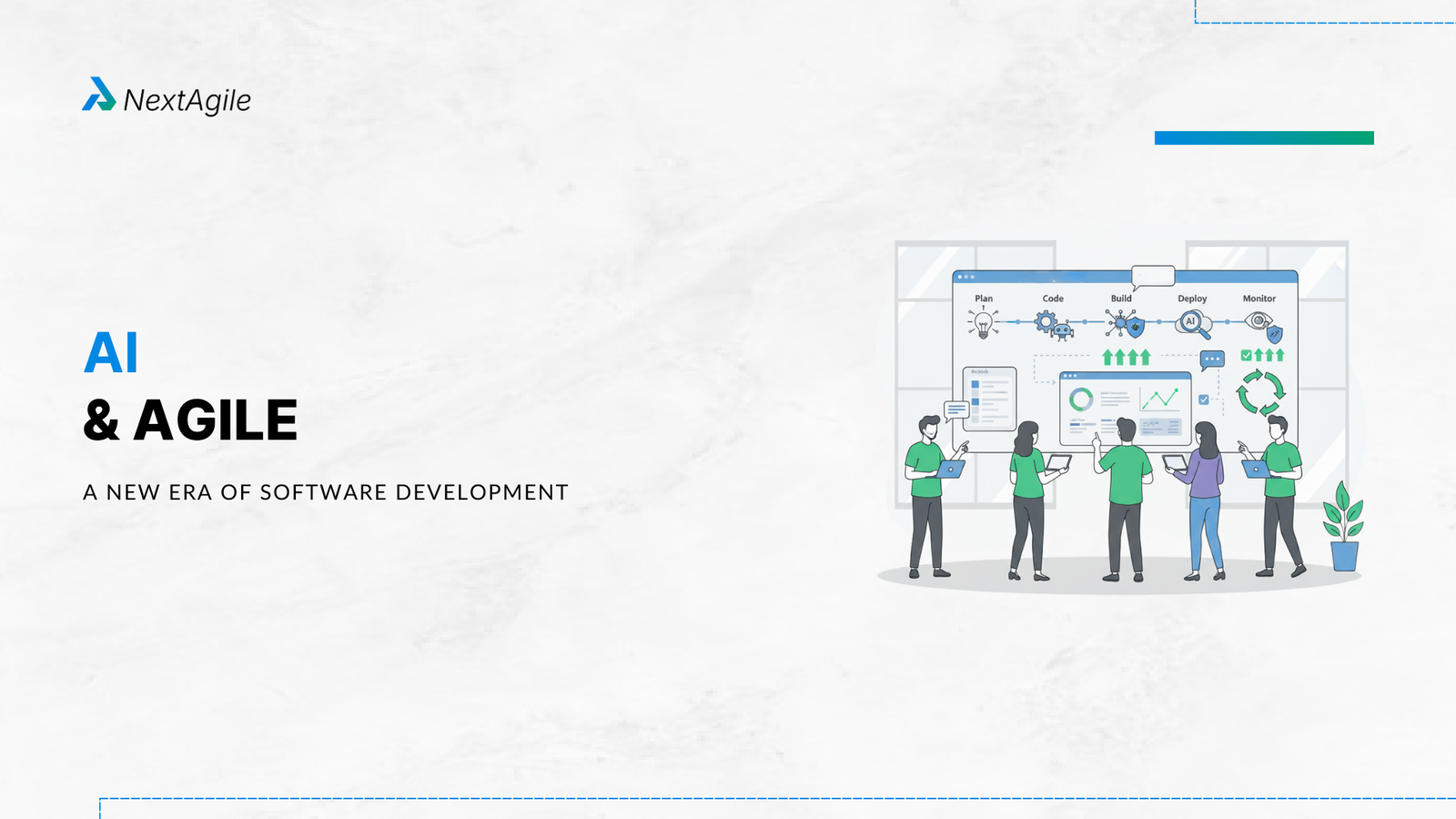
Introduction: The Unstoppable Convergence of AI and Agile I have been building things in tech for a long time. Long enough to remember when “Agile” was the radical new kid on the block.
Before that, we worked in ways that seem crazy now. We would spend a year writing a massive plan, hand it off to developers who we barely spoke to, and then, a year later, get a piece of software that was already obsolete. It was slow, painful, and disconnected from reality.
Agile, for all the buzzwords the consultants tacked onto it, was a breath of fresh air. At its heart, it was just about talking to people. It was about showing your work while it was still messy, getting feedback, and having the guts to change course. It was about putting smart people in a room and trusting them to figure it out. It was beautifully, chaotically human.
Then came the next tidal wave of hype: AI.
And honestly, my first reaction was, “Oh, here we go again.” Another solution looking for a problem, another word to cram into a PowerPoint deck. The initial talk was all about AI replacing jobs, automating tasks, and a future run by algorithms.
It all felt a bit… bleak. And boring.
But the more I see it in action, the more I realize that’s not the interesting part of the story. At all.
The real story isn’t about machines replacing us. It’s about machines freeing us up from the parts of the job that we, as creative humans, are actually pretty bad at.
Think of it like this: a great product team is like a skilled carpenter. With Agile, we learned how to be better carpenters. We learned how to measure carefully, how to collaborate on the design, and how to build sturdy, useful things for our customers.
Now, AI comes along and gives us a set of power tools we have never seen before. A drill that instantly knows where to find a stud in the wall. A saw that makes a perfect cut every single time.
Does the power saw replace the carpenter? Of course not. A fool with a power saw just makes a bigger mess faster. But a skilled carpenter with those tools? They can suddenly build things they could only have dreamed of before. They can spend less time on the tedious, repetitive work and more time on the artistry, the design, the things that require a human touch.
That’s what this is. AI is becoming the ultimate assistant. It can sift through ten thousand customer reviews and find the one sentence that truly explains why people are frustrated. It can analyze the ripple effects of a code change before we even make it. It can handle the mind-numbing data crunching that we used to dread.
And us? We get to do more of what we were meant to do. We get to talk to that one frustrated customer. We get to argue over a whiteboard sketch. We get to have that one weird, brilliant idea in the shower that changes everything.
This isn’t a story about choosing between people and machines. It’s about a partnership where each side gets to do what it does best. And if it means less drudgery and more creativity, I’m all for it.
How AI is Accelerating Agile Adoption and Evolution? What AI Actually Does for Agile Teams? For all the good Agile brought us, closer teams, faster cycles, happier customers, it also created a whole new set of chores.
Suddenly, we were spending endless hours refining backlogs, writing tickets with painstaking detail, and sitting in planning meetings trying to guess how long a task would take, knowing deep down it was just a shot in the dark. We traded one kind of paperwork for another.
For a long time, we just accepted this as the cost of doing business. But now, AI is starting to act like a powerful assistant that loves doing all the stuff we hate. And it’s changing the entire feel of the game.
It Starts By Killing the Tedious Work Think about all the time we waste on things that aren’t actually building the product. Writing boilerplate code. Manually testing every little change. Pulling together status reports that no one really reads.
This is the low-hanging fruit for AI i.e. to handle repetitive tasks. It’s like having an intern who never gets tired, never makes a typo, and frees up your best people to do what you actually hired them for: solving complex problems and coming up with brilliant, creative ideas. This isn’t about replacing developers; it’s about liberating them from monotony.
May be like a Crystal Ball (That Actually Works) In sprint planning, we all see that the entire team is trying to estimate a big project based on a mix of experience, intuition, and pure guesswork. And we are often wrong.
Welcome to AI world! Now each project could get analyzed & this tool can gently remind, “Heads up, a task like this usually has hidden complexities ,” or “Watch out, making a change here often causes bugs over there. ”
That’s what AI is starting to do. It’s giving us predictive insights that move us from just guessing to making informed bets. It spots risks we would have missed and helps us allocate our time more intelligently. Some of the stats out there are wild, companies seeing on-time project completion rates skyrocket but even a small improvement here means less stress and fewer broken promises.
From Reacting to Problems to Getting Ahead of Them The biggest shift, for me, is how this changes our posture. For years, Agile has been about getting better at reacting to change. A bug pops up in production, and we swarm it. A customer complains, and we pivot. It’s a constant state of fighting fires.
AI helps us prevent the fires from starting in the first place. Now along with responding to changes, AI could help in preventing issues.
AI-powered tools can act as bug-hunters, spotting weird anomalies in the code that a human might never catch. They can predict potential roadblocks before they happen. This fundamentally changes the rhythm of work. We move from being reactive firefighters to proactive architects.
When you can trust that you have a safety net looking for problems 24/7, you release new things with more confidence. You spend less time fixing what’s broken and more time inventing what’s next. AI doesn’t just make Agile faster; it makes it smarter, calmer, and more resilient. It helps Agile finally deliver on its original promise: letting great teams focus on building great things.
Agile’s Enduring Effectiveness in a Post-AI World Our Human Skills Are Worth More, Not Less. With all the talk about AI getting smarter every day, it’s easy to start feeling a little anxious. It’s a question that’s probably in the back of everyone’s mind: Are our skills, our experience, and our ways of working about to become obsolete?
My answer is NO. In fact, it’s just the opposite. The things that make us good at our jobs—the truly human things—are about to become more valuable than ever.
A Tool is Not a Teammate. Let’s get one thing straight: AI is a tool. It’s an incredibly powerful one, but it’s a tool nonetheless. It’s not a teammate, and it’s certainly not the captain.
This analogy might sound like desperation but it may help in setting the tone right -> Think of it like a pilot and an autopilot system. The autopilot is phenomenal. It can handle 99% of a routine flight with incredible precision, analyzing thousands of data points every second. But what happens when you hit unexpected, violent turbulence? Or when a flock of birds appears out of nowhere? Or when you have to make a split-second judgment call that isn’t in any manual?
You need the human pilot. You need someone with years of experience, intuition, and the ability to see the bigger picture. The autopilot handles the predictable; the pilot handles the unexpected.
That’s our role in a world with AI. We are the pilots. AI can take over the routine, data-heavy tasks, but it’s our job to handle the turbulence, to understand the context, and to make the tough judgment calls.
Here’s the Irony: AI Makes Our “Soft” Skills the Main Event For years, we’ve been told to be more data-driven. Now we have a tool that can beat any human alive in terms of being data driven. So what’s left for us?
Everything that Agile was trying to get us back to in the first place.
The more AI handles the predictable work—the code generation, the data analysis, the reporting—the more the spotlight shifts to the things machines can’t do. Things like Creativity ( Having a weird, brilliant idea), Empathy ( Truly understanding a customer’s frustration), Collaboration ( partnering to brainstorm), Ethical Judgment ( doing the right thing, the right way for the right reasons)
This is the so-called “Agile Paradox.” The very thing that makes Agile work—its messy, collaborative, human-centric core—is exactly what becomes most critical in a world augmented by AI.
Garbage In, Garbage Out. An over-reliance on AI is actually dangerous. An AI model is only as good as the data it’s trained on. It can’t spot a bias it wasn’t taught to see. It can’t understand the nuance of a specific customer’s situation. It can’t feel when a design is just “off,” even if the numbers say it’s right.
Without vigilant human oversight, AI is just a force multiplier for our own blind spots. It can help us build the wrong thing faster than ever before. Our judgment, our values, and our ability to question the data are not just “nice-to-haves”; they are the essential safety features.
So, the challenge ahead isn’t about learning to compete with machines. It’s about doubling down on being human. The future belongs to the teams who figure out how to use these powerful new tools without ever losing sight of the people they are building for.
AI’s Impact on Agile Values & Principles Agile Values The Common Struggle (Our Reality) How AI Actually Helps (In Simple Terms) Individuals & Interactions Customer Collaboration We get buried in admin, scheduling, and manually trying to make sense of thousands of customer comments, leaving little time to actually talk. Acts as an admin assistant to handle the grunt work. It reads all the feedback and gives you the key themes, so you can focus on the human conversation. Working Software Continuous Delivery The pressure to ship fast is high, but the fear of releasing a critical bug on a Friday afternoon is even higher. Manual testing is slow and tedious. Acts as a tireless coding partner to help write tests and spot bugs. It provides a “safety net” that gives teams the confidence to release small updates frequently. Responding to Change Welcoming Requirements Reacting to change often feels chaotic and stressful. We’re usually just guessing about the true impact of a new request and its hidden complexities. Acts as a scout or navigator. It analyzes past data to warn you about potential risks or timelines, helping you make informed pivots instead of panicked guesses. Self-Organization Sustainable Pace Regular Reflection Teams have blind spots. Burnout is a real risk from uneven workloads, and retrospectives can get stuck on surface-level issues without finding the root cause. Acts as a “fitness tracker” for the team. It can spot workload imbalances and analyze past retros to find recurring problems, helping the team see itself more clearly.
The Agile Principle The Common Struggle (Near to Reality) How AI Actually Helps (In Simple Terms) 1. Satisfy the customer through early and continuous delivery of valuable software. Building something for months, only to find out later that the “valuable” part was a bad guess. The feedback loop is painfully slow. It instantly analyzes how users engage with small, new features, giving us a rapid signal if we are on the right track. It helps us find the “value” faster. 2. Welcome changing requirements, even late in development. A late-stage change feels like a bomb going off. Teams are scared to say “yes” because they can’t predict the full impact and chaos it might cause. Acts as a scout. It can model the ripple effects of a change across the codebase, making it less risky and easier to confidently say “yes” to a good idea. 3. Deliver working software frequently… with a preference to the shorter timescale. Big, infrequent releases feel safer because manual testing and deployment are slow, stressful, and require so much ceremony. It automates the entire testing and release process, acting as a “safety net.” This makes releasing software boring, routine, and easy to do daily. 4. Business people and developers must work together daily. Business and tech teams often speak different languages. Important context gets lost in translation between a business goal and a technical task. Acts as a translator. It can summarize technical progress into plain-language business impact reports and help draft technical requirements from a business goal. 5. Build projects around motivated individuals… trust them to get the job done. Leaders get stuck in the weeds chasing status updates and checking on tasks, which feels like micromanagement and kills motivation. Acts as the perfect admin assistant. It automates status reporting, freeing up leaders to stop being project managers and start being coaches who remove obstacles. 6. The most efficient and effective method of conveying information… is face-to-face conversation. In a remote world, we’re drowning in long Slack threads and email chains where important decisions and context get buried and lost. Acts as a smart summarizer. It can analyze a chaotic chat thread and highlight the key decisions, open questions, and action items, making our actual conversations more focused. 7. Working software is the primary measure of progress. It’s easy to measure “activity” (story points, tasks closed) but hard to measure actual “progress” or “impact.” It connects the dots by linking a software release directly to its effect on business metrics (e.g., “This deployment increased user sign-ups by 3%”). 8. Agile processes promote sustainable development… a constant pace indefinitely. Burnout is a huge risk. It’s hard to spot when a person or team is overloaded until it’s too late. The pace feels like a series of sprints and collapses. Acts as a “fitness tracker” for the team. By looking at commit history, ticket loads, and calendars, it can raise a flag for workload imbalances before they lead to burnout. 9. Continuous attention to technical excellence and good design enhances agility. Under pressure to deliver features, we cut corners, take on technical debt, and code reviews become rushed or inconsistent. Acts as a tireless coding partner. It can review code 24/7 for quality issues, suggest smarter ways to refactor, and spot potential bugs a human might miss. 10. Simplicity–the art of maximizing the amount of work not done–is essential. It’s hard to have the discipline to stop and build only the absolute minimum required to solve a problem. Acts as the data-driven minimalist. It can analyze usage data and point out, “95% of our users only use these two features. Maybe you don’t need to build those other five.” 11. The best architectures… emerge from self-organizing teams. It’s hard for a single team to see the bigger architectural picture. Their solutions can sometimes create future problems for other teams. Acts as an architectural advisor. It can analyze the entire codebase and say, “Be careful, the way you’re building this might conflict with our long-term plan for X.” 12. At regular intervals, the team reflects on how to become more effective… Retrospectives can get stale, going over the same surface-level issues without ever digging deep enough to find the real, recurring problem. Acts as the retro analyst. It can review notes from all past retros to find deep-seated patterns and say, “You’ve talked about documentation issues six times.”
AI – A Catalyst for Iterative, Incremental Development and Quicker Customer Feedback The End of Guesswork: How AI Is Finally Letting Us Read Our Customers’ Minds? For years, the promise of Agile has been simple and powerful: build things piece by piece, show them to people, and get better as you go. It was a brilliant idea.
But let’s be honest about the weak link in that chain: the “getting better” part has always been a struggle. It relies entirely on how well and how quickly we can understand our customers. And for a long time, we have been trying to listen through a tin can.
We would send out a survey and get feedback a month later. We would read through support tickets, trying to find a pattern in the noise. We would run a focus group and hope that the opinions of ten people represented the feelings of ten million.
It was slow, it was fragmented, and it always felt like we were getting an incomplete echo of what our customers were really thinking.
From an Echo to a Conversation This is where AI is changing the entire game. It’s like we have finally been given a crystal-clear microphone connected to every single customer.
Think about it. AI can now read everything every tweet, every App Store review, every frustrated message to a support chatbot—and it doesn’t just count keywords. It can understand the human emotion behind the words. It can tell the difference between mild annoyance and genuine anger. This is “sentiment analysis,” and it’s a superpower for building empathy.
This is the magic behind things like Netflix’s recommendation engine, which knows what you want to watch before you do, or Spotify’s personalized playlists that feel like they were made by a friend. They are having millions of tiny, automated conversations at once, learning from every single interaction.
What was once the exclusive magic of tech giants is now becoming a tool for any team. We can finally stop guessing what people want and start knowing.
Building What People Love, Not Just What We Planned So what does a team actually do with this constant stream of insight?
It means the cycle of building and learning becomes incredibly tight. You release a small new feature on a Tuesday. By Wednesday, AI can give you a clear summary: “People are using the feature, but they are getting stuck on step three. The overall sentiment is confused, not angry.”
That’s not just data; it’s a diagnosis. It allows the team to skip the debates and go straight to solving the real problem. It ensures that every single thing they build is directly connected to a real customer need or feeling.
This is the “continuous learning loop” they talk about, but stripped of the jargon. It’s a cycle of learning that never stops, powered by what your customers are doing and feeling right now, not what they told you in a survey three months ago.
For years, being “customer-centric” was a goal we tried to achieve through slow, manual effort. AI is making it an always-on reality. It doesn’t replace our need to be good listeners, but it makes sure we never miss a whisper. It’s helping us finally close the gap between our team and the people we serve, which is what this was all about from the very beginning.
Empowering Smaller, Aligned Teams with AI We have known for years that small teams just work better. When you put a handful of smart, focused people in a room, they can run circles around a huge, bureaucratic department. There’s less miscommunication, less management overhead, and a powerful sense of shared ownership.
But let’s be honest. Even the best small teams get bogged down.
They get buried in the little things: the endless scheduling, the status reports no one reads, the constant struggle to make sure everyone in the company is on the same page. This “administrative drag” is the tax we have all had to pay to get things done.
Until now. AI is starting to act like a silent partner for these teams, automating the drag and freeing them up to do what they do best.
First, It Kills the “Stupid Work” Think about all the time we waste on tasks that require zero creativity. Data entry. Scheduling meetings across three different time zones. Translating a team’s progress into a formal PowerPoint for leadership.
AI is becoming exceptionally good at handling this kind of grunt work. It’s like having a personal assistant for the entire team, one that clears the decks of all the administrative noise. When you give smart people back 40% of their week by eliminating the stupid work, you don’t just get 40% more output. You get an explosion in morale, creativity, and focus.
It Acts Like a Universal Translator One of the biggest challenges, even in an agile company, is that different departments speak different languages. Engineering talks about APIs, Marketing talks about MQLs, and Finance talks about EBITDA. It’s easy for everyone to be looking at their own data, living in their own world.
AI is breaking down those silos. It can take a complex engineering dashboard and translate it into a simple, clear report on business impact. It ensures that everyone—from the newest developer to the CEO—is looking at the same real-time data, the same version of the truth. It gets everyone on the same page, looking at the same map.
The Small Band with a Huge Sound Here’s the most exciting part. For years, if you wanted to tackle a massive, complex problem, the default answer was to build a massive, complex team—an orchestra. But orchestras are hard to coordinate.
Agile taught us that a small, tight-knit band is often more effective. What AI does is give that small band a full recording studio’s worth of production tools.
Suddenly, a small team of four doesn’t need a separate project manager, a data analyst, and a QA team to have a huge impact. AI can help them optimize their workload, give them deep analytical insights, and test their work with incredible rigor.
It doesn’t replace the musicians. It gives them the power to create a sound far bigger than themselves.
The future of work isn’t about massive armies of people. It’s about small, hyper-focused, and incredibly powerful teams. AI isn’t getting rid of the need for talented people; it’s getting rid of the need for bloated teams. It’s letting us finally realize the true promise of Agile: small groups of passionate people, freed from distraction, doing amazing work.
AI’s Transformative Impact on Scrum Rituals Here’s how AI Is starting to help:
The core meetings of Scrum – Planning, Standups, Reviews, and Retrospectives—were designed with the best intentions. They were meant to bring discipline, focus, and collaboration to our work.
But they can often feel like chores. They can be draining, repetitive, and feel like they get in the way of the actual work.
For years, we have just accepted this as the cost of being agile. But now, AI is starting to act as a smart assistant or a “co-pilot” for teams, helping to remove the friction and get these ceremonies back to their original purpose.
Sprint Planning – From Guesswork to a Smarter Game Plan We have all been in that marathon sprint planning meeting. The one that drags on for hours as the team argues over estimates, gets lost in the weeds of every ticket, and ends up with a plan that feels more like a hopeful guess than a confident commitment.
Now, imagine going into that meeting with a helpful advisor. An AI can look at all your team’s past sprints and gently say, “Heads up, work like this has historically taken about 50% longer than you think,” or “Based on the complexity, you might want to break this story down into smaller tasks.”
It’s not making the decision for you. It’s bringing data to a conversation that has always been based on intuition and gut feel. It helps us build more realistic plans, which means fewer broken promises and less stress for everyone.
Daily Standups – From Zombie Reporting to Actually Solving Problems The daily standup can easily become a “zombie meeting,” with everyone mumbling through the three questions -“what I did yesterday, what I’ll do today, here are my blockers”—like robots. It becomes a status report for the manager, not a problem-solving session for the team.
AI is starting to kill this monotony. It can automatically summarize the key updates from everyone’s work in Slack or Jira before the meeting even starts. The “reporting” is already done. This frees up the actual standup to be what it was always meant to be: a quick, focused huddle on a single topic: “What’s stopping us from moving forward, and how can we help each other?” It turns a boring routine into an active, collaborative huddle.
Sprint Reviews – From Awkward Demos to Real Conversations The Sprint Review can be an awkward affair. The team presents a demo to a group of stakeholders who are half-listening, and the feedback is often vague and unhelpful, like “looks nice.”
AI is helping to bridge this gap. It can help translate the team’s technical accomplishments into a clear summary of the business value that was delivered. More importantly, it can analyze all the stakeholder feedback, from the chat, from follow-up emails and instantly pull out the key themes, concerns, and actionable insights. It helps turn a one-way presentation into a genuinely productive conversation, ensuring the team walks away with clear direction, not just polite applause.
Retrospectives – From a Broken Record to Real Breakthroughs This might be the most painful one. How many times have you sat in a retrospective where the same complaints come up over and over again? “Our builds are slow.” “Communication could be better.” It can feel like you’re stuck in a loop, never solving the real, underlying problem.
An AI can act as the team’s long-term memory and analyst. It can look at the notes from the last ten retrospectives and point out, “You’ve mentioned slow builds every single time. The data shows this problem always traces back to this one specific service. Maybe that’s the thing we should finally fix.”
It helps us see the patterns we’re too close to notice. It pushes us to move beyond complaining about symptoms and finally start addressing the root cause, helping us actually get better over time.
AI Tools & Their Application in Scrum Rituals Scrum Ritual AI Application Example AI Tool(s) Sprint Planning Optimize sprint scope, suggest task breakdowns, identify dependencies/risks, prioritize backlog items, forecast delays. Jira with Machine Learning, Jira Advanced Roadmaps + Atlassian Intelligence, Airfocus, Roadmunk, Craft.io, Plutora, Azure DevOps Daily Standups Transcribe meetings, summarize progress/blockers, identify trends, suggest dynamic questions, manage time, enhance remote sync, gauge morale. Standuply, Parabol, Otter.ai, Fireflies.ai, Zoom AI Companion, Microsoft Teams’ Copilot, Geekbot Sprint Reviews Enhance stakeholder communication, analyze customer feedback, generate executive summaries, facilitate data-rich discussions. AI-powered analytics/chatbots (general), (specific tools not explicitly named for reviews, but general AI analytics apply) Retrospectives Automate data collection/analysis, identify hidden patterns/anti-patterns, summarize team sentiment, generate creative brainstorming ideas/formats, enhance distributed team collaboration. Jira Align, ClickUp, MonkeyLearn, ChatGPT, Claude, Gemini, Miro, MURAL, TeamRetro General Agile Support Automate routine tasks, provide predictive analytics, enhance QA, personalize user experiences, optimize resource allocation, refine user stories. GitHub Copilot, Asana’s Work Intelligence, monday.com Work OS, Trello, ClickUp, Motion, Stepsize AI, Grammarly for Jira, IBM Watson, Epicflow
Real-World Impact: Companies Leading the AI-Agile Revolution So far, we have talked a lot about ideas. But this shift isn’t just a theory anymore. It’s happening right now, in the real world. Companies big and small are already using AI to become faster, smarter, and more in tune with their customers.
This isn’t about technology for technology’s sake. It’s about solving old, stubborn problems in brand-new ways. Here are a few stories that show what this actually looks like.
Getting Ahead of Tomorrow’s Problems One of the oldest challenges in business is guessing what the future holds. How much inventory should we order? Where might fraud pop up? For years, this was based on gut feel and prayer.
Now, companies are using AI as a powerful crystal ball. A major retailer, for example, started using AI to predict what customers would buy, which led to a massive 40% reduction in the cost of stuff just sitting in their warehouses. Think about that. They almost halved their waste just by getting better at predicting demand. Similarly, consumer giant P&G and e-commerce leader Amazon use AI to analyze trends and manage their complex supply chains, stopping bottlenecks before they ever start.
It’s the same story in finance. JPMorgan Chase uses AI as a watchdog, training it to spot patterns of fraud that a human might miss. This isn’t just saving money; it’s protecting customers by stopping crime before it happens.
Building Things We Didn’t Even Know We Wanted The best products are the ones that seem to know what we want before we do. For years, this was the result of incredible human intuition. Now, AI is providing that intuition at a massive scale.
You see this every time you open Netflix or Spotify . Their recommendation engines—which are responsible for over 80% of what we watch and listen to—are legendary. They are constantly learning from our behavior to create personalized experiences that feel like they were handcrafted just for us. It’s the ultimate form of customer collaboration, happening millions of times every second.
But it’s not just for content. Online furniture store Wayfair created a tool that uses AI to show you what a new couch would look like in a photo of your actual living room. It solves a huge, nagging customer anxiety—”Will this look good in my space?”—in a simple, brilliant way.
Making the Work Itself Smarter Perhaps the most powerful change is how AI is helping teams work inwardly . One FinTech firm used AI to get better at planning their sprints, which resulted in a 30% jump in their ability to deliver on time. IBM uses its own Watson AI as a coach for its development teams, helping them predict bottlenecks and learn from past mistakes.
And sometimes, this work has a profound human impact. Google Health paired its AI with expert radiologists, creating a tool that helps detect breast cancer more accurately and much earlier. This isn’t about replacing doctors. It’s about giving them a superpower, combining the best of human expertise with the best of machine analysis to save lives.
In all these stories, the theme is the same. These companies aren’t just “installing AI.” They are using it to be better at being agile. They’re getting closer to their customers, making smarter bets, and freeing up their teams to do their best work. The debate is over. The only question left is how quickly we can all start learning from their example.
Benefits of AI-Augmented Agile Spike in On-Time Project Completion Increase in Resource Efficiency Reduction in Lead Time Reduction Increase in Project Productivity Improvement in Time to Market Reduction in Manual Test Creation Reduction in Planning Time Reduction in Manual QA Effort Reduction in Post-Release Bugs Improvement in Forecasting Accuracy Increase in Task Completion Speed Increase in Agile Artifact Quality Reduction in Fraudulent Activity Reduction in Inventory Costs Faster Sprint Cycle Times Increase in Active User Retention Navigating the Future: Challenges and Strategic Imperatives AI Is Not a Magic Wand: The Hard Truths of Building an AI-Powered Team After all the exciting talk about what AI can do, we need to have a real conversation about what happens when the rubber meets the road. Because bringing AI into your team isn’t like installing a new piece of software. It’s not a simple, plug-and-play solution.
If we’re not smart and careful, this powerful new tool can create a whole new set of problems. Here are the hard truths we need to confront head-on.
Truth #1: People Are Scared (And They Have a Right to Be) The moment you start talking about AI, the first thing your team hears is, “My job is going away.” This is the biggest hurdle, and it’s a human one. If people see AI as a threat, they will resist it, ignore it, or find ways to work around it.
Our first job as leaders is to be honest and build trust. We have to show, not just tell, that these tools are here to be an assistant, not a replacement. This means investing heavily in training our people, helping them learn how to use AI to get rid of the boring parts of their job so they can focus on the creative, strategic parts that humans do best.
Truth #2: AI Is Only as Smart as the Data We Feed It An AI model is like a brilliant, eager-to-please intern who knows nothing about the world except what you show it. If you feed it messy, incomplete, or biased data, it will give you back flawed recommendations with incredible speed and confidence.
This is the “garbage in, garbage out” problem, and it’s dangerous. If our historical data reflects old biases, the AI will learn those biases and apply them efficiently. Making sure our data is clean and fair isn’t a technical problem; it’s an ethical one. We are the conscious. We are the quality control.
Truth #3: The Autopilot Can’t Fly the Plane Alone It’s tempting to see a powerful AI and want to just hand over the controls. But blindly following an AI’s recommendations is like letting the autopilot fly the plane directly into a mountain because the flight plan said so.
AI doesn’t have common sense. It can’t understand a unique customer context. It can’t make a creative leap that defies the data. Our judgment, our experience, and our intuition are the ultimate safety features. We need to treat AI as a trusted advisor, but remember that we are still the pilots. The final decision always rests with a human.
Truth #4: AI Is a Spotlight. It Makes Your Existing Problems Brighter. This might be the hardest truth of all. AI will not fix a broken culture. In fact, it will make it worse.
Think of AI as a giant spotlight. If your team already has communication problems, AI will create more confusion, faster. If your agile process is just a checklist you follow mindlessly, AI will help you check the boxes faster while delivering even less real value.
AI is a powerful amplifier. It makes good teams great, but it makes dysfunctional teams even more chaotic. The real work starts with building a healthy, trusting, and disciplined team culture first.
The Real Work Ahead The path forward isn’t just about buying the fanciest AI tools. It’s about investing in our people. The challenge isn’t just teaching them to use a new app; it’s about upskilling them to be critical thinkers, creative problem-solvers, and wise decision-makers.
The future isn’t about AI-driven teams. It’s about AI-augmented humans. And that’s a much more powerful and exciting future to build.
Conclusion The blend of Artificial Intelligence and Agile methods is a deep, fundamental shift that’s completely remaking how we actually build software and manage just about any project. AI isn’t here to take Agile’s place. On the contrary, it’s about supercharging Agile , making everything move quicker, leading to decisions that are genuinely smarter, and building teams that can pivot on a dime. This isn’t just theory. This potent combination accelerates that iterative development everyone talks about, delivers immediate and incredibly useful customer insights, beefs up those smaller, laser-focused teams, and really, really refines the disciplined heart of Scrum practices.
And for anyone thinking this is just corporate speak, look around. Leading companies across all sorts of sectors think Procter & Gamble, Disney, Google, JPMorgan Chase, Netflix, Spotify, IBM, and Amazon they’re not just saying it, they’re showing it. We’re seeing real, measurable benefits. Imagine significant leaps in projects actually finishing on time, far better efficiency with resources, substantial chops in lead times, and a genuinely noticeable acceleration in getting products to market. These achievements scream one thing: putting AI and Agile together isn’t some unproven idea anymore. It’s an absolute business necessity, delivering competitive edges you can feel.
At the very core of this whole transformation is something really important: nurturing a partnership . It’s where AI truly amplifies human creativity, our judgment, and our knack for strategic thinking. AI is fantastic at grinding through repetitive tasks, making sense of colossal amounts of data, and even giving us those predictive insights we crave. But human skill is required for solving truly complex problems, making the tough ethical choices, and navigating all the intricate, often messy, real-world situations.
So, for any business aiming not just to survive but to flat-out dominate in today’s constantly evolving digital landscape, the message couldn’t be simpler: adopting this integrated strategy is utterly crucial. Organizations that are smart enough to strategically embrace AI and Agile right now will simply be in a far better position. They will be equipped to leverage future innovations and keep the competitive edge.
We seriously need to rethink how our organizations think and how they are structured, all to truly unlock AI’s full potential, making sure it’s actually driving meaningful innovation. Ultimately, the way forward demands a firm, unwavering commitment: “Embrace AI, but never forget the human-centric values” This thoughtful, very human evolution of Agile promises more than just greater efficiency; it promises an ongoing, robust capacity for groundbreaking innovation and lasting market leadership. It’s the only sensible path.
Check our curated workshops on AI enabled agile adoption and AI enabled JIRA implementation for reference and reach out for a consultation on how to leverage AI to mature your agile practices .
Anuj Ojha is Co-Founder & Consulting Head at NextAgile. Anuj has designed & led multiple turnkey transformation journeys across industries, domains & geographies and has 16+ years of experience as an agile practitioner. He has worked with CXOs, CTOs & Key Leaders to translate their business objectives on the ground, contextualizing org transformations and creating buy-in across level, leading a team of coaches/consultants to implement agility across 150+ teams & trained more than 12k team members. Anuj’s core area of interest is business agility & working with leaders & teams to achieve long term sustainable, Agile culture & mindset.
 Skip to content