Introduction Today, though many organizations have adopted agile for development and delivery of the projects, a big chunk is still following the waterfall model. Some, out the ones who claim to have adopted Agile are actually not Agile but think they are since they follow or rather pick and choose a few Agile ceremonies as per their understanding.
And when they realise that even after adopting the ceremonies and timeboxing them, they are unable to achieve the desired goals, these organizations seek help from someone who is not a part of the system but understands the overall dynamics of the industry, one who can analyse the current state and advise the best practices to help them achieve their goal. They need someone who can help them by giving unbiased analysis and solutions.
And hence an Agile coach comes into picture. Agile coaches, with their in-depth understanding of Agile, act as a critical enabler in any organization’s transformation. As an agile business consulting company, we get asked a lot on how to become agile coach. If you think you have what it takes to be able to solve the problems of a business by tweaking or suggesting better ways of working but are unsure, how to embark on the journey to become an Agile Coach, this comprehensive guide will walk you through what an Agile Coach does, why they are essential, and the steps you can take to become one.
What Is An Agile Coach? Imagine an organization striving to better the way they function while becoming more adaptive, collaborative, and efficient in today’s business scenario. That’s where an Agile Coach steps in. A seasoned professional, who has worked with diverse clients across industries, helping individuals, teams, and entire organizations adopt and make best out of Agile ways of working.
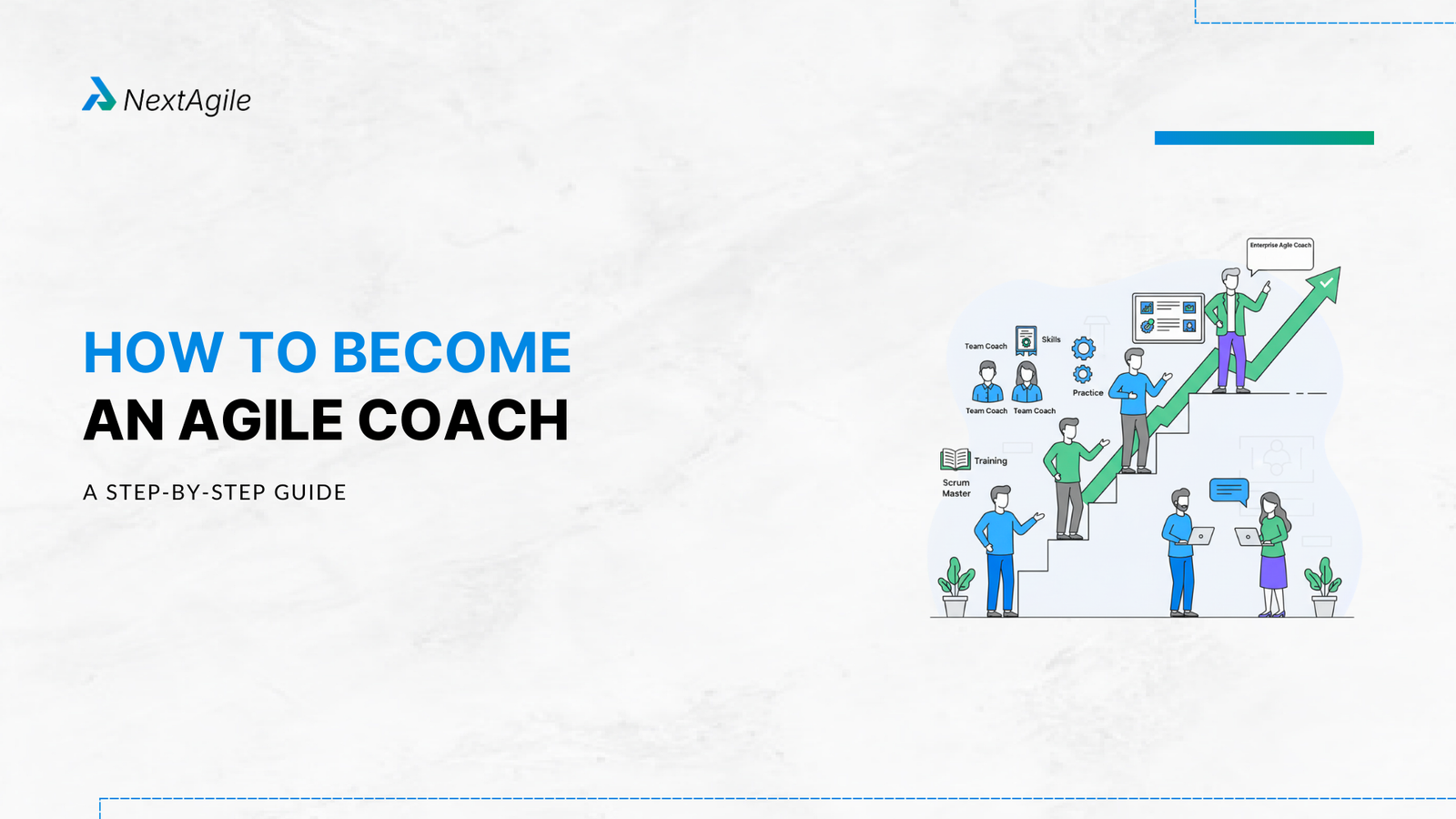
An Agile Coach is much more than just a trainer or consultant. An Agile coach mentors, facilitators, as well as acts as a change agent who guides the teams throughout the complex and chaotic Agile transformation. They don’t just teach Agile principles and frameworks like Scrum, Kanban, or SAFe but they ensure that teams understand and internalize these practices which are derived from the 12 principles and 4 values of Agile Manifesto, adapt them to their contexts, and improve continuously. At different levels of an organization, an Agile Coach plays distinct but interconnected roles:
At the team level , they help teams collaborate better, break down silos, and work towards delivering value more efficiently and often.
At the program level , they align multiple teams, building a sense of collaboration and dependency, ensuring they work together, toward the shared goals.
At the enterprise level , they work with leadership to foster an Agile mindset, drive organizational change, and ensure that agility scales effectively across departments.
In short, an Agile Coach helps in bridging the gap between where an organization is today and where it aspires to be by inducing a mindset of the team members which enables them to navigate through complexities, embrace change, and build a culture of continuous learning and improvement. Now that we have a basic understanding on what an agile coach is, let’s deep dive into the roles and responsibilities of an agile coach and how to become agile coach.
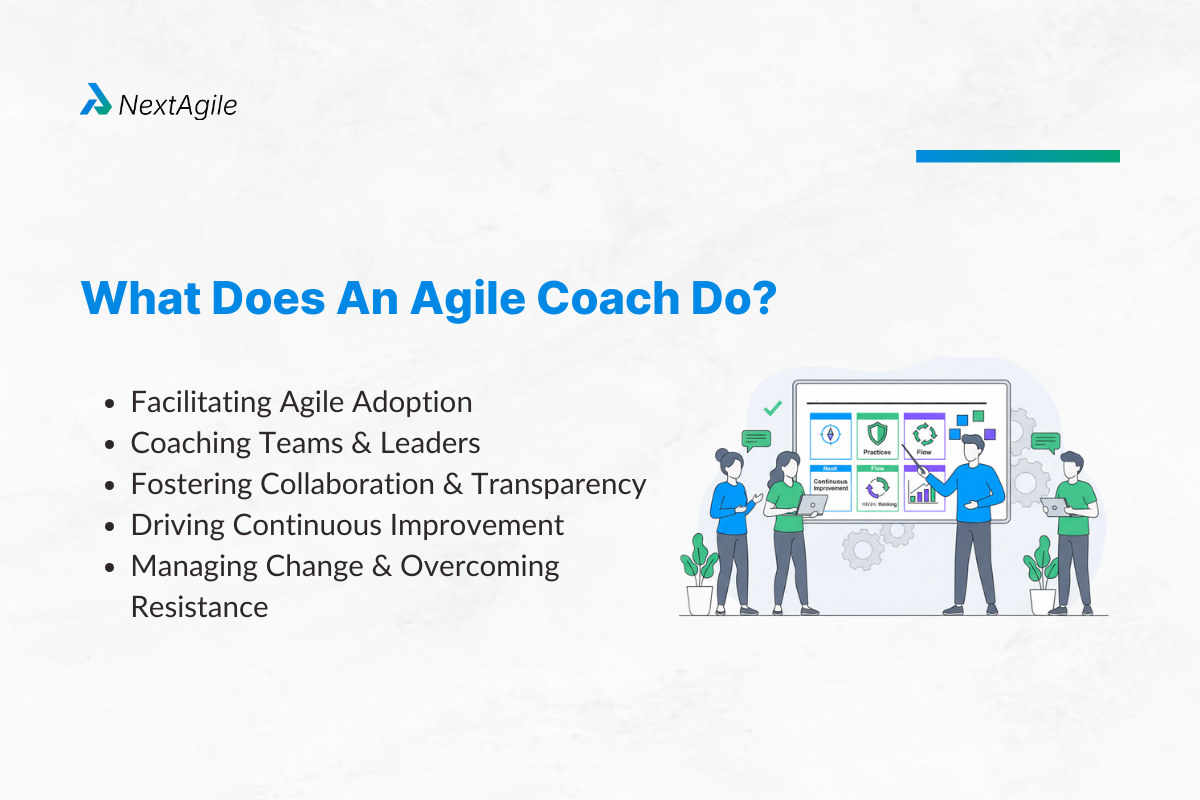
What Does An Agile Coach Do? An Agile Coach wears many hats, adapting their role to the needs of the organization they work with. They aren’t just trainers who deliver a one-time workshop on Agile or any specific topic on Agile, instead they analyse the “as-is state” of the organization/ team, and understand from them their “to-be state” i.e. where they aspire to be. Agile coaches are guides, enablers, and change agents who embed agile mindset into the DNA of teams and leadership.
Their day-to-day responsibilities can vary widely based on an organization’s understanding of Agile, their level of maturity in terms of Agile, their specific goals, and challenges , but some of their core contributions include:
1. Facilitating Agile Adoption
During the inception, being Agile, can just be a fascinating concept or idea in the leadership’s mind. Agile Coaches when hired for implementation, help organizations become agile. Coaches start with understanding the current/ existing condition of a project or process, essentially describing how things are operating at the moment and also understand their desired state or also called as the to-be state.
After critically analysing these two states, they introduce frameworks such as Scrum, Kanban, SAFe, XP and many others, based on the specific needs of teams and businesses. Whether a team is new to Agile or has some experience and is now striving for optimal implementation, the agile coach guides the teams at every step ensuring a smooth transformation of the organization.
2. Coaching Teams and Leaders
Implementing agile is more than just implementing some processes. If you look at the offset, it is about building a mindset, where the team members build a way of thinking that emphasizes flexibility, collaboration, and learning continuously. An Agile Coach helps the teams in adopting Agile ideals and practices, ensuring that they are not simply following a set of rules, but genuinely understand the philosophy of each ceremony i.e. why a particular ceremony is done at a certain time for a certain duration, what purpose does it solve, how does it help and what adverse effect can it have if not done as suggested.
The coaching is not restricted to the teams developing the product, coaches go beyond teams and collaborate with leaders to create leadership styles that promotes trust, empowerment and servant leadership. They collaborate with leadership to create a roadmap for sustaining agility, they create a culture of continuous improvement, while providing tools to help the coaches make decisions.
3. Fostering Collaboration and Transparency
One of the main goals of an Agile Coach is to break down silos and foster an environment of transparency, shared ownership, and cross functional teamwork. They encourage teams to have open communications, cross-team collaboration and retrospectives on the process and work done in the last sprint.
By implementing such practices, the teams can improve communication, bring alignment, and build problem-solving capabilities within themselves. This good communication and transparency in the team helps in building strong understanding amongst the team members and thus they can think of alternatives and better solutions when everyone is on the same page.
4. Driving Continuous Improvement
Agile is based on empiricism, meaning the teams learn as they work and evolve by learning from their past. It is not necessary to know everything before starting a project. The teams should focus on knowing just enough so that they can move forward and build the product further as they learn in the process of building the product/ project.
Agile Coaches help organizations cultivate a growth mindset by encouraging experimentation, having feedback loops, and iterative improvements. They guide teams in identifying bottlenecks while helping them to develop solutions that enhance productivity and delivering value..
5. Managing Change and Overcoming Resistance
Change is one thing that not every one is open to and usually attracts resistance because in a generic viewpoint, it is uncomfortable to change, especially if one has been doing something in a particular way for a long time. While transitioning from traditional ways of working to Agile ways of working, usually requires major organizational change, which can cause uncertainty, mistrust, and resistance, agile coaches serve as change enablers.
They guide individuals and teams through these transitions with confidence. They offer help to the teams and individuals with practical ways to overcome their concerns and ensure that Agile adoption is not as challenging as they thought it to be.
6. 1 on 1 Coaching and Mentorship
During the transition, the roles and responsibilities of team members are very likely to change. For all the teams and team members to understand how their work and role affects the team and overall goal of the project and organization, Agile coaches also have to engage in 1 on 1 meetings with the team members for them to understand their roles and responsibilities. This 1 on 1 not only helps the team members to understand their responsibilities but also helps the coach guide them and understand what kind of role would suit them the best. Also, understanding their potential and bringing out the best out of each team member.
7. Focused Group / Specialized Skillset Coaching and Mentorship
Not only 1 on 1 coaching, Agile coaches also coach and mentor specific skillset. They take separate sessions with different skillsets like only coders and testers, devops engineers and even Scrum Masters, Product Owners as one group where they coach all the people working on a specific skillset.
By understanding the problems they face in their projects and noticing the anti patterns followed by each role or skillset, Agile Coaches address them in group coaching and mentorship. This also removes ambiguity and brings standardized practice into place and ensures that everyone working in a specific role even though they work in different projects, have the right understanding and follow the same standards across the organization.
To sum up, an Agile Coach helps in bridging the gap between where an organization is today and where it wants to be in terms of agility, adaptability, and innovation. Their work isn’t about introducing and enforcing rules and ceremonies, it’s about inspiring a mindset shift that enables teams to thrive in a fast-changing world while keeping the customer at the center.
Why Do Organizations Need An Agile Coach? In today’s highly competitive marketplaces, it is no surprise that organizations must remain flexible, adaptable, and customer-focused in order to stay ahead of the competition. However, simply adopting Agile frameworks like Scrum or SAFe isn’t enough, organizations can only ensure success by deeply understanding and embedding Agile mindset and behaviors into the company’s culture. An Agile Coach becomes really valuable in such situations.
In order to help teams, executives, and organizations overcome the obstacles of Agile transformation, an Agile coach serves as a reliable advisor. They assist in changing perspectives, dismantling organizational silos, and fostering a culture of continuous learning and development in addition to implementing new processes and ceremonies. Here’s why businesses depend on them:
1. For Quick Agile Adoption
Shifting to Agile isn’t just about following a framework, instead it’s about finding what works best for the organization. Agile Coaches ensure a smooth and sustainable transition by assessing the organization’s current state of understanding about Agile and then strategically tailoring Agile practices based on the results of assessments. They help teams understand, embrace, and implement Agile methodologies like Scrum, Kanban, SAFe or any other. While working with an Agile Coach, organizations can easily avoid common pitfalls and accelerate their journey towards agility.
2. Improved Team Performance
High-performing teams don’t just happen, they are formed by providing the right support, guidance, and mindset to thrive. Agile Coaches help teams in developing self-management skills and take ownership of their work. Improve collaboration and communication, breaking down silos and continuously reflecting and improving through retrospectives and feedback loops. By embedding Agile principles into daily work habits, teams become more engaged, productive, and effective.
3. Cultural Transformation
Agility isn’t just about changing or implementing processes, it’s more about changing the overall culture or the organization. Agile Coaches work with teams and leadership to foster a mindset and culture of openness, Clear communication, looking back at the work just completed and conducting retrospectives to ensure better outcomes next time. Continuous learning. They facilitate cross-functional collaboration and knowledge sharing and build an environment of trust, transparency, and psychological safety, where people feel empowered to innovate.
4. Change Management
Adopting Agile isn’t always easy. The biggest problem faced during transformation is that people resist change, teams struggle with new ways of working, and leadership may be unsure on how to measure the success of transformation.
Agile Coaches with the help of leadership, navigate through resistance by enforcing the practices and addressing concerns from team members at all levels and skillset. They help in providing structured guidance to ensure Agile isn’t just a temporary initiative but a long-term transformation that gets deep-rooted in the organization’s culture and becomes a norm.
With an Agile Coach by their side, organizations can successfully and smoothly transition to agile ways of working, overcome challenges, and create a culture of continuous improvement which in the long run drives better business outcomes and long-term success.
How to Become an Agile Coach? [Step by Step Guide] The path to become an Agile Coach is a fulfilling one that calls for a special blend of leadership abilities, technical know-how, and a desire to see teams succeed. Understanding Agile frameworks is only one aspect of it; another is leading others, changing attitudes, and bringing about a significant change.
Here are a few steps on how to become agile coach from my personal experience:
1. Deepen the understanding of Agile Methodologies
An Agile Coach should be well-versed in Scrum, Kanban, SAFe, XP, Crystal , and other frameworks. So, I started working on building my understanding on each one of them. I would reach out to the forums and try to find the answers to all my queries. I would reach out to fellow coaches, to build my understanding on each methodology and distinction between them, more importantly, when, where and how to adapt these methodologies to fit the needs of different teams and organizations.
To be able to suggest and implement, its not only important to understand each methodology in its entirety but to understand its implementation is the key. Even if all the concepts and ceremonies of a methodology are clear in one’s head, an agile coach should be 100% sure of how it can be practically implemented in a team / organization.
2. Strengthening Coaching Skills
Agile coaching is not just about processes and frameworks; it has a lot to do with people. I realized that to be an effective coach, I had to develop a blend of coaching & mentoring skills to help teams reach the level where they could find solutions themselves rather than prescribing to what is being advised.
Since just knowing the frameworks and concepts is not enough, I worked on developing strong facilitation techniques. It was good to know various techniques to facilitate, but the real challenge comes when one has to educate the team ensuring they get the essence of why each ceremony is done. These ceremonies include Discovery Sessions, sprint planning, daily scrum, retrospection, etc. and even Agile workshops.
As an agile coach, you would not work only with the development teams but with the leadership as well. So, one needs to master communication & conflict resolution skills. Along with being good in implementing Agile an Agile Coach must be able to communicate in a way that he/she promotes trust, collaboration, and open dialogue within teams.
Agile Coaches must be able to listen actively to teams and leadership, so I worked on myself to be able to understand what the other person is trying to convey – to understand the problem rather than just replying back. Good communication also helps analyse and provide constructive feedback in a way that inspires team members to grow and work towards their full potential.
I realised soon enough that these skills are essential for influencing teams, leaders, and entire organizations to embrace agility successfully.
Another thing I realised is that Agile Coaches don’t dictate they recommend, suggest, guide and empower. So, I invested in myself to adapt the terms and vocabulary which showcases these features. I also worked on mastering powerful questioning techniques, probing i.e. asking the right questions in a way that the team thinks and finds solutions to the problems on their own. Also, working on mastering conflict resolution skills to navigate team challenges smoothly.
3. Gain Hands-on Agile Experience
Having practical experience in the real world is essential to comprehending how Agile is implemented in an organization. Though I had prior experience in Agile, and I knew what Agile is, I realized that my knowledge was partial and I had a lot of myths to be busted for myself too. So, I started by working as a scrum master, while assisting the team in using Scrum to deliver value. I also learned about the other two roles i.e. Product Owner and development team member and started observing and mentoring them whenever I noticed any anti patterns while they worked.
I realised that the more I worked as a scrum master in actual Agile settings the more I could comprehend the difficulties that the team encounters and how to help them overcome them.
4. Get Certified as an Agile Coach
While experience is key, certifications can help deepen the understanding of Agile coaching techniques. Some of the most recognized certifications include:
ICAgile Certified Professional in Agile Coaching (ICP-ACC) – Focuses on coaching mindset, techniques, and facilitation.Certified SAFe® Program Consultant (SPC) – Equips one to lead Agile transformations in Scaled Agile Framework (SAFe) environments.Scrum Alliance Certified Team Coach (CTC) – Tailored for coaching Agile teams. Although one can take these certifications to add credibility to one’s profile, certification cannot validate one’s expertise as there are varied problem statements that a Coach may need to face in real world situations and it requires the ability to understand the problems, identify potential approaches to solve the problem and then carefully drive the change.
Certifications are a structured approach to learn the traits required to address such problems when you become a coach but that ability needs to be developed solely by the Coach himself by applying knowledge that they gained during the certification process and tap their inner ability to be efficient continuously.
5. Building Emotional Intelligence
A great Agile Coach understands that transformation is an emotional journey. During my first engagement I started dealing with resistance, uncertainty, and frustration of the team members. So, building self-awareness, empathy, and trust amongst the team was critical for me to gain the team’s confidence in me and guide the teams through change.
6. A Growth Mindset
The Agile world is always evolving, and so should everyone be in this field to stay relevant. Agile Coaches must stay curious and open-minded, learn from experiments and failures and continuously adapt the coaching approach to different situations.
Becoming an Agile Coach isn’t just about knowing Agile—it’s about helping others succeed with Agile. By building the skills, gaining experience, and continuously learning, one can inspire teams and organizations to embrace agility, foster collaboration, and drive meaningful change.
Types of Agile Coaches Agile Coaches operate at different levels based on their expertise and organizational needs.
● Agile Team Facilitator
An Agile team facilitator specializes in facilitating Agile events and team dynamics. He/she typically works with one or maximum 2 teams. They lead all the ceremonies viz. standups, retrospectives, Agile planning meetings etc and strive to develop basic skills in facilitation, mentoring, or training, as well as conscious communication.
● Agile Coach
An Agile coach helps teams to adopt Agile practices and improve collaboration. He/she possesses significant facilitation skills, and some professional coaching skills, and is adept at mentoring and teaching. He/she works closely with Scrum Masters, Product Owners, and Agile teams and supports team-level transformations.
● Enterprise Agile Coach
An Enterprise Agile coach works at the organizational level, leading large-scale Agile transformations. He/she aligns business strategy with Agile execution. He/she helps leaders and stakeholders embrace Agile principles, creates roadmaps for the organization and drives Agile adoption across multiple teams, departments, and even geographies. Check some of our case studies on large scale agile transformation services on our case study page to understand what it entails.
What Is the Difference Between an Agile Coach and a Scrum Master? While both roles are essential in Agile environments, they serve different purposes:
Scrum Master
A Scrum Master primarily supports one or two Agile teams. The role of scrum master is restricted to scrum framework or can be extended to hybrid framework like Scrumban There is no role of SM in other frameworks. Scrum Master facilitates all the team meetings, Scrum ceremonies like standups, sprint planning, and retrospectives. He/she is responsible for removing impediments and blockers to ensure the team is able to achieve the sprint goal. He/she ensures the team follows Scrum principles, practices, and values. He/she also Coaches team members on the same. Agile Coach An Agile coach works at a broader level, they coach leaders, teams, and individuals on Agile mindset and practices often coaching multiple teams and organization as a whole. He/ she facilitates workshops, meetings, and discussions to drive business agility and innovation. Helps organizations scale Agile beyond individual teams. Focuses on mindset, culture, and leadership transformation. Supports change management and long-term Agile adoption strategies. Though there are similarities between Scrum Master and Agile Coach like they both focus on Agile adoption & implementation by coaching and facilitation, with the aim to improve team collaboration, productivity & efficiency, a Scrum Master is team-focused, while an Agile Coach works at a higher level—helping teams, leaders, and organizations adopt, scale, and sustain Agile practices.
Conclusion Becoming an Agile Coach is a journey that combines technical expertise, leadership, and a genuine passion for helping others grow. By gaining hands-on experience, earning relevant certifications, and continuously developing your skills, you position yourself to make a significant impact. As you guide organizations through the challenges of change, you inspire a culture of agility, collaboration, and innovation that can transform the way they work.
Embrace this journey, and be the catalyst for positive, sustainable change in a constantly evolving business world. If you are serious about becoming an Agile Coach, start by gaining hands-on Agile experience, honing your coaching skills, and continuously learning—because agility is a journey, not a destination!
With this our blog on “How to become an Agile Coach – Unlocking the Path to Agile Leadership” comes to an end and we sincerely hope it helps with necessary content for our readers. Please write to consult@nextagile.ai for any suggestions or feedback. Please reach out to NextAgile agile business consulting if you need any support in your agile transformation journey.
Frequently Asked Questions About Enterprise Agile Coach 1. Do I Need a Technical Background to Become an Agile Coach? No, becoming an Agile Coach does not strictly need having a technical background. However, it can be helpful to have prior IT, testing, or software development experience, particularly when mentoring technical teams. Agile coaching is less about technical know-how and more on leadership, problem-solving, mentality, and facilitation.
But it’s crucial to comprehend Agile frameworks like Scrum, Kanban, SAFe, and LeSS. By becoming proficient in Agile approaches, coaching techniques, and change management tactics, you can succeed as an Agile Coach even if you don’t have any prior coding experience.
2. Can I Become an Agile Coach Without Prior Agile Experience? Although it is feasible, I believe that the likelihood of becoming an effective Agile Coach is greatly increased by having practical Agile experience. The majority of Agile Coaches begin their careers in positions involving Agile implementation, such as Development Team Member, Product Owner, or Scrum Master. Although years of Agile experience is not required, you will gain credibility as an Agile Coach if you have real-world expertise with Agile teams, processes, and transformations.
3. What Is the Typical Career Path for an Agile Coach? The journey to becoming an Agile Coach is a combination of experience, coaching skills, and continuous learning. In my opinion, there is no single path to becoming an Agile Coach, but just to get an overall idea, a common progression may look like this
Gain knowledge on Agile – Learn in depth about all the various frameworks and understand which framework works best in which situation. Gain Agile Exposure – Work in an Agile environment as a team member, developer, tester, or business analyst. Observe and participate in Agile ceremonies like standups, sprint planning, and retrospectives. Move Into a Scrum Master Role – Learn how to facilitate Agile teams, remove impediments, and coach teams on Agile principles. Obtain Agile Coaching Certifications – Consider professional certifications mentioned above in the blog. Become an Agile Coach – Start working as an Agile Coach for teams, departments, or organizations and expand into Enterprise Agile Coaching if interested in large-scale transformations. 4. What Are Some Misconceptions About the Role of an Agile Coach? There can be many misconceptions about Agile Coach’s role. A few of them that I am aware of are
Misconception 1: Agile Coaches Only Work With Development Teams
Misconception 2: An Agile Coach Is Just a More Experienced Scrum Master
Misconception 3: Agile Coaching Is Only About Processes and Frameworks
Misconception 4: For all the queries all answers are provided by agile coaches
5. How Does Remote Work Impact Agile Coaching? I believe that working remotely has changed the way Agile coaches interact with teams, bringing with it both opportunities and challenges. Working remotely makes it a little more difficult to monitor team dynamics and form personal relationships. In contrast to being physically present, teams may find it more difficult to collaborate, communicate, and participate in virtual environments. It can be more challenging to lead engaging Agile ceremonies and retrospectives.
Agile coaches often use collaborative tools like Trello for virtual Agile events, MURAL, and Miro to adjust to remote locations in order to keep up with these changing times and encourage video interactions to maintain engagement and team connection.
6. How do I become an agile coach? How do I become an agile coach – we get asked this a lot. We hope the pointers we have covered in the blog are helpful to kickstart your agile journey. Below are the steps in brief –
○ Deepen the understanding of Agile Methodologies
○ Strengthening Coaching Skills
○ Gain Hands-on Agile Experience
○ Get Certified as an agile coach
○ Building Emotional Intelligence
○ A growth mindset
Sahil is an Agile consultant at NextAgile. Sahil has overall 11+ years of experience as an Agile practitioner with 5+ years of experience in agile coaching. He has been part of two organization-wide Agile transformations and coached 35+ teams across geographies. His expertise lies in fostering “One Team” mindset, collaboration and flexibility to enable a high-performing team culture led by Agile ways of working.
 Skip to content