Introduction to Agile Transformation Roadmap Why should organizations pursue agility? What’s in it for them?
An Agile Transformation Roadmap is the single most important tool an enterprise leader can have before beginning an organizational change initiative. Without it, most transformations stall at the team level, improving delivery in pockets but never achieving the business-wide agility that actually moves the needle on time-to-market, customer satisfaction, or revenue growth
This guide walks you through a proven 10-step agile transformation roadmap built from six-plus years of hands-on consulting across industries including financial services, healthcare, and technology, not a textbook framework, but a practitioner’s blueprint.
‘Knowing ’ what the customer wants ‘faster ’ than others and the ability to incorporate their ‘voice ’ in your product and services and inspect and adapt ‘frequently ’ to continuously improve and disrupt the customer experience becomes very important for businesses to grow.
We will discuss the following often-asked questions based on our experience as an agile consulting company in this blog:
What is Agile Transformation? How to plan your Agile Transformation roadmap? Is there a ready Agile Transformation roadmap template? How to build an Agile Transformation roadmap? What is an agile adoption roadmap or agile transition roadmap? Top things to consider while building enterprise Agile Transformation roadmap Key Agile Transformation benefits How does NextAgile approach Agile Transformation? Possible Roadblocks and Common Pitfalls to avoid in your Agile Transformation Journey How Do You Measure the Success of an Agile Transformation? What is Agile transformation? Agile transformation is the pursuit of achieving ‘Agility ‘ in an organization’s ways of working. This process involves adapting management and development practices to align with Agile methodology. It requires changes in how teams operate, collaborate, and engage with stakeholders.
Agile transformation is a long-term strategic effort aimed at influencing the culture and mindset at all levels of the organization, enabling it to respond effectively to changes in the market, environment, customer needs, competitors, workforce, and the value of products and services.
Successful Agile transformation necessitates a blend of people, technical, operational, and organizational capabilities. It is an ongoing journey, not a one-time event, demanding commitment, patience, and continuous effort from everyone within the organization.
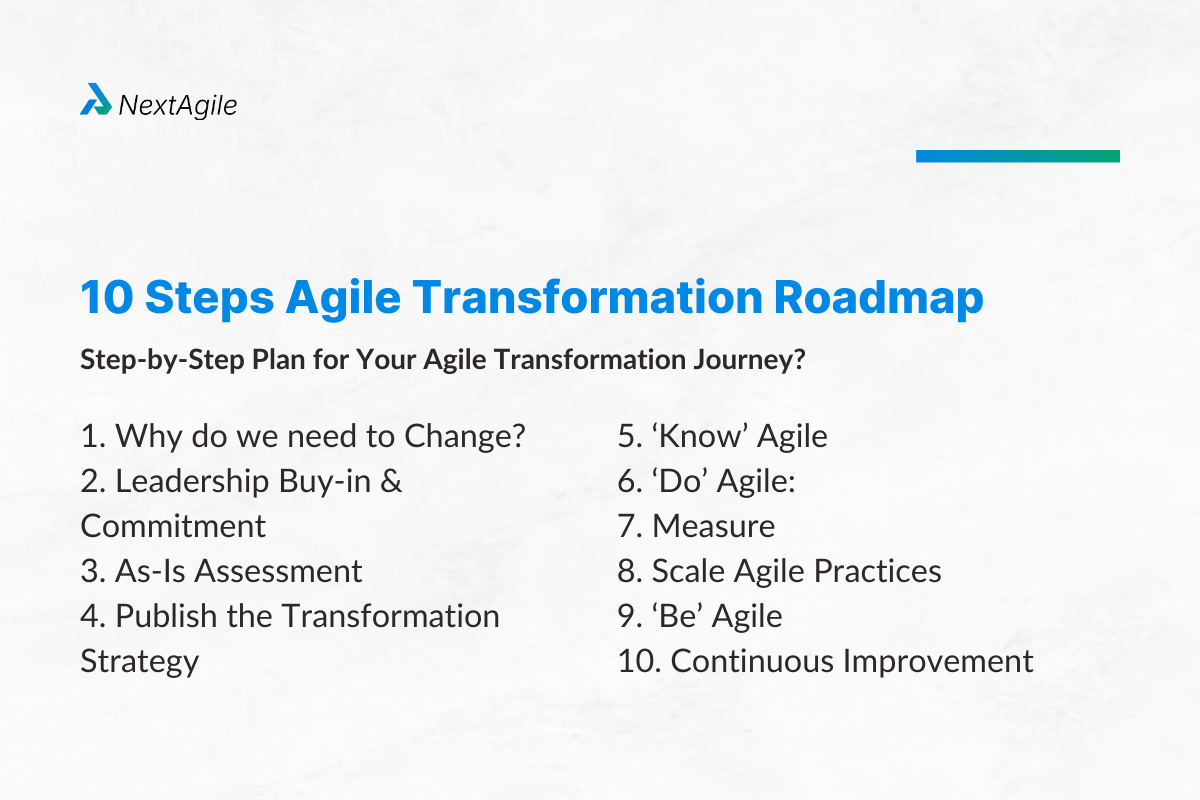
10 Steps Agile Transformation Roadmap: Step by Step Plan for Your Agile Transformation Journey? The agile transformation journey should start with a clear understanding of the need for change and a commitment from leadership to drive and support the transformation. The leadership should know their present As-Is state (get this evaluated by an external team to avoid any bias) and the desired To-Be state (clearly articulate your business goals). Everything else will follow. What is required is honesty, commitment, patience, drive, and openness to experiment and pivot if necessary.
Here are the key steps that you can follow as a template to plan your agile transformation journey:
1. Why do we need to Change? Recognizing the need for change involves understanding both external and internal factors that necessitate a more agile approach. Externally, market dynamics such as competition, customer demands, and technological advancements exert pressure on organizations to adapt and respond more swiftly. Internally, it is crucial to identify inefficiencies, bottlenecks, and areas where current processes fail to deliver value effectively. Acknowledging these challenges will motivate the transition to agile methodologies.
2. Leadership Buy-in & Commitment Leadership commitment is essential for a successful agile transformation. It starts with securing executive buy-in, and ensuring that top management is visibly supportive and actively involved in championing the change. Develop a clear vision for the transformation, and outline specific goals such as improving time-to-market, enhancing product quality, and increasing customer satisfaction.
3. As-Is Assessment This involves thoroughly analyzing the organization’s current processes, culture, and capabilities to know the current state. This is followed by evaluating the organization’s readiness for change, considering factors such as the existing ways of working, knowledge of agile practices, and the willingness to adopt new ways of working. Involve external agile consultants to drive this to ensure that there is no bias and you get an outside-in view.
4. Publish the Transformation Strategy Create a high-level roadmap that outlines the stages of the transformation, framework or a mix of frameworks key milestones and timelines after thorough discussions with all the stakeholders. Identify pilot projects or teams to test agile practices . These pilot projects should be critical yet manageable in scope to demonstrate early success and provide valuable insights for broader implementation.
5. ‘Know’ Agile This involves training programs at all levels to build awareness and understanding of agile principles , practices, identified frameworks and bringing everyone on a common understanding. These programs should be led by agile coaches to ensure consistency and uniform agile parlance.
6. ‘Do’ Agile: Start Implementing agile practices in pilot teams & projects – organize cross-functional teams that are empowered to make decisions and manage their work independently. Select appropriate agile frameworks, such as Scrum, Kanban, or SAFe, that align with the organization’s goals and context. Optimize the blast radius, inspect and adapt before scaling up, get the basic rigor and cadence in place.
7. Measure Establish regular feedback loops, such as retrospectives and reviews, to assess progress, learn from experiences, improvise and stabilize. Set up agile metrics to ensure transparency and measure productivity, quality, and customer satisfaction.
8. Scale Agile Practices Scaling agile practices involves a gradual expansion to more teams and departments, informed by insights gained from pilot projects. This incremental approach allows for careful adjustment and optimization based on real-world experiences. Additionally, implementing scaling frameworks such as SAFe, LeSS or Disciplined Agile Delivery (DAD) helps manage larger and more complex agile initiatives effectively, ensuring alignment and coordination across the organization.
9. ‘Be’ Agile Building an agile culture involves promoting a cultural shift towards values such as collaboration, transparency, continuous learning and adaptability. This requires a concerted effort to embed these principles into the organization’s DNA. Additionally, it is crucial for leadership to lead by example, demonstrating agile behaviors and creating an environment where teams feel empowered to innovate and experiment without fear of failure. This supportive leadership approach is instrumental in nurturing an agile mindset throughout the organization.
10. Continuous Improvement Continuous improvement is a cornerstone of the agile mindset , characterized by ongoing iteration and refinement of practices, processes and structures. This iterative approach relies on feedback and performance data to identify areas for enhancement and implement necessary changes.
Sustaining agility over the long term requires embedding agile principles deeply into the organization’s culture and operations. By fostering a culture of continuous learning and adaptation, organizations can ensure they remain agile and responsive to evolving challenges and opportunities.
Key Elements of an Agile Transformation Roadmap: Top 9 Essential Considerations Building an agile transformation roadmap involves a structured approach to ensure that all aspects of the transformation are effectively addressed. Here are the top 9 things you should consider while building an agile adoption roadmap:
Define the Problem – Get a clear understanding of the existing challenges and the specific problems that the agile transformation aims to solve.Focus on Mindset – Initiate a cultural shift where employees and leaders are mentally prepared for the agile journey. We simply need to focus on customer value and be open to continuous improvement and change. Rest all will follow.Get the Buy-in – Reduce the resistance and increase acceptance of the agile transformation among employees. Provide clear communication, support and articulate why we are adopting agile.Get the Outside-in view – Experienced agile coaches who are external are neutral, non biased, have in depth experience driving multiple transformations, bring in industry best practices and help you to accelerate your agile transformation journey.Set SMART Goals – Define a clear and focused vision for the agile transformation. Set specific, measurable goals that align with the strategic organizational business objectives.Empower Your Teams – Encourage autonomy and accountability within teams.Let the teams take ownership of their work and decision-making processes. Fostering a culture of self-governance where teams are empowered to manage their tasks and collaborate effectively will lead to higher productivity and innovationTransparency & Communication – Maintain consistent and open communication that ensures everyone is on the same page and can contribute to the transformation’s success. Keep all stakeholders informed about the progress of the transformation.Optimize Blast Radius – Adopt a structured approach to manage change that minimizes disruption and maximizes adoption. Plan negotiating resistance, manage stakeholder expectations, create great success stories, cross-pollinate best practices and ensure smooth transitions.Fix Accountability – Clear accountability helps to ensure that responsibilities are understood and met. Accountability also ensures an ongoing commitment to the transformation and timely resolution of challenges. Agile Transformation Roadmap Benefits? Agile transformation enables organizations to become more responsive, innovative and customer-centric, driving business growth and success in today’s dynamic and competitive environment. Agile transformation offers numerous benefits to organizations across various dimensions. Here are some key benefits:
Increased Adaptability – Agile methodologies enable organizations to respond quickly to changing market conditions, customer needs and emerging opportunities, enhancing their adaptability and resilience.Faster Time-to-Market – By breaking work into smaller, manageable increments and delivering value iteratively, Agile enables faster delivery of products and services to customers, reducing time-to-market and increasing competitiveness.Improved Customer Satisfaction – Agile focuses on continuous collaboration with customers and stakeholders, resulting in products and services that better meet their needs and expectations, ultimately leading to higher levels of customer satisfaction.Enhanced Product Quality – Agile practices such as continuous testing, feedback loops and iterative development contribute to higher product quality by identifying and addressing issues early in the development process.Better Team Collaboration – Agile promotes cross-functional teams working collaboratively towards common goals, fostering a culture of trust, transparency and shared ownership, leading to improved teamwork and morale.Increased Employee Engagement – Agile empowers teams to make decisions and encourages autonomy, creativity, and innovation, leading to higher levels of employee engagement and job satisfaction. Improved Risk Management – Agile’s iterative approach allows for early identification and mitigation of risks through frequent inspect and adapt cycle, reducing project risks and increasing project success rates.Greater Business Value – Agile focuses on delivering the highest value features first, enabling organizations to prioritize work based on business value and achieve better return on investment.Enhanced Predictability – Agile methodologies provide greater visibility into project progress through regular feedback, measurement and metrics, improving predictability and enabling better decision-making.A Better Culture – Agile transformation often leads to cultural shifts within organizations, promoting values such as collaboration, transparency, one team mindset, continuous improvement and customer focus, which has far-reaching positive impacts on organizational culture and performance. A structured agile transformation service
How Does NextAgile Approach Agile Transformation Roadmap? As an agile transformation company , NextAgile key focus always has been to design and implement business outcome led turnkey agile transformation journeys which are milestone based, timebound and framework agnostic .
Our team comprises seasoned Agile practitioners with in depth experience in leading agile transformations in diverse and intricate work settings worldwide across various industries and domains. We offer an outside in perspective , aligning agile transformation with the business objectives and leveraging our extensive expertise in designing and implementing agile transformations across teams, projects, programs, portfolios and the entire organization.
It is important for us to understand our client’s current context, challenges and objectives before we design the agile transformation blueprint. Subsequently, we collaboratively develop agile business transformation strategies with key stakeholders, drawing upon industry best practices and contextualizing a blend of agile frameworks such as Scrum, Kanban, XP, SAFe, LeSS etc to suit each client’s unique context.
Leadership, middle management and team are three pillars of agile transformation strategy . It is important for an agile consulting company to ensure minimal buy-in of all impacted stakeholders at the start of the implementation phase. Agile transformation is more about people management than process management. Leadership should be convinced that agile will help them reach their desired to-be state and fulfill their business goals.
Middle management should endorse the change in the ways of working and overall culture of the organization with a realization that it will give them the required execution certainty and will make their life easier. Similarly teams should feel that these changes are empowering them, giving them more responsibility and accountability of their work and helping them to self organize to excel in their work.
Crucial to effective management of the Agile transformation is the identification of required resources, budget development, and the establishment of a governance structure. We start in a controlled environment to minimize the impact of these changes at the start. Select a few teams and projects for the pilot, get the required resources to start the changes in these teams. Restructure them, if necessary and start introducing the most impactful changes in the process first.
The idea is to create pockets of excellence . Why is that important? Showing results, progress and positive stories creates an organic pull for the agile transformation initiative, making it easier for the leadership to commit to more organizational effort in the agile transformation journey.
Our consultants would work embedded in the select teams to get the sprinting rigor and cadence in place. We work with the team on the product backlog, stories, estimation, prioritization, DoDs and DoRs, demos, meetings, metrics and dashboards, role clarity and all other things relevant to enable and nurture a more mature agile environment. We leverage our real-world implementation experiences to maintain the discipline, solve wicked problems, manage stakeholders, inspect, adapt, refine and pivot through closed feedback loops.
The idea is to inculcate the rigor of ‘doing’ agile in these teams and slowly create stability and sustenance of these new ways of working. Develop internal agile champions and general competency to sustain the agile transformation and prepare the ground for scaling agile to the entire organization.
Pursuit of business agility or complete organizational agility in the next logical step with all the functions and internal and external teams being aligned to the core business goals and working together. Concepts like Value Stream Mapping are very important to plan this next stage. We have also covered scaling using SAFe in our blog ‘How to scale agile using SAFe ?’ Please check for further reading.
Here is a one line mantra for each stage of a typical enterprise agile transformation roadmap –
Explore and know the current state Get Consensus on the desired To-Be State Discuss and Finalize Agile Transformation Roadmap Create common understanding on Agile Stress why we are doing agile for all levels – leadership, middle mgmt & teams Pick pilot projects and teams Get resources, roles, ceremonies, sprinting and backlog in place Get the basic metrics and measurement in place Perfect the team level agility – build cadence and rigor Publish success stories and create the groundwork to scale to wider teams Build internal competency for sustenance and stability Scale , get more teams on boardTarget program-portfolio and organizational agility Create internal governance and an overall culture of agility Target continuous improvement , adaptation and learning to evolve further Possible Roadblocks and Common Pitfalls To Avoid in Your Agile Transformation Journey Agile Transformations can fail. It is also noteworthy that agile transformations are pursued to achieve specific business objectives and not to implement agile ways of working. Agile is a means to an end. Any agile transformation journey is fraught with multiple potential roadblocks and pitfalls, understanding these challenges and knowing how to avoid them can significantly increase the likelihood of success.
Below are some common roadblockers and pointers on how to avoid them. By proactively addressing these potential roadblocks and following these avoidable pointers, organizations can navigate their agile transformation journey more effectively and achieve their desired outcomes.
Culture – Recognize that agile transformation is more about people and cultural change than process change. Promote values like collaboration, accountability and customer-centricity throughout the organization. Foster a culture of openness and continuous learning. Educate, involve and engage stakeholders across all levels in the transformation process to reduce resistance.Lack of alignment – Encourage a flexible and adaptive organizational structure. Empower teams to make decisions and remove hierarchical barriers that impede agility. Implement regular feedback mechanisms, such as retrospectives and customer reviews, to continuously improve processes and ensure alignment with customer needs.Unclear vision – Customize agile practices to fit the specific context and needs of the organization. Avoid a one-size-fits-all approach and be willing to adapt practices as necessary. Ensure that leadership is actively engaged and committed to the agile transformation. Align agile practices with the organization’s strategic goals. Use frameworks like OKRs (Objectives and Key Results) to ensure that agile adoption is contributing to business objectives.Availability of tools – Focus on the principles and mindset behind agile, rather than just the tools and processes. Agile is about adaptability, collaboration and delivering value and not about following a particular framework, guide or implementing an agile lifecycle management tool .Scaling beyond team level – Agility is not for technology teams alone. Everyone in the organization is a stakeholder in making the organization agile. Revisit organizational objectives frequently, align them with the culture and ways of working. Use techniques like Value Stream Mapping to know the flow of value and dependencies. Establish clear communication channels and ensure regular, transparent communication among all stakeholders and business units. Publish org level metrics and dashboards. Agile Transformation Roadmap: Key Metrics to Measure Success Measuring the success of an Agile transformation involves evaluating various quantitative and qualitative metrics to ensure that the transformation achieves its intended goals and delivers value to the organization. We have published a very comprehensive blog on key agile transformation metrics , it covers all key metrics and their basics in great detail.
Below are few ways you can explore to measure the success of your Agile transformation:
1. Quantitative Metrics Time-to-Market Cycle Time – Measure the time it takes from starting a work item to its completion Lead Time – Measure the time from a customer’s request to the delivery of the product or feature Product Quality Defect Density – Track the number of defects per unit of code Escaped Defects – Monitor the number of defects found after release to production Productivity Velocity – Measure the amount of work a team completes in a sprint (usually in story points) Throughput – Track the number of work items completed in a given time period Customer Satisfaction Net Promoter Score (NPS) – Gauge customer loyalty and satisfaction Customer Satisfaction Surveys – Collect direct feedback on product quality and service Employee Engagement and Satisfaction: Employee Satisfaction Surveys – Measure team morale and engagement. Turnover Rate – Track the rate at which employees leave the organization Predictability Sprint Predictability – Compare planned vs. completed work in each sprint Release Predictability – Measure adherence to release schedules 2. Qualitative Metrics Team Collaboration and Communication Feedback from Retrospectives – Assess how effectively teams are collaborating and communicating with people and process centric improvements Stakeholder / Consumer Feedback – Gather testimonials from stakeholders and consumer’s on team interactions and outcomes Adoption of Agile Practices Compliance with Agile Principles – Evaluate how well teams are adhering to Agile principles and practices Agility Health Assessments – Conduct periodic assessments to gauge the maturity of Agile practices Business Value Delivery Alignment with Business Objectives – Ensure that delivered features align with strategic business goals with OKRs Feature Usage and Impact – Track how delivered features are used and their impact on business outcomes Continuous Improvement Frequency and Quality of Retrospectives – Monitor how often retrospectives are held and the quality of actions taken Improvement Initiatives – Track the implementation and impact of continuous improvement initiatives Innovation driven development – Monitor the level and cadence of innovation happening within the teams 3. Key Performance Indicators (KPIs) Deployment Frequency Track how often new releases are deployed to production Failure Rate Measure the percentage of deployments that fail and require remediation Mean Time to Recovery (MTTR) Assess the time it takes to recover from failures in production 4. Frameworks and Tools Utilize models like the Agile Maturity Model to assess the maturity and effectiveness of Agile practices Scaled Agile Framework (SAFe) Metrics: Apply SAFe’s built-in metrics if using SAFe for scaling Agile practices JIRA, Azure DevOps, and Other Tools: Use Agile project management tools to track and visualize metrics 5. Feedback Loops Regular 1 on 1 Reviews: Conduct regular 1 on 1s with the individuals to enable self improvements Skip Level team meetings: Hold regular meetings with the team members without the managers to to identify areas for improvement Surveys and Interviews: Use surveys and interviews to gather qualitative feedback from team members and stakeholders Use an agile transformation checklist to ensure readiness across teams and leadership.
Conclusion Building a robust Enterprise Agile Transformation Roadmap that is aligned to your business objectives and is sustainable and scalable from a long term perspective is very important. There should be multiple considerations while finalizing a transformation roadmap and you should carefully analyze your organizational context, business goals, timelines, work culture, leadership, internal and external environment before selecting a particular approach.
The guiding principle should be your long term business goals. Seek external support at least to explore various approaches and frameworks. It always helps to get outside-in view from neutral experts who have led and have been part of such transformation journeys. It will always be a more prudent and good ROI option to get them on board at the start of the journey before you commit resources, money and effort for the transformation.
At NextAgile Consulting, as an agile consulting firm , our key focus is on curating business context driven agile transformation journeys for our clients which are aligned with their core business goals. We will be glad to discuss and explore how we can add tremendous value to your business and your agile transformation.
This brings our blog on “Building Agile Transformation Roadmap: Definitive Guide” to an end. We sincerely hope this was helpful. In case you need to talk to us or want us to share any feedback, please reach out to us at “consult@nextagile.ai ”
Many successful companies agile transformation journeys begin with a clear operating model.
Frequently Asked Questions About Agile Transformation Roadmap 1. How do you create an agile transformation plan? Creating an agile transformation plan involves a structured approach to ensure that the transition to agile methodologies is smooth, effective, and aligned with the organization’s goals. Here’s a step-by-step guide to creating an agile transformation plan:
Define the clear vision and objectives that the transformation aims to achieve, such as improved time-to-market, increased customer satisfaction, or enhanced team collaboration Assess the Current State by evaluating existing workflows, practices, understand the organizational culture and readiness for change and by assessing the skills and capabilities of the teams involved Develop a Transformation Roadmap with manageable phases, and a realistic timeline for each phase, including key milestones Engage Leadership and Stakeholders to secure commitment and active involvement from senior leadership Form Agile Teams of cross-functional composition to execute agile practices with clearly defined roles and responsibilities, such as Product Owners, Scrum Masters, and team members Provide Training and Coaching sessions on agile principles, practices, and tools Implement Agile Practices with pilot projects to test and refine agile practices before scaling up, Choosing appropriate agile frameworks (e.g., Scrum, Kanban, SAFe) as well as the agile tools for project management, collaboration, and continuous integration Foster a Culture of Continuous Improvement by establishing regular feedback mechanisms such as retrospectives and reviews Monitor and Measure Progress by Defining and tracking key performance indicators (KPIs) to measure the success of the transformation, such as cycle time, lead time, team velocity, and customer satisfaction Gradually scaling the agile practices across the organization, learning from the pilot projects and initial phases and ensuring that agile practices are embedded into the organizational culture and continuously evolve to meet new challenges and opportunities By following these steps, you can create a comprehensive and effective agile transformation plan that aligns with your organization’s goals and enables a successful transition to agile methodologies.
2. How long does Agile transformation take? The duration of an agile transformation can vary significantly depending on several factors, including the size of the organization, the complexity of its processes, the level of existing agile knowledge, and the commitment from leadership and teams. However, here are some general timeframes and considerations:
Initial Planning and Preparation (1-2 months)
Defining Vision and Objectives, Assessment and creating a detailed transformation roadmap Pilot Phase (2-6 months)
Pilot Projects with few selected teams and Training and Coaching about the agile principles Scaling Phase (6-18 months)
Rolling out agile practices across more teams and departments with continuous Training and Cultural Change Continuous Improvement (Ongoing)
Continue to refine and improve agile practices, Adapting to new challenges and opportunities as they arise In summary, while the initial phases of an agile transformation (planning and pilot implementation) can be achieved within 6 to 9 months, achieving full-scale adoption and embedding agile practices into the organizational culture typically takes 1.5 to 3 years. However, it’s important to view agile transformation as an ongoing journey rather than a one-time project, with continuous improvement and adaptation as core elements. Discuss with agile transformation companies about your unique context and timelines before finalizing an agile transition roadmap.
3. Who should lead an Agile transformation? Leading an agile transformation requires a combination of strategic vision, hands-on experience with agile practices and strong leadership skills. Typically, the leadership of an agile transformation is shared among several key roles to ensure comprehensive guidance and support throughout the process. Here are the main roles involved in leading an agile transformation:
Executive Sponsor – The executive sponsor is typically a high-ranking leader such as a CEO, CTO, or a senior executive with decision-making authority that provides overall vision, support, and strategic alignmentEnterprise Agile Coach – A person with extensive experience in agile practices and skilled in change management to drive the implementation of agile practices and principles across the organization. Enterprise Agile Coach will set the common agility context, product roadmap strategy, leadership expectation, business/team metrics Team Agile Coach – Team coach will manage Team level agile implementation for all the teams & will work embedded within the teams for Agility adoption and ensure that agile practices are correctly implemented at the team levelProduct Owners and Scrum Masters – Facilitating the agile practices within their respective teams and ensuring alignment with business objectives, while fostering a collaborative environment.HR and Organizational Development – Supporting the cultural and structural changes required for agile transformation with training programs and nurturing an agile mindset within the organizationMiddle Management – Acting as enablers and supporters of the agile transformation between teams and upper management In summary, leading an agile transformation is a collaborative effort that requires a dedicated executive sponsor, an experienced enterprise agile coach, team agile coach, and active participation from product owners, scrum masters, HR, and middle management. This multifaceted leadership approach ensures comprehensive support, alignment with business goals, and successful adoption of agile practices throughout the organization.
4. What Are The Three Levels of Agile? The three levels of Agile typically refer to the different scopes at which Agile practices and principles are applied within an organization. These levels are:
Team Level Emphasis on individual team dynamics, sprint cycles, and delivering small increments of work with Tools and ceremonies tailored to small, collaborative team environments. Practices: Common practices at this level include daily stand-ups, sprint planning, sprint reviews, retrospectives, and the use of frameworks such as Scrum or Kanban. Goals: The goals are to deliver high-quality, incremental value to customers, enhance team collaboration and productivity, and continuously improve processes through regular feedback and iteration. Program Level (or Team of Teams)
Focus on coordination, integration, and alignment across multiple teams with emphasis on managing dependencies, synchronized releases, and broader stakeholder engagement. Practices: Practices at this level often include program increment planning, synchronized sprints, integration efforts, and the use of scaled Agile frameworks such as SAFe (Scaled Agile Framework), LeSS (Large Scale Scrum), or Nexus. Goals: The goals are to ensure that teams are working towards common objectives, to manage dependencies and integration issues, and to deliver larger, cohesive increments of value to customers. Portfolio Level Strategic oversight and resource management across the organization with alignment of initiatives with business strategy and long-term goals. Practices: Practices at this level include portfolio Kanban, lean budgeting, value stream mapping, and strategic roadmapping. Frameworks like SAFe include portfolio management practices to align strategy with execution. Goals: The goals are to allocate resources effectively, prioritize initiatives based on value and strategic alignment, and ensure that the organization’s overall efforts are directed towards achieving long-term business objectives. By understanding and effectively managing these three levels of Agile, organizations can ensure that Agile practices are scaled appropriately, strategic goals are met, and value delivery is maximized across all layers of the organization.
5. What Are The 4 Pillars of Change at NextAgile? The four pillars of change at NextAgile are critical elements that guide and support the organization through its agile transformation journey. These pillars ensure that the change process is holistic, sustainable, and aligned with the overall business goals. The four pillars of change at NextAgile are:
People Focus: The emphasis is on individuals and their interactions, fostering a culture of collaboration, empowerment, and continuous learning. Practices: Investing in training and development, promoting agile mindsets, and ensuring that team members are motivated and engaged. This includes roles, responsibilities, and the development of cross-functional teams. Processes Focus: Optimizing and streamlining processes to support agile practices and principles. Practices: Implementing agile methodologies such as Scrum, Kanban, or SAFe, and continuously improving processes through feedback loops, retrospectives, and iterative development. This also involves aligning workflows and practices with agile values. Technology Focus: Leveraging technology to enable and support agile practices, ensuring that teams have the tools they need to collaborate effectively and deliver value. Practices: Adopting and integrating tools for version control, continuous integration/continuous deployment (CI/CD), project management, and communication. Ensuring that the technology stack is flexible and scalable to meet the evolving needs of the teams. Culture Focus: Cultivating an organizational culture that embraces change, values innovation, and encourages transparency and accountability. Practices: Promoting agile values such as openness, trust, and respect. Encouraging a mindset of continuous improvement and adaptability. Leadership plays a key role in modeling and reinforcing these cultural values. Integration and Alignment:
These pillars are interconnected and aligned to drive successful agile transformation. For example, process improvements are supported by the right technology, which is adopted by well-trained and motivated people, all within a culture that supports agile values. Continuous assessment and adjustment are essential to ensure that these pillars are working harmoniously and effectively contributing to the overall transformation goals. By focusing on these four pillars, NextAgile ensures a comprehensive approach to change that not only transforms processes and technology but also empowers people and nurtures a culture that supports sustained agile practices.
Achieve seamless project execution with our agile project management consulting . We boost accountability and agility, ensuring your teams can deliver on time and exceed expectations.
Alok Dimri is the co-founder and leads the overall business at NextAgile, where he is responsible for strategy, client and consultant partnerships, and a whole lot of other core business activities like solutioning, branding, and customer engagement.
Over the past 16 years, he has worked extensively in business strategy, new business development, and key account management initiatives across process consulting and training domains.
 Skip to content