...

Agile Culture and Mindset: Key Principles, Examples & How to Build

Agile Culture and Mindset Guide + Examples (2026)
Share

Key Takeaways

  • Agile culture is driven by behaviors, leadership decisions, and team dynamics, not just frameworks
  • Agile mindset enables teams to continuously learn, adapt, and improve delivery outcomes
  • Most transformations fail because leadership and incentives don’t change, even if teams adopt Agile
  • Core foundations include psychological safety, servant leadership, transparency, and outcome focus
  • Agile culture must be built across teams, leadership, and enterprise systems (HR, governance)
  • Culture can be measured using team health, feedback loops, and decision-making speed

Introduction

Most Agile transformations don’t fail due to frameworks; they fail because underlying behaviors, incentives, and leadership decisions remain unchanged.

Organizations adopt Scrum, run ceremonies, and track velocity. Yet outcomes remain the same:

  • Slow decisions
  • Low innovation
  • Disconnected teams

The reason is simple: You cannot change delivery outcomes without changing how people think, behave, and make decisions.

Agile only works when teams shift from executing tasks to continuously learning, adapting, and improving how they deliver value.

This guide goes beyond theory to explain how to build a real Agile culture and mindset with practical examples, strong leadership insights, and enterprise-level strategies. A simple reality check most organizations miss:

What Is Agile Culture? Definition and Why It Matters More Than Process

Agile culture is the system of behaviors, norms, and decision patterns that enable teams to collaborate, adapt, and deliver value continuously.

Agile Culture vs Agile Process

Agile Process Agile Culture
Ceremonies and frameworks Behaviors and decision-making
Visible and structured Invisible but impactful
Easy to implement Hard to sustain

Processes create structure, and culture determines outcomes. A practical lens for leaders:

If processes improve but outcomes don’t, culture is the constraint.

Typical signals:

  • Ceremonies followed but no improvement
  • Teams aligned locally but misaligned globally
  • Execution happening but impact missing

What Agile Culture Looks Like in Real Teams?

  • Teams raise risks early without fear
  • Leaders remove blockers instead of controlling work
  • Decisions happen quickly, not escalated endlessly
  • Feedback leads to visible change

Agile culture is revealed in how teams behave under pressure, not during ceremonies.

Culture becomes visible in moments of stress when deadlines slip, priorities change and when failures occur. High Agile maturity teams respond with transparency over blame, collaboration over escalation and adaptation over rigidity.

Agile Mindset Explained (Practical, Not Theoretical)

An Agile mindset is not about terminology; it’s about how work gets approached daily.

Fixed vs Growth Mindset (In Real Work)

Fixed Mindset Agile Mindset
Avoids risk Experiments frequently
Hides problems Surfaces issues early
Seeks certainty Adapts continuously

What Agile Mindset Looks Like in Practice

  • Teams release early to learn faster
  • Feedback loops are short and frequent
  • Problems are treated as system issues not individual failures

A deeper distinction:

Activity does not equal agility

Teams can run all ceremonies and track all metrics. Yet fail to improve outcomes and adapt effectively. Mindset is validated through change, not consistency of rituals.

Common Misunderstanding

“We do standups, so we are Agile.”

Reality:

  • Standups without transparency = status reporting
  • Retrospectives without change = wasted effort

Agile mindset is visible in decisions and actions not rituals. A quick diagnostic for teams:

  • If retrospectives generate insights but no action → learning gap
  • If standups report status but don’t unblock work → execution gap

Both indicate mindset is not embedded yet.

Foundations of a Strong Agile Culture (With Real Impact)

Foundations of a Strong Agile Culture (With Real Impact)

1. Psychological Safety

Teams feel safe to speak, challenge, and fail.

If missing:

  • Issues are hidden
  • Defects surface late
  • Innovation drops

Impact example:
Teams with high psychological safety detect risks earlier, reducing rework and delays.

2. Servant Leadership

Leaders enable rather than control.

If missing:

  • Bottlenecks increase
  • Teams lose autonomy

Leaders who remove blockers improve delivery flow more than those who track progress.

3. Continuous Learning Culture

Driven by retrospectives and feedback loops.

If missing:

  • Same problems repeat
  • Improvement stagnates

Refer: Sprint Retrospectives

4. Radical Transparency

Work, decisions, and failures are visible.

If missing:

  • Misalignment grows
  • Trust erodes

5. Customer Obsession

Decisions prioritize user value.

If missing:

  • Teams optimize internal metrics
  • Business impact declines

6. Outcome Orientation

Focus on value, not activity.

If missing:

  • Teams chase velocity
  • Delivery loses meaning

Agile succeeds when teams measure impact not output. A practical shift:

  • Output answers: “What did we deliver?”
  • Outcome answers: “What changed because of it?”

Organizations that stay output-focused scale activity but not impact.

What Leaders Must Do Differently to Build Agile Culture?

Agile culture is shaped less by teams and more by leadership behavior.

Leadership Shifts Required

  • From control → to enablement
  • From approval → to trust
  • From output tracking → to outcome focus

Daily Behaviors That Build Culture

  • Rewarding transparency
  • Acting on feedback
  • Removing systemic blockers

What Kills Agile Culture?

  • Ignoring retrospective outcomes
  • Rewarding individual performance over team success
  • Delaying decisions

Culture is reinforced through daily decisions, what leaders reward, what teams prioritize, and how failures are handled.

Why Agile Culture Fails in Most Organizations?

  • Agile Limited to Teams

    • Leadership doesn’t change
    • Result: local optimization, global inefficiency
  • Metrics Focus on Speed, Not Value

    • Velocity becomes the goal
    • Result: high output, low impact
  • Retrospectives Without Action

    • Feedback is ignored
    • Result: disengaged teams
  • Old Management Habits Persist

    • Command-and-control remains
    • Result: reduced autonomy and trust

Most organizations try to scale Agile practices. But fail to scale decision-making, trust, accountability. This creates fast teams inside slow systems.

Refer: Agile Transformation Challenges

Real-World Case Study: Culture Driving Delivery Outcomes

Context:
A large enterprise struggled with:

  • High defect rates
  • Low team engagement
  • Delayed releases

Intervention:

  • Leadership coaching
  • Psychological safety workshops
  • Retrospective-driven improvements

Results (6 months):

  • Defects reduced by 30%
  • Team engagement increased significantly
  • Faster delivery cycles

Insight: Culture improvements directly impacted delivery performance.

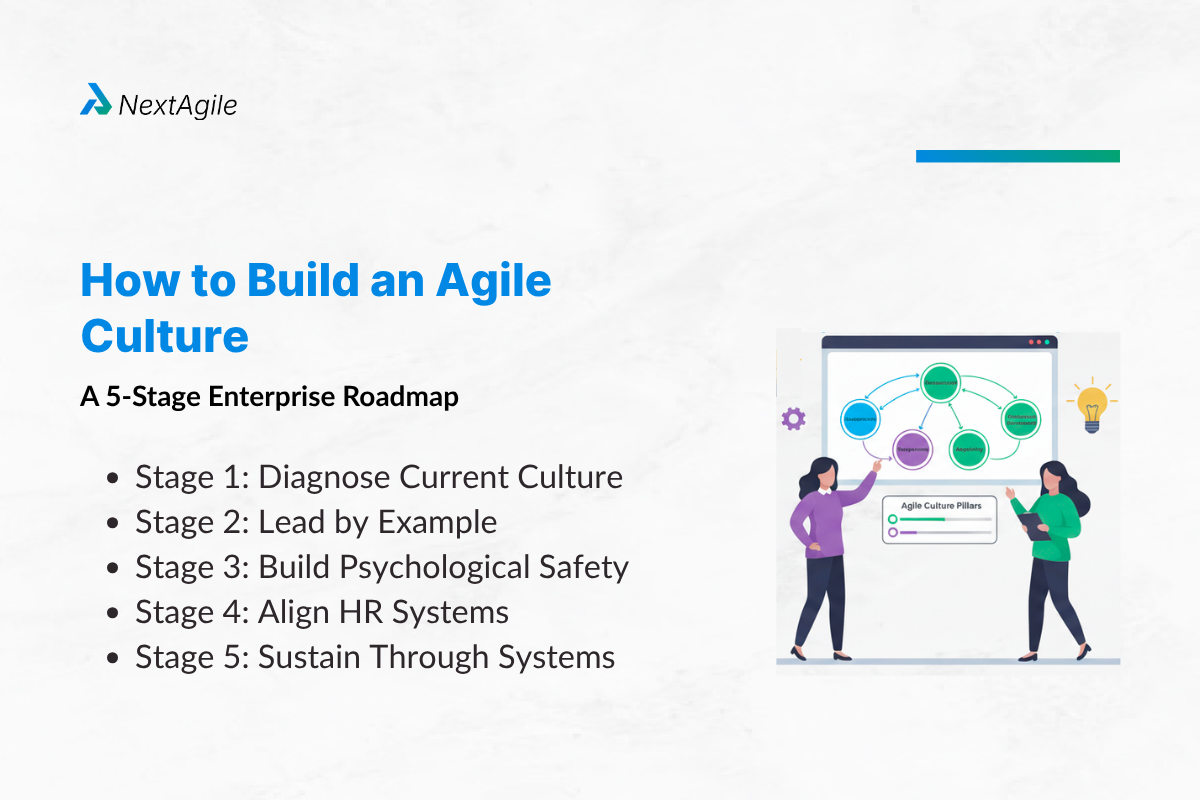
How to Build an Agile Culture: A 5-Stage Enterprise Roadmap

How to Build an Agile Culture A 5-Stage Enterprise Roadmap

Stage 1: Diagnose Current Culture

Assess:

  • Leadership behavior
  • Team dynamics
  • Metrics

Use Organizational Culture Workshop

Stage 2: Lead by Example

Executives model:

  • Transparency
  • Adaptability

Culture change starts at the top

Stage 3: Build Psychological Safety

  • Encourage open feedback
  • Run blameless retrospectives

Refer: Psychological Safety Workshop

Stage 4: Align HR Systems

  • Reward collaboration
  • Hire for mindset
  • Measure outcomes

Stage 5: Sustain Through Systems

  • Communities of Practice
  • Coaching
  • Continuous assessment

Culture must be continuously reinforced.

Agile Culture Self-Assessment (Practical Framework)

Ask your organization:

  • Do teams feel safe raising concerns?
  • Are decisions made quickly?
  • Do retrospectives lead to action?
  • Are leaders enabling or controlling?
  • Are outcomes prioritized over output?

Gaps here indicate cultural misalignment. If answers are inconsistent across teams:

  • Culture is fragmented
  • Alignment is weak
  • Transformation impact will vary

Consistency across teams is a stronger indicator than isolated success.

Common Agile Culture Mistakes (Anti-Patterns)

  • Meetings without action
  • Velocity used as performance metric
  • Agile limited to IT
  • Feedback ignored

These create the illusion of Agile without real impact.

Fixing culture reduces friction without increasing effort.

Measuring Agile Culture: What Actually Works

Leading Indicators

  • Team health scores
  • Feedback frequency
  • Decision cycle time

Practical Metrics

  • % of retrospective actions implemented
  • Time taken to resolve blockers
  • Cross-team collaboration index

Culture becomes measurable when linked to behavior and outcomes.

Agile Culture in the Future (AI + Work Trends)

AI-Driven Insights

  • Real-time sentiment tracking
  • Early detection of team risks

Human + AI Collaboration

AI supports but cannot replace:

  • Leadership judgment
  • Team trust

Future Agile culture will be data-informed but human-led.

Conclusion

Agile culture is not something you implement. It is something you build through consistent leadership behavior, aligned systems, and everyday decisions.

In our experience at NextAgile, organizations often focus on frameworks, expecting culture to follow. But culture does not emerge automatically; it is shaped by what leaders prioritize, what teams experience, and how systems reinforce behavior.

Because Agile frameworks may enable delivery, but culture determines whether transformation actually succeeds. Agile culture acts as a multiplier. It amplifies:

  • Good leadership into high performance.
  • Weak systems into visible dysfunction.

This is why culture determines whether transformation sustains or stalls.

If your organization is adopting Agile practices but still facing low engagement, slow decisions, or limited innovation, the gap is often cultural. As an agile consulting company, NextAgile helps organizations build a strong Agile culture by aligning leadership behaviors, team dynamics, and operating systems for real impact. Reach out to us at consult@nextagile.ai to explore how we can support your journey toward true business agility.

Frequently Asked Questions

Q1: What is the difference between Agile culture and Agile methodology?

Methodology defines practices; culture defines behaviors and mindset.

Q2: How long does it take to build an Agile culture?

Typically 6–18 months depending on organizational scale.

Q3: What is psychological safety in Agile teams?

The ability to speak openly without fear of blame or punishment.

Q4: How do you measure Agile culture?

Through team health, feedback loops, and decision speed.

Q5: What role do leaders play?

Leaders shape culture through behavior, decisions, and incentives.

Leave a Reply

Your email address will not be published. Required fields are marked *