What is a Persona in Design Thinking? A Complete Guide
Sujith G
Talk to Expert for Free
Table of Contents
Introduction
In today’s world where there is a lot of competition, product development is not just about developing what a company thinks the users need. Rather it is about developing what the actual users want. There has been more emphasis on frameworks like design thinking and user centric design etc. and there has been growing market needs for design thinking workshops and design thinking services and solutions.
While the industry is moving towards understanding more about the users and solving their problems, there comes a catch as to how do we categorise the user base because:
A product can be used by multiple roles
Different set of people look at the product in different ways
Users come from varied backgrounds, geographies and goals
For Example, for a tech savvy delivery person, using a map is easier than for a person who does not understand how to use maps.
When this is the case, it is essential for any product teams to understand how to segregate the userbase and understand more about each type of user and create a solution that solves each user type’s problems. One effective way of achieving this is with the help of a concept called Personas. Creating a Persona in design thinking helps teams to understand and empathize with their users and help them always stay user centred from the ideation phase till the implementation. In this blog, we will try answering a few basic questions like:
What is a Persona in Design Thinking?
Why are personas used in Design Thinking?
What are the different types of personas in design thinking?
A persona in design thinking is a character which is fictional and represents a set of users or customers. They are not real people but a representation of a group of users based on real data collected through user research and generally define the characteristics, behaviours, goals and traits.
Design Thinking Persona Examples: Let’s take the role of Delivery person in an amazon product. If we have to derive personas for this role, some of them can include:
John – Representing set of delivery people who are relatively older in age and are not tech savvy
Ganesh – Represents set of delivery people who may not know the routes in the city
Grenger – Represents the set of delivery people who do part time delivery
Let’s also look at what are the key elements that makes a good persona:
Name and Demographics – Basic details like age, occupation and location and background
Goals and Needs – What does this user want to achieve with this product and what motivates them
Challenges and Pain Points – How frustrated is the user with the product and what is causing it?
Behavioral Patterns – How does the user make decisions, what is the lifestyle of the user, why and when does the user use the product?
Quotes and Mindset – Words from the users captured during the interviews that talks about their mindset
Why Are Personas Used During Design Thinking?
The main purpose of using personas in design thinking is to understand the users problems in the real world and provide solutions which actually solves them. Personas represents actual user segments and gives details which are necessary to understand more about them like their demographic, challenges, behaviors and backgrounds. Below are a few points on how persona design thinking is useful:
Why Are Personas Used During Design Thinking
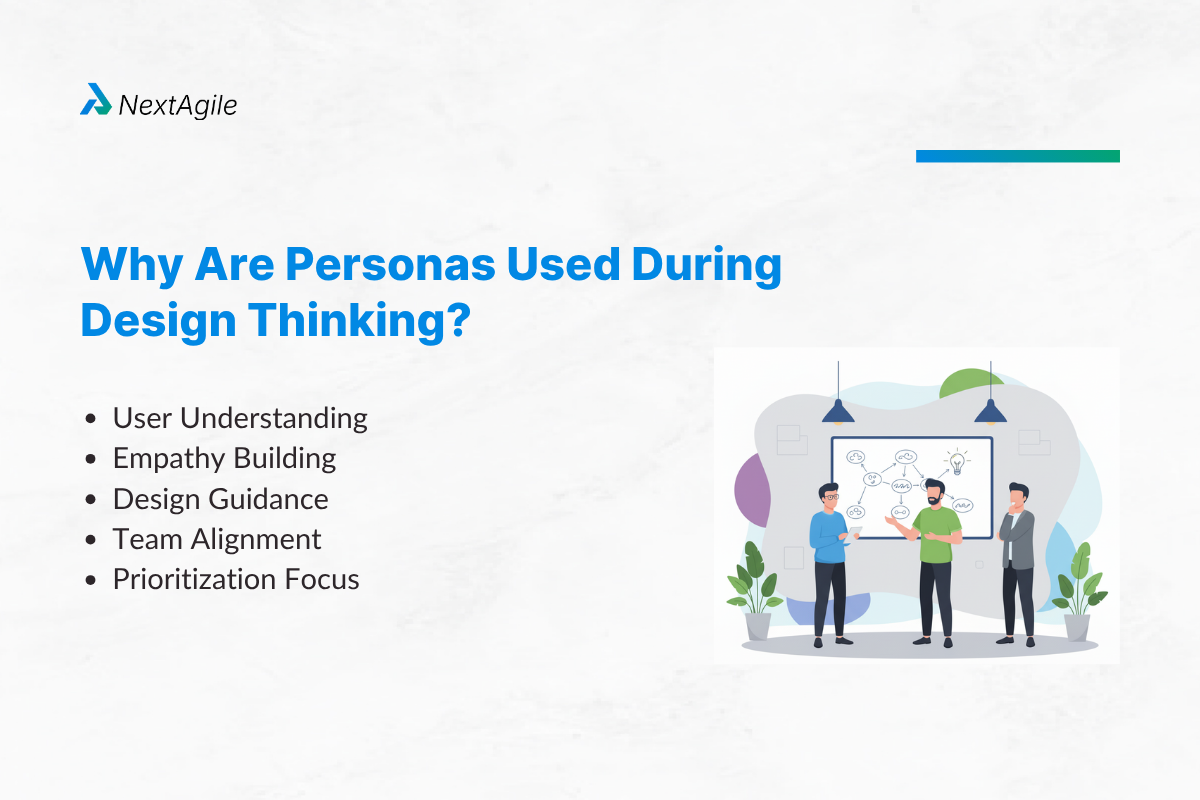
Understand user needs – Detailed information about the users and their goals along with their backgrounds help design team and stakeholders to understand more about who are using their solutions, how are they using and pain points which helps teams to provide a solution that is tailored and solves the actual problem without any assumptions
Emphatize with users – Details like user behavior, pain points, background which are key elements of a persona helps designers and developers to step into their shoes which helps them build emotional connect with them and this helps in developing solutions that matters to them
Help in design decisions – Teams can start building designs and solutions based on the details of a persona and this helps teams in designing the screens, navigation, button size etc according to them
Creates Alignment within the team – Persona in design thinking helps in creating common consensus amongst all the members involved of the target user. This helps in everyone thinking about the same set of problems, pain points and challenges where everyone in the team can think about sharing their opinions and suggestions
Helps in Prioritisation – Personas come with background and basic insights on their problems. This helps teams to focus on those pain points which when solved adds value to the users
Scenario Building and Testing – Personas help in avoiding building and solving problems based on assumptions. They give us realistic scenarios and environments in which they use the product. This makes it easy for the quality team to test the solution in the context of actual users
What Are Different Types Of Personas In Design Thinking?
Now that we have understood what a persona in design thinking is, we must also understand the fact that not all personas are created at the start. Personas for a product keeps evolving or adding based on new markets, product extensions, features etc. Depending on the stage of the product and data available, there are various types of personas which are used which serve specific purposes. Some of the persona design thinking types include:
 Skip to content