Introduction to Enterprise Agile Agile has been the go to approach for teams in building products in recent years. With agile ways of working, teams have been able to constantly deliver value to the customers, take quick feedback, and incorporate them with the base of inspection and adaptation. While a lot of teams have reaped the benefits of agility over the years, there has been a pushing need for businesses as a whole to become agile.
As time and competition become all the more critical in the business environment today, enterprises now are moving towards expanding their agility at a strategic or business level. This helps organizations to stay relevant in the market amongst their competitors and respond to changing market needs faster.
Unlike traditional agile approaches which mainly focus on agile software development teams, enterprise agile is about bringing in agility at a business and enterprise level which includes functions like HR, Finance, Operations, admin, marketing, sales etc. The need for iterative and incremental ways of working, one team mindset, frequent customer feedback, breaking down work in smaller pieces, collaboration and breaking silos, greater transparency is felt across all the business functions and all of them must work in tandem, aligned towards the larger organizational business goals to create long term success. When this is the need, there are some questions which come to our minds naturally, some of them being:
What exactly is enterprise agile? How can organizations benefit from enterprise business agility? What are the challenges in pursuing enterprise business agility? Where do we start and how do we bring agility at enterprise level? What is the use case for Agile in HR or Agile in marketing or agile in finance functions? What are the various frameworks used to implement scaled agile for enterprise? Well if you are also looking for answers around these questions, you have landed on the right page. This blog aims at answering questions and throwing some light around enterprise agile. So let’s start.
What is enterprise agile? Enterprise agility is an organisation’s ability to compete, thrive and stay relevant by quickly responding to market changes. Enterprise agile is about creating a culture of agility beyond individual teams. It is an application of agile ways of working across all the departments in an organization like HR, Admin, Finance. Enterprise agile is about bringing in agility from strategy and planning to delivery and operations.
Enterprise agile is about bringing in agility beyond individual teams and departments . It is applying agile to all departments within an organization It ensures the entire organization is working towards a shared company vision Brings in the flavour of value delivery to the customers across the organization Promotes common understanding of the processes and practices within the organization Reduces siloed mode of working between inter dependant departments with shared goals While enterprise agility is scaling of agile ways of working, culture and mindset across organizations, it can be achieved using one of the frameworks enabling scaled agile for enterprises like:
Disciplined Agile Delivery or DAD Scaled Agile Framework or SAFe Large Scale Scrum or LeSS Spotify model for scaling Agile Benefits of Enterprise Agility There could be several reasons why organisations move towards bringing in enterprise agility. Enterprise agility helps an organisation fix all the gaps which could potentially be hindering the company at different levels. A few benefits of an agile enterprise exploring enterprise agility are:
Common understanding of processes and practices across teams within the organisations and alignment to the larger business goalSynchronised cadence based delivery cycles which helps monitor and manage enterprise strategy which promotes continuous and frequent value deliveryHelps teams prioritised value delivery which are rolling up to the strategies Brings everyone to work as a team to deliver what matters to the customers increasing customer satisfaction Reduces overheads with inter team communication and dependencies Brings in structure to cross pollinate strategy into workable deliverable initiatives Reduces operational cost by streamlining processes and reducing inefficiencies Measuring enterprise agility There are several models available to measure enterprise agility like agility health assessment, SAFe business agility health, comparison models. What becomes important is to concentrate on key business outcomes and decide the right set of metrics for your business. Enterprise agility is a measure of how well the business is doing. Some of the key traditional metrics can help us define the maturity of agile enterprise like:
Customer centric metrics like NPS, CSAT etc Delivery metrics like Lead time, Cycle time, Time to Market, Change failure rate, deployment frequency, program predictability measure Team level metrics like velocity chart, flow distribution Fulfilment of strategic objectives and key results Delay reduction using value stream mapping Retro action items closure rate Innovation percentage with work items What are the key challenges in adopting Enterprise Agile? The journey of achieving enterprise agility could be chaotic if not implemented properly or without a concrete goal. There could be a lot of process tweaks needed, systems changed, mindset change between the team members when it comes to transforming an organisation to adopt agile ways of working. When there are changes involving people and process at such a large scale, any initiatives or transformation faces some challenges, some of them include:
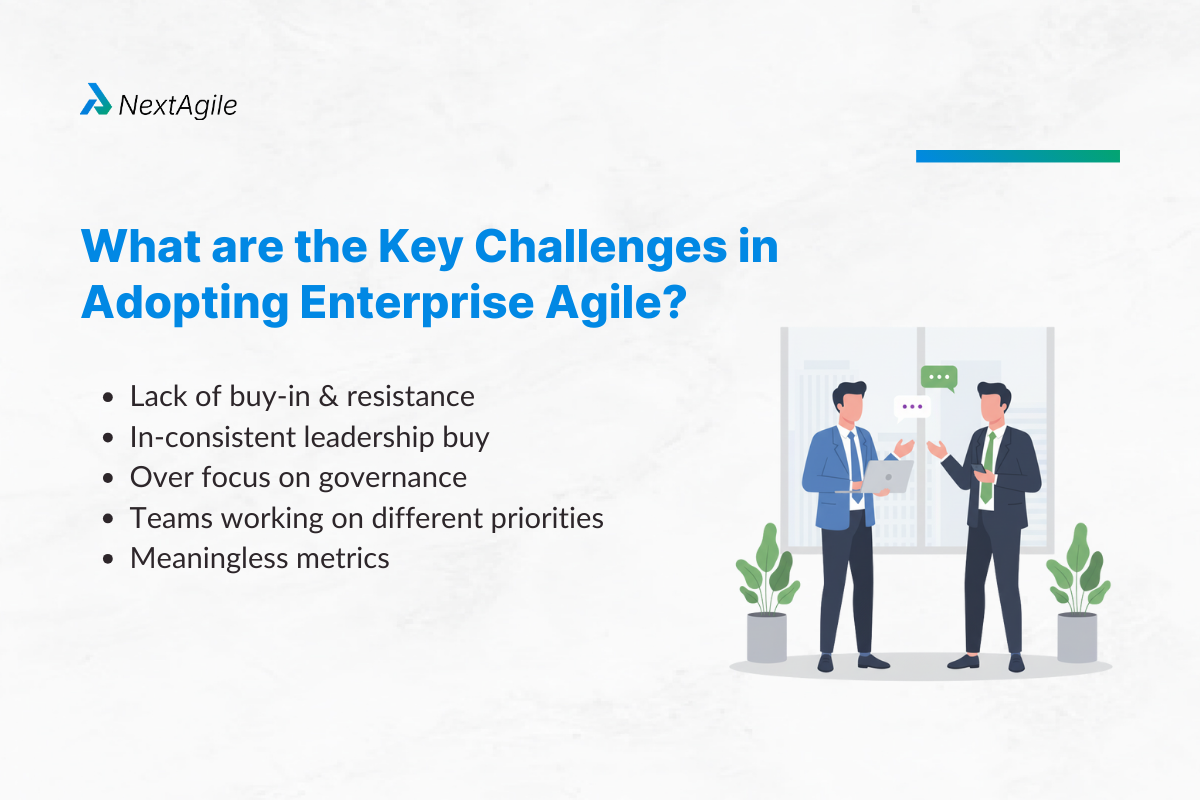
Lack of buy in and resistance from people who are accustomed to legacy processes (This is the number one bottleneck and most important to solve to ensure success, take help from a good agile consulting company , if you are not able to solve this as an outside-in perspective helps) Teams working on different priorities which may not align with the transformation journey Scaling without understanding the team dynamics and business goals may become chaotic and the process may be blamed before we see any results In-consistent leadership buy in may lead to dilution of transformation goals Transition from command control mindset to open cross functional collaboration and self organizing is a difficult change which needs to be managed delicately Teams starting agile transformation without adequate awareness or previous experiences may become a slave of the process Metrics which are not meaningful may result in confusion Existing systems may stop teams from becoming agile Over focus on governance without being flexible may put a lot of pressure on the teams Strategy of Enterprise Agile Transformation Agile transformation should solve a business problem. It is a journey which teams and people go through to achieve the nirvana state of ‘being agile’. There are several problems enterprises face because of which they reach a tipping point of becoming an agile enterprise. Let’s understand in detail as to how and what an organisation has to take care before or during the enterprise agile transformation:
1. Establish a vision The first step is to clearly define a vision of the transformation. Why are we doing this? What problems are we trying to solve? What are the business metrics we are looking to improve with this transformation are some of the questions which will help in defining a vision. You also can use an elevator pitch technique to define the vision of the transformation.
2. Create empowered teams Next is to get the people on board with the idea of transformation. Get the leadership to buy in with shared interests. Conduct customized workshops to a smaller group who can act as a change agent. Create COE of agile who can help identify and coach internal process champions in the journey. Set the right expectations with the smaller group of people to share the ownership. Leverage good agile transformation companies to contextualize agile to your environment and business objectives.
3. Introduce tools and technologies Tools and technologies are enablers in any agile transformation journey . The right set of tools can make a considerable difference in the journey by streamlining workflows, monitoring and managing the progress, provisioning visibility of the process and helping teams stay aligned to the vision. Select and narrow down on the appropriate tools for various aspects like project management , quality, DevOps, designing etc. These tools can help achieve success in your transformation.
4. Take the first steps Once the vision is defined and the roadmap is laid out, it is time to now pilot the transformation with a few teams. This helps reduce the blast radius in case things do not go as planned. Coach and mentor these teams on the practices, mindset. Introduce the right set of mindset to being in an inspect and adapt mindset. Create the first win with pilot teams.
5. Accelerate Once the first win is created, it is time to scale. Cross pollinate the principles, practices and process to other teams and bring them to a common understanding. Choose and decide the best fit scaling frameworks and implement them across teams, programs, portfolios and to the business level. Bring in agility with other departments of the business like HR, Finance, Admin etc.
6. Adapt Any enterprise has to go through forming, storming, norming, performing stages of transformation. Once there is a basic sense of agility in the enterprise, it is now time to continuously monitor, observe practices and processes which are not working for the business and pivot. Processes set at the beginning may not necessarily be working now. And there is always room for improvement even with best performing teams. Adapt phase is a continuous process of understanding the gap and making changes to improve them.
8 Steps to Achieve Enterprise Agile Planning Success Enterprise agile planning (EAP) is the approach of implementing agile across the organization to align agile practices with the business strategic goals. It consists of steps an organization can take to successfully transform their businesses to continuously deliver value to their customers and innovate.
Step 1: Focus on cultural and organizational alignment first Define the vision and communicate what this transformation is all about. What are the key elements or problems we are trying to address and what metrics we are looking to improve. Communicate this clearly and get a buy in from the leadership teams and onboard the other teams. Get people the adequate training and workshops so that they are aware of the changes they will have to go through. This should set the right tone and the direction for the people.
Step 2: Communicate your organization’s goals in implementing EAP Define the business outcomes and communicate it to the entire organization. Clearly communicate how initiatives are tied to what business goals and how are we going to achieve it. Onboard everyone including the engineers, HR, Finance, Mid level management, leadership teams on to the program.
Step 3: Select the right EAP tool No transformation is successful without intermediate milestones. To manage and monitor the success of the enterprise agile transformation, teams generally use tools. Tools provide enough visibility and are one of the means to keep everything transparent. EAP tools like Jira Align, Target process etc helps in efficient collaboration as well. Select the right tool based on your constraints and implement it.
Step 4: Calculate Agile capacity Select people who will be actively involved in the journey. How much time will they spend on the initiative? Effective planning can be achieved by calculating agile capacity, it helps teams in planning how much work they can realistically complete in a sprint/PI or project cycle. This step is crucial as it may lead to teams being overburdened or underutilised. Define the scope of the transformation and plan the capacity accordingly.
Step 5: Prioritize and prepare Understand the initiatives with higher business value and prioritise them. Ensure all essential infrastructure and resources are available and aligned to support the teams to get the desired outcomes. Consider the integration of updates and processes from slower moving projects / teams and formulate a roadmap. Select the pilot teams and coach, train and mentor them initially to create the first win and success story to cross pollinate.
Step 6: Monitor progress continually Once the journey starts, there needs to be dedicated roles like Release Train Engineers (RTEs), Scrum Masters (SMs), Solution Train Engineers (STEs), or Members of agile COE need to continuously monitor. There could be potential bottlenecks or problems teams could be facing to deliver value. These things need to be addressed to ensure the transition is smooth and does not dilute away. Set up metrics on the EAP tools to gather insights, patterns and then try solving/bridging the gaps.
Step 7: Establish a continuous EAP feedback loop Conduct retrospectives at team level, program and portfolio levels. Gather insights from the tools to stitch it to understand the gaps and problems teams are facing. Understand and define lessons learnt and ensure it is implemented in the next iteration/cycle. Celebrate success and acknowledge the areas of improvement rather than ignoring them. Present the transformation milestones to the stakeholders and sponsors and get feedback on where we need to pivot.
Step 8: Align human capital with financial management Insights from the right tools can help in streamlining forecasting, budgeting and capacity planning leading to the best workforce and workload utilization and reducing cost. To make the enterprise agile work, organizations must also prioritize human capital and streamline and optimize them to get the best result and outcome.
Enterprise Business Agility: Why It Matters In today’s VUCA world, increasing business agility is not a luxury. To stay relevant organisations should achieve business agility to keep the customers satisfied, continuously inspect and adapt and deliver value. Below are a few pointers on why Enterprise business agility matters:
Pivot business strategies based on changing market demands and conditionsStay ahead of the competition by quickly understanding new business opportunitiesContinuously deliver products and services that the customers needKeep customers close by incorporating the feedback quickly Get to iterative and incremental delivery to continuously explore and experiment to minimise risks Streamline processes to eliminate waste and delays Be proactive in identifying bottlenecksAligning business strategies and objectives across the organisation The Role of Leadership in Enterprise Agile Transformation Leadership buy-in plays a vital role in the success of enterprise agile transformation. Leaders could potentially decide the success of the transformation at various levels and phases. Here is how they can help the transformation:
Define the purpose and vision of the agile transformation and align it with the business objectives Act as change agents and onboard teams and people on to the journey Help in decentralizing decision making by empowering teams Push and promote for continuous improvement at all levels Clear out barriers and roadblocks that could potentially hinder the progress Identifying and encouraging awareness of agility in all levels Bridge the gap between strategic business objectives with day to day activities Define the metrics to measure the progress of the transformation What is the difference between Enterprise Agile and team-level Agile? Team level agile operates at a smaller scale, mainly focussing on individual team’s mindsets and processes. Where as enterprise agile applies practices and principles to the entire organization which aligns strategic objectives to all departments in the organization:
Scope: Team level operates at a smaller scale to maybe an individual team or project. Whereas enterprise level operates at the entire organization level with multiple teams/product and departmentsObjective : Team level agile works to improve efficiency, collaboration of a single team while scaled agile enterprise transformation will include implementing business agility across teams in all the functions aligning the agile ways of working with long term business and strategic goals and objectivesCycles : Planning cycles are generally for weeks at team level. Planning cycles are for long term through program or portfolio managementFrameworks Used: Team level uses frameworks like Scrum, kanban etc. Whereas enterprise level uses SAFe, DAD, LeSS etcCoordination – Team level coordination limits to inter team crossfunctional dependencies which are minimal. But in Enterprise agile, teams may coordinate with other teams, departments, portfolios etcKey Metrics – Team level metrics are limited to burndown charts, velocity chart etc. While Enterprise agile concentrates on customer satisfaction, NPS, LEad time for value delivery which are usually business centric How can NextAgile Consulting help with Enterprise Agile? NextAgile as one one of the top agile consulting firms , has successfully transformed businesses with custom, tailored approaches to solve their problems like execution certainty, siloed mode of working, transparency, predictability, streamlining workflows and processes, scaling agile adoption, reduced time to market and increased customer satisfaction leveraging our indepth agile transformation experience.
Below is a sample approach we take as an agile transformation consulting company when working with organizations to design and implement enterprise agility solutions:
As Is Assessment and Strategic Roadmapping – We start the implementation journey with an assessment to understand the current team’s maturity and practices. Based on the assessment, we create a tailored customized roadmap to align with the problem statement or goalsFramework Agnostic, Outcome Driven Transformation – NextAgile consultants are SMEs who have knowledge of various frameworks. They design and recommend framework implementation based on need rather than just applying one framework because of organizational norms. They cater to solving a problem with best suited framework with agility in mind versus adopting agile for the sake of itEducation/Awareness and Education – NextAgile provides training and programs to train teams and stakeholders with Agile principles, practices, and frameworks such as Scrum, Kanban, and Extreme Programming (XP). Training sessions may include workshops, seminars, and hands-on exercises to reinforce learning based on the needCoaching and Handholding – Our agile consultants work closely with teams and leadership to guide them through the Agile transformation process. They provide ongoing support, feedback, and guidance on implementing Agile practices , resolving challenges, and adapting to change.Unbiased, Outside-In Perspective – We at NextAgile are generally contract based and the contracts are usually outcome driven. Their experience having worked with multiple companies enables them to overcome challenges/resistance with a lot more ease and help organizations with insights with their experience.Metrics and Milestone Based Transformations – We prefer contracts that are usually for a shorter duration and outcome driven. And usually there are intermediate milestones and KPIs based on the roadmap more like a checkpoint. This enables the transformation to be faster and effective. Conclusion Enterprise agile is definitely more than just copy pasting practices/frameworks across teams. It is an approach that helps businesses stay relevant and ahead in this era of changing technological innovations and rapidly changing customer needs.
There are several frameworks that can be implemented to bring in enterprise agility like SAFe, LeSS, Spotify model or even DAD. Just by applying one of these frameworks it does not mean that enterprise agility will be achieved. It is a journey that demands a strategic alignment. Please evaluate the best fit as per the organizational construct and what you want to achieve before embarking in your pursuit of Agile enterprise transformation.
Leadership plays a vital role in this journey, be it by defining a clear vision, investing in the right tools and technologies, and empowering teams, organizations can achieve the nirvana state of business agility . There could be a lot of challenges such as resistance, lack of awareness, scaling without understanding the frameworks which will create chaos within the organization. Leveraging neutral external consultants with an outside-in perspective can be a good option to explore to manage some of these challenges.
Enterprise agile is a continuous journey of improvement. One should understand that by embracing agile principles and tailoring strategies to align with organizational needs, businesses can thrive in uncertainty, seize new opportunities, and consistently deliver value to customers.
With this our blog on “Enterprise Agile: Strategies, Benefits, and Key Insights for Success” comes to an end and we sincerely hope that the reading is worthwhile. Please write to us at consult@nextagile.ai for any suggestions or feedback.
Frequently Asked Questions About Enterprise Agile 1. How do you measure the success of an Enterprise Agile transformation? Measuring success of an Enterprise agile transformation involved monitoring the impact it is creating on defined key metrics at various levels. Some of the key traditional metrics can help us define the maturity of agile enterprise like:
Customer centric metrics like NPS, CSAT Delivery metrics like Lead time, Cycle time, Time to Market, Change failure rate, deployment frequency, program predictability measure Team level metrics like velocity chart, flow distribution Fulfilment of strategic objectives and key results Delay reduction using value stream mapping Retro action items closure rate Innovation percentage with work items 2. Can Agile be applied to non-IT departments in an enterprise? Yes absolutely. Agile can be applied to all the departments in an organization. Below are some examples
Agile in HR – Agile can be implemented in people onboarding and recruitment processes to speed up the conversion process.Agile in Marketing – A marketing team might work in sprints to test different advertising creatives, measure customer response, and adjust campaigns rapidly to optimize resultsAgile in Sales – A sales team might break down goals into smaller sprints (e.g., weekly or monthly sales targets) and hold regular retrospectives to discuss challenges, identify improvement opportunities, and refine sales strategiesAgile in Finance – Agile finance teams might use sprints to refine budget allocations, run iterative forecasting, or conduct post-mortem analysis of financial results to improve future planningAgile in Customer Support – A support team might work on a sprint to address a specific set of common customer complaints, or even implement Kanban to address continuous input of tickets 3. How does Enterprise Agile impact traditional project management practices? Traditional project management practices usually are rigid and linear, focussing on everything. Which may not be feasible in the current world. Enterprise business agility is more relevant in the current world because of its inherent flexibility, focus on collaboration and iterative and incremental value delivery. Enterprise agile focuses on ‘Just Enough’ and helps organizations to pivot based on the market or customer needs.
4. How does Enterprise Agile help improve customer satisfaction? Enterprise Agile enhances customer satisfaction by promoting a more responsive and collaborative approach to delivering value. By breaking projects/initiatives/programs into smaller iterations or sprints, Agile allows teams to deliver incremental improvements to products or services, ensuring that customers receive usable features more frequently. This continuous delivery model enables businesses to get early feedback from customers, helping them adjust products or services to better meet evolving customer needs and expectations.
5. How does leadership support impact the success of Enterprise Agile initiatives? Leadership buy-in plays a vital role in the success of enterprise business agility transformation. Here is how they can help the transformation:
Define the purpose and vision of the agile transformation and align it with the business objectives Act as change agents and onboard teams and people on to the journey Help in decentralizing decision making by empowering teams Push and promote for continuous improvement at all levels Clear out barriers and roadblocks that could potentially hinder the progress Identifying and encouraging awareness of agility in all levels and the need for scaled agile for enterprise Bridge the gap between strategic business objectives with day to day activities Define the metrics to measure the progress of the transformation Explore the key Agile SDLC Phases to streamline your development process. Achieve better project outcomes with efficient planning and execution.
Sujith G. is an agile practitioner with expertise in setting up the agile environment by coaching and training teams, individuals and stakeholders in the area of lean agile software principles. He has overall 12+ years of exp out of which 9+ years have been in Agile and Scrum implementation and adoption. Sujith has coached 70+ teams on agile practices & implementation techniques and has extensive experience in setting up metrics, JIRA & Azure DevOps. Experienced in identifying gaps in the system, creating scrum awareness, piloting and scaling scrum.
 Skip to content