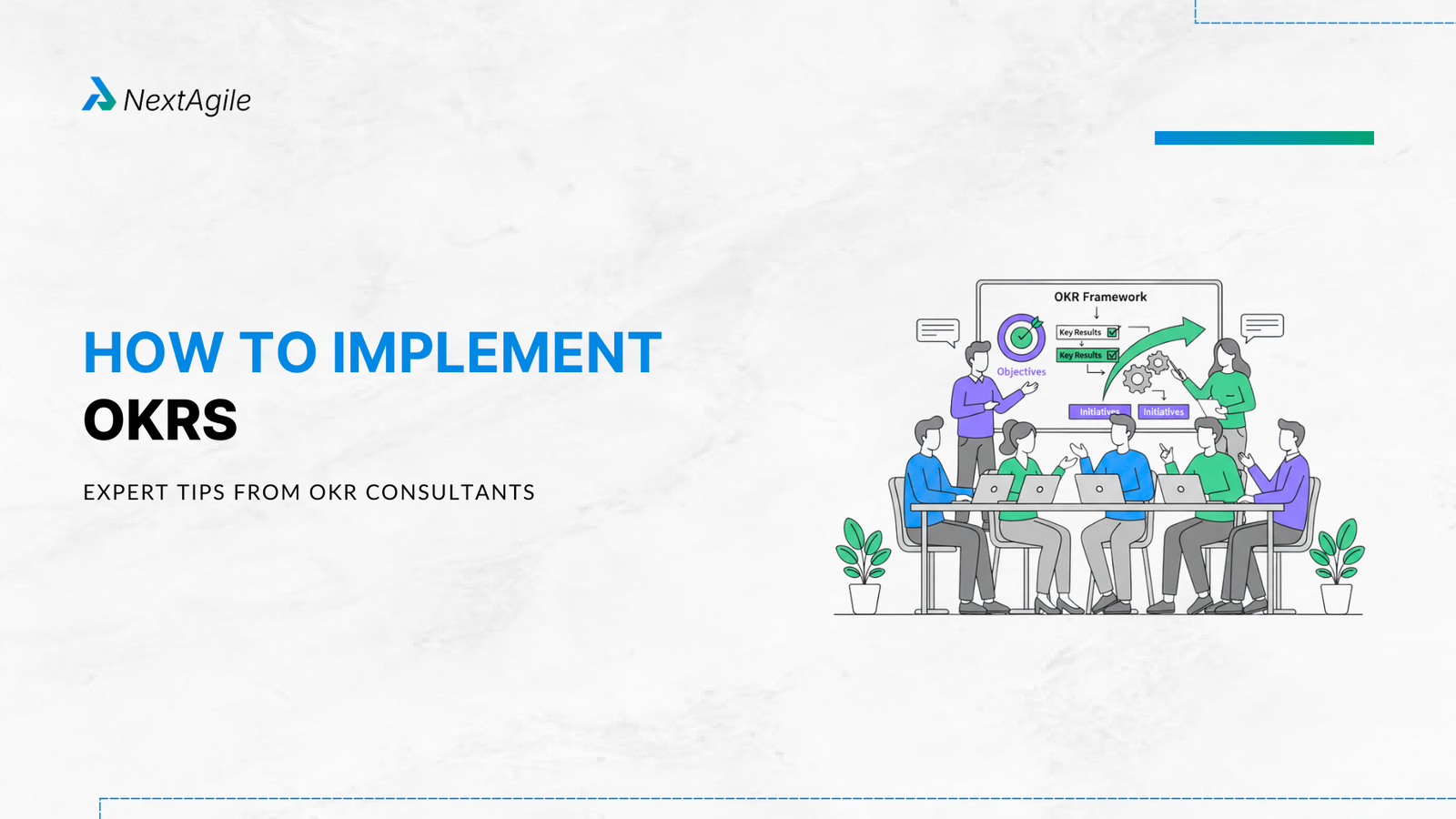
Introduction To OKR Implementation By implementing OKRs, organizations can achieve strategic goals, boost productivity and measure success. Many organizations are implementing Objectives and Key Results (OKRs) in their environment today as they find it a simple and effective way to achieve goals.
How to implement OKRs? At 20,000 feet, one should start by setting a clear and ambitious Objective, aligned with their vision & mission, such as “Improve Customer Satisfaction.” Then, define 3-5 measurable Key Results that will help you reach it, like:
Increase customer retention by 15% Reduce support response time to under 2 hours and Launch 2 new customer feedback channels Now, assign specific targets and deadlines to each Key Result. Regularly track progress, review and adjust the plan quarterly. Simple, isn’t it? Actually, it isn’t as simple as it sounds. The complexity lies in framing the OKRs so that they actually deliver what we intend. We will explore a step by step approach on how to implement OKRs in this blog which can be used a OKR implementation guide for reference.
Let’s try to relate it to the same Objective that we explored above “Improve Customer Satisfaction”. Following could be misleading key results:
Increase the number of features in our product by 50% in the next quarter Reduce customer support staff by 20% to cut costs Achieve an average call handling time of 1 minute What do you think might go wrong? Here is what we believe may happen –
Adding more features may overwhelm customers & might actually cause decrease in satisfaction Reducing support staff can lead to longer wait times and decreased support quality Focusing on quick call handling may prioritize speed over resolving customer issues So, now you might have figured out that though it may look trivial, finding the right recipe on how to implement OKRs is tricky when it comes to identifying and implementing on the ground.
We need to focus on the OKR implementation plan, where OKRs align with teams, focus efforts and drive tangible outcomes. In the long run OKRs will also encourage collaboration, accountability and continuous improvement.
How to start with OKRs? So how do you start with OKRs? Think of it like planning a dream vacation. Before booking flights and hotels, you define your destination (vision), decide on travel dates (objectives), and identify essential activities (key results). For instance, Alok wants to plan a trip to Goa with his family. His groundwork includes:
Vision : A relaxing beach vacation
Mission : Spend quality time with family
Objectives :
Book accommodations near the beach Plan activities for all family members Stay within budget Only after laying this groundwork can Alok start booking flights, hotels and activities (implementing OKRs). Similarly, organizations must establish clear direction, align stakeholders and define measurable objectives before implementing OKRs to ensure everyone works towards the same goals. Laying the groundwork for OKRs involves setting the foundation for successful implementation.
Consider talking with an OKR expert to provide guidance and support while framing your OKR implementation plan, it will solve much of the rework and set you on the right path.
As programs scale, many organizations adopt OKR software tools
How to implement OKR? Coming back to our topic on a step by step guide on how to implement OKRs in your organizations. Below is a 9 step process which should be helpful to give you an idea on how to go about implementing OKRs and things you need to consider.
Leadership teams often accelerate adoption through a structured OKR training program .
9 steps to a successful OKR implementation
Step 0: Create Awareness and Align Stakeholders Introduce OKRs to stakeholders, ensuring understanding and buy-in, and aligning everyone toward common goals. Emphasize ongoing feedback and coaching throughout the process and also consider OKR software or tools to streamline tracking and communication. Like everything else, successful implementation of OKRs will depend on stakeholder support and commitment.
Step 1: Define Your Goals Clearly articulate your organization’s goals, aligning with its vision and mission, to establish a direction for success.
Example : Yamini, a restaurant owner, wants to increase customer satisfaction.
What might go wrong
Tips
Step 2: Set SMART Objectives Establish specific, measurable, achievable, relevant, and time-bound objectives, providing focus and clarity for teams to work towards.
Example : Yamini’s objective: “Increase customer satisfaction ratings by 20% within 6 months.”
SMART criteria: Specific, Measurable, Achievable, Relevant, Time-bound
What might go wrong
Tips
Step 3: Define Key Results That Will Measure Progress Define quantifiable key results to track progress toward objectives, ensuring measurable outcomes and data-driven decision-making.
Example : Yamini’s key results:
Reduce customer complaints by 30% Increase positive online reviews by 50% Achieve 90% customer retention What might go wrong
Tips
Step 4: Assign Ownership and Responsibility Assign clear ownership and accountability to teams or individuals for achieving objectives and key results, ensuring focused effort.
Example : Yamini assigns to:
Customer Service Manager: Reduce complaints. Marketing Team: Increase online reviews. Operations Manager: Improve retention. What might go wrong
Tips
Step 5: Communicate Goals and Progress Share OKRs with stakeholders, track progress transparently, and facilitate collaboration through regular updates and feedback.
Example : Yamini shares OKRs with staff, and tracks progress on a shared dashboard.
What might go wrong
Tips
Step 6: Make Individuals and Teams Accountable Regularly review progress, provide constructive feedback, and recognize achievements to ensure accountability and motivation.
Example : Yamini sets quarterly reviews with teams, addresses roadblocks.
What might go wrong
Tips
Step 7: Set Frequent Review Of Objectives and Key Results Assess OKRs quarterly or bi-annually to ensure relevance, adjust course as needed, and maintain alignment with organizational goals.
Example : Yamini reassesses OKRs quarterly, and adjusts as needed.
What might go wrong
Tips
Step 8: Celebrate Successes Recognize and reward teams and individuals achieving OKRs, fostering motivation, engagement, and a culture of success.
Example : Yamini recognizes teams achieving key results, celebrates milestones.
What might go wrong
Tips
Step 9: Redefine Goals As Necessary Stay agile, adapt OKRs to shifting market trends, customer needs, or organizational priorities, ensuring relevance and effectiveness.
Example : Yamini adjusts OKRs due to changes in market trends.
What might go wrong
Tips
Scaling OKRs within the company with Examples How to implement OKRs in a company? Let’s continue with the same analogy that we have used before. So far Yamini managed to have a successful pilot. For piloting, we have had the following aspects in place in our OKR implementation plan:
OKR templates and processes were designed and informed to all Governance structure and training to members of the pilot OKR champions/ambassadors were identified for the pilot group. The weekly and quarterly review cadence were set We learnt and course-corrected our way Now is the time to scale to all the other groups and departments. In our example, we may relate it with Yamini introducing new objectives for extended teams in her restaurant:
Kitchen staff: “Reduce food waste by 15%.” Service staff: “Increase customer satisfaction ratings by 20%.” For new department or other group roll-outs, following is the suggestion:
Preparation for Scaling Introduce OKRs to department heads. Align departmental goals with company objectives. Assign OKR champions for each department. Dig down to Team-Level Rollout Cascade OKRs to individual teams. Ensure team goals align with departmental objectives. Provide training and support. Example: Yamini’s kitchen staff sets team-level OKRs:
Reduce food preparation time by 10% Increase menu item consistency by 90% Enterprises scaling alignment often choose a proven OKR service .
Zoom-out & Publish Organization-Wide Rollout Communicate OKRs company-wide. Ensure all employees understand their role. Provide ongoing support and feedback. Example: Yamini shares entire restaurant-wide OKRs:
Increase customer retention by 25% Achieve 95% customer satisfaction ratings Monitor & Pivot Regular progress reviews. Continuous feedback and coaching. Celebrate successes and adjust course. By following this structured approach, Yamini successfully scales OKRs across her restaurant, aligning teams and employees toward common goals. Scaling OKRs requires careful planning, communication, and support. Yamini’s example demonstrates a phased approach to ensure successful organization-wide implementation.
How do consultants help to implement OKR for any business? OKR consulting services firms help businesses implement Objectives and Key Results (OKRs) by bringing expertise and objectivity to the process. They assess the organization’s current goals, identify areas for improvement, and develop tailored OKR implementation plan aligned with business strategies.
Key differentiators that consultant bring: Change management and cultural alignment Data-driven decision-making and metrics development Leadership coaching and stakeholder engagement Contextual consulting (considering industry, market, and organizational nuances) Staying Contextual by being: Industry-specific, example:
Healthcare: OKRs aligned with patient outcomes, regulatory compliance Finance: OKRs focused on risk management, ROI optimization Technology: OKRs centered on innovation, agile development OKR implementation plan aligned with market trends and competitor analysis Tailored to organizational structure, size, and culture OKR implementation plan Integrated with existing systems and processes Result-oriented OKR consultants focus on delivering: Aligned and focused organizational goals Sustainable OKR adoption and continuous improvement Clarify vision and mission statements Define measurable objectives and key results Establish effective tracking and review processes Facilitate cross-functional collaboration Provide training and coaching for sustainable adoption By partnering with experienced consultants, businesses ensure successful OKR implementation, achieving tangible results and long-term success.
Conclusion Yamini’s restaurant story demonstrates the power of Objectives and Key Results (OKRs) in driving focus, alignment, and growth. By defining clear objectives, tracking key results, and adapting to changing circumstances. Don’t let your business goals gather dust. Implement OKRs to clarify your vision, focus your team & drive measurable results.
To summarize, remember these 5 key OKR implementation Steps:
Align OKRs with your organization’s vision and mission Set SMART objectives and measurable key results Assign ownership and ensure cross-functional collaboration Regularly review and adjust OKRs Celebrate successes and learn from setbacks Start your OKR journey today and watch your business thrive! OKRs are not a one-time implementation, but a continuous improvement process. Stay committed, adapt to changing circumstances, and celebrate your successes. We at NextAgile OKR consulting services would be glad to discuss your OKR implementation journey with you and share our inputs and perspectives.
With this our blog on ‘How to implement OKRs within organizations – A step by step guide’ comes to end, hope this OKR implementation guide is informative and adds value to your OKR implementation journey. Best of luck on your OKR journey!
Frequently Asked Questions About How to Implement OKRs within Organizations: 1. Will OKRs be reviewed on a quarterly or annual basis? OKRs are typically reviewed on a quarterly basis, with annual or longer-term objectives broken down into smaller, manageable quarterly goals. You may follow the below approach:
Set annual objectives & then break down annual objectives into quarterly goals (typically around 3-5 OKRs per quarter). Then review progress quarterly and adjust OKRs as needed based on progress, changes in priorities or new opportunities.
2. What’s the ideal time frame when implementing OKRs? The ideal time frame when implementing OKRs depends on the magnitude of the OKRs. For the pilot launch, it might take around 12-16 weeks and for overall organization roll-out it may range from 4 to 12 months depending on the organization size and available bandwidth. However, the actual OKR implementation timeline will depend on the client context.
3. What are the biggest mistakes in OKR implementation? Insufficient training, communication and lack of collaboration are some common mistakes while implementing OKRs and could lead to major disconnects, followed by lack of clarity on objectives and having unmeasurable key results can also lead to failure. Check the ‘what might go wrong’ pointers in this OKR implementation guide to avoid the common pitfalls.
4. What are the similarities and differences between OKRs and SMART goals? Both OKRs and SMART Goals emphasize setting specific, clear objectives and require measurable outcomes to track progress.
About differences, SMART Goals usually focus on individuals or departments whereas OKRs aligns company, department, and individual goals.
Structurally, SMART stands for ‘Specific, Measurable, Achievable, Relevant, Time-bound’ and applied to individual goals, whereas OKRs stands for Objectives (high-level goals) + Key Results (measurable outcomes).
OKRs are often more ambitious and stretchy, while SMART Goals are more achievable.
5. What is the OKR format? The Objectives and Key Results (OKR) is a goal-setting framework used to define and track objectives against measurable outcomes. It has two parts: an Objective, which is a clear and concise statement of what needs to be achieved, and 3-5 Key Results, which are specific, measurable, achievable, relevant, and time-bound outcomes that demonstrate progress toward achieving the Objective. We have mentioned examples of OKR format and OKR implementation steps in this OKR implementation guide.
Enhance your team’s performance with our agile services consulting . We tailor solutions to your business goals, fostering an agile mindset that drives innovation and operational excellence.
Anuj Ojha is Co-Founder & Consulting Head at NextAgile. Anuj has designed & led multiple turnkey transformation journeys across industries, domains & geographies and has 16+ years of experience as an agile practitioner. He has worked with CXOs, CTOs & Key Leaders to translate their business objectives on the ground, contextualizing org transformations and creating buy-in across level, leading a team of coaches/consultants to implement agility across 150+ teams & trained more than 12k team members. Anuj’s core area of interest is business agility & working with leaders & teams to achieve long term sustainable, Agile culture & mindset.
 Skip to content