Introduction to Agile Tranformation Strategies In the digital age organizations have to constantly adapt to a VUCA environment, stay ahead of their competition, implement Agile Transformation Strategies, know what their customer wants and deliver the right products faster. How do they do it consistently, successfully and in a scalable way?
The solution lies in constant innovation and pursuit of operational excellence to transform the ways of working from a gated, big upfront planning to an iterative and incremental mode with just enough planning. Every aspect of business – projects, programs, core delivery and supporting functions need to constantly assess and revamp their processes and working models to be relevant and align towards a common business objective. An organization embracing the values of agile and working towards creating an agility-based culture across the entire organization is the essence of any agile transformation strategy.
So what is Agile methodology? Agile revolves around 12 principles and a set of values. Agile methodology came into existence with ever changing needs of customers in this fast paced world. Agile is about faster delivery facing continuous demands from the market, to gain quick wins from the user, understanding the relevance and currency of the product being developed throughout the development phase of the product/service, to accommodate changes during the development phase without compromising on quality or time.
Working hand in hand with businesses and clients is key to delivering value added services or products in today’s VUCA world. Continuously incorporating customer feedback, making improvements and showcasing value-added deliverables at frequent intervals is important to –
Correct course faster Embrace the change needed Keep the customer engaged It is also crucial to effectively engage team members and other concerned stakeholders- preferably face to face and to continually evolve the team in terms of pertinent technology advancements. We also need to prepare the team to improve in areas of performance, stability, resilience etc through better technical design and architecture. This plays a major role in delivering value added functionality, satisfying our customers and managing other challenges posted in the VUCA world.
Multi-country businesses often need tailored agile transformation strategies for global enterprises .
Importance of Business agility Business agility
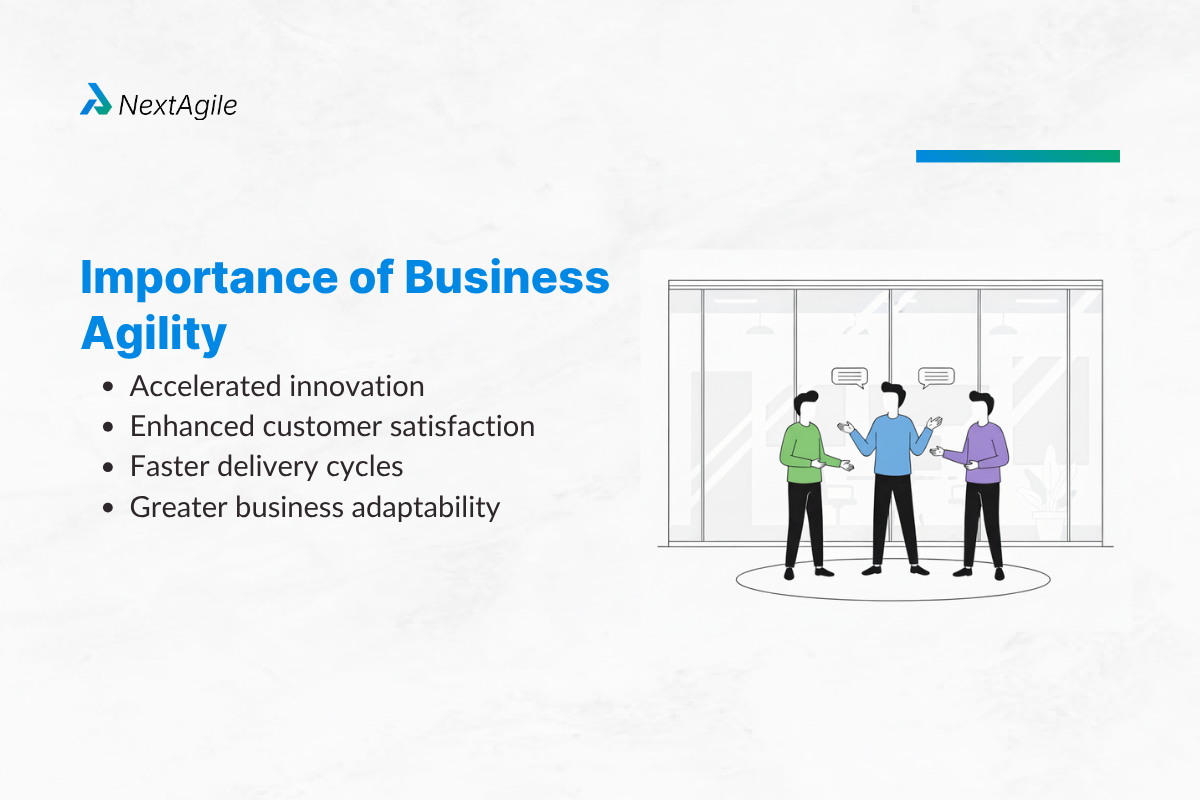
Business agility is essential in today’s rapidly changing business environment, where companies must be able to respond to new opportunities and challenges quickly and effectively. Organizations that are able to achieve business agility are better able to innovate, respond to customer needs, and remain competitive in their market.
The key benefits of business agility
Increased innovation Improved customer satisfaction, Faster time-to-market Ability to respond quickly to new opportunities and challenges. By embracing business agility, organizations can remain competitive and achieve sustainable growth and success in the long term.
Agile Transformation Strategies: Three Key Components for Effectiveness Agile transformation steps must include transforming processes, people, technology/tools. Following are the important components for any successful agile business transformation strategy :
Role of Leadership – This does not limit to getting their buy-in and sponsorship but also being change agents, accelerating change. Strategy to Implementation – Agile Transformation starts at the strategic and all the way must get to tactical/execution level. Strategies developed at the top must translate in specific implementation at lower levels. The teams must align their work to strategic goals. Teams – Build self organizing teams around motivated individuals. Ensure the teams are actively engaged in their agile roles. Sustainable change depends on an agile transformation maturity model .
Purpose of Agile Transformation Strategies Responding to change, ability to self organize, empathy driven customer orientation, one team mindset, pull based work culture are the core benefits of pursuing agile transformation.
Close collaboration between the client and you is key to deliver real business value, organizations that ‘listen’ frequently to their end customer and make effort to incorporate their ‘voice’ at timeboxed frequent intervals are able to Course correct faster, Embrace and welcome the change needed and Drive customer engagement
Agile transformation strategies is not just into transforming processes, business units, and various other functions but also imbibing an agile mindset by leadership, management and individuals.
The purpose of agile transformation is to enable organizations to be more responsive to change, deliver at faster intervals of time, being more customer-centric and empathetic to the needs of the user, flexible in the ways of working, inculcate partnering experiences with vendors/suppliers, inject innovation at all levels in the organization, embrace the culture of continuous improvement. Transforming the organizations to lead through change through these disruptions is the sole purpose of bringing agility into the system and forms the core of agile software development consulting .
Top 10 Agile Transformation Strategies Transformation means change, a positive change to negotiate the external and internal bottlenecks using agile at the core is what constitutes an Agile transformation. This change to improve or adopt new ways of working must bring joy and a shift in fundamental behaviors and values. Many picture agile transformation merely as adoption of practices, this usually leads to superficial transformation and does not translate to actual benefits on the ground.
Comparing leading agile transformation companies
Below are ten important Agile Transformation strategies or best practices that must be in place for an effective transformation:
1. Leadership Buy-in: For any successful Agile transformation, leadership engagement, participation, buy-in is a key. Most of the times during earlier stages of transformation we often experience strong presence of leadership while making announcements on org wide transformation but as time passes support becomes lesser and they become less tolerant to change.
How to avoid this? Frequent updates on the status of agile transformation backed by data, including the leadership team in major events/ceremonies where the teams showcase their work are the ways to keep the interest and influence levels of leadership higher during the transformation phase. Aligning agile transformation with organizational strategic objectives and drawing a success roadmap plays a major role in getting the buy in. Provide confidence and gain trust by having continuous dialogues, involving them in decision making and seeking their inputs and feedback at every stage. Inshort, involve them throughout the journey.
2. Sensitize and onboard management and teams on agile ways of working: Understand the current level of agile maturity before starting the agile transformation journey. Know the strengths, bottlenecks, improvement areas and the desired to-be state. Discuss with the management and teams separately and jointly and agree on a transformation roadmap.
Start socializing the need for agility, success stories, agile fundamentals, selected frameworks and other basic things through core agile training. Agile coaches must provide frequent workshops based on their use cases to spread awareness and to onboard the teams. Form cross functional agile teams to reduce functional silos, define clear roles and responsibilities Shadow the teams to find gaps in the practices established, provide feedback and make course corrections. Form communities of practice to exchange learnings, experiences.
3. Select appropriate frameworks, tools and model: Many organizations and individuals believe Agile transformation is about Scrum and JIRA. People believe doing daily stand ups and running a sprint make them Agile.
It is very important for a successful agile transformation to choose the right framework or a mix of frameworks aligned to the organizational culture, project context and business objectives. Starting point of this should be to check the organization’s release cycle, existing project management practices, tools used to manage projects, various roles involved, levels of hierarchy within management frameworks, the business model currently being used.
As an example, If the organization is after frequent releases, predictability in the releases is needed, if close customer engagement is the emphasis then Scrum is the option. Kanban should be considered when the incoming workload needs to be visualized and flow of work optimized to remove bottlenecks. The essence in selection of a tool or a framework is to keep it contextual to the organization needs, the problem the organization is trying to solve and their targeted outcomes.
4. Periodic agility maturity assessment embedding improvement plan: As mentioned, conducting an “As-Is” assessment of the current state of an organization before the organizations sets out on an agile transformation journey should be the starting point of any agile transformation journey. We should also plan to conduct periodic assessments of agile maturity to evaluate the success of our agile transformation strategy, state of adopted agile principles and practices, overall team maturity, etc.
The focus areas of the assessment are typically one team mindset, continuous improvement, customer centricity, metrics, and practices. Based on the insights drawn from the agility assessment chart out an improvement plan for the areas that need course correction.
5. Publish agile success stories: Creating islands of excellence and publishing their success stories is one of the important strategies to cross pollinate agile to other teams and scale agile transformation journey. Publish metrics, and agile maturity scores of teams, conduct org wide events, and talk about the success stories in their agile transformation endeavor. Success stories set examples for other teams to adopt agile practices.
6. Progressive elaboration and adaptive planning: Moving away from upfront detailed planning to just in time planning is one of the most important focus areas to move away from traditional project management style to agile ways of working. Adaptive planning emphasizes on responding to requirements and replanning the work as the projects progress. Encourage trial and demo to find the right requirements, which then require replanning. Establish the mindset that midcourse adjustments are the norm. Encourage prototyping to better understand the domain and use this prototype as the basis for further plan and elaborate.
7. Continuous improvement and experimentation: This is another element for a successful agile transformation. Incorporate mechanisms to capture feedback at various levels within the organization. Inputs from the feedback must be actioned to bridge the gaps. Take small steps to bring in incremental changes in ways of working. Retrospectives must be used to reflect on lessons learned. Techniques like Five whys, Fishbone analysis can be used. The lessons learnt must be looked into while planning. Learning and seeking lessons must be deliberate and frequent.This ensures that we regularly consider adaptation and improvement to the point where they become a habitual part of our normal way of working.
Continuous improvement must focus not just on processes but also on products and people. Focus on building the product in increments and getting feedback from customers. Encourage the teams to challenge the status quo. Provide an environment where teams search for innovative ways to change, grow and improve and then experiment. Encourage teams to take risks by constantly generating small wins and learning from their mistakes..
8. Transparent engagement and communication with stakeholders: One of the important aspects of agile transformation is to bring best practices around communication. Identify the stakeholders, plan their participation in the events and make sure they are available. Effective communication and stakeholder engagement are critical to ensure that team members know what they are building and what the customer is asking for. Employ digital tools for planning and tracking. Usage of tools like Mural during project discovery sessions promote collaboration and communication among various types of stakeholders.
Keep stakeholders engaged to ensure change requests are notified and captured as soon as possible. An ongoing dialogue with our stakeholders will also help identify potential risks, defects, and issues. Ensure multiple touch points with stakeholders and regular communication to facilitate early and continuous feedback.
Coach Scrum masters, project managers on areas of emotional intelligence, interpersonal skills to handle impediments, understand stakeholder needs and engage with them in the project. Encourage face to face communication, bi-directional flow of information among stakeholders like customers and agile teams. Bidirectional communication makes hierarchies flatter and expectations on feedback from the customer higher.
9. Psychological safety at all level: To ensure that agile transformation is successful at all levels it is important that along with defined practices, processes, frameworks, we also have teams and individuals who feel free to speak, experiment, fail, learn and evolve. Management of projects or programs is also about the management of teams. A successful journey is more than following a series of Agile transformation steps.
For a successful transformation in this dynamic environment of projects, teams need to be resilient to changes and focus on open communications, continuous collaboration between various stakeholders. To increase team resilience Agile coaches should work with the management to inculcate a culture of Psychological safety. Focus must be on innovation in teams to provide confidence to the teams and a safety net to fail.
10. Establishing customer centricity and building product mindset: Customer centricity and product mindset form the core of Agile transformation journey . Right from the inception of the project having continuous engagement with customers to get the right product is needed. Discovery sessions to understand the pain points of the product, capturing the needs of various users as part of empathy and persona mapping should be introduced.
Continuous Feedback loops at shorter intervals to get early insights on the products being developed is key. Having customer representatives in all major events promotes a customer centric mindset. Discussions on various ways of solutioning the product by the development teams must be encouraged to bring in a product mindset.
Metrics to track customer satisfaction must be in place. These metrics should allow the organizations to track the value delivered to the customers. Technology must be harnessed to collect data to improve customer experiences and deliver a better customer experience.
Equip your team with the skills for agile success with consulting and training services . Drive organizational transformation. Explore our offerings today.
How consulting companies will help to adopt agile transformation strategies in an organization. Agile transformation led by Agilists, agile coaches from within an organization may not have the same kind of momentum, results as opposed to led by external agile consultants. Internal Agile evangelists face a certain amount of friction and also lack the autonomy to bring about the changes needed for an organization to be transformed. As the organizations transition to agile, employees fear losing their jobs due to restructuring.which increases the resistance to change and makes it difficult for internal agile coaches to bring about change.
When external Agile consultants are engaged in helping organizations transform the existing state the results would be faster and more structured as the consultants work with a structured approach and a time bound plan. This helps organizations save time and resources that would otherwise be spent.
An Agile consultant is focussed with one thing on their plate, they can create positive tension and a sense of urgency which helps teams achieve their agility goals on time .
At an agile transformation company like NextAgile, our consultants are hands-on Agile practitioners with experience leading agile transformations in varied, complex work environments across the globe and across different kinds of client scenarios. We bring an outside-in view, business objective focus and an in depth experience of designing and implementing turnkey agile transformation journeys in a time bound, sustainable and scalable model.
We spend time understanding our customers needs, problems, end goals during the due diagnostics phase and evolve an agile business transformation strategy roadmap in close collaboration with client business stakeholders leveraging the best industry practices and a customized mix of various agile frameworks like Scrum, kanban, XP etc suited to the client context, identifying the resources that will be needed, developing a budget for the transformation and establishing a governance structure is important to ensure that the Agile transformation is managed effectively.
Fundamental training on Agile methodologies are delivered to teams and leadership to bring in a common understanding of Agle. This is followed by coaching teams and individuals on how to apply Agile practices in their work with coaches embedded in the teams and multiple role and work specific training. We ensure the necessary rigor and cadence in agile practices and metrics across all levels, progress and stability is regularly monitored. Insights gained from real-world implementation experience of our consultants inform adjustments, refinements and pivot led by closed feedback loops
Teams and individuals are mentored to drive continuous improvement and pursuit towards agility. We at, NextAgile believe in long term partnerships and work in close collaboration with our clients for establishing processes that are build to last, but also open to inspect and adapt in a VUCA environment.
Choosing the right strategy is only half the equation, a step-by-step agile transformation roadmap
Recommended Read Conclusion Agile Transformation Strategies should be thought through comprehensively before you even embark on the journey. Your organizational context, business goals, timelines, work culture, leadership, internal and external environment should be baked in a good strategy.
This brings our blog on “Top Agile Transformation Strategies for Business” to an end. And we sincerely hope this was helpful. In case you need to talk to us or want us to share an agile transformation strategies ppt please reach out to us at “consult@nextagile.ai ”
Frequently Asked Questions About Agile Transformation Strategies 1. What is the top-down approach to agile transformation? For any transformation leader buy-in is a prerequisite.A successful transformation is top down and bottom up . A top down approach is about having leadership and executives to embrace agile ways of working by incorporating agile practices at all levels throughout the organization .Since the directive comes from the leadership everyone in the organization gets involved and stays geared towards this from the beginning. The resistance which is usually seen from certain teams can be handled better.
2. What is the highest priority of agile methodology? Being Agile is about frequent introspection, course correction, collaboration, iterative and incremental development to manage markets and customers in a VUCA environment. Highest priority for bringing agile ways of working is customer centricity. Ability to respond and adapt to change, value driven delivery at shorter intervals of time.
3. Which Agile methodology to choose? Agile in itself is a methodology. There are multiple frameworks under the agile umbrella like Scrum, XP, Kanban, LeSS, SAFe etc to choose from.
4. Is Scrum a framework or methodology? Scrum is a framework under Agile methodology which follows iterative and incremental development. Scrum is aligned with agile principles and values.
5. What does an agile transformation coach do? An agile transformation coach carries the toolkit to bring in transformational change in organizations and help adopt agile ways. A transformation coach helps teams to imbibe agile principles, train and mentor on practices, help streamline processes and improve efficiencies. For more information you can refer to our page – NextAgile Agile Transformation Company
Alok Dimri is the co-founder and leads the overall business at NextAgile, where he is responsible for strategy, client and consultant partnerships, and a whole lot of other core business activities like solutioning, branding, and customer engagement.
Over the past 16 years, he has worked extensively in business strategy, new business development, and key account management initiatives across process consulting and training domains.
 Skip to content