Scaled Agile Framework – SAFe is one of the most trusted set of principles, practices and structures companies adopt to scale their agile practices at an organization or enterprise level. Companies adopt SAFe with a purpose of achieving their goals hand in hand reaping the benefits of business itself being agile.
SAFe recommends structuring teams and delivery around value streams that usually align themselves around a common shared goal, technology. And the heartbeat of structuring a set of agile teams who can plan, commit and deliver value incrementally over a cadence is nothing but an Agile Release Train. Establishing agile release train is a vital part of your SAFe implementation and could eventually make or break your transformation.
If you have decided to implement SAFe and want to learn a few aspects in establishing the first agile release train, you have landed on the right page. This blog aims at covering the following high level topics.
What is an Agile release train?
What are the Agile release train launch readiness?
What are the roles in an ART?
What are the steps involved in launching the first Agile release train?
What Are Agile Release Trains?
Agile Release Train (ART) is a set of agile teams with shared/common goals who can plan, commit and deliver an increment to a solution/product over a cadence. ARTs are cross functional mini organizations usually consisting of around 50 to 125 people. They usually have all the expertise needed to plan, develop, test and deploy the commitments towards one or multiple solutions or products.
But what can be the structure of an ART or how do we envisage an ART structure? Well SAFe recommends a few topologies for a better structured ARTs and they are:
Stream Aligned Teams – Usually the teams who have the capabilities who can perform all steps to deliver an end to end experience
Complicated SubSystems Teams – Teams with specialized technical expertise who can help ART in a particular area of need
Common Platform Teams – Teams who can be specific to all the services and APIs usually catering to a platform
Enabling Teams – Teams who can take care of the tools, licenses etc for the agile teams
Now there are a few aspects which one needs to be aware of before launching Agile release train (steps for releasing first Agile train) and they are
ART’s primary goal is to cater to the customer needs. Hence it becomes important to apply customer centricity techniques like Design thinking etc to relate to customer problems
ARTs Plan the work in a cadence called as Program Interval and must be aligned with the strategic goals
Have enough maturity and systems to build small increments, deliver continuously and deploy them
Aligned towards keeping the customer close even during the development phase to get constant feedback
Closely Inspect the metrics, understand the gaps in process and people and improve based on the needs
Optimize your management practices with agile management consulting. Strategic insights for enhanced efficiency and effectiveness. Explore our solutions now.
Roadmap To Launch Agile Release Train
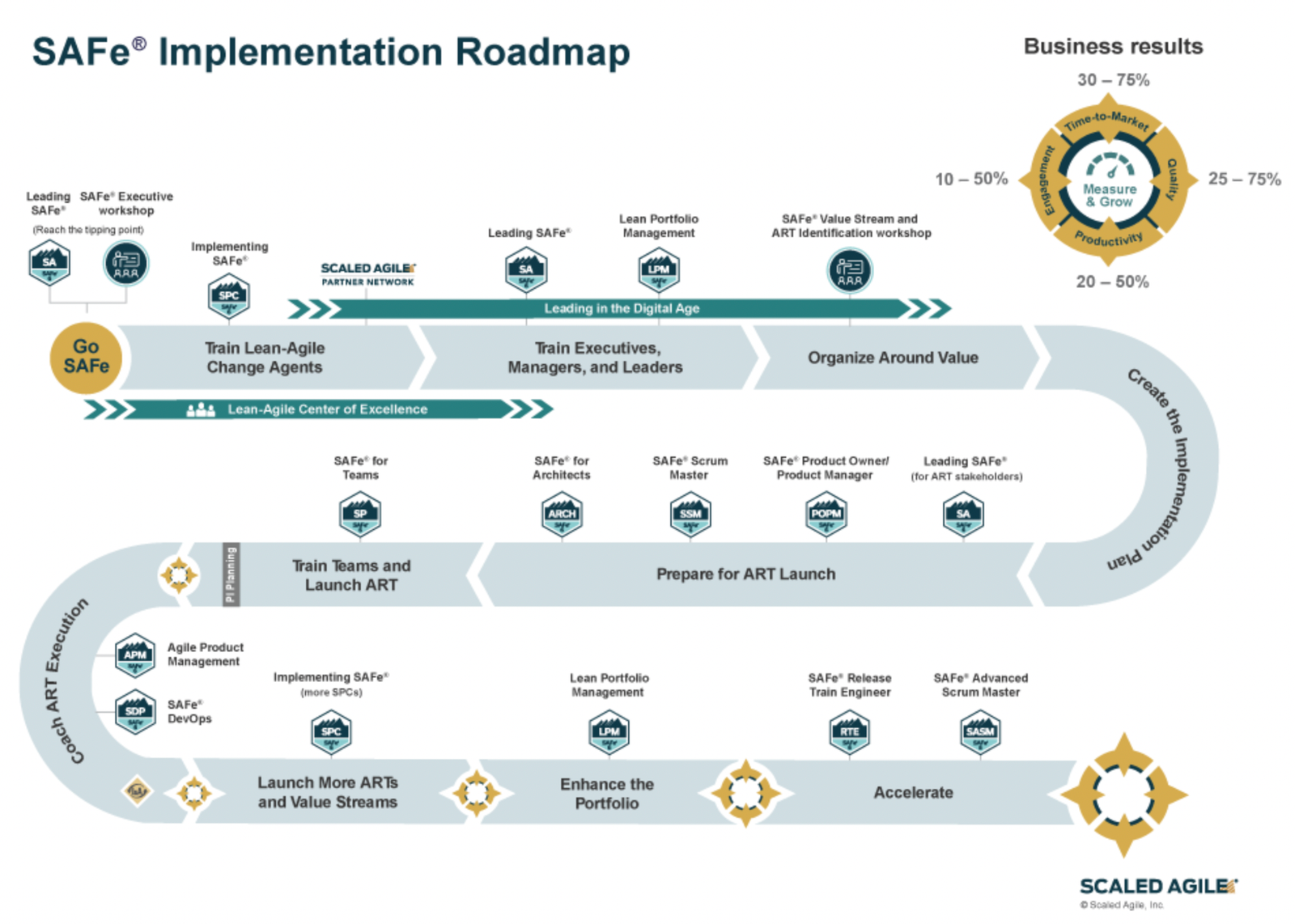
SAFe suggests a roadmap for it’s implementation across an organization and the journey looks like the picture below.
It all starts with a need for the implementation within the organization, which could be the need to stay relevant in the market, cater to change in market environment, leadership pressure etc. There are 4 major aspects to be taken care of as far as first agile release train launch readiness is concerned as per Scaled Agile and they are:
Awareness and Trainings For Agile Release Train
The building block of any transformation journey is to bring in the awareness within the unit of transformation. Why are we doing what we are doing? What are the benefits? What is the framework? How is it going to help the organization etc. There are various levels of stakeholders involved in the transformation and it is only fair to train everyone on SAFe.
Training SAFe Program Consultants (SPCs)
The change agents/practitioners who will be driving the change. These change agents are responsible for the implementation, training, coaching and certifying leadership team, product team, agile teams.
 Skip to content