Why Should Organizations Be Agile? The purpose of Agile is not to create beautiful egalitarian processes or a product with every possible feature or an organization where people are happy and close to Nirvana. All these can be/should be byproducts and not the core focus. Core is always aligned with the business objective – responding to change, ability to self organize, empathy driven customer orientation, one team mindset, pull based work culture, and Agile Transformation Challenges is applicable across domains and industries.
Anything and everything that a business does has a customer focus. Products are built so that the customer finds some value in using it. People come together to create such a product, they are enabled – incentivized – empowered to be able to do so. Processes are set in place so that there is visibility, structure, optimization, risk mitigation. Everything has one core focus customers.
Big upfront planning, gated processes, meticulous project management, governance oversight, great detailing in specifications, requirements, planning, roles and responsibilities, milestones worked very well for a very long time. They will still work well in pockets.
Why did we feel that the above tried and tested ways of organized working may need to change?
What led industry to explore new ways of working?
Why was ‘just enough planning’ introduced to replace big upfront planning?
Why should the client and you be on the same side of the table?
The answer may lie in a complex plethora of fast, rapid, unpredictable changes in the business environment, too much competition, technological advancement which enabled more skilled professionals to ship products in an iterative and incremental mode and the need to constantly adapt and innovate to avoid the product getting obsolete.
Close collaboration between the client and you is key to deliver real business value, organizations which ‘listen’ frequently to their end customer and make effort to incorporate their ‘voice’ at timeboxed frequent intervals are able to :
Course correct faster Embrace and welcome the change needed Drive customer engagement All this can’t be achieved without having ‘agility’ as the bedrock of your organizational culture and mindset. How are your teams structured? How do they interact internally and externally? Learning and skill improvement focus, self organizing traits within the teams, pull based work culture, customer centricity as a core interest area and working environment which has a long term vision are the questions one must answer when embarking on their agile journey .
What is Agile Transformation? Agile Transformation is the pursuit of ‘Agility’ in an organization’s ways of working. It is a long term strategic endeavor to impact the ‘culture’ & ‘mindset’ at all levels within an organization to be able to respond to changes – market, environment, customers, competitors, workforce, product and service value etc.
Agile transformation requires a combination of people, technical, operational, and organizational capabilities.
What are some questions you need to ask before planning an agile transformation journey (notice that none of them explicitly mention agile
What is your long term business vision? What is it that you need to get there? How are you placed currently? Are you moving continuously towards the right direction? Could you frequently deliver just-enough but the most important things? As an intrinsic part of your culture, are you embracing failure in your development process so that you do not need to fail when you go-live? What do you mean by collaboration? Do you have a one-team mindset over safeguarding local interest and turf? What is the effort you are willing to put to reach an immediate desirable ‘to-be state’ – time, budget, resources etc How will you measure success? What is the cost of failure? Answer each of them, sincerely and you will have the first draft of a business outcome led transformation plan. Get outside experts to review and delve deeper into your first draft to know an external perspective and what is happening in the wider industry.
Start small with high impact low investment teams, early success is extremely important to get buy-in at all levels. Inspect and adapt, scale slowly (deal with scaling agile challenges once you have stabilize and shown quick results in select teams), measure and publish frequently and invest in upskilling and larger cultural impact.
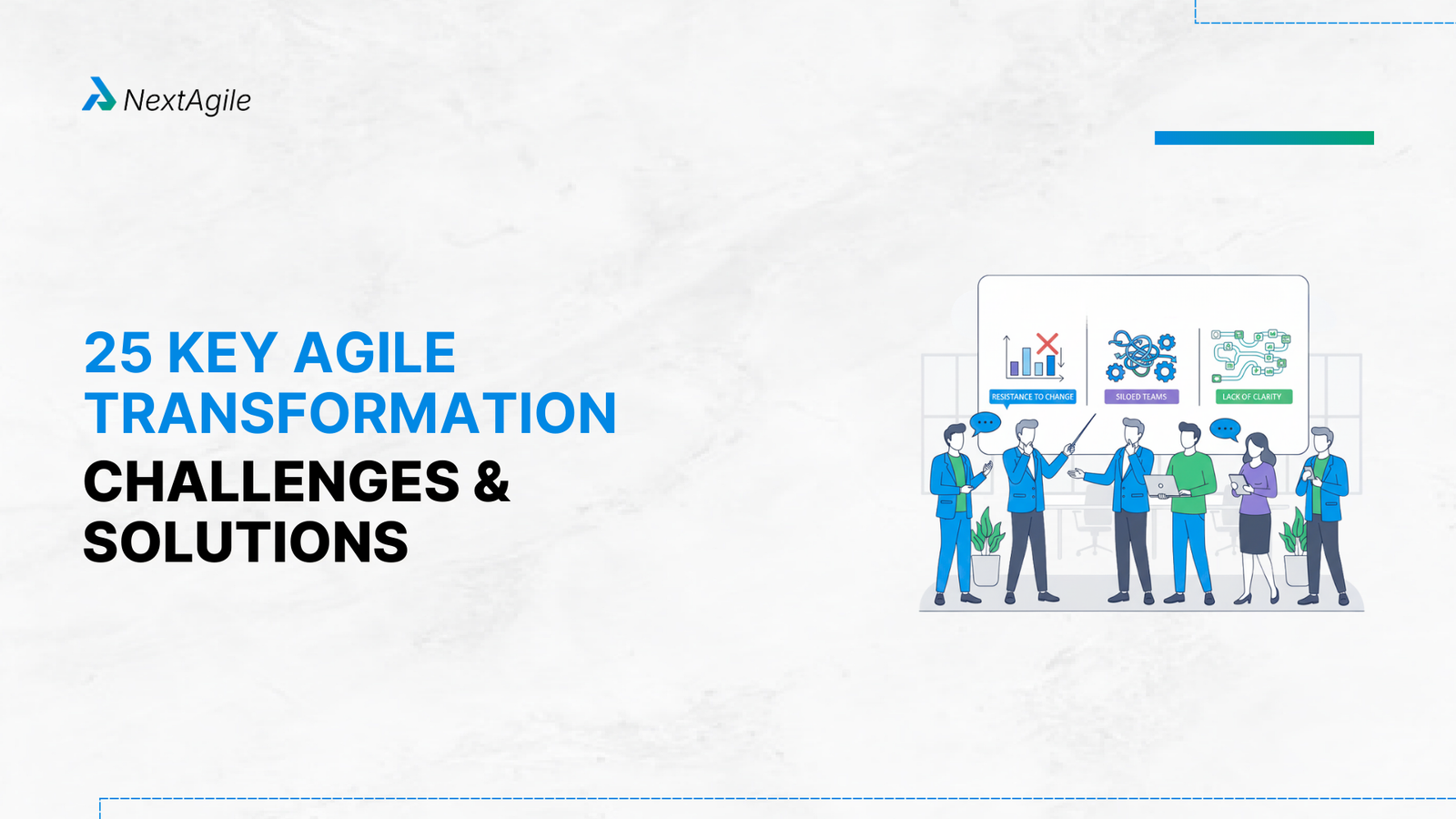
Agile Transformation Challenges: Why Do Agile Transformations Often Fail In Businesses? What are the key agile transformation challenges? Simply, the fact that transformation is not a single player game. There are scores of people involved and all of them must contribute towards this pursuit of agility in the organization.
Mostly, Individuals, teams, organizations start their pursuit of Agility with great excitement and enthusiasm, somewhat similar to a person starting his dream job. While we start with good intentions and motivation, the initial excitement can quickly disappear as they hit any challenges in an agile transformation journey.
What can go wrong (Agile Transformation barriers)?
Transformation is about people, more than anything else. People are opinionated and not everyone gives the same level of buy-in There will always be resistance to change Transformation takes time but there may be a top down push for quick results, patience is a rare virtue Misplaced priorities – You wanted A but you end up spending a big chunk of your time on B and many other reasons. At the same time, it’s also important that any organization embarking on a new transformation journey experiences ‘incremental’ improvements in time-bound intervals. Nothing creates buy-in more than success stories.
Select your agile experts/champions carefully, these should be practitioners trying to solve business bottlenecks using agile among other things and not the other way around. If you are not careful, you will end up with ‘surface-agile’ which is more like a lipstick job, with all the ceremonies, roles, artifacts in place but no real benefits on the ground. We have all heard of ‘culture’ & ‘Mindset’ so many times at so many forums without proper explanation or lucid definitions of what it means.
The correct way to adopt agile is to find an ultimate balance between the Micro and Macro where the agility can sustain. It’s important for the organization to have a pragmatic mix of both to move slowly, yet steadily towards the right direction to leverage ‘Agile’.
Understand and define the business reasons for Agile Adoption very clearly Always get ‘outside-in’ view, no organization becomes agile by attending a few trainings & changing designations You can not be somewhat ‘Agile’, be honest Create buy-in at all levels, people don’t change mindset by being told to change mindset Focus on creating small ‘pockets of excellence’ & share ‘success stories’ widely Empower people to tell their stories & learn from each other Encourage teams to continuously inspect and adapt Have a long term strategic view and a short term tactical mindset Don’t think and act in binaries. Multiple things can work at the same time, also same things need not necessarily work in different scenarios Your unique solution will lie in marrying deep domain knowledge, agile mindset and a lot of common sense + empathy 25 Key Agile Transformation Challenges Pursuit of ‘Agility’ is a continuous journey. Organization culture and mindset needs constant work. There are hundreds of things which can go wrong and will go wrong in this pursuit depending on specific client context. We try to list some of the most common challenges in agile transformation below and what could work to resolve them (however, there is no fixed formula and it is advisable to get expert help, these solutions are for learning purposes only).
1. Inadequate 3rd party influence on work methods It is one of the most common agile adoption & transformation pitfalls, people working for a long time in the same organization on the same things may end up doing things driven by biases and environmental consequences which may lead to lack of experimentation and more head-nodding. Bringing the 3rd party in the system and empowering them to conduct due-diligence followed by partnering with the internal core team to bring change will help in marrying the inside-out viewpoint with outside-in reality.
2. Need for upfront certainty in investment decisions The annual planning and budgeting process certainly is time consuming and may also feed a culture of too much upfront planning and lack of agility but it is still continued in organization as it supports them in managing their investments. Instead of negating the entire need of it we need to find methods like lean budgeting and continuous strategic review of already budgeted items to persevere or pivot.
3. Stakeholder discomfort with reduced predictability and control The annual planning and budgeting process certainly is time consuming and may also feed a culture of too much upfront planning and lack of agility but it is still continued in organization as it supports them in managing their investments. Instead of negating the entire need of it we need to find methods like lean budgeting and continuous strategic review of already budgeted items to persevere or pivot.
4. Difficulty in finding the right Product Owner Understanding of the Product Owner role varies based on the level of exposure people have with the agile ways of working. Popularity of Scrum has made this role a necessity in organizations that are pursuing agility. At the same time, people still perceive it as either a new name of a Product Manager or a mix of a Product Manager and a Program Manager.
In the truest sense, this role is responsible for identifying the right direction for the product to succeed by continuously evaluating the ongoing market needs, the customer personas, the evolving technologies and various other factors which then needs to be further collaborated with development team and add to the their backlog and once the outcome is delivered, PO needs to investigates if the idea has matched the purpose. It is not easy to identify such a person who is creative, thinks outside the box and has product-thinking skills over just playing the role of a yes man to leadership and technology folks.
5. Persistent sluggishness in governance processes If one needs to find out which group is most hated or unlikely in an organization then PMO or Governance or Process custodians might be one of the few. It might not be the case in all the organizations as they may have addressed the need of governance is not to police the teams or slap them with myriads of Excel , docs, PPTs, etc but to enable the teams to succeed. Also, they realized that the governance isn’t just a departmental goal but its a purpose which is owned by everyone and the Governance team acts as a mentor or guide. Most importantly, the process should be always relevant and not outdated or prescriptive.
6. Incomplete team member allocations As the word team means a group of people who are working together with a common purpose to win and to do so we need to know for what task we are forming it. If we mismatch the complexity of the problem and the capability of the team (in terms of skillset or count) then that may have its own consequences like poor quality product, missing important release dates, toxic work-life balance and many more. This is one of the very common challenges with agile transformation and can be addressed with proper planning.
7. Prolonged project initiation times You may ask for a long time to plan and suppose you are granted the same, then it might have an important loophole, which is, validating the right-market fit. The best way to negotiate this is just-enough planning, MVP mindset, continuously delivering the outcomes and seeking feedback, iterations to fail fast and building things incrementally. Empiricism might cost the same or at times more initially, but it will surely help you with realizing value in the long run and in the worst case scenario it will let you know that this project is a flop show quite before you invest loads of money.
8. Insufficiently mature tooling and automation landscape The competition is cut throat, nobody can deny that and to keep up the pace, we need to automate everything possible to eliminate waste and make things leaner. With the evolution of technology, new age techniques and trends, anyone can push code to production and you may make dozens or more releases every day. And all that will become possible only with the maturity of toolsets and automating everything.
9. Scarcity of individuals with the required skills What happens when you are having a stomach ache and the nearest doctor you found is a dentist? Would you be ok with the dentist prescribing you medicines for your gut dysfunction? When we form the team we need to be mindful that a right-fit is important unless you have ample time and money. Plus the candidate should also have a zeal to be adaptable. Continuously creating the awareness among individuals to upskill and creating a learning culture in organizations is very important to ensure that we can deliver the solutions that are needed. Skill mismatch is a common yet fatal agile adoption and transformation pitfalls.
10. Crucial organizational decision-making Decision making could be categorized as centralized or decentralized. Centralized decision making should happen for time-critical decisions which have a direct impact on the company’s strategy, reputation and revenue streams. Decentralized decision making creates the culture of ownership and responsibility to identify, build and deliver impeccable solutions that can help us in improving the customer experience and provide them the sense of purpose to make decisions that contribute to overall success.
11. Ambiguous scope and unclear outcomes An agile organization believes in continuously exploring the opportunities of improvement by adapting to changing demands and frequently delivering outcomes. Having said that, it doesn’t mean that we shouldn’t have a plan in place. Strategy to have long term, mid-term and short term plans are always helpful as we may pivot whenever we feel like. Henceforth, the product team should keep on finding the future scope and well-defined expectations so as to move things forward in a faster way by minimizing the to and from.
12. Inability to break activities into small iterations A common agile transformation barrier. Building bigger requirements have many loose ends and can cause the slippage of time and money since the scope is too big to deliver and may be found to be inefficient after it is delivered. The overall ability to do things incrementally so as to inspect and adapt will help us align with the effectiveness of our requirements. Henceforth, there is a dire need to break things down to the level of iterations and each iteration should help us to learn if we are on the right track or not by showcasing potentially shippable outcomes at the iteration offset.
13. Ineffective risk mitigation Anticipating risk is not a one-off event. It should happen from initiation, planning, detailing, execution, before production and even in production to assure reliability. There are practices like ROAM which help us in predicting risks and categorizing them in states like Resolved, Owned, Accepted and Mitigated. In a timely cadence we should inspect the actions taken to mitigate them and if not done then it may end up in states like critical or show-stopper which no business would want.
14. Maintaining alignment on agile transformation objectives and value One of the more complex challenges with agile transformation. Agile transformation focuses on driving the change but shouldn’t happen with a big-bang but by doing pilots and gradually expanding the landscape. The key reason is not just to create success stories but by learning the underlying issues that might be common across the target group and may need to be addressed.
This is why it is important to first learn why in the first place the organization demands agile transformation, then setting the objectives that have measurable key results and focus on delivering a value that could be experienced by everyone. If not done rightly it might end up being a lipstick job and lead to further resistance in the system to embrace such change.
15. Prioritizing agile transformation as a strategic imperative We often experience that there are organizations where agile transformation is looked upon as a process used by IT or Technology teams to build software products but in the truest sense it is beyond that. For an organization to bring agility, we need all the wheels to be aligned with the common purpose. The way we approach our customer, position our product, explore problems, budgeting initiatives, form teams and orchestrate to deliver outcomes. This requires top leadership buy-in and there should be ways to measure progress that are impacting the business. Without this, there would be scaling agile challenges in pursuit of real business agility.
16. Placing culture above all else in prioritization The fabric of the company contributes directly to its success and that fabric is the culture where people may either carry a growth mindset with focus on delivering outcomes or they may just wait for someone to tell them what to do next. The self-drive requires minimal or no delegation and to imbibe such traits it is important that the individual and teams are aligned with the purpose and autonomy. The investment in culture is ongoing and that requires not just training but continuous reminder of purpose, importance of people capital, focus on secured and qualitative outcomes and customer centricity.
17. Strategic investment in the right talent Piloting is no doubt a starting point as it gives you the pulse check of ground realities and possible issues that could occur in scaling. The learnings from the pilot should be carefully considered and discussed with the leadership team. The next step should be to create pull instead of pushing the initiative as it might be overwhelming. The new groups or teams should feel inspired and excited about the benefits of the agile transformation realized by the pilot teams and that should be the next stair to climb.
19. Emphasizing supporting tools and core management processes The supporting tools should be curated in such a way that they weed out any level of redundant or erroneous aspects that could happen if done manually. That way the people could relate with the issues and the importance of tools in the system. In parallel, the management process should be driven by purpose and solve specific problems, so that it could be accepted unanimously.
20. Providing necessary training for agile transformation After the investigation of the ongoing state, identifying the strengths and opportunities of improvement and finalizing the roadmap for agile transformation, the first step is always to conduct focused workshops with the target groups so as to onboard them with the change they will experience. It is essential to drive the simulations and case studies aligned with their context to help them in realizing the benefits of the to-be state while pursuing the agile transformation. A good awareness session on what entails an agile transformation journey will help you negotiate agile transformation difficulties encountered later in the journey.
21. Lack of executive engagement Executives are usually the sponsors of agile transformation and many times we experience that they believe the change is for those who are lower down in hierarchy and not for them. That’s where the conflict begins. The agile transformation is neither top-down or bottom-up. It starts from somewhere and scales to all levels of the organization henceforth the alignment of executives with their level of engagement is paramount.
22. Excessive focus on “product output” More the organization focuses on product output, the more they will invest in predictability and less would be the experimentation, autonomy and innovation. Product focus is important but at the same time, the organization needs to invest into necessities like technology upskilling, revamping the architecture, exploring different working models and virtues like delayed gratification over instant ones.
23. Insufficient reliable customer insights In the competition to do things faster, the organization listens less to customers and starts believing that they understand the customer and do not need to invest more. Actually, with changing demands and different options in the market, the customers are continuously experiencing the insufficiency of services which they are currently opting for and feels that there are better alternatives which are feature rich, cost effective and more convenient. The initiatives like Product Trio enables the organization to pursue elements of design thinking where the customers are categorized carefully to personas and studied continuously.
24. Unclear roles and responsibilities The roles and responsibilities are treated like a trivial aspect when agile transformation happens. With the changing environment, it’s important to repurpose the expectations at all the levels within the impacted landscape. Having a habit of being told it is not easy for people to align to the bigger picture henceforth dialogues need to happen where we should let them unlearn the RACI mindset and understand the essence of collective ownership. The intent is to inculcate the mindset of tightly aligned (with goals) and loosely coupled (with activities). It requires focused coaching to impact these traits so as to let people know that a one-team mindset is driving the new fabric and not my-work-and-your-work approach.
25. Lack of communication between teams During the agile transformation, it often happens that there are mutual dependencies between teams and within a team too and that if not communicated well then there will be delays, impact on quality and many more issues. A structured approach could be helpful like weekly or daily syncs between the representatives of the team. A common dashboard to visualize the overall work and respective contributions by teams to align and deliver them.
Mitigate risks caused by such gaps by doing team building exercises and joint planning. Identifying areas where both teams can come together and collaborate on mutually beneficial tasks. Also, we have seen that setting up norms at the level of team, programs and portfolio has helped in overcoming issues arising due to communication gap.
Engage with a premier agile consulting company dedicated to facilitating transformative change. We ensure your initiatives are aligned with long-term success and constantly changing market landscape
Agile Transformation Solutions: How Do consulting Agencies Aid Businesses In Overcoming These Challenges?NextAgile’s core focus is on driving turnkey transformation and it has seasoned consultants who have helped and are helping organizations in pursuing business agility in several ways:
Conclusion: Are you struggling to get the real benefits of agile implementation in your organization? Do your teams see agile as another overhead process? Do your stakeholders – senior, middle management and teams see agile as something others need to follow? Do you have all the roles, processes, artifacts and events in place but are struggling to see real changes on the ground? Agile Transformation is a complex journey with more than a few ingredients you need to get right. Drop us a mail at consult@nextagile.ai if you would like to have a quick conversation with our agile experts on your agile transformation challenges or one of the many agile transformation difficulties, we would be glad to help.
Alt text: key agile transformation challenges
Alt text: How do consulting agencies aid businesses in overcoming transformation challenges
Alt text: How do consulting agencies aid businesses in overcoming transformation challenges
Alok Dimri is the co-founder and leads the overall business at NextAgile, where he is responsible for strategy, client and consultant partnerships, and a whole lot of other core business activities like solutioning, branding, and customer engagement.
Over the past 16 years, he has worked extensively in business strategy, new business development, and key account management initiatives across process consulting and training domains.
 Skip to content