What Is Lean Portfolio Management and How To Implement? A Quick Guide
Anuj Ojha
Talk to Expert for Free
Table of Contents
Introduction
‘Running fast in the wrong direction is worse than walking slowly in the right one.’ – something like this quoted by Simon Sinek on X
Today’s business arena demands not just speed, but also strategic agility. The true meaning of agility is also about moving continuously towards the right direction which might have been interpreted as just moving fast. Traditional methods of overseeing organizational investments often falter in this fast-paced environment, leading to wasted effort, protracted timelines and a disconnect between high-level strategy and on-the-ground execution. One of the reasons could be less tolerance of uncertainty & a focus on ‘making the perfect plan’, and then strategising to get the plan ‘right’.
Let’s understand the Lean Portfolio Management (LPM), a contemporary approach that injects Lean and Agile thinking into how organizations manage their most significant investments. This concise guide unpacks LPM and provides a tangible pathway for its adoption.
Before starting your journey to go through this quick guide, I would like you to remember a famous quote by futurist Alvin Toffler –
“The illiterate of the 21st century will not be those who cannot read and write, but those who cannot learn, unlearn and relearn.”
What is Lean Portfolio Management?
Scaled Agile Framework (SAFe) has introduced Lean Portfolio Management in Portfolio flow as a way to translate enterprise strategy pertaining to a portfolio for execution.
LPM transcends the conventional view of a portfolio as a mere collection of projects. Instead, it champions a holistic perspective focused on optimizing the continuous flow of value across the entire enterprise.
Think of LPM as the smart way for an organization to handle its big bets – its portfolio of products and initiatives. It’s not about setting things in stone and hoping for the best. Instead, LPM is designed to be really tuned in to how things are constantly shifting: what customers want, what new tech is out there, and just the general ups and downs of business.
The whole point? To build stuff that people genuinely love and that also makes good business sense. To pull that off, everyone needs to be on the same page, marching to the beat of the company’s overall strategy. LPM makes sure that connection is strong and clear.
One of the big wins of LPM is making the day-to-day work – the operational value stream – run like a well-oiled machine. It streamlines how ideas become actual products and services.
LPM really shines in three key areas:
Smart Money Moves (Strategic and Investment Funding): This is not about throwing money at every bright idea. LPM helps organizations make thoughtful choices about where to invest, making sure the big projects actually line up with the company’s goals. It is about funding value streams – the ongoing ways you deliver value – rather than just individual projects, giving teams more flexibility.
Keeping Things Agile at the Top (Agile Portfolio Operations): Just like your development teams use Agile to be nimble, LPM brings that same spirit to the portfolio level. It is about coordinating all the different moving parts, supporting the teams doing the work, and constantly looking for ways to improve how things run. Think of it as the conductor making sure the whole orchestra plays in harmony.
Guiding Without Being Heavy-Handed (Lean Governance): No one likes a ton of red tape. LPM offers a lighter touch to oversight. It sets clear boundaries and expectations but empowers teams to make decisions. This includes smart ways to handle budgets, make forecasts, and keep an eye on how the portfolio is performing without slowing everything down.
How has Portfolio Management Evolved?
To truly grasp the significance of Lean Portfolio Management (LPM), it’s beneficial to trace the evolution of portfolio oversight:
Using the business lens as a guiding light – In early portfolio management the most usual move was to diversify business holdings and mitigate risk across various operational units. This was creating structural overheads. The business lens enables us to move away from project thinking to outcome or value based thinking
Shifting from project paradigm & moving towards product focus – As businesses matured, the emphasis shifted towards strategically managing a suite of products or services to enhance market penetration and profitability.
Factoring the IT Imperative: With the increasing criticality of technology & the perks of its advancement, focus has shifted towards frequent & short releases to continuously delivering value to customer (desirability), benefits to the business (viability) and upskilling the technological skillset to deliver solutions (feasibility) aspects.
Making transformation leaner & aligned to product vision: LPM represents the latest stage in this evolution, directly addressing the shortcomings of earlier approaches by prioritizing value streams, seamless flow, and adaptive planning. The roadmap shouldn’t be output or feature focused but outcome driven.
Why Lean Portfolio Management?
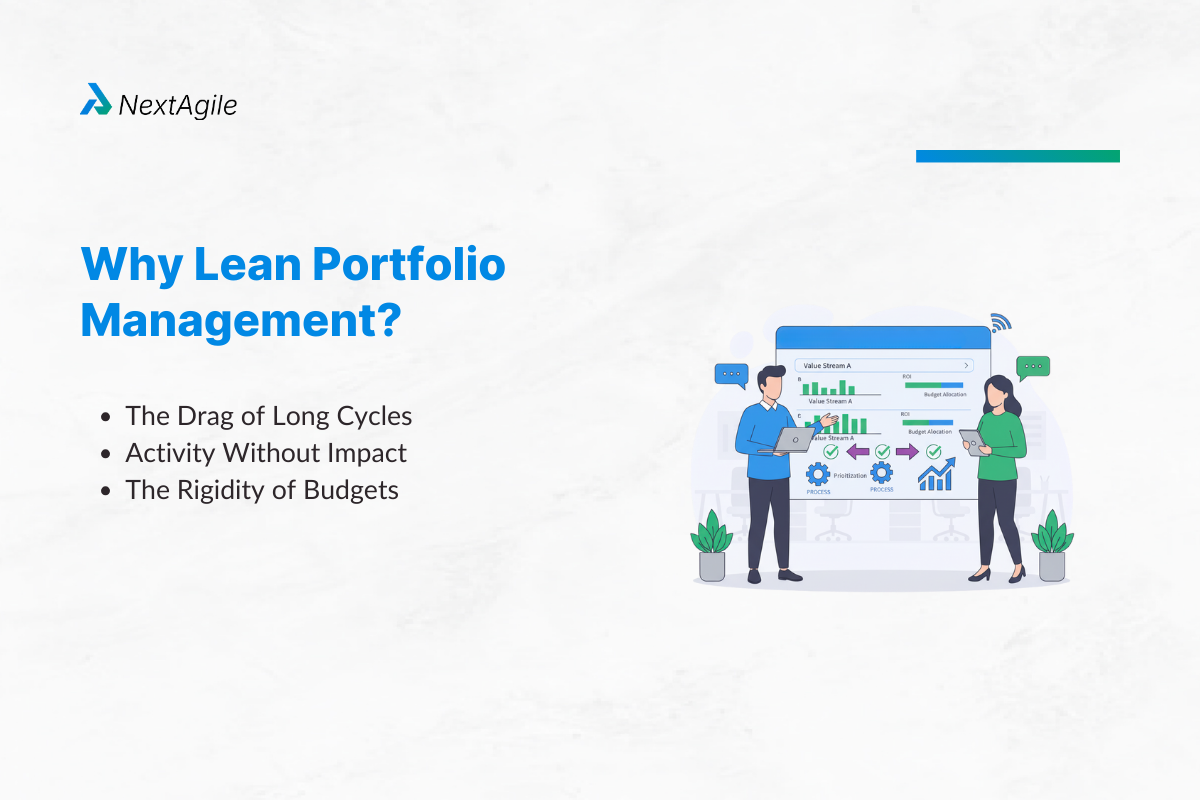
The impetus for adopting LPM stems from persistent challenges within organizations:
 Skip to content