Gantt Charts and Agile have traditionally been viewed as mutually exclusive. Gantt Charts represent a traditional, predictive methodology that emphasizes planning, control and linear progression. Gantt Chart relies on a detailed project schedule, precise task dependencies, and fixed deadlines. In contrast, Agile is an adaptive, iterative framework that prioritizes flexibility, collaboration and continuous improvement.
The differences between Gantt Charts and Agile are stark. Gantt Charts require detailed upfront planning, while Agile encourages iterative development and flexible requirements. Additionally, Gantt Charts measure progress through percentage completion of the entire work, whereas Agile ways of working is about delivering value to end users by continuously experimenting, failing faster, encouraging feedback and delivering incrementally.
These opposing philosophies often lead to conflicting views on project management. Proponents of Gantt Charts value structure, predictability, and control, whereas Agile advocates prioritize adaptability, collaboration, and responsiveness. Gantt Charts are often seen as rigid and inflexible, while Agile is viewed as lacking structure and discipline as it is applied in cases with vulnerabilities, uncertainties, complexities and ambiguity . However, this dichotomy overlooks the potential synergy between the two.
Despite their differences, Agile methodology and Gantt Chart are not inherently antithetical. By recognizing their strengths and weaknesses, teams can integrate elements of both to create a hybrid approach that suits their specific needs. This blended methodology can leverage the predictive power of Gantt Charts for high-level planning while embracing Agile’s iterative nature for tactical execution.
Ultimately, the choice between Gantt Charts and Agile Methodology should not be an either-or proposition. Instead, teams should focus on finding a balance that harnesses the benefits of both to deliver successful project outcomes.
What is an Agile Gantt Chart?
As mentioned in the above heading, we need to explore the hybrid approach that could give the power of predictability & control as offered by Gantt Chart and at the same time the flexibility, element of experimentation and continuous improvement traits which are characteristic of agile approaches.
Here is an attempt to introduce an integrated framework that enables teams to leverage the benefits of both worlds, for that the hybrid approach has to blend two key elements –
High-Level Planning (Gantt Charts) defines project scope, timeline, and milestones, identifying critical dependencies and major deliverables.
Iterative Execution (Agile) breaks down major deliverables into smaller, iterative tasks, using Agile sprints, Kanban boards, or Scrumban for task management.
In brief, the mantra is:
For long-term planning, we should use Gantt charts.
For day-to-day execution, we should use Agile approaches.
To maximize usage, the Gantt chart could also be used to showcase the iterative outcomes and incremental fulfillment of objectives.
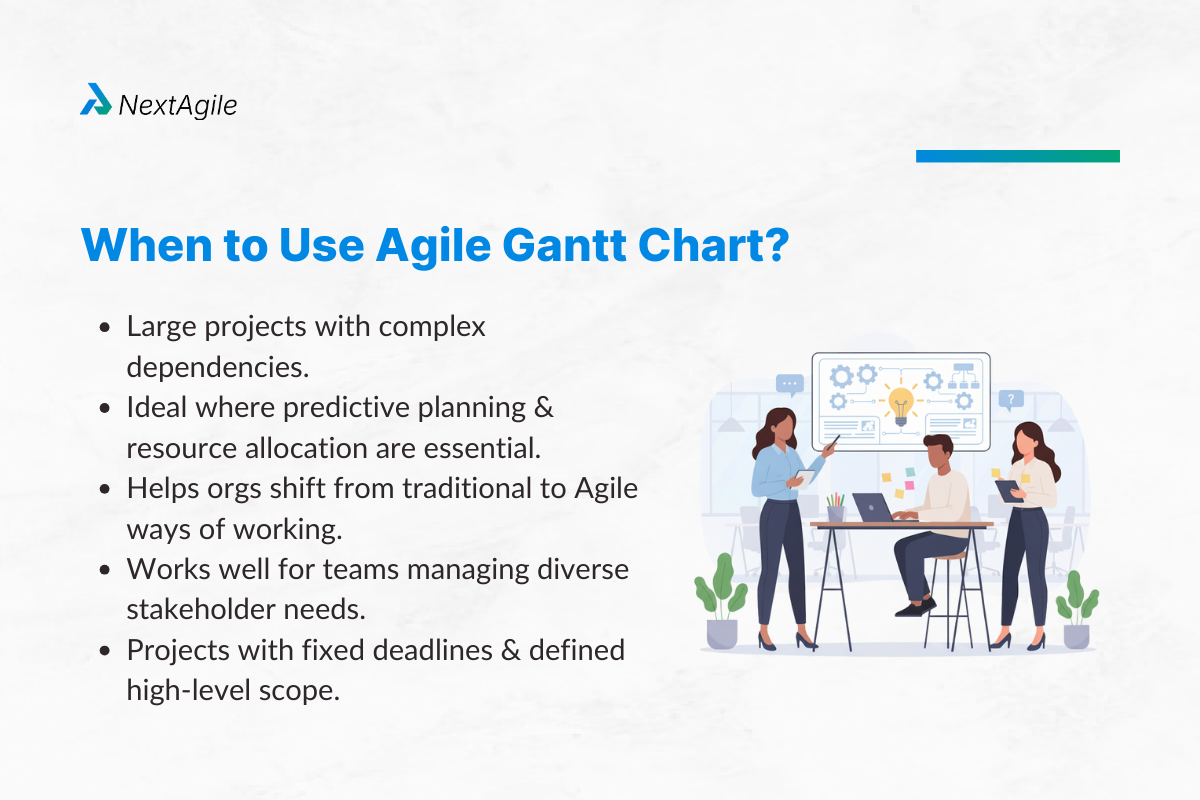
Almost all the tools provide timelines features which is nothing but a Gantt chart. Also, we should use Agile metrics to calibrate Gantt Chart adjustments. Let’s explore by understanding certain use cases. The Agile-Gantt hybrid approach is suitable for:
Large-scale projects with complexdependencies
Projects requiring predictiveplanning and resource allocation
Organizations transitioning from traditional to Agile methodologies
Teams with diverse stakeholder requirements (e.g., regulatory compliance)
Projects with fixed deadlines and high-level scope definitions
These use cases are primarily applicable to industries like Construction, Manufacturing, Banking & Finance, Healthcare, Insurance and more of such core segments and in certain scenarios even in the IT industry.
Even in industries that are experiencing a VUCA environment like IT, the trends like OKRs (Objectives and key results) requires setting up of objectives which are reviewed weekly and quarterly, Gantt chart could be used for visualizing the plan vs actual development against the objectives.
While we are exploring the possibilities of implementing the hybrid approach, we should also be aware of following anti-patterns that may create new pain:
 Skip to content