Skip to content


Key Takeaways: What is OKR
- OKR stands for Objectives and Key Results, a framework for setting measurable goals
- OKRs focus on outcomes, while KPIs track performance metrics
- Effective OKRs include Objectives, Key Results, and Initiatives
- Teams should set 3-5 OKRs per quarter for focus
- Weekly check-ins are critical for successful execution
- A score of 0.7-0.8 indicates strong OKR performance
- OKRs work effectively with Agile and Scrum frameworks
Introduction: Why OKRs Matter More Than Ever?
Ever feel like your team is working hard but not necessarily moving the needle?
You’re not alone. Most organizations today face the same challenge: too many priorities, not enough clarity. Teams commit to ambitious goals in Q1 and by week 4, no one is talking about them anymore.
Here’s the thing, execution doesn’t fail because of poor intent. It fails because goals aren’t structured, tracked, or aligned consistently.
That’s exactly where OKRs (Objectives and Key Results) come in.
As an OKR consulting firm, we’ve seen a clear pattern: Over 70% of first-time OKR implementations struggle not because of strategy, but because teams skip alignment and weekly tracking.
Done right, OKRs don’t just track goals. They change how decisions are made every week.
What Is OKR? Definition, Origin, and Core Components
OKR (Objectives and Key Results) is a goal-setting framework that defines:
- Objective: What you want to achieve
- Key Results: How you measure success
But here’s what most definitions miss, OKRs only work when they’re actively used in decision-making, not just documented. In practice, the effectiveness of OKRs is directly proportional to how often they are referenced in day-to-day conversations. Teams that treat OKRs as a living system – reviewed in planning, check-ins, and retrospectives – consistently outperform those that treat them as quarterly artifacts.
Who created OKRs and how companies like Google use them today?
OKRs were introduced by Andy Grove at Intel and later adopted by Google in its early days.
Google didn’t just use OKRs to track goals; they used them to maintain focus during hypergrowth. What made early adopters successful was not the framework itself, but the operating discipline around it. OKRs were embedded into leadership conversations, funding decisions, and prioritization trade-offs. This integration, not adoption, is what differentiates high-impact implementations.
And that’s why OKRs matter today. Because scaling companies face the same challenge:
- Too many opportunities
- Limited focus
- Misaligned teams
OKRs solve this by forcing clarity.
The 3 components: Objective, Key Results, and Initiatives (the missing piece most teams skip)
1. Objective (The “What”)
A strong Objective is:
- Clear and directional
- Ambitious but grounded
- Easy to understand
Example: Improve customer onboarding experience
2. Key Results (The “How”)
Key Results define success through measurable outcomes.
Example:
- Increase onboarding completion rate from 45% → 70%
- Reduce time-to-first-value from 5 days → 2 days
3. Initiatives (The Execution Layer Most Teams Miss)
This is where execution actually happens. Initiatives are the projects and actions that drive Key Results.
Example:
- Redesign onboarding UX
- Launch guided walkthroughs
- Optimize onboarding emails
Critical insight: OKRs often fail not because they’re poorly written but because teams don’t define how they’ll achieve them.
Another common gap is the absence of clear ownership at the initiative level. While Objectives and Key Results may have defined owners, initiatives often become loosely managed, leading to execution gaps. High-performing teams assign explicit ownership to initiatives, ensuring accountability translates into action.
OKRs vs KPI: Key Differences Every Leader Must Understand
Direct answer:
- OKRs drive change and strategic direction
- KPIs measure ongoing performance and stability
But here’s where it gets interesting. Imagine your revenue KPI is stable but growth has plateaued. Everything looks “healthy,” yet nothing is improving. That’s the limitation of KPIs. OKRs step in to push transformation.
| Aspect | OKRs | KPIs |
| Purpose | Drive change | Measure performance |
| Focus | Future growth | Current state |
| Nature | Ambitious | Stable |
| Example | Increase revenue by 30% | Maintain revenue above X |
A practical way to combine OKRs and KPIs is to treat KPIs as health indicators and OKRs as change drivers. When KPIs signal stability but strategic movement is required, OKRs introduce intentional disruption to shift performance trajectories.
What we’ve learned: High-performing organizations don’t replace KPIs with OKRs; they layer them. KPIs keep you stable. OKRs help you grow.
How to Write Good OKRs: A Step-by-Step Guide
How to write a clear and motivating Objective?
A great Objective should answer: Why does this matter?
Increase revenue by 20%
Accelerate revenue growth through high-value customer acquisition
If your Objective sounds like a metric, it’s not an Objective.
A useful test for strong Objectives is whether they can inspire multiple solution paths. If an Objective already implies a specific solution, it limits creativity and reduces strategic flexibility. The best Objectives create direction without prescribing execution.
How to write measurable Key Results (with examples)?
Key Results should reflect outcomes not tasks.
Example:
Objective: Improve product adoption
- Increase DAU/MAU ratio from 25% → 40%
- Improve feature adoption from 30% → 55%
- Reduce churn from 8% → 5%
Well-defined Key Results also act as early warning systems. Instead of waiting until the end of a quarter, they provide progressive signals that indicate whether execution is on track. This allows teams to intervene early rather than react late.
Ambitious vs realistic OKRs: what targets should you set?
Here’s the nuance.
- Committed OKRs → Must be achieved
- Aspirational OKRs → Stretch goals (~70% success is strong)
In our experience, a mix works best because teams need both predictability and ambition.
Mature organizations often separate OKRs into learning-oriented and delivery-oriented goals. Learning OKRs focus on experimentation and discovery, while Delivery OKRs focus on execution and outcomes. This distinction prevents teams from forcing certainty in areas that require exploration.
How do regular check-ins and feedback improve OKRs?
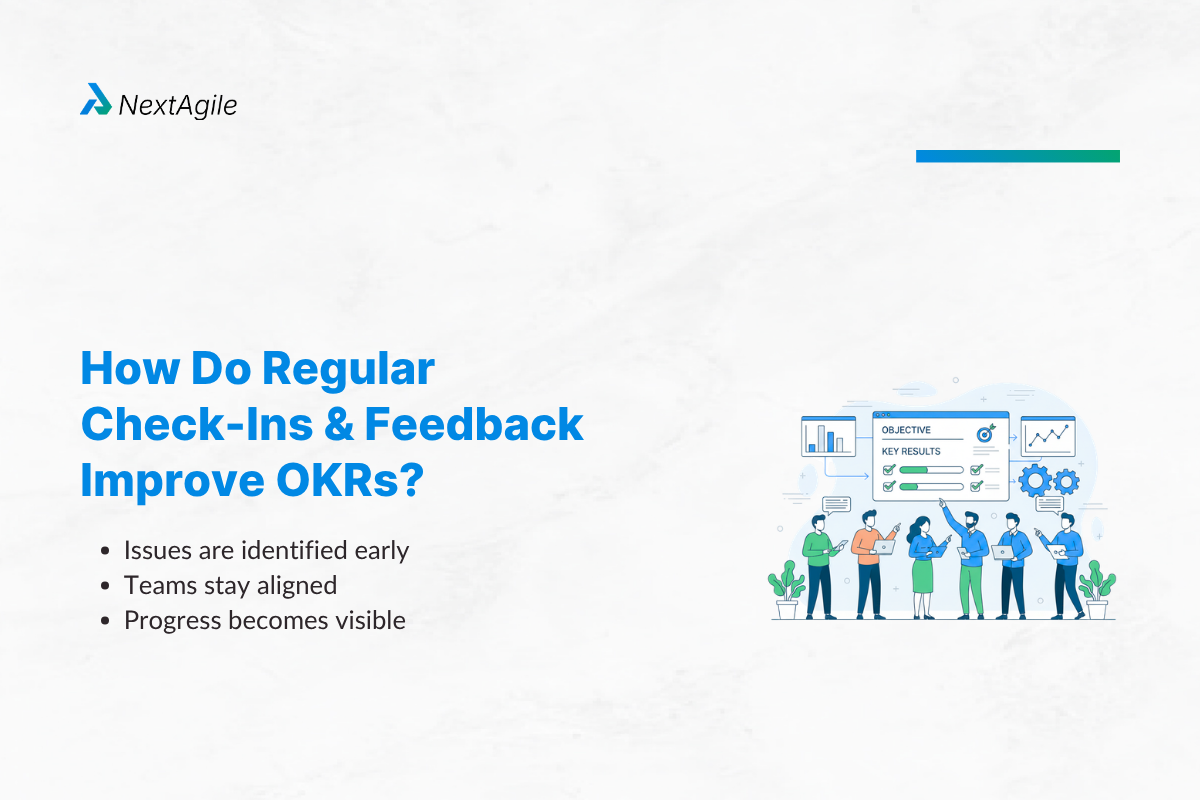
Most OKRs don’t fail during planning; they fail in week 3, when check-ins stop happening. Teams that track weekly tend to improve completion rates significantly because:
- Issues are identified early
- Teams stay aligned
- Progress becomes visible
Explore our blog on OKR planning for a complete guide.
OKR Examples by Level and Industry
Examples are where OKRs finally “click.”
Full library: OKR examples
Company-level OKR example: growth and expansion
Objective: Expand market presence in APAC
- Enter 3 new markets
- Increase revenue by 40%
- Acquire 500 enterprise customers
Department-level OKR example
Objective (Product): Improve engagement
- Increase session duration by 25%
- Improve feature adoption by 40%
Objective (Marketing): Generate quality leads
- Increase MQLs by 50%
- Improve conversion rate from 2% → 5%
Team-level OKR example (Scrum team)
Objective: Deliver high-impact features faster
- Reduce sprint spillover from 30% → 10%
- Improve deployment frequency
- Reduce bugs by 40%
Individual OKR example
Scrum Master:
- Improve sprint predictability to 90%
- Reduce blocker resolution time
The OKR Cycle: Annual, Quarterly, and Weekly Cadence
Most OKRs don’t fail because of bad goals; they fail because execution rhythms break down.
How do companies set annual OKRs?
Annual OKRs define strategic direction:
- Growth
- Expansion
- Innovation
How teams plan quarterly OKRs?
Quarterly OKRs translate strategy into execution.
Best practice:
- 3-5 Objectives per team
- 2-4 Key Results each
- Clear ownership
Check our detailed guide on how to implement OKRs to learn more.
Weekly OKR check-ins: the habit that drives execution
This is the difference-maker.
A simple weekly rhythm:
- Update progress
- Identify blockers
- Adjust priorities
Not complex but incredibly effective when done consistently. The quality of check-ins matters more than their frequency. Effective check-ins are not status updates; they are decision forums where teams reassess priorities, address risks, and reallocate effort based on current progress. This shift transforms OKRs from tracking tools into execution drivers.
How OKR scoring works (0.0 to 1.0 explained simply)?
- 1.0 → Fully achieved
- 0.7-0.8 → Strong performance
- <0.5 → Needs attention
Scoring should not be treated as a performance judgment but as a learning signal. The real value lies in understanding why a Key Result scored high or low, and what that reveals about assumptions, execution, and strategy.
A 0.7 score is often a success because it reflects ambitious goals.
How OKRs Work in an Agile and Scrum Environment?
OKRs and Agile complement each other by operating at different altitudes. While Agile frameworks optimize how work is delivered, OKRs define why that work matters. When disconnected, teams may deliver efficiently but without meaningful impact.
Sprint goals vs OKRs
- OKRs → Strategic direction
- Sprint goals → Execution steps
Sprints build toward OKRs.
How do OKRs connect with backlog and epics?
OKRs determine:
- What gets prioritized?
- What gets deprioritized?
Without OKRs, backlogs become cluttered. In many teams, backlog overload is not a prioritization problem but a lack of strategic elimination. OKRs provide the clarity needed to remove low-impact work, ensuring that backlog size reflects focus rather than ambition.
Daily Scrum vs OKR check-ins
- Daily Scrum → Tactical updates
- OKR check-ins → Strategic alignment
Both are essential. A subtle but important distinction is that Daily Scrums focus on progress visibility, while OKR check-ins focus on progress validity. One answers “what is happening,” the other answers “does it still matter.”
Using retrospectives to review OKR progress
Retrospectives help teams:
- Reflect
- Adjust
- Improve execution
Common OKR Mistakes (and How to Avoid Them)
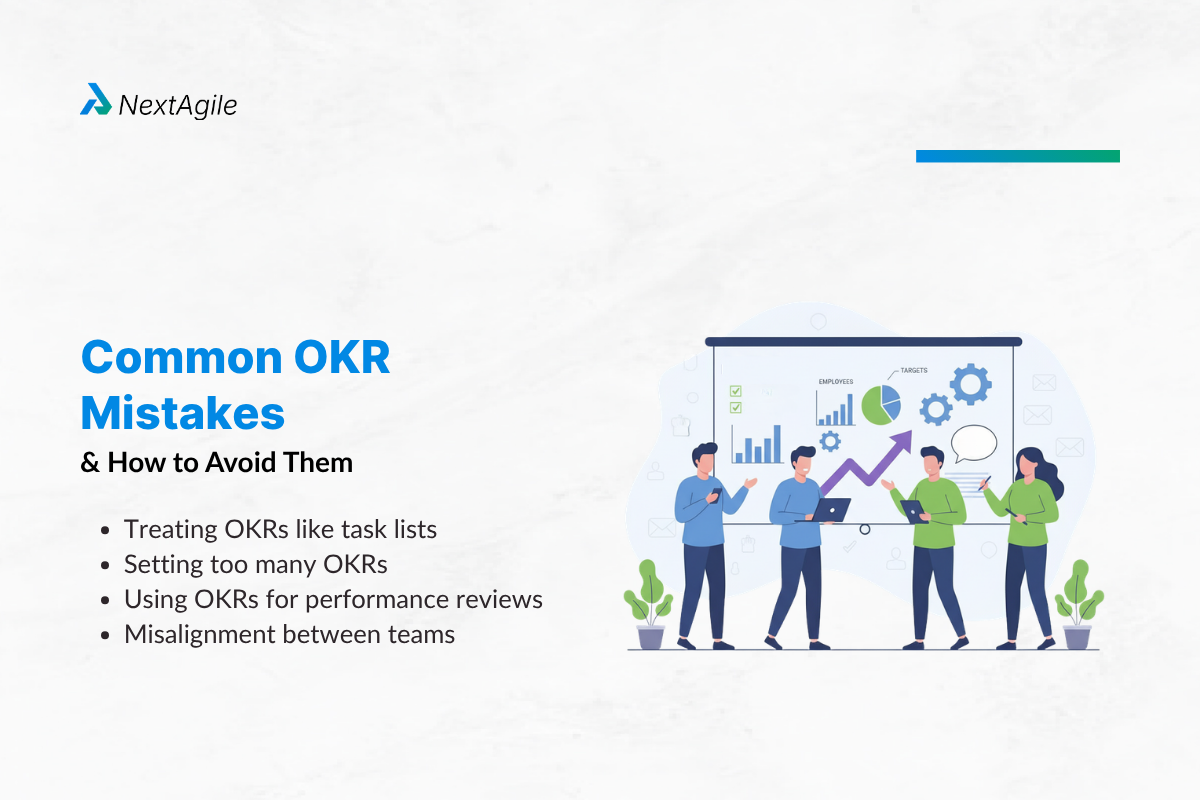
1. Treating OKRs like task lists
Launch new feature instead of Increase adoption by 30%
2. Setting too many OKRs
One team we worked with had 12 OKRs and completed none. After reducing to 3, execution improved within a quarter.
3. Using OKRs for performance reviews
This leads to safe goals and not ambitious ones.
4. Misalignment between teams
When OKRs don’t connect, execution fragments.
Another overlooked mistake is over-engineering the OKR process. Excessive tooling, complex scoring systems, or rigid templates can reduce adoption. Simplicity and consistency are often more impactful than sophistication in early and mid-stage implementations.
What Your First 30 Days of OKR Implementation Should Look Like?
If you’re starting fresh, here’s a practical rollout:
Week 1-2:
- Define company OKRs
- Align leadership
Week 3:
- Set team-level OKRs
- Identify initiatives
Week 4:
- Start weekly check-ins
- Track progress
This is where most companies either succeed or stall.
The first 30 days are less about perfection and more about behavior formation. Organizations that focus on building the habit of weekly alignment and transparent tracking tend to refine their OKRs naturally over time.
Over time, OKRs evolve from a goal-setting framework into an organizational rhythm. When embedded deeply, they influence how teams plan, communicate, and evaluate success, creating a consistent cadence of alignment and execution.
Conclusion: OKRs Are Not Just Goals; They’re a System
OKRs aren’t just about writing better goals. They’re about changing how your organization operates:
- How priorities are set
- How decisions are made
- How progress is tracked
And when implemented correctly, they create clarity, alignment, and momentum. If you’re looking to implement OKRs effectively and not just theoretically, explore our OKR consulting services.
If your teams struggle with misaligned goals, lack of clarity, or inconsistent execution, implementing a structured OKR framework becomes essential. At NextAgile, we help you co-create and implement a practical OKR strategy that aligns teams, drives focus, and delivers measurable outcomes. Do reach out to us at consult@nextagile.ai, we’d be happy to explore how we can support your OKR journey.