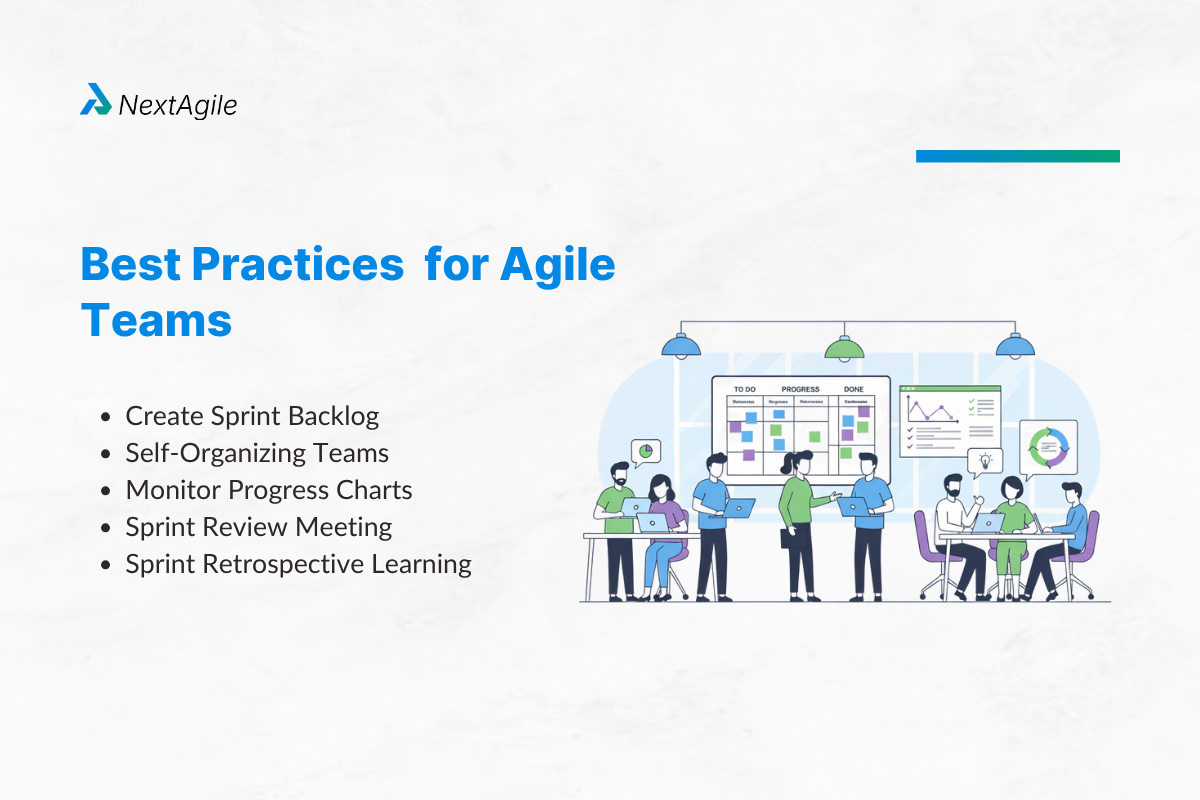
Here are the top 15 Agile Best Practices Guide for Building Highly Effective Teams. Create the sprint backlog during the planning meeting Encourage self-organizing teams Maintain charts to monitor progress Sprint reviews to present work Sprint retrospectives to learn from the previous sprint Release planning meeting to create a release plan Cross training Creating an ideal Agile workspace where the team enjoys working Setting a sustainable pace Estimating the projected velocity Always having the customer available Creating spike solutions to reduce risks Work together with the client Build projects around motivated people Transmit information in person Read the full Article to learn more in details
Current times demand organizations to quickly adapt to changes in the customer demands, technology, design patterns, competitive landscape & a plethora of other things in constant flux.
Agile ways of working have become very popular across industries because it promotes and encourages flexibility, collaboration and ways to respond to uncertainty. Today’s VUCA world just demands teams and organizations to plan, deliver and pivot quickly based on the feedback they get. Agile ways of working help teams plan just enough, collaborate and deliver, and inspect and adapt based on the feedback.
Indeed, there is a lot of content on the internet regarding agile, certifications specific to roles, frameworks specific certifications and of course our knowledge based on our learnings from our previous organizations. However, there is a lot of gap in the learning and practice, organizations seldom are able to leverage agile to impact their business objectives and it has become more of a cult and a series of practices, roles, ceremonies, which defeats the entire purpose of agile. The questions that organizations need to ask themselves are :
Are your teams agile just by implementing Scrum? You have integrated JIRA and your teams are agile? The answer is clearly a “NO”. These are agile methodology practices, frameworks, tools that help teams attain agility. With Scrum being the world’s most used agile framework, you could have a well defined 2 week sprint, all ceremonies religiously followed, reports and metrics diligently looked upon but if you are not delivering a potential project increment, if you rely on one person to tell what to do, If you need someone to closely manage you, your team is definitely not agile.
But what could ensure our teams are agile? What are some of the best practices in agile methodology? What best practices of agile methodology could we implement so that we are truly agile? How do we implement these agile practices? Let’s understand these questions in detail and try to answer them. This is the main agenda of this blog.
Top 15 Agile Best Practices Guide for Teams As mentioned earlier in the blog, agile is not a methodology, it’s a mindset with different approaches, frameworks and practices which are not very prescriptive. To know more about the difference between agile and scrum, please refer to our blog Agile Vs. Scrum
In this blog, we will discuss 15 best agile practices for agile teams which will help them in their pursuit of agility and make them more effective as teams.
1. Create the Sprint Backlog During the Planning Meeting In Scrum, a Sprint is a time-boxed iteration during which a specific set of work is completed. Sprints are typically short, ranging from one to four weeks in duration, with two weeks being a common choice. Every sprint starts with a planning meeting as a ceremony on Day 1. The intention of the sprint planning meeting is to plan our work/increment for the next 10 days or whatever the sprint duration is.
Product Owner is responsible to set expectations as to what is the goal of the sprint and work items prioritized. While the development team is responsible for committing to finish the work based on capacity. End goal of sprint planning is to create a sprint backlog. This serves as the list of work items to be finished within the sprint. But here are a few pointers to create effective sprint backlog
Have a SMART goal created by the PO and get a consensus Understand each stories in detail with acceptance criteria Break each story down into doable subtasks Estimate the stories appropriately and understand what is the priority of delivery Commit the stories and work items based on your capacity 2. Encourage Self-Organizing Teams Creating a work environment wh ere everyone in the team can take ownership of work, discuss constructively, take decisions collectively, continuously improving the process, is probably a very important aspect of adopting agile ways of working. Here are a few practices that could help create them:
Set clear roles and responsibilities for everyone in the team Do not impose everything on the team, empower the team members Decentralized decision making within the team Set goals and expectations with the team members Let the team celebrate the success and welcome failures 3. Maintain Charts to Monitor Progress Metrics and charts are a key part which enables teams to learn based on how they have performed. While the tendency is to achieve a target metric, teams should evolve on the thought process of monitoring metrics
Burndown charts to continuously monitor the work remaining and predicting the completion Velocity charts to monitor the planned vs actual in every sprint Release burndown chart to ensure the release is on track Agility health radar to track the progress and maturity of teams on agile practices Refer to our blog on key agile transformation metrics to understand more about metrics which in more detail.
4. Sprint Reviews to Present Work Agile is all about inspecting and adapting. Scrum is a lightweight framework which enables products to improve after every increment plus people and process to also improve. Sprint review is a ceremony which happens on the last day where the development team presents the work done in that particular sprint. This helps the stakeholders and the team to ensure if the product being built is right and it is built in the right way. Below are a few best practices in agile methodology for an effective sprint review:
Ensure we have all participants who can give us feedback Summarize the sprint goal and work items picked Showcase working software one by one Collect feedback from the participants and log it into your backlog Avoid just using PPTs in the review 5. Sprint Retrospectives to Learn from the Previous Sprint Sprint retrospections are the last ceremony in the sprint which happens on the last day. The whole intention of this ceremony is to understand how the team performed in the last sprint, what are the opportunities of improvements.
A very common antipattern is that teams avoid retros or take it lightly. Retrospections are crucial to talk about people and process part of improvements. Doing this every sprint not only is important but also promotes and gives a platform to the team members to improve process and people. Below are some of the best practices to do retros every sprint:
Choose a template for the retrospection Give some time to the participants and collect data from everyone Allow some time to the team members and ask them to vote for the highest priority items they want to solve in the next sprint For the top 5-6 points discuss the action items and identify the owner
6. Release Planning Meeting to Create a Release Plan Release planning starts with deriving the product backlog, identifying the epics , breaking the epics into user stories. And slicing the release as “NOW”, “NEXT” and “LATER”. Basically defining the features into milestones based on the customer priority.
Development teams use T shirt sizing and planning poker estimation to estimate the epics and user stories which is a relative way of estimation.
A milestone or release can span across months, e.g. a milestone can be of one month duration or even 3 months duration. And this level of plan is revisited / modified / updated every month or quarterly. This gives the team a direction and a common understanding between the stakeholders as to when what is going out.
7. Cross Training Cross functional teams is one of the main aspects to consider when you talk about forming agile teams. That means everyone in the team has all the skills necessary to convert a user story into a working software. Cross training is one of the key best agile methodology practices where team members learn and acquire new skills other than what they already are good at. At times, one or two people in the team who are skilled at one skillset tend to become a bottleneck. Below are a few pointers which cross training could enable:
Decreases dependency on one person becoming a bottleneck Provides more options and flexibility in planning Reduces waste in waiting time and gated approach Acts a catalyst in collaboration as it becomes easy to bring consensus 8. Creating an ideal Agile Workspace where the Team Enjoys Working Agile teams are built around motivated individuals. It is important to create an environment where development team members are working without any struggle and have all support and systems which could help them with ease of work and collaboration. As an Agile Scrum Consulting company, this is a very crucial success factor for us. Below points can ensure an ideal agile workspace.
Avoid cubicle and keep the space as open as possible to avoid silos mode of working Have enough board where teams can quickly collaborate over a problem or solution Keep your information systems always on. This will enable teams to constantly monitor the current status, and enables pull system Ensure you have space for open celebrations and recognitions Have focus areas like a room where team can feel comfortable without any distractions 9. Setting a Sustainable Pace Nature of agile projects is such that there is continuous input of backlog and there is continuous output of delivery. Often teams get burnout and is not a good sign for long term projects. Here are a few things to consider to maintain a pace which is consistent:
Do not set over ambitious goals for the team and monitor them Keep in mind the capacity of the team when you are planning Use best practices of agile methodology like WIP in each column to ensure smooth flow of work Do the homework before ceremonies like keeping the backlog ready and prioritized Move ahead of the team and keep all the roadblocks removed Ensure team has good work life balance Promote open communication about stress within the team 10. Estimating the Projected Velocity Agile planning is all about predicting what is the size of the backlog as of now and how many sprints we will take to complete it. Velocity is a measure of how many story points of work can be done in one sprint on an average. It is the average of velocity achieved in the last 3 sprints and it keeps changing during the course of execution.
There could be various reasons because of which velocity may change, some of them include, unplanned leaves, holiday season, reduction in team size etc. Hence it is recommended to keep an eye on future sprint’s projected velocity in order to predict if the project backlog can be finished in time or if there are any surprises.
11. Always Having the Customer Available Having customer involvement in Agile projects is highly beneficial as it ensures that the product being developed meets the needs and expectations of the end-users. If not for the sponsor from the customer side, there needs to be SPOC to represent the customer to ensure to:
Help teams make the right decisions Mitigate risks that could come up later Avoid miscommunications that could become a potential threat later Build trust between the client and the team Get quick feedback Deliver value to the customer’s goals 12. Creating Spike Solutions to Reduce Risks How do we handle uncertainty in agile projects? How do we handle POCs and RnDs in agile projects? Well the answer is by creating spikes. Spikes are those work items which are created to find answers for the questions. Well but the catch is spikes are created well before the work item/story is picked up in a sprint.
For example, if you are prioritizing to pick up a story for which you have to select one library out of 4-5 options in sprint N, you create a spike and pick it up in at least N-2 sprint. This ensures smooth delivery of sprint N deliverables and also makes decision making easy.
13. Work Together with the Client “Customer collaboration over contract negotiation” is one of the Agile manifesto point. Agile promotes keeping your customer close right from the start of the project rather than treating them as externals. Value delivery to the customers is the only measure of success. Collaborate with your customer on a daily basis if need be.
Plan your sprints based on customer priority, involve them in decision making, constantly showcase working software, collect feedback from them, respond to their change requests. These are a few best agile practices and principles to collaborate closely with your customers.
14. Build Projects Around Motivated People Nature of agile projects demands people who are motivated. There is continuous input of work and output of delivery. Unmotivated people can spread negativity within the team and hamper the delivery of the entire project. Here are a few pointers to help keep team members motivated:
Do not micro manage rather be a servant leader Give autonomy to the team members Create a fail safe environment Promote team level experimentation and innovation Celebrate achievements Have frequent one on one and help team members grow Provide a solid growth path for the team member’s career progression 15. Transmit Information in Person The first agile manifesto point is “Individual and interactions over process and tools”. Silos mode of working kills the whole purpose of agile teams.If there is a blocker or a dependency, just pinging on the chat window or writing a mail on it and waiting for the other person to respond or help does not solve the purpose.
Information radiators need to be set up and constantly reviewed to avoid any leakage and waste to ensure smooth delivery of the project.
Choose a trusted agile consulting firm for strategic guidance and transformative solutions. Empower your business with agility. Explore our offerings now.
A few great agile practices from not so popular agile frameworks Practices from other frameworks which could be leveraged
Pair Programming
Pair programming is a practice from extreme programming in which two developers work on a single piece of work at the same time in the same workstation collaboratively. The developer at the keyboard is called as Driver and the other developer who is focusing on overall direction is called as Navigator. Both the developers swap roles every few minutes.
Benefits:
Increased code quality Knowledge sharing Better transfer of skills Resilience to external prompts Adds another perspective of thought Mob Programming
Mob Programming is a practice where the entire agile team works as a team together on one task at the same time. Every Agile team member is given a role in mob programming, and one must ensure everyone has a role to play while they are brainstorming together to deliver. This extends the concept of Pair programming from two people together to entire Agile team continuously collaborating to deliver a single work item. We have at any point 1 Driver and rest of the team
members play the role of Navigators. Virtually, we should use collaboration tools such as MS Teams through collaboration events, workshops, working meetings, etc.
Benefits:
Simplicity on building so that it is easy to manage Questions can be answered immediately Multi-dimensional quality in the code Common understanding of the work Improved team building Rule out code conflicts and repeated code Scenarios to practice Pair and Mob programming
Teams can practice Pair and Mob Programming in the below scenarios for the above stated benefits.
when there is a gap in the skillset of individuals when there is a complex problem to solve, then it’s better to have more than one person involved
on-boarding new teammates exchanging perspectives and identify better ways of working Why Organizations should Implement Agile Best Practices?
With increased competition, time has become a critical factor in delivering a product. That is, if you delay in delivering a critical feature, your competitor has already taken a portion of your market. With evolving technology including AI and rapidly changing customer requirements, your delivery methods have to be flexible, iterative and incremental with a focus on quick delivery and quicker course correction. You cannot wait for a long period of time to get feedback from your customers. We can’t assume our consumers need a particular feature, we will need to validate them at every stage.
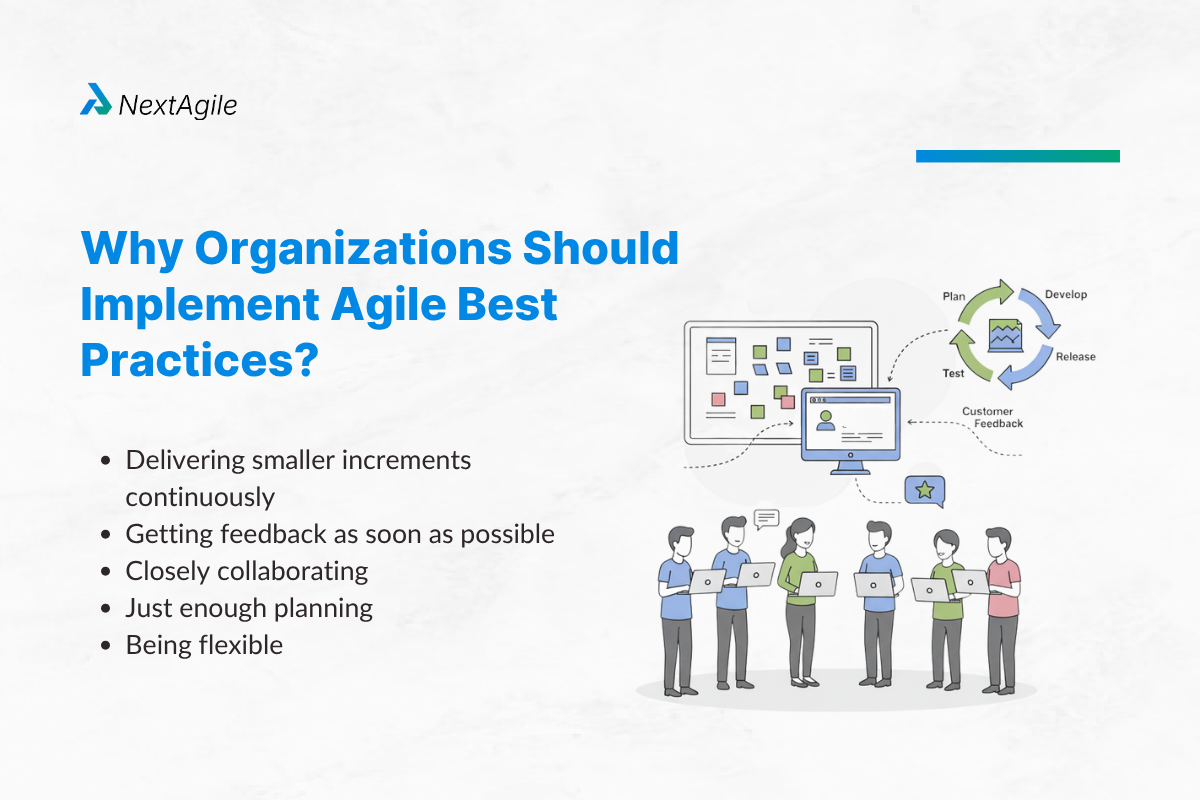
Agile emphasizes on :
Delivering smaller increments continuously against one big fat release Getting feedback as quickly as possible versus waiting till the end Closely collaborating against siloed mode of working Just enough planning against big upfront planning everything at the start Adequate documentation versus sign off culture Being flexible in working on changes required versus resisting it With this there is enough room to experiment, innovate and pivot as and when needed. And these are a few critical reasons as to why organizations should implement agile practices and principles.
How Consulting Companies are Helping Businesses to Adopt these Agile Best Practices. Consulting firms play an important role in helping companies adopt agile ways of working. For a detailed read, check our approach to agile enablement and transformation services . Consultants are subject matter experts and generally come with a lot of ground level experience and are unbiased in their implementation. Here are a few pointers on how consulting firms can help bring agile within teams:
As Is Assessment and Strategic Roadmapping – Agile consulting firms start their implementation journey with an assessment to understand the current team’s maturity and practices. Based on the assessment, they create a tailored customized roadmap to align with the problem statement or goals Framework Agnostic, Outcome Driven Transformation – Consultants are SMEs who have knowledge of various frameworks. They design and recommend framework implementation based on need rather than just applying one framework because of organizational norms. They cater to solving a problem with best suited framework with agility in mind versus adopting agile for the sake of it Education/Awareness and Education – Consulting firms provide training and programs to train teams and stakeholders with Agile principles , practices, and frameworks such as Scrum, Kanban, and Extreme Programming (XP). Training sessions may include workshops, seminars, and hands-on exercises to reinforce learning based on the need Coaching and Handholding – Agile consultants work closely with teams and leadership to guide them through the Agile transformation process. They provide ongoing support, feedback, and guidance on implementing Agile practices, resolving challenges, and adapting to change. Unbiased, Outside-In Perspective – Consultants are generally contract based and the contracts are usually outcome driven. Their experience having worked with multiple companies enables them to overcome challenges/resistance with a lot more ease and help organizations with insights with their experience. Metrics and Milestone Based Transformations – Consultants contracts are usually for a shooter duration and outcome driven. And usually there are intermediate milestones and KPIs based on the roadmap more like a checkpoint. This enables the transformation to be faster and more effective. Suggested Articles For You: Conclusion Adoption of Agile practices enables teams to deliver value more efficiently, adapt to change more effectively, and continuously improve their processes and outcomes. The 15 best Agile practices discussed above serve as foundational for creating effective, collaborative, and high-performing agile teams .
Promoting open communication, prioritizing customer feedback, and fostering a culture of continuous improvement are key elements of Agile success. Additionally, providing support, promoting transparency, and empowering team members to take ownership of their work contribute to the overall success of Agile teams.
By implementing these practices and iteratively improving them, teams can overcome complexity, respond to change, and deliver value to stakeholders. Ultimately, by embracing few of these best Agile practices and principles, teams can achieve their goals and help companies tackle today’s problem of a fast paced environment.
With this our blog on “15 best agile practices for effective teams” comes to an end and we believe it has given you adequate insights and was helpful. Please write to us at “consult@nextagile.ai ” for any feedback, suggestions or if you would like to talk to NextAgile consulting team for solving specific problems, check NextAgile agile enablement & transformation services.
FAQ Question About Agile Best Practices 1. What are the three C’s of Agile practice? 3C’s stands for Card, Conversation and Confirmation in agile methodology practices. This framework ensures effective collaboration and to get common consensus with respect to a requirement. Card is a physical representation of a user story generally written on a post-it in one liner, based on which teams need to have a conversation on the requirements, explore solutions and approaches, which helps teams to confirm the acceptance criteria and all things needed to deliver the user story.
2. What is an epic in agile? Epic is the biggest form of a requirement in the agile world. It is a collection of similar user stories which would generally take more than 3-4 sprints to finish. They are key steps in the customer journey. For example, in the customer journey of an amazon user, “User Onboarding” can be the first step and epic. OTP login, user name login, phone number login, email login, social media login etc all are user stories under that epic.
3. How do you scale in Agile? Scaling agile means implementing agile methodology practices and principle in more than one project or even beyond project teams like a program, portfolio or even at a business layer. There are several frameworks which can be used to scale your agile practices. Some of the mostly used ones are:
SAFe – Most widely used scaling framework . It is built on lean agile principles, which prescribes a structure based on what level of scaling you are looking for. It extends practices and principles starting from the team level till the business level.Spotify Model LESS – A simple SCRUM framework extended at a bigger product level. Teams are structured in the form of feature teams. FOcussing on simplicity and reducing unnecessary complexity and dependencies. 4. What is the first agile principle? “Individuals and interactions over processes and tools.”
5. What is the difference between Agile and scrum? Agile is a set of principles and values guiding better ways of working, while Scrum is a one of the Agile frameworks that provides a structured approach to managing projects. Scrum is one of many methodologies and widely popular framework that align with Agile principles and can be used within an Agile framework, but it’s not the only one. Read more in our blog – Agile Vs. Scrum
Sujith G. is an agile practitioner with expertise in setting up the agile environment by coaching and training teams, individuals and stakeholders in the area of lean agile software principles. He has overall 12+ years of exp out of which 9+ years have been in Agile and Scrum implementation and adoption. Sujith has coached 70+ teams on agile practices & implementation techniques and has extensive experience in setting up metrics, JIRA & Azure DevOps. Experienced in identifying gaps in the system, creating scrum awareness, piloting and scaling scrum.
 Skip to content