What Is Spotify Model In Agile? Key Elements, Structure & Benefits
Anuj Ojha
Talk to Expert for Free
Table of Contents
Key Takeaways from This Blog
The Spotify model is a culture-first Agile scaling model, not a rigid framework
Built on autonomy + alignment, enabling faster and more adaptive delivery
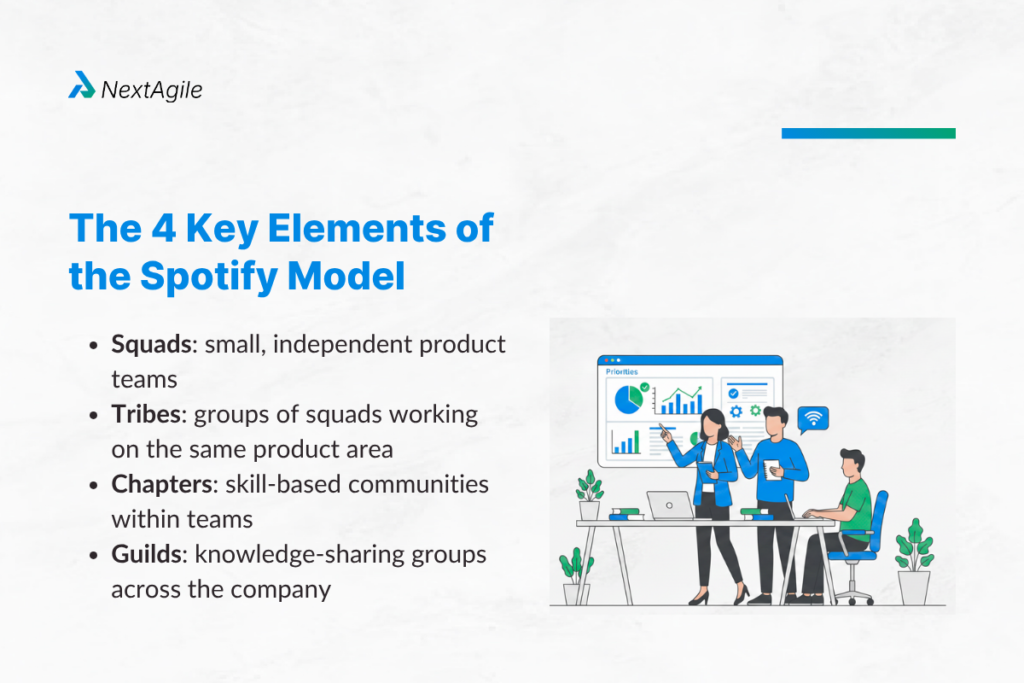
Core structure includes squads, tribes, chapters, and guilds
Works best for product-led, innovation-driven organizations
Struggles in highly regulated or low Agile maturity environments
Not directly used by Spotify anymore, but its principles still influence modern Agile scaling
Compared to SAFe, it offers flexibility over governance
Introduction
Scaling Agile across teams is where most organizations hit friction. As companies grow, coordination increases, dependencies multiply, and delivery slows down. Traditional frameworks often solve this with more structure but at the cost of speed and autonomy. This tension between alignment and autonomy sits at the center of most enterprise Agile scaling problems. As organizations grow, they naturally introduce governance layers, approval mechanisms, and coordination processes to maintain control. Over time, these mechanisms improve predictability but often reduce adaptability, slow decision-making, and increase dependency friction across teams.
The Spotify model offers a different path. Instead of enforcing process-heavy scaling, it focuses on designing an organization where teams can operate independently while staying aligned to business goals.
If you’re already exploring concepts like What is Business Agility, the Spotify model represents a shift toward adaptive, product-centric operating models, especially relevant in today’s AI-accelerated delivery landscape.
What is the Spotify Model? (Simple Explanation)
The Spotify model is often mistaken for a framework but in reality, it’s a culture-first operating system designed to scale autonomy without losing alignment. This distinction matters because frameworks typically define processes, events, and governance expectations. The Spotify model instead provides organizational design principles. Companies attempting to implement it as a rigid blueprint often struggle because the model was never intended to be copied mechanically.
It emerged as a response to a core problem: How do you scale Agile without slowing teams down?
Instead of prescribing ceremonies or roles, the model emphasizes:
Decentralized decision-making
Cross-functional Agile teams
Continuous improvement through culture
This makes it fundamentally different from frameworks like SAFe or Scrum; it provides principles and patterns, not rules. The model operates more like an adaptive organizational philosophy than a prescribed implementation method. Teams are encouraged to evolve structures based on context, product complexity, engineering maturity, and customer needs rather than adhering to fixed procedural standards.
Where Did the Spotify Model Come From?
The 2012 whitepaper by Henrik Kniberg & Anders Ivarsson
The model gained global attention through a 2012 whitepaper by Henrik Kniberg and Anders Ivarsson. It captured how Spotify structured teams to maintain speed, innovation, and alignment during rapid growth.
Importantly, it was never intended to be a standard, just a snapshot in time. This is one of the most misunderstood aspects of the Spotify model. Many organizations attempted to replicate the visible structure while ignoring the underlying conditions that enabled it, including strong engineering culture, leadership trust, technical excellence, and high organizational maturity.
Why Spotify needed a different Agile approach?
Spotify faced classic scaling challenges:
Increasing team size
Complex product architecture
Faster release expectations
Traditional Agile approaches introduced coordination overhead. Spotify needed a model that preserved startup-like speed at enterprise scale leading to its now-famous structure. The broader objective was not simply Agile scaling. It was organizational adaptability. This approach is optimized for rapid learning, decentralized experimentation, and fast customer feedback loops, capabilities that traditional enterprise operating models often struggle to sustain as scale increases.
 Skip to content