Key Highlights of Agile Maturity Assessment 1. Agile Maturity Assessment measures how well teams adopt Agile practices, identifies gaps, and provides a roadmap to improve performance, delivery speed, and customer value.
2. You Can’t Improve What You Don’t Measure Most teams think they’re “doing Agile” but without a structured assessment, they’re guessing. This article reveals exactly how to get an honest, data-backed picture of where your team truly stands.
3. A 5-Level Maturity Model That Maps Your Entire Journey From Pre-Crawl to Fly, discover a clear, visual framework that shows your team’s current state and lays out a concrete path to higher performance. No vague theory, just actionable levels.
4. Agile Maturity Isn’t Just for Tech Teams Whether you’re in finance, operations, or leadership, agility matters everywhere. The article breaks down how to run meaningful assessments for any team, at any level of the organization.
5. The 5 Pitfalls That Silently Kill Your Assessment Anonymous or not? One survey for all teams? Biased questions? The article exposes the most common mistakes practitioners make and exactly how to avoid them before they sabotage your results.
6. A Complete, Battle-Tested Assessment Template, Free Get a step-by-step template used with real client teams: survey design, stakeholder alignment, radar chart analysis, growth plan creation, and post-assessment follow-through, all in one place.
7. The Assessment Is Just the Beginning Most guides stop at “collect the data.” This article goes further, showing you how to turn findings into a co-created Growth Plan with clear owners, priorities, and a roadmap that actually gets implemented.
To measure is to know. If you can not measure it, you can not improve it. – Lord Kelvin
What is Agile Maturity Assessment? Agile maturity assessment refers to the state of agile adoption in the organization focused around agile principles, practices, organizational structure and culture. Also referred to as an Agility Assessment, it provides organizations with a structured way to evaluate their current agile health and identify opportunities for growth. Agile Maturity Assessment involves assessing an organization’s ability to respond to change, deliver value to customers and continuously improve. Agile maturity is not a one-time achievement, but a continuous journey of growth and improvement.
An Agile maturity assessment should be used to understand an organization’s current state of agile adoption and identify areas for improvement. It involves evaluating various aspects of Agile adoption, such as team collaboration, customer satisfaction and continuous delivery. Using an Agile maturity assessment
An Agile maturity matrix can be used to visualize an organization’s Agile maturity across various dimensions. Scrum maturity assessment models are also available, specifically tailored for Scrum teams.
Refer to the separate section below – A Sample Agile Maturity Assessment Template, for a detailed explanation on how to use the template
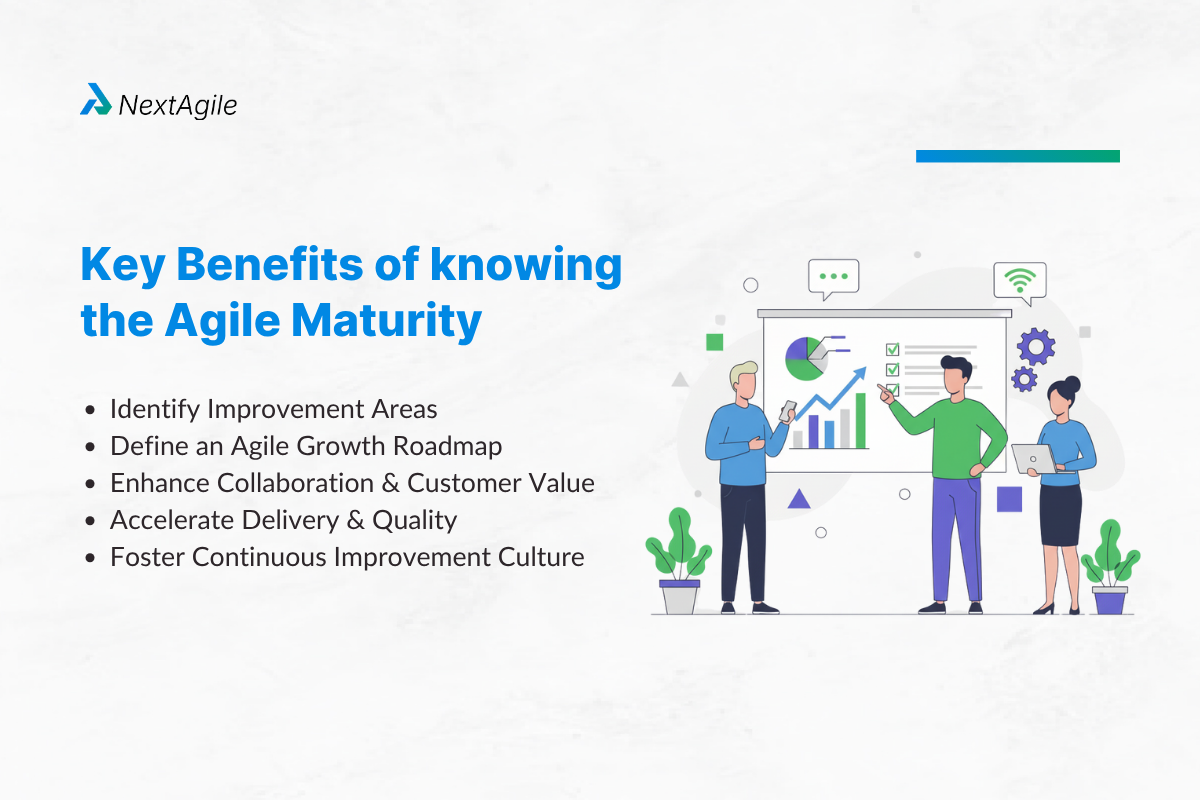
Key Benefits of knowing the Agile Maturity Assessment The key benefits of an agile maturity model are that it provides a common understanding of what it means to be “agile”, it helps organizations identify areas for improvement and it provides a roadmap for continuous improvement. By using an agile maturity model, organizations can assess their current level of agility and work towards becoming more agile, delivering better value to their customers, and improving overall business performance.
Below are the prominent benefits of knowing the agile maturity of teams, programs and organization:
Identify areas for improvement Develop and implement a roadmap for Agile adoption Enhance team collaboration and customer satisfaction Increase delivery speed and quality Foster a culture of continuous improvement Agile Maturity Assessment Levels Let’s understand more about the levels at which agile maturity can be assessed using agility health assessments, below are the four basic agile maturity levels at which we can check agile maturity :
Team level – Focus on individual team’s Agile practices and collaborationProgram level – Focus on multiple teams working together to deliver a programPortfolio level – Focus on strategic alignment and prioritization of multiple programsBusiness/Organization/Enterprise level – Focus on enterprise-wide Agile adoption and business agility There can be various facets to divide these levels contextually.
The Dimensions of Agile Maturity at Various Levels Inspired by CMMI framework, we could also map each of the above levels in 5 dimensions:
Levels Initial/Pre-Crawl Managed/ Crawl Defined/ Walk Quantitatively Managed/ Run Optimizing/ Fly Team Team members lack understanding of Agile principles Team follows basic Agile practices, but struggles with consistency Team has standardized Agile processes and clear roles Team measures and optimizes Agile processes Teams are autonomous, self-driven, goal oriented & continuously improving, innovating their Agile practices Program Programs lack clear goals and coordination Programs have basic coordination, but struggle with consistency Programs have standardized processes and clear goals Programs measure and optimize delivery Programs continuously improve and innovate delivery with close collaboration between all participating teams with shared goals Portfolio Portfolio lacks clear strategy and prioritization Portfolio has basic prioritization, but struggles with consistency Portfolio has standardized processes and clear strategy Portfolio measures and optimizes value delivery Portfolio continuously improves and innovates strategy orchestrating solutions from various programs and aligned with OKRs Enterprise Business lacks understanding of Agile principles Business has basic understanding, but struggles with adoption Business has standardized Agile processes and clear strategy Business measures and optimizes Agile adoption Businesses are experiencing continuous value realization, aligned to strategic themes and defining OKRs and KPIs to attain business growth
We could always align them in context to the organization’s goals.
Different Names but Same Intent Agile maturity levels provide a clear roadmap for organizations to progress and improve their Agile capabilities. Different agencies use it differently. They also name it differently :
The Agile capability maturity model Agile development maturity model (ADMM) Agility Health Assessment Agile Maturity Assessment and many more. We will use these names interchangeably in the blog.
What is Agile Maturity Assessment? An Agile Maturity Assessment is an evaluation process that helps organizations assess their current level of Agile adoption and maturity. It’s a comprehensive review of an organization’s Agile practices, processes and culture, aiming to identify strengths, weaknesses, opportunities, and threats.
Key Focus Areas of Agile Maturity Assessment Below are the standard key focus areas of Agility Health Assessment, though this may change as per the organizational context.
Team collaboration and communication Customer satisfaction and involvement Agile practices and ceremonies (e.g., Scrum, Kanban) Continuous integration and delivery Product focus & Quality Technical practices (e.g., coding standards, refactoring) Agile leadership and support Organizational culture and mindset Evaluate current delivery capability using our Agile maturity assessment tool .
Recommended Approach for Conducting Agile Maturity Assessment Surveys and questionnaires Interviews with team members, leaders, and stakeholders Observations of Agile practices and ceremonies Review of documents and artifacts (e.g., project plans, user stories) Elements of Agile Maturity Assessment What should an Agile Maturity Assessment report contain?
The Agility Maturity Assessment insights should help in understanding the As-Is and To-Be states which could be captured by presenting the following information –
Current Agile maturity level (e.g., Pre-Crawl, Crawl, Walk, Run, Fly) Strengths and weaknesses Agreements and Disagreements Opportunities for improvement Recommendations for advancing Agile maturity A roadmap for Agile adoption and maturity Key Components of Agile Maturity Assessment Agile Maturity Assessment is a comprehensive framework for assessing and identifying opportunities for growth and improvement. Following are the key focus areas that act as a component of measuring the maturity –
Practice Focus Evaluation of Agile ceremonies, events, and practices, such as Scrum, Kanban, Daily Stand-ups, Retrospectives, and Sprint Planning. Evaluation of technical practices, including coding standards, testing, refactoring, and continuous integration. Assessment of continuous improvement practices, such as retrospectives, feedback loops, and experimentation Culture & Mindset Focus Assessment of team dynamics, communication, and collaboration, including roles, responsibilities, and decision-making processes Evaluation of the organization’s culture, values, and mindset, including adaptability, transparency, and trust. Assessment of leadership support, sponsorship, and engagement with Agile teams, including alignment with organizational goals. Business Focus Evaluation of customer involvement, satisfaction, and feedback mechanisms, including customer-centricity and requirements gathering. Provision of a roadmap and recommendations for advancing Agile maturity, addressing gaps and areas for improvement. Metrics and Measurement Assessment of metrics and measurement practices, including velocity, cycle time, lead time, and customer satisfaction. Scaling Agile Evaluation of Agile scaling practices, including multi-team coordination, program-level planning, and organizational alignment. The intention of these components are to explore the entire landscape which impacts agility and the assessment helps us in knowing the current state. We use the data points against these components, analyze them and showcase the findings. It helps in deep diving the strengths, weaknesses, consensus, disagreements and many other facets which could help in finding insights to develop the growth plan.
Once gaps are identified, the next step is building a clear Agile transformation roadmap
Agile Maturity Assessment Models Alignment with organizational goals is a prominent consideration when selecting an Agile Maturity Assessment model. We also share the prima-facie template to target groups to understand the current ways of working that makes them feel that they are agile or doing agile. One insight that guides the practice section of the maturity model is their relevance to specific Agile frameworks (Scrum, Kanban, etc.).
Depending on the urgency of need and gravity of issues, we design the assessment, keeping in mind that it has ease of implementation. While designing assessment, we should seek clarity & agreement with key stakeholders on maturity levels and criteria which will map the state of agility within the target group.
The outcome of assessment should always be actionable recommendations for improvement and a buy-in from sponsors and also doers on their respective ownership. So, in our experience we have always in been contextual and mindful of above points and used following assessment models to assess agile maturity –
Agility Health Assessment for Scrum Teams (Scrum Maturity Assessment) Agility Health Assessment for Kanban Teams Technical Agility Health Assessment for Teams Agility at Scale Health Assessment for Portfolio – in general Business Agility Assessment for Leadership Team In organization using SAFe framework,
SAFe Business Agility Assessment SAFe Core Framework Assessment (SAFe Agile maturity Assessment)
Organizational Agility Lean Portfolio Management Enterprise Solution Delivery Agile Product Delivery Team and Technical Agility Continuous Learning Culture Lean-Agile Leadership Agile Maturity Assessment Metrics The Agility Maturity assessment has both subjective and objective parts. For objective statements, we conduct the following steps:
Curate the survey All objective statements are expected to score against the dimensions. Ex: Scale of 1 to 5 where, 1 is Not Happening & 5 is Exemplary. Collect the response We recommend doing it all together in a call or face to face meet-up. Just sending the link and waiting for people to respond at times call for follow-ups and no responses. Analyze the data If you are using the survey tools, then most of the time they also provide the analysis charts and insights. Otherwise, you can always export the data on excel or sheets. We could find the overall score of a target group ex: on scale of 1-5 as we used in above point We could use radar chart to identify the top scorers and bottom scorers in terms of survey statements or also focus areas Such metrics can also help in identifying the differences and commonalities between multiple teams Discuss the insights Finally, identify the growth plan for future improvements Benefits of Agile Maturity Assessment Bringing agility would help teams or organization to respond quickly to changing market conditions. This trait of not reacting to change but responding helps them in fostering a culture of innovation and continuous improvement. Customers appreciate that their requests are getting quickly resolved and they are provided with competitive offerings in today’s fast-paced environment. While faster delivery is key & at the same time we should focus on delivering high-quality products and services.
The purpose of an agile maturity assessment is to assess an organization’s level of maturity in their adoption and implementation of agile principles and practices. The assessment provides an objective and comprehensive view of an organization’s agility and helps identify areas for improvement.
By conducting an agile maturity assessment, organizations can:
Understand their current level of agility : The assessment provides a clear picture of an organization’s current level of maturity in their adoption and implementation of agile principles and practices.Identify areas for improvement : The assessment provides a detailed analysis of strengths and weaknesses in an organization’s approach to agility, and helps identify areas for improvement.Establish a roadmap for improvement : The results of the assessment can be used to create a roadmap for continuous improvement, helping the organization move towards greater agility and better business outcomes.Align teams and stakeholders : The assessment helps align teams and stakeholders around a common understanding of what it means to be agile, and provides a shared vision for how the organization can improve.Measure progress : The assessment provides a baseline for measuring progress and tracking improvements over time, helping the organization continuously improve their agility. The purpose of an agile maturity assessment is to provide organizations with a comprehensive view of their agility and to help them improve their ability to deliver value to customers and achieve better business outcomes.
How to Use an Agile Maturity Assessment Agile maturity assessment will help you in understanding the current state in frames of strengths, weaknesses, mindset, culture and many other aspects. Once the assessment is ready, we suggest the following –
Communicate findings and recommendations to stakeholders and also the participants of the assessment. Develop an improvement or growth plan for addressing gaps. You may co-create it with participants. Ensure that improvement items are prioritized and ownership is clearly identified. Start implementing recommended improvements. Regularly assess and adjust the improvement plan. How to Do an Agile Maturity Assessment? At NextAgile agile consulting services , we categorize Agile Health Assessment into 3 steps:
Pre-assessment Assessment Post-assessment Let’s understand them in detail –
1. Pre-assessment Intention behind this step is to collect all the information that is relevant to design and perform assessment. It includes knowing the business goals, key stakeholders, target group to access, the tools and technologies that they are using today etc.
2. Assessment To conduct assessment we have already identified the landscape to cover during the pre-assessment step. Now, is the time to perform the following :
Design the assessment Book appointments for both interviews and also conducting assessment Conduct assessment Analyze the collected data Collate findings Present insights Prepare growth or improvement plan Draft a improvement roadmap 3. Post-Assessment Post-assessment is intended to hand-hold the target group on an improvement plan and continuously measure the progress. Following could be the logical set of events that could happen post-assessment:
Start on Implementation Roadmap Prioritize recommendations by focusing on high-impact improvements. Define tasks, timelines, and resources. Designate teams or individuals responsible for each improvement. Identify Transformation Need & Drive it Provide guidance and support for teams. Offer workshops, training sessions, and mentoring. Implement changes to existing processes and practices. Set the momentum Monitor progress and identify new areas for improvement. Hold regular team retrospectives to reflect on experiences. Establish mechanisms for continuous feedback and adaptation. Plan for Scaling Roll out Agile practices to more teams and departments and conduct focused assessments for them Ensure Agile practices support organizational goals. Build COE by defining roles, responsibilities, and decision-making processes. Progress to next maturity level Continuously refine and adapt Agile practices. Throughout, look up for benefits realization by tracking and measuring the benefits of Agile adoption, also in terms of Return on Investment (ROI) and do not forget to celebrate success.
What does an Agility Health Assessment look like? Agile Maturity in Teams helps them in learning about questioning their experience against various frames of thoughts. These frames are categorized primarily in focus areas like Clarity of Requirements, Maturity of Practices, Measurement of Performance and few other contextual aspects.
As NextAgile agile transformation consulting , we conduct such agile team health assessments or agile team maturity assessment for various customer teams and as explained above we start with pre-assessment to learn about the teams to assess, their current practices, the way they have organized themselves in terms of people, process, product, technology and other aspects.
It helps us in curating contextual assessment. For one of the teams, we came up with below preparation for agile team maturity assessment:
Assessment Type: Self-assessment, Anonymous Format: Objective & Subjective An X number of statements Assessment against few focus areas:
One Team Mindset Product Focus Continuous Improvement Practices & Traits Measurement & Tracking People Dimension:
Strongly Disagree – Scored as 1 Disagree – Scored as 2 Neutral – Scored as 3 Agree – Scored as 4 Strongly Agree – Scored as 5 Single Team Radar Radar chart is one of the ways to showcase the scores of objective statements/questions that we have analyzed based on the inputs by the target group who has taken the survey used for assessment. The trendline (in Orange) shows that the strong focus areas are One Team Mindset, Enabler-Manager, Enabler-Tech Lead, whereas, the Enabler-Product Owner is a concern for the team and they need help with that.
Multi-team Radar plots the trends of agile team maturity assessment across multiple teams which helps in visualizing the common patterns across multiple teams in terms of agreements, disagreements, strengths, and weaknesses corresponding to focus areas.
A few sample Agile maturity assessment questions Here are some examples of questions that can be used in an Agile maturity assessment questionnaire:
How well defined are your Agile processes and methodologies? How consistently are Agile practices being applied across teams? How well is Agile being scaled across the enterprise? How are Agile metrics and KPIs being used to measure the effectiveness of your Agile implementation? How are continuous improvement and experimentation incorporated into your Agile approach? How is Agile being used as a strategic advantage to drive business value? How is the organization managing risk and uncertainty in an Agile environment? How is Agile being used to deliver value to customers? How is Agile being used to drive innovation and growth? How are stakeholders involved in the Agile process? These are just a few examples of the types of questions that can be used in an Agile maturity assessment questionnaire. The specific questions will depend on the organization’s unique situation and goals. The goal of the assessment is to identify areas for improvement and provide a roadmap for continuous improvement, so the questions should be tailored to the organization’s specific needs.
A sample Agile Maturity Assessment Template Below is a sample agile maturity assessment template for an agile maturity assessment we did for our client teams. Teams were using scrum framework.
Imagine, you are coaching a team for quite some time and now you want to know their agile maturity. Usually, we recommend quarterly rhythm to conduct such assessments. What do you need to have in place to conduct such an assessment? At a high level, below is a sample agile maturity assessment template :
An Agility Health Survey Blocking stakeholder calendar & Sharing expectations Collecting insights via a survey tool Collating insights Present findings and creating a growth plan with recommendations Let’s discuss these steps in more detail.
1. Agility Health survey – The first step is to design an agility health survey which is relevant to your teams and project environment. Below is a basic step wise process which has worked for us:
Identify the focus areas that you want to assess – Clarity of roles & events, Leadership support, continuous improvement, culture, adaptability – anything that in your environment you want to improve by implementing agile ways of working
Survey statements against each focus area – Think of 10-15 easy to understand yet insightful statements against each focus area. Statements should capture the essence of the focus area, check below examples for ‘Culture’ as a focus area.
We think as ONE team and not silos We understand that change even in later part of development is acceptable In our team, everybody pulls their work since we do not assign the work Ensure that you include open ended subjective questions for each focus area
Identify the scale of response that participants will give, for example :
Rating – 1 to 5 where 1 is Not happening & 5 is exceeding expectations Moods – Sad, Mad, Glad Visual imagination – Pre-crawl, Crawl, Walk, Run, Fly Anything that makes sense to you & it will be easier for participants.. Populate the survey tool. Conducting the assessment online is easier these days and there are tools which can help you with metric views on the data you have collected which will simplify the analysis.
Ensure that the survey pages are organized neatly. We prefer one page for one focus area & the statements it contains. Few tools we have used – Google forms , SurveyGizmo , SurveyMonkey LimeSurvey 2. Blocking stakeholder calendar & Sharing expectations –
It’s important to set the context and purpose of the assessment with all the stakeholders to get their buy-in and ensure the effectiveness of the entire process. You will need to do the following :
Book the appointments – Book two appointments with your target team:
First appointment, of 3 hours/team where you as a facilitator of assessment will conduct the assessment and collect the inputs from all the participants Second appointment, of 2 hours where you will present the findings of the assessment post-analysis and help the team in preparing the growth plan . Whom should you invite?
Entire scrum team – Product Owner, Development Team/Developers, Scrum Master Team’s reporting manager/s (selective participation) Client stakeholders/sponsors (selective participation) Representatives of supporting team (selective participation) Selective participation implies, these participants will be having a separate survey to fill which is focused to their role
Reconfirm participation . Ensure that all the participants MUST show up.
3. Collect the Insights via a Survey Tool Explain the focus areas & create comfort Ensure the participants understand the importance of the survey and their responses will be anonymous Share the links with Scrum Team members Share the separate focused links with other participant groups – client stakeholders, sponsors, reporting managers, supporting team members & others. Since they may get done sooner hence they may leave. Kickstart the assessment
Keep a timebox for each ‘Focus Area’ page. Nearly 5-15 min could be needed by participants to respond. Clarify doubts on statements – right understanding is paramount Continuity is key.. Incase taking breaks then pls don’t keep it more than 2 min otherwise it is tough to get the hold of participants Conclude,
Ensure all participants have submitted and tally the count of submissions with your survey dashboard Remind all to participate in the next appointment to look at the survey report and prepare growth plan 4. Collating Insights Almost all tools provide facility to download the responses in your preferred format We prefer to collate following information:
Strong points – choose top 5-8 Weak points – choose top 5-8 Top Agreements & Disagreements – choose top 5-8 Collate Subjective answers Use Radar chart to show the average scores against each focus area
Inform the top & lowest scoring focus area Ensure to reword or remove any profanity used 5. Present findings and create a growth plan with recommendations All who have participated in responding to assessments are expected to participate in this event also in its entirety First part, present
Present the findings that you have prepared The conversations will be triggered, let it flow Let it all sink in Request people to make notes of their key observations for the later part Second part, growth plan creation
Probe people about the key improvements that they want to bring it and use some tool to collect all such pointers Show them the improvements that they have shared and try to merge those which are similar. Let’s say we have consolidated them in a list called “GROWTH” Ask them all to vote 2 (or any count) against the items in the GROWTH list Now, identify the top voted items Shortlist the top 3-5 and add them to a list of GROWTH PLAN. It’s important to have each GROWTH PLAN item to be actionable hence request all the participants to suggest action points Also, remember to identify the OWNER against each action item who is responsible for getting it done Once done, reiterate the GROWTH PLAN list and get the consensus on understanding At conclusion of the event, thank everyone & later share the findings ‘deck’ with everyone Assessment is OVER but now the real action is to help the team in achieving the GROWTH PLAN.
It may sound like any other assessment but it has its own distinct features:
It’s not an audit but a self-assessment Anonymity of respondents is respected Your role is to just be a facilitator and the respondents are the main actors It’s progressive. Happens every quarter and you can compare the scores to analyze Build your own contextual assessment from the above agile maturity assessment template keeping in mind the factors we have discussed in this blog.
How Consulting Firms Can Help Your Organization Assess Agile Maturity NextAgile Consulting’s core focus is on designing and driving turnkey agile transformations for our clients. Our consultants are framework agnostic agile practitioners who have been part of agile transformations at different types of clients and understand the importance of business context and organizational construct while planning an agile transformation roadmap
Agility Health Assessment or Agile Maturity assessment is a very important initial step for us as we start our engagement with the client in the capacity of external agile experts. Knowing the As-Is and To-be state is very important while selecting the right agile maturity assessment model.
As an external consulting team, people in general are more open to us about the state of agile maturity and general bottlenecks. We establish our credentials as neutral observers who just want to understand the culture, process, metrics, team health as it is, with no judgements or immediate feedback. It is important for an organization to invest effort, cost, time and resources transparently to know where they are, what are things holding them back and what are things pushing them forward before they embark on a transformation journey.
A good agile consulting company should come with an open mind, have meaningful conversations with people across the spectrum, understand the cultural construct, team dynamics, organizational goals and delve deep to get the nuances right in an agile health assessment – the transformation roadmap will flow from there.
Conclusion There should be multiple considerations while designing and conducting agile maturity assessment and you should carefully analyze your organizational context, business goals, work culture, leadership, internal and external environment before selecting a particular approach. The guiding principle should be your long term business goals. Seek external support to bring in neutral, industry experts when necessary. Agile Maturity Assessment is not a one time activity and should follow a cadence.
At NextAgile Consulting, as an agile consulting firm , our key focus is on curating business context driven agile transformation journeys for our clients which are aligned with their core business goals. We will be glad to discuss and explore how we design, facilitate a meaningful, call to action focused agility health assessment for your teams and programs..
This brings our blog on “Agile Maturity Model and Assessment” to an end. We sincerely hope this was helpful. In case you need to talk to us or want us to share any feedback, please reach out to us at “consult@nextagile.ai ”
Frequently Asked Questions About Agile Maturity Assessment:- 1. How often should an Agile Maturity Assessment be conducted? We recommend a 2-3 months cycle is optimal for Team level Maturity. For program, portfolio & business levels, we recommend a 6 months cycle should suffice.
2. Can Agile Maturity Assessment be applied to non-technical teams? Yes, definitely. Agility is not confined to just the tech team as it is a trait which is required in all the segments. It’s just that technical teams experience more randomness and for that there are competencies that are available in the market and for non-technical it needs specialist experience to curate contextual assessment.
3. What common pitfalls should I avoid during an Agile Maturity Assessment? Some of common pitfalls of agile health assessment –
1. Please do not use the same assessment technique for every team hence thorough pre-assessment is required to understand the context
4. How do I ensure team buy-in for the Agile Maturity Assessment process? Team might get intimidated when they get to know that assessment is going to happen as they might think that they are going to get negatively impacted in their appraisal or promotion and they might end up rigging their response. So, it is important to position it rightly –
1. Assessment is not meant for any promotion, appraisal or competition to give the ‘Best or Worst team award’. It is just a way to find what is working and not working for the team and identify the opportunities of improvement through a growth plan.
5. What are the signs that indicate a successful Agile Maturity Assessment? 1. Results provides correct insights
6. What is an Agility Assessment and how does it relate to Agile Maturity Assessment? An Agility Assessment is an evaluation of how well an organization or team can respond to change, deliver value continuously, and improve over time. It is closely related to an Agile Maturity Assessment; in fact, both terms are often used interchangeably. While Agile Maturity Assessment maps your current state against defined maturity levels (Pre-Crawl to Fly), an Agility Assessment focuses on the real-time health and behaviors of your teams and organization. At NextAgile, our agility assessment covers practices, culture, mindset, metrics, and business outcomes, giving you a 360° view of your agile health.
Scale your agile practices effectively with our expert agile at scale consulting . We enhance enterprise agility, ensuring that your organization can navigate complexity and drive impactful results consistently.
Anuj Ojha is Co-Founder & Consulting Head at NextAgile. Anuj has designed & led multiple turnkey transformation journeys across industries, domains & geographies and has 16+ years of experience as an agile practitioner. He has worked with CXOs, CTOs & Key Leaders to translate their business objectives on the ground, contextualizing org transformations and creating buy-in across level, leading a team of coaches/consultants to implement agility across 150+ teams & trained more than 12k team members. Anuj’s core area of interest is business agility & working with leaders & teams to achieve long term sustainable, Agile culture & mindset.
 Skip to content