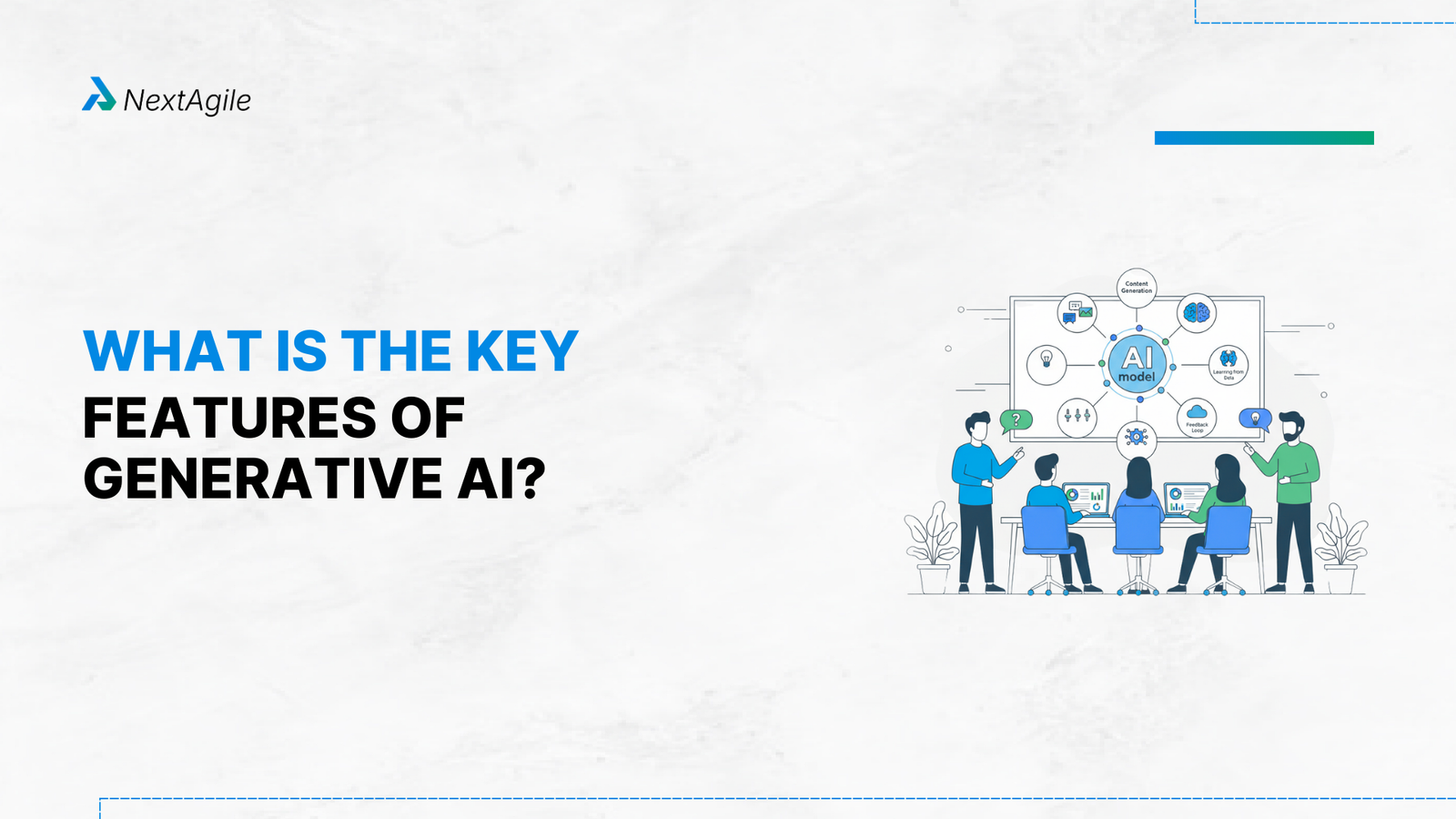
Introduction Generative AI has emerged as one of the most transformative technologies of the 21st century, revolutionizing industries such as healthcare, marketing, education, and software development. Unlike traditional AI systems that classify, predict, or retrieve existing information, generative AI has the ability to create entirely new content , whether in the form of text, images, videos, or even code.
But what is the key feature of generative AI that makes it stand out from conventional AI approaches? Among its many capabilities, one defining characteristic underpins its entire power: the ability to generate contextually relevant and novel outputs based on input prompts.
This blog will explore the key feature of generative AI , why it matters, the technologies enabling it, real-world examples, benefits, challenges, and best practices for leveraging this unique capability.
Explaining the Core Feature: Contextual and Novel Content Generation The key feature of generative AI is its contextual generation ability producing content that is not only new but also relevant to the user’s input and intent. Unlike simple rule-based or retrieval-based systems, generative AI models use deep learning and large-scale training to understand the context of prompts and generate coherent, meaningful responses.
Definition: Generative AI’s core feature lies in creating original content that aligns with context and user expectations rather than just selecting from a pre-existing database.Why Contextual Relevance Matters: Without context-awareness, outputs would be generic or incorrect. Contextual generation ensures accurate, personalized, and valuable results , which is essential for applications like chatbots, image generation, and content creation. This ability stems from advances in transformer architectures , attention mechanisms , and autoregressive models in AI , allowing systems to predict and generate sequences step by step with context preserved.
The Technology Behind It Generative AI’s defining feature is powered by sophisticated architectures and algorithms:
Autoregressive Modeling Explained Autoregressive models generate text or other data token by token , predicting the next element based on previous ones. This sequential prediction process ensures fluency and coherence in generated outputs. For example:
Input: “The future of AI is” Model prediction: “exciting and full of possibilities.” Role of Transformers and Attention Mechanisms Transformers introduced the attention mechanism , enabling models to focus on relevant parts of the input while generating new content. This feature allows long-range contextual understanding , making outputs more coherent and aligned with the prompt.
Latent-Space Understanding Generative models operate within a latent space , a compressed representation of knowledge learned during training. This helps the AI generate novel combinations of learned patterns, contributing to creativity in generative AI while maintaining contextual accuracy.
Illustrative Examples The generative AI ability to generate new, context-aware outputs is evident across multiple applications:
Chatbots (e.g., ChatGPT): Generates natural language responses in a conversational manner, demonstrating strong AI contextual understanding and natural language generation AI capabilities.Image Generators (e.g., DALL·E, Midjourney): Create original, visually appealing images based on descriptive text prompts.Code Assistants (e.g., GitHub Copilot): Generate functional programming scripts from natural language instructions, increasing developer efficiency. These examples highlight how foundation models’ key feature contextual and creative generation enables real-world innovation.
Why It’s the Standout Capability Why does contextual content generation set generative AI apart?
Beyond Predictive Tasks Traditional AI focuses on classification, prediction, and pattern recognition. Generative AI, however, creates original content such as text, images, and code, moving from analysis to generation.Contextual Understanding Unlike older models that rely on rigid rules, generative AI uses context from user inputs to produce coherent, relevant outputs, improving adaptability in real-time interactions.Creativity at Scale Generative AI introduces human-like creativity , generating novel solutions, designs, and ideas, something traditional AI cannot achieve without predefined logic.Dynamic Adaptation While traditional AI performs repetitive tasks based on training data, generative models adapt to changing prompts , making them ideal for conversational agents, content creation, and personalized experiences.From Recognition to Creation A conventional AI system might identify an image as a “dog,” but generative AI can create a unique, realistic image of a dog based on a text prompt, showing a leap in capability.Industry-Wide Impact This standout feature enables personalized marketing, automated design, coding assistance, and entertainment innovations , driving efficiency and innovation across sectors. Implications & Benefits The key feature generative AI offers brings significant advantages:
Personalization at Scale Generative AI enables businesses to deliver tailored experiences for users by understanding context and preferences. From personalized ads to curated content, it improves engagement and conversion rates.Scalable Creativity Unlike traditional AI, which follows set rules, generative AI produces creative outputs on demand from marketing copy to product designs allowing businesses to scale content creation without sacrificing originality.Diverse Applications Across Industries Industries such as healthcare, education, finance, and entertainment leverage generative AI for tasks like virtual tutoring, automated report generation, drug discovery, and immersive media creation.Improved Efficiency & Automation Generative AI reduces manual effort in writing, coding, and designing. This leads to faster turnaround times , cost savings, and operational efficiency across workflows.Enhanced User Experience With contextual understanding and natural language generation, generative AI creates conversational and intuitive interfaces , making digital interactions more human-like and satisfying.Innovation & Rapid Prototyping Businesses can prototype new ideas quickly , generate design variations, and test multiple creative concepts without high costs, accelerating product development cycles.Knowledge Expansion & Assistance Generative AI serves as a knowledge augmentation tool , assisting professionals in coding, legal research, or content creation with contextual accuracy and actionable insights.Built-in Security, Governance and Compliance Security, Governance and compliance features are essential part of any system. However, they are often patched to the system as an afterthought, rather than a part of design. GenAI, by having a built in context can have guardrails built so that Security, Governance and compliance requirements are notified or enforced as part of the lifecycle itself.
Potential Challenges Despite its strengths, the generative AI core feature introduces unique challenges:
Hallucinations and Inaccuracies Generative AI can produce incorrect or fabricated information , leading to misinformation risks in critical domains like healthcare or law.Context Drift and Prompt Sensitivity Outputs often depend heavily on prompt phrasing . Slight variations can change meaning, reducing reliability and consistency.Bias in Outputs Models trained on biased datasets may generate discriminatory or offensive content , raising ethical and legal concerns.Managing Output Quality Ensuring accuracy and relevance requires continuous monitoring , which can be resource-intensive for enterprises.Data Privacy Risks Generative models may unintentionally leak sensitive data from training sets, creating compliance challenges.Ethical and Regulatory Compliance Organizations must align outputs with AI governance frameworks to avoid reputational and legal consequences. Best Practices to Maximize the Key Feature To fully leverage generative AI’s ability to generate contextually accurate outputs , organizations should adopt these practices:
Effective Prompt Engineering Craft precise and well-structured prompts to ensure contextually relevant outputs . Use iterative refinement for better accuracy.Fine-Tuning for Domain Specificity Train models on industry-specific datasets to improve relevance and reduce generic or off-topic responses.Retrieval-Augmented Generation (RAG) Combine LLMs with external knowledge bases to enhance factual accuracy and minimize hallucinations.Human-in-the-Loop Validation Involve experts for review and approval of outputs , especially in regulated sectors like healthcare or finance.Continuous Monitoring & Evaluation Implement AI output quality checks and feedback loops to maintain accuracy and compliance over time.Diverse Training Data Use balanced, unbiased datasets to reduce harmful biases and improve inclusivity in responses.Output Guardrails & Filters Apply moderation layers for detecting offensive, harmful, or irrelevant content before deployment.Regular Model Updates Keep models up-to-date with latest data and security measures to maintain performance and reliability. Leading Tools & Platforms Several platforms demonstrate the foundation models’ key feature effectively:
ChatGPT (OpenAI) A leading conversational AI leveraging transformer architecture for natural language generation . Core feature: context-aware responses across multiple domains.Gemini (Google DeepMind) Advanced multimodal AI with deep contextual understanding , enabling integration of text, images, and code. Ideal for complex reasoning tasks .Claude (Anthropic) Designed with constitutional AI principles , Claude emphasizes safety and ethical alignment while delivering highly coherent outputs .Stable Diffusion A popular image generation model using latent diffusion techniques. Key feature: high-quality, customizable visual content creation from text prompts.DALL·E (OpenAI) Specializes in generating creative and realistic images from descriptive prompts. Core advantage: contextual and stylistic adaptability .GitHub Copilot AI-powered coding assistant built on OpenAI Codex. Feature highlight: real-time code generation and context-sensitive suggestions for developers. These tools illustrate the core feature of generative AI contextual and creative content generation across modalities . Each platform focuses on delivering personalization, efficiency, and adaptability for varied applications like chatbots, design, and coding assistance .These tools leverage transformer architecture features and autoregressive models in AI to deliver context-aware outputs.
Future Outlook The future of generative AI will push its core feature contextual generation further. As research evolves, expect generation accuracy in AI to improve, making contextual generation even more powerful and reliable.
Generative AI is moving beyond single-modality outputs toward multimodal capabilities , enabling models to understand and generate text, images, audio, and video This evolution will power next-generation applications like AI-driven creative suites , immersive virtual environments , and intelligent personal assistants capable of cross-format reasoning. A key focus will be grounding AI outputs in real-world facts to minimize hallucinations and misinformation. Integration with retrieval-augmented generation (RAG) and knowledge bases will improve reliability, making generative systems more trustworthy for critical sectors such as healthcare, law, and finance. Explainable generation is another major priority. Future models will incorporate interpretability tools that allow developers and enterprises to understand why a specific output was generated , addressing the black-box problem and improving compliance with global AI governance frameworks .We will also see specialized foundation models trained for domain-specific use cases , enhancing precision and reducing risks of bias and contextual drift . Combined with human-in-the-loop mechanisms and robust output moderation frameworks , these advancements will ensure safe, creative, and scalable AI adoption . Ultimately, the future of generative AI lies in responsible innovation , blending creativity with control , and building systems that are transparent, explainable, and aligned with human values .
Conclusion The key feature of generative AI is its ability to generate contextually relevant and original content, a capability that sets it apart from all previous AI paradigms. This feature powers everything from conversational assistants to creative design tools, offering personalization, scalability, and enhanced user engagement.
However, challenges like hallucinations, bias, and output quality remain, underscoring the need for responsible AI practices . To maximize value, businesses and developers must embrace prompt optimization, monitoring, and human-in-the-loop strategies while staying informed about emerging tools and standards.
Generative AI is redefining what machines can create. By harnessing its core feature responsibly, we can unlock endless innovation while ensuring trust, accuracy, and ethical use.
Is your organization looking to integrate AI into your development and operational processes? Start with an AI readiness assessment first and see what the gap is between the As-Is and the desired To-be state. Reach out to NextAgile AI Consulting group for an in-depth contextual discussion with our AI experts. You can write to us consult@nextagile.ai or leave a message on our website. You can also explore NextAgile AI Training enablement programs for your teams and leadership for ramping up your Gen AI capabilities.
FAQs 1. What exactly is the key feature of generative AI? The key feature of generative AI is its ability to generate new, contextually relevant content including text, images, code, and more rather than just predicting or classifying existing data.
2.How does contextual generation differ from simple pattern matching? Contextual generation uses deep learning to understand user intent and relationships in data , allowing coherent and relevant responses, unlike simple pattern matching, which relies on predefined templates.
3. Can generative AI create misinformation? Yes. Without proper safeguards, it may produce AI-generated misinformation or biased outputs. This is why AI content moderation and output control frameworks are essential.
4.What is autoregressive modeling? Autoregressive models generate sequences token by token , predicting the next element based on the previous ones, ensuring fluency and coherence in outputs.
5. How can I enhance contextual quality in outputs? Use clear prompts, fine-tuning, retrieval-augmented generation (RAG) , and human validation to improve the contextual accuracy and reliability of AI outputs.
Alok Dimri is the co-founder and leads the overall business at NextAgile, where he is responsible for strategy, client and consultant partnerships, and a whole lot of other core business activities like solutioning, branding, and customer engagement.
Over the past 16 years, he has worked extensively in business strategy, new business development, and key account management initiatives across process consulting and training domains.
 Skip to content