“Begin with the end in mind.” – Stephen Covey
In the often-murky waters of software project management, having a clear “end” is half the battle, so we can not agree totally with Mr. Covey here. We’ve all been there, haven’t we? Staring at project plans that resemble an enigma wrapped in a riddle, a veritable labyrinth of jargon, wondering if anyone truly understands what’s going on. Buzzwords like “Agile” and “OKRs” get thrown about, but what do they actually mean ? And, crucially, how do we transform these abstract concepts into practical tools that help us deliver tangible results? Let’s try to explore in future headings.
Introduction To OKR in Agile We live in a world of perpetual flux where we do-not know how we will start our day, with what surprise it may end with and absolutely no idea on what it could bring tomorrow.. In today’s world, projects pivot, priorities shift, and it feels like we’re constantly playing catch-up. That’s where the synergy of Agile and OKRs comes in. They’re not just trendy terms; OKR is a framework & agile is a mindset designed to navigate uncertainty and deliver tangible outcomes.
What Are OKRs? Let’s begin with OKRs (Objectives and Key Results). Think of them as your project’s reliable compass who will guide us towards the right direction and we will navigate to stay on the route.
An Objective is a grand, inspiring goal. You clearly identify ‘What do you intend to achieve?’. It should be ambitious, qualitative, and easily digestible. Consider, “Launch a mobile app that delights our users with its intuitive design.”
Key Results: These are the measurable milestones you’ll hit to reach your Objective. They should be SMART: Specific, Measurable, Achievable, Relevant, and Time-bound. For our app example, a Key Result might be, “Achieve a 4.2 star rating on the app store within 4 months.”
The beauty of OKRs lies in their simplicity. They provide a clear focal point and enable you to track your progress. They’re not about heavy-handed control; they’re about empowering teams to own their objectives.
What Are OKR in Agile? Understanding its Role Let’s say you want to attend a wedding. Let’s explore 3 facets to it:
Why do you want to attend? -> to be with the couple in their special moment and share the joy. What are the initiatives you want to take? -> Within guardrails of budget & convenience, we could identify objectives that are logistics centric (stay, travel, gift), wedding event centric (attendance, taking pictures, videos etc) What might affect these initiatives? -> Making the booking within the guardrails, clearing the appointments, discounts related issues on certain cards or portals while making the booking, planning to achieve other tasks near the vicinity of the wedding location etc. In the example above, we could face certain changes which might fail a fixed plan and cost budget over-run or disappointment to you and your host but with the help of an agile mindset you could still achieve your objectives. Also, if we do not have objectives that are guiding us then we are just randomly moving somewhere which might be driven by biases and not by purpose.
I believe agile is pretty much misunderstood today. Some see it as a set of practices to deploy and others think that it adheres to a certain framework which will bring agility and for few it is a way of life to continuously move towards the right direction. OKR helps in finding the right direction whereas agile ways of working helps in moving continuously. With both of them together, we could help our product to stay relevant. Isn’t that what it’s all about?
Where OKR is about setting the goal, agility is all about flexibility and iterations. It’s about just enough planning and focusing on identifying and delivering meaningful increments through manageable sprints and adapting as you progress by seeking feedback from your stakeholders continuously on the small working increments. This way we keep on responding to change by adapting those which keep us moving forward to goal achievement.
OKRs provide the strategic direction. They answer the “why” behind the “what.” They ensure that each sprint and iteration aligns with the overarching goals.
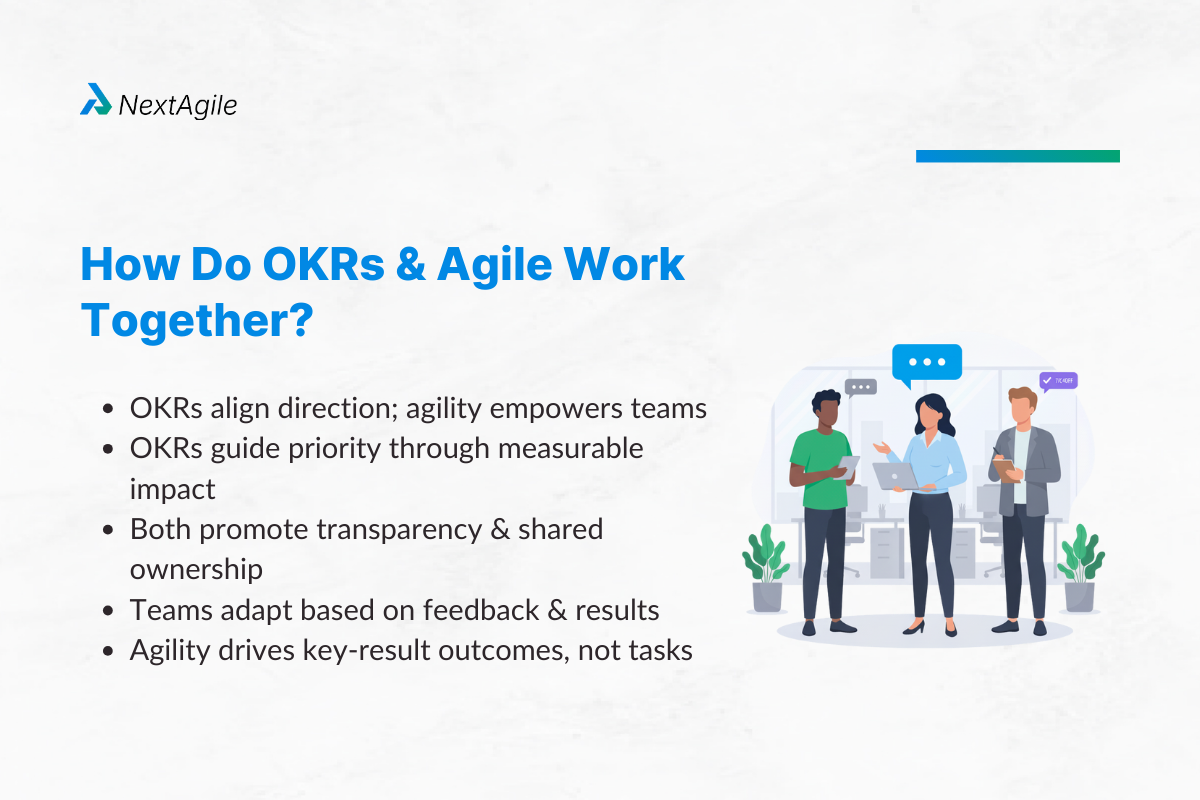
How Do OKRs and Agile Work Together? OKRs help us in aligning with business goals and agile ways of doing things gives us flexibility to choose initiatives to fulfil those goals. Let’s explore how could they work together:
OKRs approach ensures everyone is rowing in the same direction and in alignment to it, agile ways of working provides autonomy to each team to innovate, maintain, create or address changes of their respective contributions to the common shared goals set using OKR. OKRs guides prioritisation by communicating measurable business impact through key results and by bringing agility, teams could create out-of-the-box customer focused & business viable solutions in order of priority Both promotes transparency and collective ownership Promotes teams to adjust their approach based on feedback and results The agility will help in finishing initiatives that will lead to fulfilment of the key results impacting the business KPIs and not just finishing the tasks Best Practices for Implementing OKRs in Agile Teams: I haven’t found it tough implementing OKR in Agile teams since they are already used to setting up the sprint goals & adhering to acceptance criteria of user stories for doing the right things, and following the Definition of Done to do the things right. Agile teams already have the one team mindset and believe in a fail-faster approach which helps them in pivoting as much required to stay focused on goals to achieve.
Involve the entire team in setting OKRs for the overall product will help them in understanding the benefits to business and connection of them to sprint goals The way agile teams review their incremental outcome, likewise they should also review the OKRs regularly, track progress, and make adjustments as needed. The Key Results in OKR should measure the impact of your work, not just the volume of work completed and it should be measured through the KPIs set. Don’t overcomplicate your OKRs by making long and vague objectives and adding too many key results. Keep it concise and clear. Recognise and celebrate when you achieve your OKRs. In terms of lag, identify the root cause and keep improving. Untangling Agile, OKRs, and Scrum: Key Differences Explained It’s easy to confuse these terms. Let’s clarify:
Agile, A philosophy and set of values and principles that will enable you to embrace changes and staying relevant
Scrum, A specific framework that promotes iterative and incremental approach and uses practices like specific roles, sprints, daily stand-ups, and other ceremonies
OKRs, A goal-setting system that helps us in finding the right directions and what results should be achieved to reach there.
So, OKRs guide our efforts towards common shared goals, agile is a mindset and one of the approaches to pursue agility is Scrum.
How Agile Team Structures Evolve Through Experimentation and Adaptation? Agile teams embrace the dynamism of the work environment and at times trigger it themselves so that they could continually evolve based on what they learn to experiment, try new things, gather feedback, and refine their approach.
This evolution is not haphazard. OKRs help guide the changes, ensuring they align with the overall objectives. And by looking at the changes in the KPIs we track the fulfilment of the key results.
When the team commits to certain objectives, it’s primarily based on historical trends and by baselining the achievements for a certain period of time. This helps in setting up the milestones in terms of OKRs and then implementing solutions to track progress on OKR cadence. The iterative nature of agile can help us in seeing the results to fulfil the overarching objectives. The maturity to commit to OKRs and fulfilling them is highly dependent on empiricism that team experiences during their course of development.
Benefits of Using OKRs in Agile: A Comprehensive Overview
Everyone knows what they’re working towards and all the activities or initiatives are connected to OKRs that are published for various levels like Organizational, Portfolio, Program or Project team level. Hence, there is a complete alignment. In organizations that embrace agility, the OKR act as guardrails and help in staying innovative and at the same time, purposeful.
The progress is visible to all. There are fixed cadences to review & update OKRs which are further published and accessible to everyone. In agile environment, there is a strong emphasis on openness, collaboration and open communication.
OKRs removes confusion among teams about the existence of certain behaviors within the system and the need for certain critical enhancements or tech debt removal. As they then know that while they are trying to contain or solve the issues in hand, with the help of OKRs they also need to be objective-driven or future ready.
OKR in agile environments bring in a sense of accomplishment among team members which they otherwise would feel uninformed due to the multitude of structures within the organization.
Integrating OKRs with Agile Methodologies: Step-by-Step Guide Let’s get down to the nitty-gritty. Here is a step-by-step guide to integrating OKRs with your Agile methodology and just a reminder to all readers that based on your context, there could be slightly different approaches that we may choose:
Start by defining your ‘objectives’ for the quarter or year in partnership with the key stakeholders Define the specific, measurable steps you’ll take to reach the objectives by breaking down objectives into ‘Key Results’ Use OKRs to guide your sprint planning and prioritisation, basically, start the event by looking at OKRs first & reviewing their progress and make it a basis to set your sprint goals with a sole purpose to fulfil those milestones Review your OKRs during daily stand-ups and sprint reviews for tracking progress Don’t be afraid to pivot & talk about failures, or change in your approach to achieve OKRs if things aren’t working Measure by impact and not by some metrics which satisfied the fake sense of satisfaction that we as a team working, in actuality we are not producing outcomes but just outputs Be proactive in identifying the objectives for next quarter before the end of the ongoing quarter and conduct retrospective to understand actionable changes An OKR is NOT a basis for individual appraisal so be careful or its purpose will get diluted How to Measure Performance Effectively in Agile Performance measurement should always be outcome driven and not output driven when we talk about ‘value’ delivery. If we measure outputs, then we are primarily measuring individualistic or a targeted performance. For an example, in a factory that is making tomato sauce, the speed at which the sauce is getting bottled could be increased but that may affect the next step of capping the bottles and may end up in unacceptable results of loose caps for all the sauce bottles, hence the entire batch could go waste due to spillage.
With the help of OKRs, we focus on producing outcomes, which in our example’s context, is more related to timely delivery of customer orders with satisfactory NPS.
In certain use-cases, the intention is to increase operational efficiency by reducing lead and cycle time and in scenarios like effective inventory management, we could measure it by the shelf-life of a product. The agile teams also use velocity to predict the time it will take to finish a certain size of work. Quality metrics are kind of the same where we want effective DRE, zero show-stoppers, quicker time to resolve the issues. In software teams, they use DORA metrics to track the engineering excellence.
OKR Examples for Agile Teams: Practical Applications Let’s look at some real-world agile okr examples for agile teams to put what we have learned into practice.
For a software development team who has built an application has received complaints on its performance that resulted in poor user engagement. Let’s try to help this team by writing OKR for them: Objective A: Improve the user engagement by revamping the app’s performance. Key Result:
Reduce app loading time to 0.05 seconds Reduce the time taken to address the customer complaints by 25% Add more features in ‘free-mode’ to retain 50% of lost users For a business to expand their market to new geographies, they want their development team to add internationalization support and adherence to the local norms in terms of compliance and security. This will also help in increasing the annual revenue. Objective B: Successfully Launch Product in Target International Markets Key Results
Complete core product internationalization (i18n) support, including language and regional formatting, by July 2025 Achieve successful deployment of localized product versions in at least one target country by Aug 2025. Roll-out to remaining target countries by Oct 2025 Secure and maintain all required compliance certifications (e.g., GDPR, local data privacy laws) for target markets by June 2025 Implement and pass security audits for data handling and storage in target regions, with zero critical vulnerabilities found Top Tools and Resources for Implementing OKR in Agile Since the OKRs have become popular in the market, lot of ALMs have started incorporating OKR features and the one that we have used are:
JIRA Lattice Kendis BusinessMap How NextAgile Consulting Can Help You Implement OKRs in Your Agile Team At NextAgile OKR implementation services , we have hands-on practitioners who have experience in investigating the problem to solve, framing the problem that leads to common agreement, helping organizations in framing those into motivational objectives that aligns the doers and give them a sense of purpose and at the same time help them to drive key results that could be challenging but feasible in partnership with internal champions.
Identifying OKRs is not a one time activity, same as continuously tracking its progress. While we build in the fabric of continuous improvement by not punishing failures albeit seeing it as opportunities to grow, likewise, we do not want organizations to get complacent by achieving few OKRs and think that it will be the end of their problems.
We work in setting up cadences and with our deep expertise in agile ways of working and bring measurable results, we also help organizations in fulfilling their OKRs. Our agile experts work with respective teams and help in resolving bottlenecks to assure key result fulfillment and use OKRs for agile transformation journeys at our clients.
Conclusion OKRs are not just the tools for senior management to translate their strategy but also an essential tool for the teams who are working on ground, building solutions and hustling continuously with challenges. Such teams, who are already having prowess in agile practices , could seek right direction by knowing and understanding OKRs for organization and creating meaningful OKRs for themselves so as to stay connected to the overall goals. Both OKRs and agile work in harmony and it should be curated for the specific needs of an organization and within its various departments and teams.
With this our blog on “OKRs in agile : Best Practices and Strategies” comes to an end and we sincerely hope it helps with necessary content for our readers. Please write to consult@nextagile.ai for any suggestions or feedback or in case you are looking for OKR implementation services .
Frequently Asked Questions About OKR Agile 1. What Are OKRs in Scrum? In Scrum, the OKRs could be used as reference for deciding the goals of the sprint, identifying the priority of work in backlog refinement and also in sprint review event for evaluating the working software’s capabilities in terms of outcome required for fulfilling the objectives.
2.What Is an OKR in Jira? In JIRA (an Atlassian tool of project management), OKRs could be set for teams or group of teams and we could connect the respective issue types like initiatives, epics, stories, tasks etc. to the corresponding OKRs and track the progress at run-time.
3. What Is Scaled Agile OKR? In SAFe (or scaled agile framework), OKRs are used to define the strategic themes by the Lean Portfolio Management team, who further on evaluate the Epics proposed by Epic owners and do budgeting and planning in context with objectives fulfilment. These OKRs could be fulfilled by one or multiple value streams and likewise multiple ARTs.
4. Can OKRs Be Applied to Non-Software Agile Teams? Definitely. They could be applied anywhere. There are already a lot of examples that we could find for marketing, HR, procurement, sales and other teams. Also, for organizations that are in manufacturing, healthcare and other non-software segments.
5. How Can OKRs Be Adapted for Remote or Distributed Agile Teams? OKRs are not affected by how the agile team is grouped. It is primarily focused towards outcomes that should fulfil the key results of the objectives. So, a distributed team could help align themselves with OKR and seek benefits.
6. How Can OKRs Improve Communication and Transparency in Agile Projects? OKRs are a mutual agreement between the team and their stakeholders. They are negotiated and not imposed, also the tracking is continuous and everyone supports each other in fulfilling them, and doesn’t promote a culture of blame-game or mud-slinging. This already makes it explicit that OKRs improve communication, bring transparency and expects collaboration in project teams.
Anuj Ojha is Co-Founder & Consulting Head at NextAgile. Anuj has designed & led multiple turnkey transformation journeys across industries, domains & geographies and has 16+ years of experience as an agile practitioner. He has worked with CXOs, CTOs & Key Leaders to translate their business objectives on the ground, contextualizing org transformations and creating buy-in across level, leading a team of coaches/consultants to implement agility across 150+ teams & trained more than 12k team members. Anuj’s core area of interest is business agility & working with leaders & teams to achieve long term sustainable, Agile culture & mindset.
 Skip to content