Building a Culture of Psychological Safety: A Practical Guide (2026)
Anuj Ojha
Talk to Expert for Free
Table of Contents
Introduction
Why do some teams thrive under pressure while others crumble at the first sign of change? The secret often lies in an organizational culture driven by psychological safety, the belief that one can speak up, share ideas and take risks without fear of embarrassment or retribution. Building a culture of psychological safety is the invisible engine behind organizational courage and innovation.
But establishing this culture isn’t an accident. It takes deliberate effort on the part of leadership, HR, and teams.From creating open communication to reworking processes that enable openness, every rung in the organization has a stake.
In this guide, we’ll explore why psychological safety matters, break down its core elements, provide a step-by-step framework for implementation, and share actionable strategies for modern workplaces from hybrid teams to fast-paced, high-pressure environments. By the end, you’ll have a clear roadmap for embedding psychological safety into your organizational DNA.
Safe cultures accelerate learning while unsafe cultures institutionalize hesitation.
Understanding the Psychology Behind Building a Culture of Psychological Safety
Psychological safety, at its essence, speaks to fundamental human needs: belonging, respect, and the ability to contribute. When employees can safely express opinions, own up to errors, or question assumptions, engagement and creativity thrive. When fear is in charge, teams silence each other, and organizational learning grinds to a halt.
The term became recognized thanks to Harvard professor Amy Edmondson, who described psychological safety as a “shared belief that a team is safe for interpersonal risk-taking.” That is, it’s the shared trust that voicing something won’t result in humiliation or punishment. This shared belief determines whether ideas surface or stay buried.
Psychological safety thrives on trust, empathy, and inclusive communication. Leaders play a pivotal role: their behavior signals what is acceptable.
Leadership – A manager who dismisses questions or punishes mistakes inadvertently creates a culture of fear. Conversely, leaders who actively solicit input, acknowledge errors, and celebrate learning foster environments where creativity and collaboration can flourish. Leadership reactions become emotional signals that teams quickly internalize.
Team dynamics – Not only are high-performing teams talented, but they are also interpersonally safe, i.e., members feel safe challenging assumptions, offering new ideas, and admitting ignorance. In psychologically safe cultures, disagreement is no longer stress-inducing but is instead a productive conversation. High performance without safety leads to burnout; safety sustains performance.
Context – It’s also worth noting that psychological safety is environment-specific. Teams with multiple backgrounds, distributed configurations, or cross-cultural teams present specific challenges. Having an understanding of the psychology involved is the precursor to developing interventions that actually succeed across settings. Context matters. Safety must be intentionally designed for each team environment.
In this day and age of remote work, agile teams, and technological upheaval, psychological safety is no longer a nice-to-have; it’s a business necessity. When teams are safe, they contribute more freely, innovate more quickly, and overcome obstacles with resilience. Time and time again, research demonstrates that organizations that make psychological safety a priority experience greater engagement, lower turnover, and improved overall performance.
Silence in teams is rarely neutrality, it is often fear disguised as compliance.
Core Elements of Building a Culture of Psychological Safety
Psychological safety isn’t one policy or a workshop, it’s a multi-dimensional culture. High-performing organizations continually infuse several key elements:
Leadership Modeling: Leaders establish the tone. Self-disclosing errors, questioning, and vulnerability embolden others to follow suit.
Open Communication: Candid, two-way communication builds trust. Employees require forums for idea sharing, feedback, and concerns without fear.
Inclusive Practices: Psychological safety flourishes in diverse teams when every voice is heard. Policies and processes must actively invite contribution from everyone, not only the loudest voices.
Learning-Oriented Mindset: Mistakes are to be learned from, not penalized. Teams that learn from failures as lessons build continuous improvement.
Structured Support Systems: Mechanisms like feedback loops, mentorship programs, and safe spaces for dialogue enforce safety norms.
These components are interrelated. Leadership behavior impacts team norms, which in turn impact individual openness to voice. Organizations that incorporate these values across the board experience increased engagement, innovation, and retention. Psychological safety is cumulative; every leadership interaction either builds or erodes it.
It is important to note that psychological safety does not equate to comfort. It supports challenge, debate, and healthy conflict but within a context of trust. Teams learn more quickly, adapt more successfully, and react more imaginatively to change when safety exists. Safety encourages candor, not complacency.
Incorporating these foundational elements depends on strategic planning as well as day-to-day practice. Leaders and HR specialists need to track team climate, demonstrate preferred actions, and support norms by means of recognition, coaching, and system support.
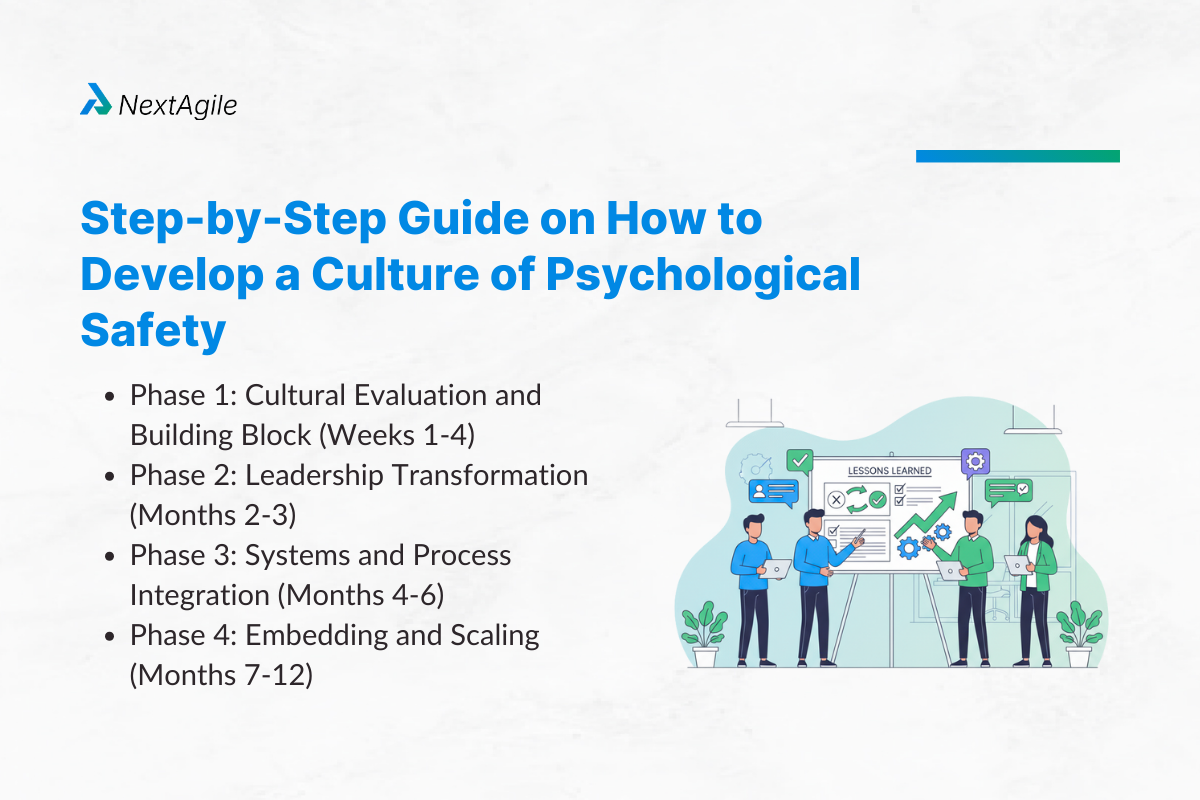
Step-by-Step Guide on How to Develop a Culture of Psychological Safety
 Skip to content