Skip to content
Introduction
Markets don’t wait anymore. Customer expectations shift overnight. Technology evolves faster than most annual plans can keep up with. And suddenly, organizations realize that “doing Agile” isn’t enough.
That’s where Business Agility comes in – Business agility isn’t about running more sprints or launching another transformation program. It’s about how quickly and confidently, an organization can sense change, decide what matters, and respond without chaos. Over the past few years, we’ve seen enterprises invest heavily in Agile frameworks but still struggle to adapt at the business level. Why? Because frameworks alone don’t change how decisions are made, how priorities shift, or how leaders lead.
Business agility principles address that gap.
They guide how organizations operate across strategy, leadership, governance, funding, talent, and execution — not just software delivery. When applied well, these principles create organizations that are resilient under pressure, customer-focused by default, and capable of scaling change sustainably.
What will we cover in this Business Agility Principles guide?
In this guide, we’ll break down:
- What business agility principles actually mean in practice?
- The 7 core business agility principles and their real business impact
- Benefits enterprises see when these principles are embedded
- A step-by-step approach to implementing them across the organization
- How business agility differ from traditional Agile methodologies?
If your organization wants to move faster without breaking things, this is where it starts. In practice, business agility shows up not in ceremonies but in everyday decisions: how fast priorities change, how funding shifts, how leaders respond to signals, and how teams are trusted to act.
Business Agility Principles Explained
At its core, business agility is the ability of an organization to adapt rapidly to market changes while continuing to deliver value to customers — consistently and sustainably.
Business agility principles are the foundational beliefs and behaviors that make this possible. They shape how strategy is formed, how teams are empowered, how decisions flow, and how learning happens across the enterprise.
Unlike an Agile framework or operating model, these principles are framework-agnostic. Whether an organization uses SAFe, LeSS, a custom business agility framework, or a hybrid model, the same principles apply. They influence how those models are applied and whether they succeed or fail. Think of business agility principles as the operating logic of the enterprise. Frameworks define structure. Principles determine behavior.
What we’ve noticed in large-scale transformations is this:
Organizations that focus only on processes scale complexity. Organizations that anchor on business agility principles scale adaptability. This distinction explains why many Agile transformations plateau: execution improves, but organizational responsiveness does not.
These principles:
- Extend agility beyond IT into finance, HR, operations, and leadership
- Enable decentralized decision-making without losing alignment
- Support an adaptive business strategy rather than fixed long-term plans
- Encourage continuous improvement as a cultural norm, not an initiative
In other words, business agility principles help organizations respond to uncertainty with confidence instead of control. In mature organizations, these principles act as stabilizers during uncertainty allowing speed without sacrificing coherence.
The 7 Core Business Agility Principles (With Business Impact)

Principle 1: Customer-Centricity First
Everything starts with the customer. Yet in many enterprises, internal metrics, approval layers, and annual plans still take precedence over real customer needs.
Customer-centricity as a business agility principle means:
- Decisions are guided by customer outcomes, not internal convenience
- Teams have direct access to customer feedback
- Value is defined externally, not internally
Customer-centric organizations operationalize feedback as a strategic input, not a retrospective artifact.
We’ve seen organizations shift from project-based delivery to outcome-based value streams — and the impact is immediate. Priorities become clearer. Wasteful initiatives lose sponsorship. Teams align faster because the “why” is obvious.
A truly customer-centric organization doesn’t ask, “Did we deliver the plan?”
It asks, “Did we improve the customer experience?” This subtle shift reframes success from delivery efficiency to experience impact.
Principle 2: Decentralized Decision-Making
Speed dies in hierarchies.
One of the most powerful — and challenging — core business agility principles is decentralizing decisions to the lowest responsible level. This doesn’t mean chaos or lack of governance. It means:
- Strategic intent is clear
- Decision boundaries are explicit
- Teams are trusted to act within those boundaries
The goal is not autonomy everywhere—it’s clarity everywhere.
When enterprises apply this principle well, they reduce decision latency dramatically. Teams stop waiting for approvals. Leaders shift from gatekeepers to enablers. And the organization becomes more responsive without losing alignment.
This principle is especially critical in enterprise business agility, where centralized control often becomes the biggest bottleneck to change. Decision latency is one of the most underestimated constraints in large enterprises.
Principle 3: Continuous Learning and Adaptation
Agile transformations fail when organizations optimize execution but ignore learning.
Business agility requires a continuous improvement culture — one where experimentation is safe, feedback loops are short, and learning influences strategy, not just delivery.
Practically, this looks like:
- Regular inspection of business outcomes, not just velocity
- Retrospectives at team, program, and leadership levels
- Willingness to pivot based on evidence, not sunk cost
Learning organizations shorten feedback loops not just in delivery—but in strategy itself.
Organizations that embed learning into their operating rhythm adapt faster because they treat change as normal, not exceptional.
Principle 4: Flexible Resource Allocation
Annual budgeting is one of the least agile practices still deeply embedded in enterprises.
Flexible resource allocation as a business agility principle challenges the idea that funding must be fixed upfront. Instead:
- Funding follows value streams, not projects
- Investment decisions are revisited frequently
- Underperforming initiatives are stopped early
This principle replaces “fund and forget” with continuous investment stewardship.
This principle enables organizations to redirect energy toward what’s working — a key requirement for modern business agility principles in volatile markets.
Principle 5: Cross-Functional Collaboration
Business agility breaks down when work crosses silos slowly.
Cross-functional collaboration means organizing around outcomes rather than functions. Teams include the skills needed to deliver value end-to-end — business, technology, operations, and customer perspectives.
The result?
- Fewer handoffs
- Faster feedback
- Better-quality decisions
Cross-functional teams reduce coordination overhead by design rather than by escalation.
This principle is foundational to organizational agility and essential for scaling agility beyond isolated teams.
Principle 6: Iterative Development and Delivery
Iteration isn’t just for software.
Iterative delivery at the business level means:
- Testing assumptions early
- Delivering value in increments
- Reducing risk through frequent validation
Iteration transforms risk from something avoided into something managed continuously.
When leaders embrace this principle, strategy becomes adaptive. Plans evolve based on learning. And organizations stop betting everything on long-range forecasts that rarely survive contact with reality.
Principle 7: Data-Driven Responsiveness
Opinions slow organizations down. Data speeds them up.
This principle emphasizes data-driven decision making across the enterprise — from team-level improvements to executive strategy shifts. Metrics are used to inform action, not to punish teams.
High-performing agile organizations:
- Use leading indicators, not just lagging KPIs
- Combine quantitative data with qualitative insights
- Respond quickly when signals change
Data becomes actionable only when paired with empowered decision-making. Data becomes a navigation system, not a reporting burden.
Benefits of Implementing Business Agility Principles
Organizations that apply business agility principles in organizations consistently see benefits that go far beyond faster delivery.
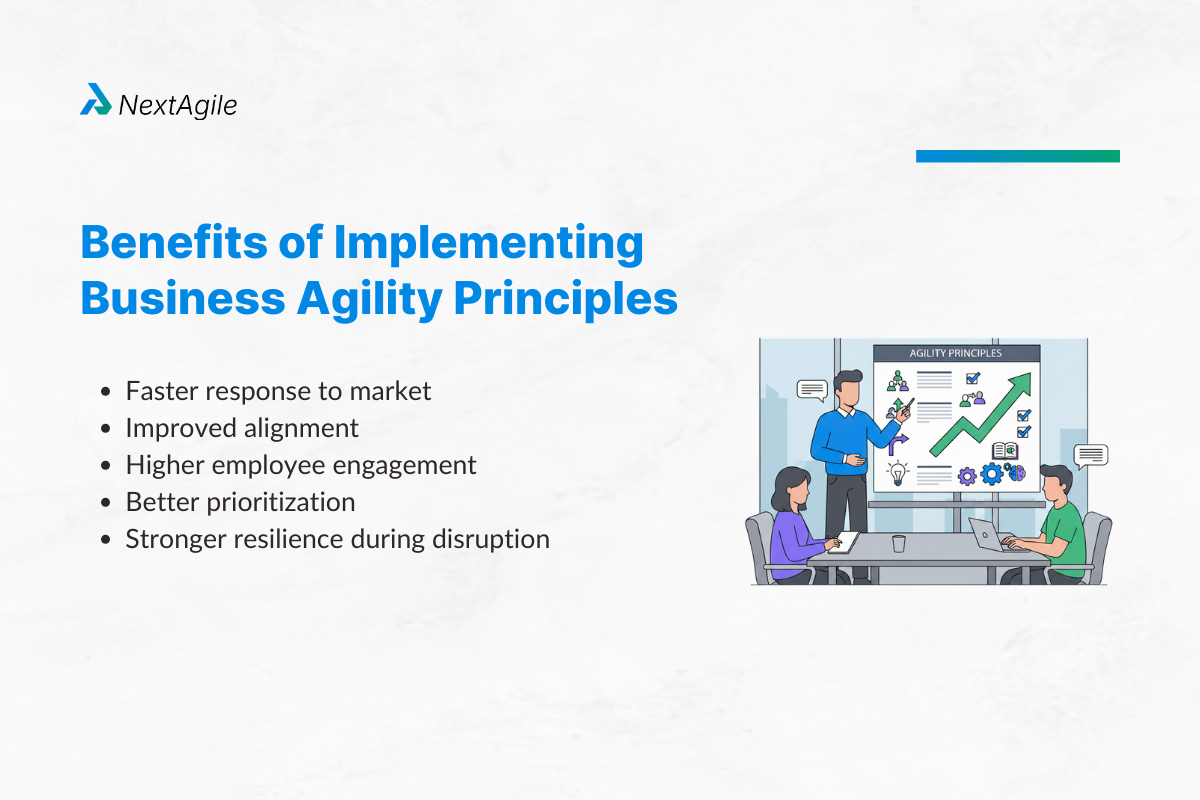
Some of the most common outcomes include:
- Faster response to market and customer changes
- Improved alignment between strategy and execution
- Higher employee engagement and ownership
- Reduced waste through better prioritization
- Stronger resilience during disruption
In practice, these benefits compound over time. The organization doesn’t just move faster — it becomes better at changing. Over time, adaptability compounds into strategic advantage.
This is why many leaders now view business agility not as a transformation initiative, but as a long-term competitive advantage.
How to Implement Business Agility Principles in Your Organization?
Here is a step by step guide to implement business agility in your organization.
Step 1: Assess Current State
Start by understanding where agility already exists — and where it doesn’t. Look beyond IT. Examine leadership behaviors, funding models, governance structures, and decision flows.
This is often where agility assessments provide clarity by making systemic constraints visible early. Most constraints surface outside delivery teams—in governance, funding, and leadership behaviors.
Step 2: Start with Leadership Buy-In
Business agility principles live or die with leadership behavior.
Leaders must model:
- Trust over control
- Learning over certainty
- Outcomes over outputs
Without visible leadership modeling, agility remains localized and fragile. Without this shift, agility stalls at the team level.
Step 3: Begin with Pilot Teams
Rather than scaling prematurely, start with a few value streams or business units. Apply the principles end-to-end. Learn what works. Adapt the approach.
Pilots create evidence and evidence builds momentum. Momentum follows proof, not presentations.
Step 4: Scale Gradually
Scaling agility is less about replication and more about evolution. As the organization learns, adjust structures, roles, and governance to support broader adoption.
This is where many organizations move from Agile adoption to true business agility. Successful scaling adapts structures to learning rather than forcing consistency too early.
Step 5: Embed Continuous Improvement
Finally, make improvement part of the system. Not a quarterly initiative. Not a transformation phase. A permanent capability.
Organizations that sustain business agility treat change as routine and not disruptive. This is where agility becomes institutional rather than programmatic.
How Business Agility Principles Differ from Agile Methodologies?
Agile methodologies focus on how teams work.Business agility principles focus on how the organization works.
One optimizes delivery. The other transforms organizational behavior. Scrum, SAFe, or any business agility model can support agility — but only when guided by the right principles. Without them, frameworks become rigid processes. With them, frameworks become enablers of adaptability.
Think of principles as the why and how, and methodologies as the tools.
Conclusion
Business agility isn’t achieved by installing a framework or running a transformation program. It’s built by consistently applying the right principles even when it’s uncomfortable. Sustainable agility emerges when principles guide choices at every level—not just during transformation phases.
The 7 core business agility principles outlined here help organizations move faster, learn continuously, and stay aligned in the face of uncertainty. More importantly, they create environments where people can make better decisions — closer to the customer, closer to the work.
For enterprises navigating complexity, disruption, and constant change, business agility isn’t optional anymore. It’s fundamental. And when these principles are applied thoughtfully, agility stops being a buzzword — and starts becoming a capability. Across enterprises, the pattern is consistent: frameworks enable change but principles sustain it.
At NextAgile, we have collaborated with numerous clients across geographies to help them design and implement contextual business agility transformation journeys as an agile consulting partner. Do reach out to us at consult@nextagile.ai and we would be happy to explore more.
Frequently Asked Questions
1. How do business agility principles apply beyond IT and software teams?
They guide decision-making, funding, leadership, and collaboration across all functions — including HR, finance, operations, and strategy.
2. Can business agility principles work in highly regulated industries?
In fact, they often improve compliance by increasing transparency, feedback, and early risk identification.
3. What leadership behaviors enable business agility principles to succeed?
Trust, empowerment, learning orientation, and outcome-focused decision-making are critical.
4. Are business agility principles suitable for large enterprises or only startups?
They’re especially valuable for large enterprises, where complexity and decision latency are the biggest barriers to speed and adaptability.