Business Agility Principles: A Practical Guide to Building Adaptive Organizations
Anuj Ojha
Talk to Expert for Free
Table of Contents
Introduction
Markets don’t wait anymore. Customer expectations shift overnight. Technology evolves faster than most annual plans can keep up with. And suddenly, organizations realize that “doing Agile” isn’t enough.
That’s where Business Agility comes in – Business agility isn’t about running more sprints or launching another transformation program. It’s about how quickly and confidently, an organization can sense change, decide what matters, and respond without chaos. Over the past few years, we’ve seen enterprises invest heavily in Agile frameworks but still struggle to adapt at the business level. Why? Because frameworks alone don’t change how decisions are made, how priorities shift, or how leaders lead.
Business agility principles address that gap.
They guide how organizations operate across strategy, leadership, governance, funding, talent, and execution — not just software delivery. When applied well, these principles create organizations that are resilient under pressure, customer-focused by default, and capable of scaling change sustainably.
What will we cover in this Business Agility Principles guide?
In this guide, we’ll break down:
What business agility principles actually mean in practice?
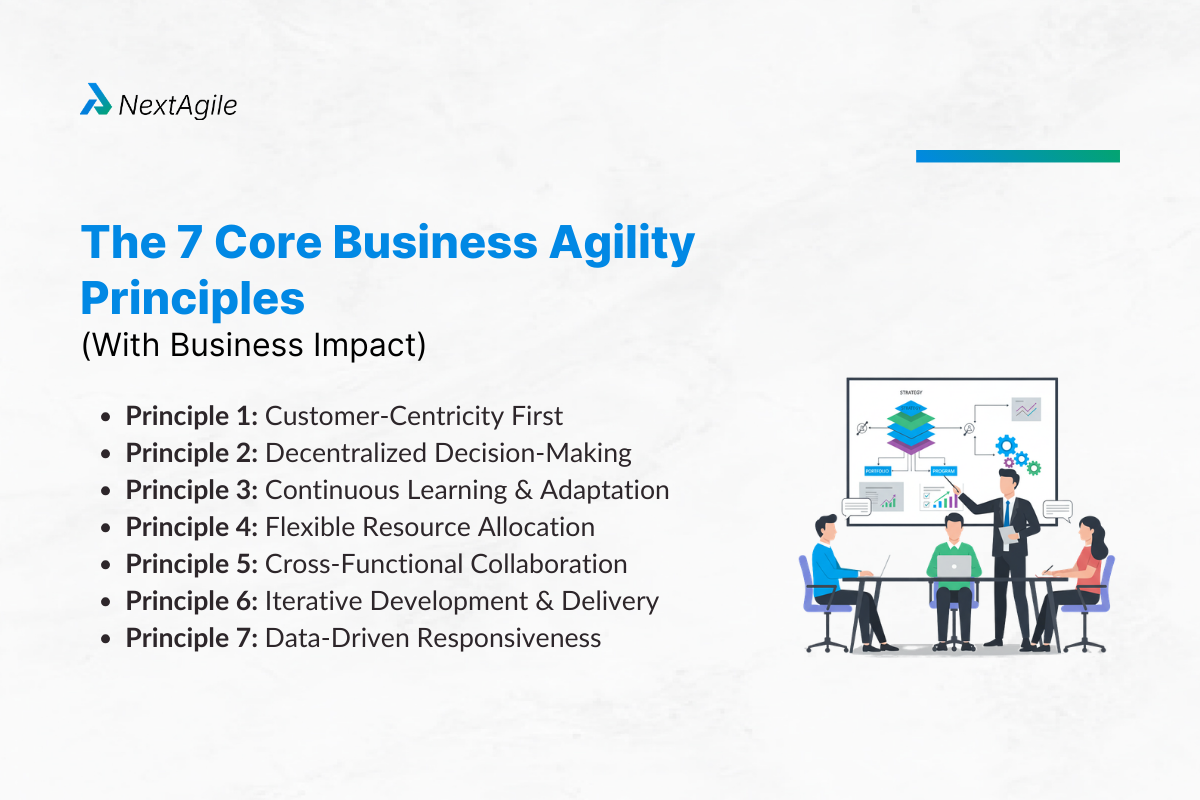
The 7 core business agility principles and their real business impact
Benefits enterprises see when these principles are embedded
A step-by-step approach to implementing them across the organization
How business agility differ from traditional Agile methodologies?
If your organization wants to move faster without breaking things, this is where it starts. In practice, business agility shows up not in ceremonies but in everyday decisions: how fast priorities change, how funding shifts, how leaders respond to signals, and how teams are trusted to act.
Business Agility Principles Explained
At its core, business agility is the ability of an organization to adapt rapidly to market changes while continuing to deliver value to customers — consistently and sustainably.
Business agility principles are the foundational beliefs and behaviors that make this possible. They shape how strategy is formed, how teams are empowered, how decisions flow, and how learning happens across the enterprise.
Unlike an Agile framework or operating model, these principles are framework-agnostic. Whether an organization uses SAFe, LeSS, a custom business agility framework, or a hybrid model, the same principles apply. They influence how those models are applied and whether they succeed or fail. Think of business agility principles as the operating logic of the enterprise. Frameworks define structure. Principles determine behavior.
What we’ve noticed in large-scale transformations is this:
Organizations that focus only on processes scale complexity. Organizations that anchor on business agility principles scale adaptability. This distinction explains why many Agile transformations plateau: execution improves, but organizational responsiveness does not.
These principles:
Extend agility beyond IT into finance, HR, operations, and leadership
Enable decentralized decision-making without losing alignment
Support an adaptive business strategy rather than fixed long-term plans
Encourage continuous improvement as a cultural norm, not an initiative
In other words, business agility principles help organizations respond to uncertainty with confidence instead of control. In mature organizations, these principles act as stabilizers during uncertainty allowing speed without sacrificing coherence.
The 7 Core Business Agility Principles (With Business Impact)
 Skip to content