Introductions to Agile Principles In today’s environment, continuous evolution, responding to change and ever increasing demands are must for every organization. Agility in practice, both at organizational and individual levels, thus becomes very important and key to giving an organization a competitive edge.
Agility in its simplest sense is nothing but continually moving in the right direction, introspecting, and course correcting along the way.
Agility is bound by a set of principles or guiding obligations that one should adhere to. Agility is achieved by first “knowing agile” followed by “doing agile” and eventually getting to a state where agility becomes second nature or the “being agile“ state ! This is easier said than done, and this blog lists out the 12 principles that could help you and your organization get started.
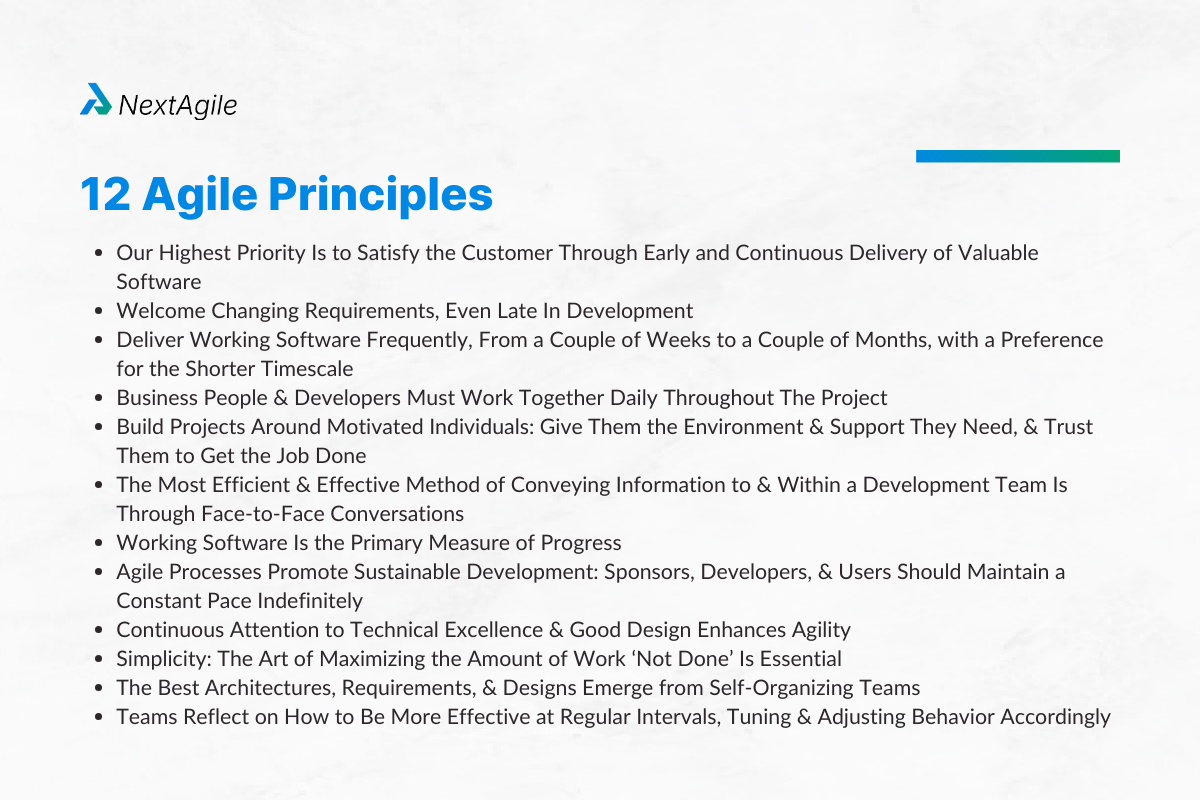
12 Agile Principles: A Guide to Effective Agile Practices All the below listed principles are equally important and all should be given due importance while designing your agile transformation journey and aligning the best practices, mindset and culture to your context
1st Agile Principle: Our Highest Priority Is to Satisfy the Customer Through Early and Continuous Delivery of Valuable Software Continuous engagement, feedback, and demonstration of products built – at shorter and frequent intervals of time is critical. The essence is to deliver usable, valuable software to the customer in increments, rather than in one single go.
2nd Agile Principle: Welcome Changing Requirements, Even Late In Development Adjust parameters like time & cost, descope, prioritize requirements to accommodate frequent changes in customer requirements through product development.
3rd Agile Principle: Deliver Working Software Frequently, From a Couple of Weeks to a Couple of Months, with a Preference for the Shorter Timescale Breaking the deliverables into 2 or 3 week iterations, ensuring they are working functionalities, and delivering them at frequent intervals is most important. Avoid following a traditional linear delivery model – delivering the entire functionality at the end of the project.
4th Agile Principle: Business People And Developers Must Work Together Daily Throughout The Project In the traditional approach of project management business analysts, developers, quality analysts work in silos and the work is mostly linear in fashion. Agile encourages frequent interactions between businesses, customers, and development teams (developers and QA). The requirements are vetted out to the development team at various points of the project life cycle. This allows the incorporation of changes needed by the business and customers at every phase.
5th Agile Principle: Build Projects Around Motivated Individuals: Give Them the Environment and Support They Need, and Trust Them to Get the Job Done Moving away from command and control, and trusting the development team to deliver what they have committed to is a key ingredient. Trusting the team to meet its goals is as important as providing it with the necessary support in terms of tools, infrastructure et al. The leaders must focus on “what“ and the “why” – trusting the team to figure out the “how” (development )
6th Agile Principle: The Most Efficient and Effective Method of Conveying Information to and Within a Development Team Is Through Face-to-Face Conversations Effectively engage team members and other concerned stakeholders – ideally face to face. Face to face engagement helps to proactively identify impediments, resolve issues faster, and clarify relevant matters most effectively.
7th Agile Principle: Working Software Is the Primary Measure of Progress Success of the project is not just defined by delivering within time, scope and budget. Delivering valuable functionality that customers require, and one which solves their problems is as important – if not more.
8th Agile Principle: Agile Processes Promote Sustainable Development: Sponsors, Developers, and Users Should Maintain a Constant Pace Indefinitely It is important to maintain a cadence throughout the life of the project to avoid shunt effect like in traditional projects. So working iteratively and incrementally at a steady and sustainable pace is paramount.
9th Agile Principle: Continuous Attention to Technical Excellence and Good Design Enhances Agility Attention to code and product quality is crucial. Mechanisms to reduce technical debt periodically must be embedded within the plan. As much as a working feature is the primary measure of success, to make these high quality features focus must also be on improving the technical areas.
10th Agile Principle: Simplicity: The Art of Maximizing the Amount of Work ‘Not Done’ Is Essential Focus on finishing any work taken up. Avoid switching tasks to complete the work as context switching complicates the work and results in waste. Focus and re-plan on how work items can be taken to completion.
11th Agile Principle: The Best Architectures, Requirements, and Designs Emerge from Self-Organizing Teams Lead and engage with teams in a way that motivates them to innovate and design solutions. Provide psychological safety and openness – allowing them to fail, ideate, and discover their own ways of working
12th Agile Principle: Teams Reflect on How to Be More Effective at Regular Intervals, Tuning and Adjusting Behavior Accordingly Team members get together and introspect their ways of working, in terms of performance, processes, systems etc so as to improve when and where required
Let us explain the above 12 principles in a nutshell and how well they are intertwined.
Working hand in hand with businesses and clients is key to delivering value added services or products in today’s VUCA world. Continuously incorporating customer feedback, making improvements and showcasing value-added deliverables at frequent intervals is important to –
Correct course faster Embrace the change needed Keep the customer engaged It is also crucial to effectively engage team members and other concerned stakeholders- preferably face to face and to continually evolve the team in terms of pertinent technology advancements. We also need to prepare the team to improve in areas of performance, stability, resilience etc through better technical design and architecture. This plays a major role in delivering value added functionality, satisfying our customers and managing other challenges posted in the VUCA world.
Drive business excellence with Scaled Agile Framework consulting tailored to your needs. Let’s empower your teams and fuel your success story.
To sum it up, agility is all about making everything around you simpler. And last but not the least, do remember that team focus should also be futuristic – look at what needs to be done to deliver as opposed to dwelling on the past!
We would love to hear your feedback on the above best practices. Please reach out to us at “consult@nextagile.ai ” for further details on these steps or for any support in your agile transformation journey .
Why Agile Principles Matter in Business & Technology? The world is moving in hyper drive mode with a lot of changes and uncertainty along with competition. New technologies come up every day and also become obsolete very soon, customer expectations are a moving goal post. In this world, one thing which does not fit it is the rigidity. Businesses need to be flexible and pivot as fast as possible.
The principles of agile like valuing individuals and interactions over process and tools, responding to change over following a plan, frequently delivering working software are not just statements which when read would make someone agile, they are directions and guides for a new way of working. They ensure environments where teams can pivot quickly, learn from feedback and deliver value incrementally.
Agile manifesto and the principles are more suitable now than ever. Especially now when AI is also evolving. If there is a time when companies need to move away from plans in silos and deliver in years it is now.
Benefits of Agile in software development and project management
Faster Time to Market – Instead of waiting for the entire product to be completed, teams can go with bare minimum features and increment which reduces the time to market Higher Customer Satisfaction – Continuous feedback loops mean you are building what the users actually want Reduced feedback loop – With smaller increments, there are multiple opportunities to validate if the product is being built correctly Flexible for change – With just enough planning and delivery, it enables teams to accept change continuously Reduced Risk – Fail faster, learn faster. Small iterations mean mistakes are caught earlier and fixed before it becomes too expensive Improved Team Dynamics – Autonomy, collaboration and visible progress keeps the team motivated Real-world case studies of Agile success Spotify did not become a global giant by following a rigid waterfall approach. Their concepts of squads, tribes, chapters and guilds model was born from a deep understanding of agile principles. Collaboration, rapid experimentation, autonomy and continuous improvement were the core foundational characteristics of those teams. They learnt that empowering small, cross functional teams to own their features end to end led to faster innovation and better products Amazon is another perfect example. Their “two pizzas teams” concept which is nothing but teams small enough to be fed by two pizzas is an example of small, empowered and autonomous units. This decentralized approach combined with focus on customer feedback and incremental delivery helped them to expand and build incredible products Agile Principles vs. Agile Frameworks “I want to be a good person in life” is a guiding principle. While there are a lot of practices that lead to being a good person. To mention some, we help someone in need, we feed a stray dog, or we are nice to people. Likewise, there are several agile frameworks which are practices when implemented in a team, promoting agile principles. Frameworks are tools which help apply agile principles.
Difference between Agile principles and frameworks This is where most of the teams go wrong, they go into a belief that they are agile by just applying scrum or other frameworks. If a team has the perfect scrum framework implemented and they do not have incremental delivery, do not continuously improve or deliver value, they are still not agile. On the other hand, if a team has incremental delivery and continuously improves on their gaps with collaboration, even if they do not follow scrum or any other framework, they are agile.
Overview of Scrum, Kanban, SAFe, and Lean Agile Scrum – An agile framework with structured sprints, roles (Scrum master, Product owner) and ceremonies (Standup, Review, Retrospectives) which can be used for teams that need rhythm and can plan a part of their backlog and deliver them incrementally Kanban – An agile framework which focusses on visualising the flow of work, limiting work in progress that can be sued for teams where continuously delivery is the key and cannot plan an increment because of continuous inflow or work SAFe – A framework which is structured and prescriptive that scales agility at enterprise level with defined roles and cadence based planning Lean Agile – An agile framework that mainly focusses on cutting waste and maximizing the flow of value delivery Common Myths & Misconceptions About Agile Principles Most companies these days use Agile ways of working but that is also the most widely misunderstood concepts. There has been a lot of myths around why teams also decide to use agile ways of working, some of the main myths include,
Agile means no documentation
This is one of the main myths which people blindly believe in. Mainly because of the manifesto point “Working software over comprehensive documentation”. This does not mean no documentation. It means adequate and just enough, valuable documentation. If it helps the customer, teams and the future maintenance, it is important to document it. If documentation is purely with the intention of archiving and playing safe it does not make sense to spend time on it. There have been incidents where teams have discarded the documentation after spending time preparing it and not even finalising it.
Agile is only for software development
Agile can be applied to any domain any type of work not just for software development. It’s principles are universal. Marketing teams use kanban to manage their campaigns, HR teams use it for talent acquisition, even construction companies, event management companies, can use those 12 agile principles. Any domain of company where complexity, change and collaboration is needed, agile principles can be used.
Agile teams don’t follow structure
Agile frameworks provide structure in multiple ways. Regular cadences, defined roles, clear feedback loops, DOD etc. Where people feel that is does not have structure is the fact that is it more designed to be adaptive and not rigid and sequential.
How to Implement Agile Principles in Your Organization Steps to transition to Agile culture
First understand the dynamics by defining the vision of transition Get awareness training sessions and get a leadership buy in Pick a few pilot teams or a specific project and let them implement agile ways of working, make mistakes and learn from them Get an expert coach or consulting firm’s help for your transformation Make work more visible, celebrate the win, acknowledge failures as learning opportunities Ensure teams are empowered and adequately empowered With the win from the pilot phase, cross polinate the success across other teams and departments (Please refer our blogs for more information – How to Implement agile in a project? )
Challenges and how to overcome them Leadership and Cultural Resistance – Without leadership support or buy in and organizational resistance to transparency, collaboration and cultural shift agile transformation becomes very difficult. It is important to have a clear vision for the transformation and explain the benefits for both leadership and the management teams Knowledge and Awarrenes Gaps – Lack of awareness of agile or misconceptions or not having experienced practitioners, teams may feel burnt out or chaotic because of the changes. So it is always important to take help from agile consulting services from the market to make full use of their expertise in overcoming these challenges Using Scrum Everywhere – A lot of teams use scrum where it is not suitable for their environment. Choosing the right framework depends on a few criteria and becomes even more important for the teams to keep the practices consistent and adhere to the process to see benefits Lack of technical Systems – Agile comes hand in hand with concepts like DevOps and automation. Both are needed together to ensure the benefits of agility. Poor technical practices including lack of tools, automation and code quality problems hinders the transformation. While in the journey, it is also crucial for the teams to pay attention to automation, DevOps, CI/CD and code quality and then improve continously Measurement and Expectation Problems – Using wrong metrics focussed on output rather than outcomes combined with unrealistic expectations is also a major challenge for a transformation. Review the list of metrics which makes sense to the business and only use them to avoid any confusion (Please refer our blogs for more information – Agile transformation / implementation challenges )
Agile coaching and leadership tips As mentioned above, agile transformation is a journey and requires a lot of support and dedication from seasoned, expert agile consultants and also leadership of the organization. Below are a few tips on coaching and leadership,
Leaders must first model their beheaviours themselves. Be transparent, admit mistakes, encourage experimentation and focus on removing roadblocks for the teams Invest time and money in building a safe environment, trust within the teams and mindset of experimentation before going with scrum or kanban Implement regular retrospectives not just for the teams but for leadership as well. Provide coaching and handhold teams on agile principles and mentor them Sfit metrics from output focus to outcome focussed. Hours worked, features delivered etc in the bigger picture does not add value. Move to metrics like customer satisfaction, time to market, team happiness and value delivered Understand that agile transformation is a journey rather than a destination. Avoiding rushing for an immediate result, communicate realistic timelines, celebrate and acknowledge small wins Agile Principles in Action: Use Cases Across Industries As I mentioned above, agile is not just for software development projects, but can be used across domains and industries. Agile principles are universal in nature. Let’s take a look at some industries where agile has helped,
Agile in Software Development
Challenge – Adobe had been known for selling its flagship software for years often with new versions released every 18-24 months. They needed to transition to a subscription based, cloud delivered model because of revenue fluctuations.
Impact of Agile principles – Agile principles like, shorter feedback cycles, incremental delivery helped them with predictable revenue subscriptions, allowed for a faster innovation. Their stock price soared building more confidence in their agile approach
Agile in marketing
Challenge – General Electric was emarking a bold new vision of “Industrial internet” and wanted to connect machines with data analytics. This concept needed to be effectively to a B2B audience across industries. Long lead times for major campaigns would not allow them to adapt to evolving understanding of market reception
Impact of Agile Principles – GE became a leader in industrial internet space. Agile principles allowed them to quickly identify effective messaging and adapt to evolving market understanding. It fostered a culture of continuous learning and optimization within their marketing organization
Agile in manufacturing & construction
Challenge – Right after the earthquake in Chirstchurch, New Zealand needed to rapidly rebuild critical infrastructure including a new modern services for hospitals with significant technical challenges and tight deadline also public scrutiny.
Impact of Agile Principles – Despite significant challenges, Christchurch hospital services building was compelted on time and whtihin budget. Agile inspired apprach fostered flexibility, improved communication and allowed the project to navigate a highly volatile environment delivering critical piece of infrastructure when it was most needed
Future of Agile Principles: Trends & Innovations Agile in AI-driven development
Agile does not just help AI evolve, it helps people and processes around AI evolve with it.Incorporating AI into product development brings both excitement and uncertainty. Unlike traditional features, AI evolves with data, training and ongoing validation. This is where agile comes into picture. With agile, teams can build incrementally, starting with a smakk machine model, testing it in sanbox and gathering feedback for real users. Agile principles like quick iterations and continuous learning makes perfect sense in these conditions.
The rise of Agile scaling frameworks
As organizations grow, applying agile principles becomes a little challenging. Thats where frameworks like SAFe, LeSS and Nexus come in. These frameworks help large enterprise align multiple teams maintain transparency and manage dependencies without loosing the core meaning of agility. These frameworks help synchronize planning across teams, maintain shared backlog and establish system level feedback loops.
How Agile is evolving with DevOps and CI/CD
Agile and DevOps work hand in hand not just to make teams move faster, but faster, safer and deliver value on demand to the customer. Together they bridge the gap between idea and delivery. CI and CD make it possible for the teams to ship small changes frequently and focus on delivery and customer feedback.
Conclusion & Key Takeaways Agile principles, derived from the manifesto, offer a guiding direction for creating adaptable and customer centric teams and organizations. They prioritize individual and interactions over rigid processes, which promotes direct collaboration. It focssues on delivering working solutions frequently whether it is a software or building module or even marketing campaigns. More importantly, agile values customer collaboration throughout the entire process ensuring the product really meets the evolving needs. It promotes responding to a change as a competitive advantage helping teams to understand that the plans must adapt to new condition. With self organing teams, agile principles ensures they are continuous improvement and delivery value iteratively.
Agile adoption is a marathon and not a sprint. It is about people and culture. Do not chase buzzwords and frameworks. Instead concentrate on understanding the core agile principles and collaboration, continuous learning, adaptability and focus on delivering true value. In the journey, one can expect resistance, celebrate small wins and need for leadership support. Agile transformation takes time, patience and the need to inspect and adapt the journey itself. With this, our blog on “Agile principles” comes to an end and we sincerely hope it has helped our readers. For any suggestions or feedback or even to avail our agile consulting services , please write to us at consult@nextagile.ai
Frequently Asked Questions 1. How do Agile principles help teams improve productivity? Agile principles boosts team productivity by prioritizing collaboration and continuous improvement. Teams communicate more effectively, resolving issues faster. Frequent smaller delivery allows for quick feedback and prevents wasted efforts. Responding to change helps team pivot avoiding costly rewords. Regular inspection and adaption enables continuous learning.
2. What is the most important Agile principle? There is nothing like the most important agile principle, however, the one that makes or breaks a system is the agile principle “individiauls and interactions over processes and tools” because the software development is a human activity requiring collaboration and communication. While processes and tools are valuable, they should serve people rather than making it difficult for them.
3. Can Agile principles be applied outside software development? Ofcourse yes. As mentioned in the blog with case studies, agile principles are universal and can be applied to various industries and domains. Agile principles can be applied wherever there is complexity involved and incremental valur delivery, reduced feedback loop, inspection and adaption is needed.
4. What are the key differences between Agile principles and Scrum? Agile principles are the foundational values and beliefs that guides a team. While scrum is one of the most used framework/set of practices that apply agile principles in a team. It brings in defined roles, ceremonies and artifacts to operationalize the principles of agile.
Sudha Madhuri is an Agile practitioner with 19+ global experience across Industry domains. She has worked extensively as a trainer and coach. Sudha has delivered 200+ training programs around Agile, Scrum, Kanban and Project/Program Management covering more than 8k+ professionals. Sudha has been part of multiple agile transformations across product and service based organisations. She has transformed 50+ agile teams, helping them build an agile culture at team and program level.
Sujith G. is an agile practitioner with expertise in setting up the agile environment by coaching and training teams, individuals and stakeholders in the area of lean agile software principles. He has overall 12+ years of exp out of which 9+ years have been in Agile and Scrum implementation and adoption. Sujith has coached 70+ teams on agile practices & implementation techniques and has extensive experience in setting up metrics, JIRA & Azure DevOps. Experienced in identifying gaps in the system, creating scrum awareness, piloting and scaling scrum.
 Skip to content