Transactional Leadership: Mastering Results Driven Leadership in Modern Teams
Alok Dimri
Talk to Expert for Free
Table of Contents
Introduction to Transactional Leadership
Why do some leaders excel at delivering quick results while others struggle to maintain their team’s performance? The difference often, may, stem from their approach, particularly whether they use transactional leadership. What is transactional leadership, it is a leadership style that focuses on results through clear expectations, rewards for good performance, and consequences for underperformance. Unlike transformational leadership, which inspires through vision and influence, transactional leadership relies on discipline, organization, and accountability. In such environments, leadership effectiveness is judged less by intent and more by outcomes like deadlines met, quality maintained, and deviations corrected quickly.
Our experience as a leadership enablement training firm with leadership coaching has shown that blending transactional approaches with modern leadership strategies can drive measurable outcomes, especially when paired with frameworks like OKRs to align business strategy with execution. This blog will break down transactional leadership, its components, practical applications, and when it works best — all while offering actionable insights you can apply immediately. When applied deliberately, transactional leadership does not restrict modern leadership, it stabilizes it, allowing innovation to occur within clear boundaries.
What is Transactional Leadership?
Transactional leadership, also known as managerial leadership, is a style focused on structure, clear roles, and reward-punishment mechanisms. Leaders who adopt this style concentrate on completing tasks, following rules, and achieving measurable outcomes. It operates like a system where clear expectations are communicated and compliance is closely monitored. This clarity creates a low-ambiguity environment where performance discussions are factual, not emotional.
In today’s fast-paced business world, grasping the concept of transactional leadership is not just theoretical; it’s practical. Teams frequently work under tight deadlines or high-pressure situations, requiring efficiency and predictability. Leaders skilled in transactional techniques can ensure that tasks are completed reliably while providing clarity and consistency to their teams. Transactional leadership provides the operational backbone teams rely on when predictability and execution discipline matter more than experimentation.
This approach runs on a simple principle: reward performance, correct mistakes, and oversee actions. For example, it may involve setting daily production targets, tracking progress, and providing immediate feedback based on results. It’s practical, predictable, and very effective in settings where efficiency and standardization are key. Such systems reduce variability in execution, making performance easier to track, correct, and improve.
In simple words, transactional leadership is leadership through structured transactions which is a clear contract of expectations and outcomes between the leader and the team. Leaders may not inspire a long-term cultural shift or spark creativity, but they excel at getting things done, meeting deadlines, and maintaining operational stability. Its strength lies in operational dependability rather than emotional inspiration.
Not every situation in modern organizations requires visionary or transformational leadership. Sometimes the pressing need is for reliability, compliance, and measurable results. This is where transactional leadership excels. Execution gaps often emerge not from lack of vision, but from unclear expectations and weak accountability.
Consider high-pressure projects, crisis situations, or companies with strict operational protocols. Leaders capable of setting clear goals, defining consequences, and ensuring accountability can often avoid mistakes and maintain consistent output. In today’s hybrid and remote work landscapes, transactional methods provide the structure needed for teams to stay organized and productive. In distributed teams, transactional structures act as anchors, preventing drift in priorities and performance.
Understanding transactional leadership offers executives the flexibility to change styles based on the situation. It’s not about replacing visionary leadership; it complements it. At NextAgile, we’ve noticed that executives blending transactional principles with adaptive strategies often achieve both efficiency and engagement, maximizing team performance without losing accountability. This balance allows leaders to scale execution without losing control or clarity.
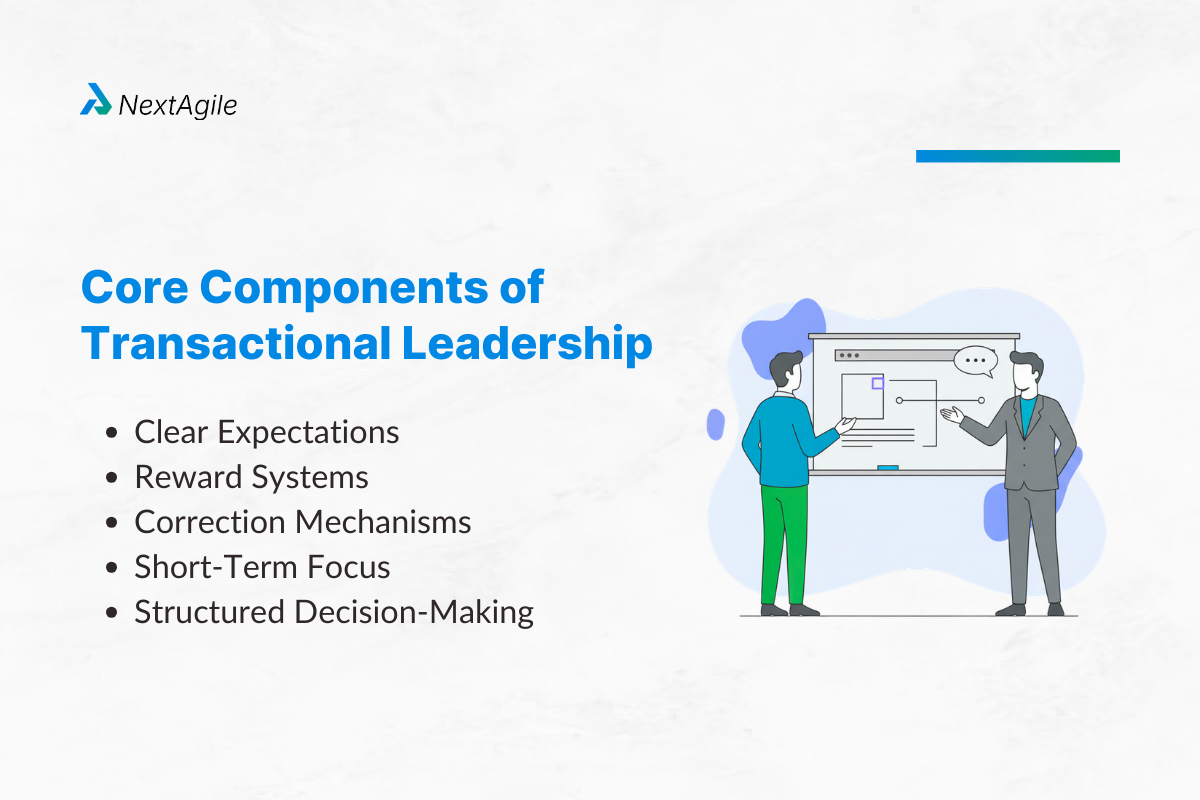
Core Components of Transactional Leadership
Transactional leadership is based on several key components that guide its practical application:
Clear Expectations – Leaders set specific goals and responsibilities.
Reward Systems – Performance is acknowledged, often through bonuses, promotions, or recognition.
Correction Mechanisms – Mistakes are addressed promptly, ensuring accountability.
Short-Term Focus – The approach prioritizes immediate results over long-term vision.
Structured Decision-Making – Leaders use established protocols and traditional methods instead of experimentation.
Together, these elements create an execution system where accountability is explicit and performance conversations are objective. These components create a predictable, disciplined environment where team members understand exactly what is expected of them. When applied correctly, transactional leadership drives measurable results while reducing confusion and misalignment.
Key Characteristics of Transactional Leadership
Clear Expectations and Structure
Transactional leaders excel at clarifying roles, responsibilities, and outcomes. Teams know the hierarchy, reporting lines, and performance standards. This clarity reduces uncertainty and ensures everyone is aware of what to deliver, a vital aspect in organizations where consistency is crucial. This reduces dependency on constant supervision by replacing assumptions with shared understanding.
 Skip to content