...

Generative AI Consulting for Small and Mid-Sized Businesses: A Practical Guide

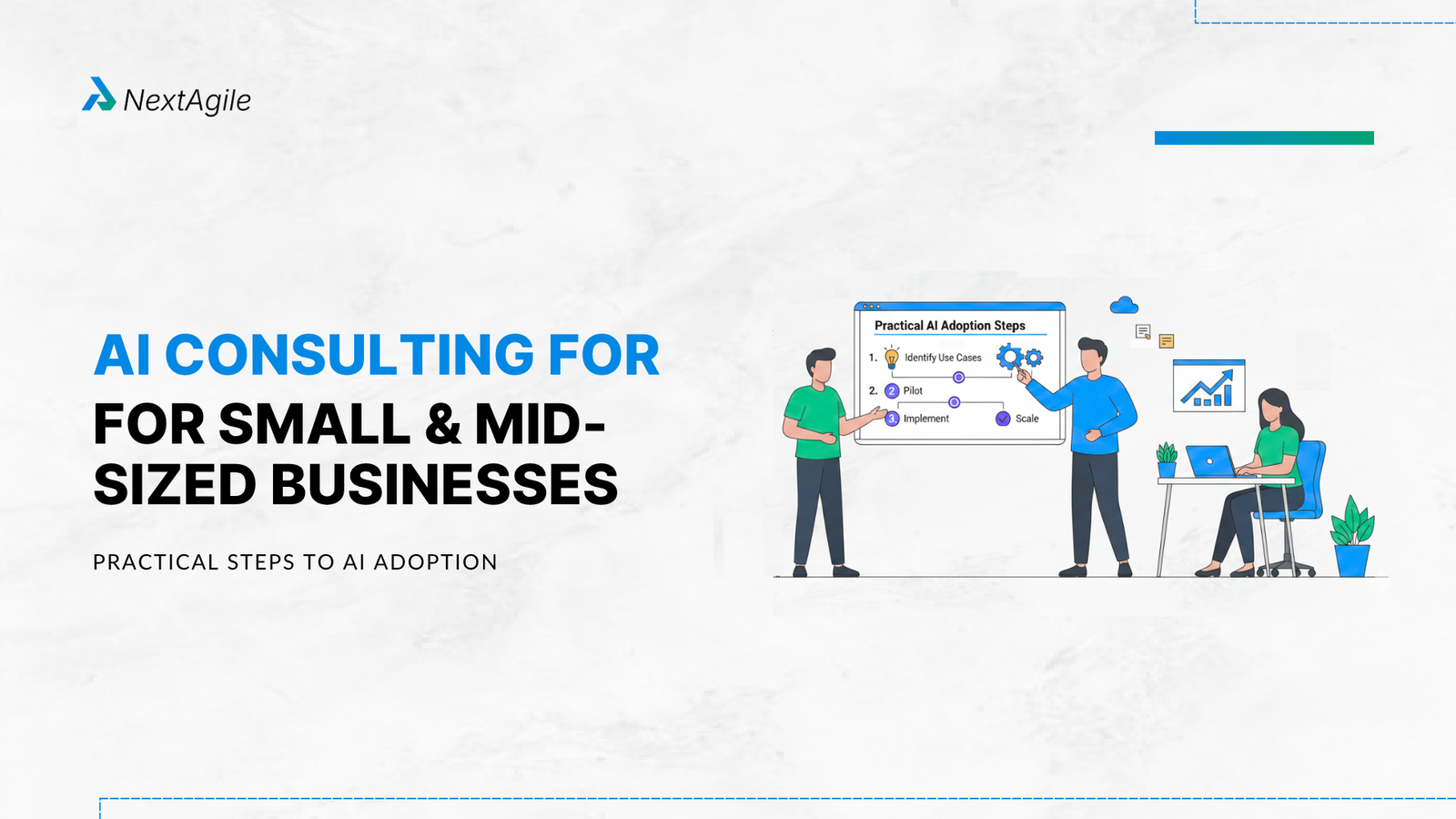
AI Consulting for Small and Mid-Sized Businesses Practical Steps to AI Adoption
Share

 Key Takeaways

Generative AI adoption for SMBs is different from enterprise adoption. It requires different consulting approaches, different timelines, and different expectations. The SMBs that succeed with AI are the ones that start with quick wins, focus on measurable ROI, and build internal capability over time. You do not need large budgets or years of planning. You need clarity on what you are trying to accomplish, focus on high-impact use cases, and the discipline to measure and learn from early implementations. That is how SMBs win with generative AI.

 Introduction

The generative AI conversation has been dominated by what big tech companies and large enterprises are doing. You read about OpenAI and ChatGPT. You see Fortune 500 companies spending millions on AI transformations. You watch competitors in your space experiment with AI features. But if you lead a small or mid-sized business, those stories feel disconnected from your reality. You do not have unlimited budgets. You do not have dedicated machine learning teams. You cannot afford to take risks on technology that might not work out. You need AI to solve actual business problems with actual ROI, not to chase headlines.

That gap between what you read about and what is actually viable for a mid-market business is where practical generative AI consulting begins.

Most generative AI consulting firms are built around enterprise deals. They are built to manage complex organizational transformations across hundreds of people. Their pricing reflects that. Their timelines assume deep resources. Their solutions are complex. If you are an SMB, you need a different approach. You need consulting that understands your constraints and works within them.

Why SMBs Have Different AI Requirements Than Enterprises?

The most dangerous mistake an SMB can make is assuming that AI strategies designed for Fortune 500 companies will work for them. They will not. The constraints are fundamentally different.

Enterprise AI strategies are built around organizational scale and complexity. A Fortune 500 company might need to change how a hundred teams work. They need to navigate complex governance structures. They need to manage change across geographies and business units. They can afford to spend eighteen months and millions of dollars on an AI transformation because the ROI is distributed across thousands of employees.

SMB AI strategies are built around speed and focus, SMB AI strategies are built around speed and focus, much like modern agile business consulting models that prioritize fast execution and measurable outcomes. A mid-market company cannot afford lengthy transformations. You need to show ROI quickly so you can justify the investment and move on to the next priority. You need to focus on a narrow set of high-impact use cases, not try to transform the whole organization at once. You need solutions that work with your existing tech stack rather than requiring massive infrastructure investments.

The second difference is budget. A large enterprise might spend five hundred thousand dollars on an AI consulting engagement. An SMB might be able to spend fifty thousand dollars. That fifty thousand dollars has to go much further. It cannot be spent on lengthy discovery phases and complex implementations. It has to be spent on quick wins that build momentum.

The third difference is timeline. Enterprises plan in multi-year phases. SMBs cannot wait two years to see results. You need to see impact within ninety days. You need to prove that AI is worth continued investment quickly, or you move on to something else.

The fourth difference is team structure. A large enterprise has dedicated roles for every function. An SMB has people wearing multiple hats. Your VP of operations is also handling some sales. Your head of customer service is also managing communications. You cannot afford to pull people out of operational work for months to learn AI frameworks. You need solutions that integrate into existing workflows quickly.

Where Generative AI Creates Value Fastest in SMBs?

Not all use cases are created equal for SMBs. Some AI applications take months to implement and show unclear ROI. Others create value within weeks and are measurable.

Customer communication is the fastest win for most SMBs. If your company sends emails, creates proposals, handles customer inquiries, or manages customer communications in any form, generative AI can handle a portion of that work today. You can implement AI-assisted email drafting for your sales team. You can build AI-powered customer service responses that humans review before sending. You can generate proposal templates automatically that your team customizes. These are not futuristic capabilities. These are available today and can be implemented in days or weeks, not months.

Content creation for marketing is the second fastest win. If your marketing team is creating blog posts, social media content, product descriptions, or email campaigns, generative AI can accelerate the process significantly. The key is understanding that AI is not creating final content. AI is creating first drafts that humans edit and refine. This workflow is much faster than having humans write from scratch. Most SMBs see fifty to seventy percent improvement in marketing content velocity when they implement AI-assisted writing.

Data analysis and reporting is the third fastest win. If your team spends time pulling data from systems, creating reports, and summarizing findings for stakeholders, AI can automate much of that work. You connect your business systems to an AI tool. You define the metrics you care about. The AI extracts data, creates visualizations, and summarizes findings. Your team reviews the output and uses it to make decisions. The time savings compound quickly across the organization.

These three use cases have something in common. They start with existing processes that humans are doing. They do not require building new workflows or changing organizational structure. They do not require complex infrastructure work. They can be implemented using commercial tools that are available today. They produce measurable results quickly.

The Cost Structure of AI Adoption for SMBs

One of the biggest misconceptions SMBs have about AI is that it requires massive upfront investment. It does not. The cost structure for SMB AI adoption is much lighter than for enterprises.

Most of the generative ai tools SMBs need to get started with AI cost under five hundred dollars per month.ChatGPT Plus is twenty dollars a month. Anthropic offers Claude API access for pennies per API call. Writing assistants like Copy AI or Jasper cost one hundred to three hundred dollars per month. Document analysis tools like Document AI cost based on usage, not fixed seats. Data analysis tools are increasingly available on usage-based pricing.

The bigger cost is often consulting or implementation help, not the tools themselves. If you are working with a consultant to help you implement AI in your organization, that consultant should understand SMB budgets and constraints. They should be looking for quick wins that create momentum rather than long-term transformation programs that require significant investment.

The hidden costs that SMBs often miss are training and change management, The hidden costs that SMBs often miss are training and change management, which is why many companies invest in structured leadership training programs during AI adoption. Your team needs to understand how to work with AI tools. Some people will adopt quickly. Others will resist. You need to budget time for training and support during the adoption phase. This is where SMBs often underestimate.

The path that most successful SMBs take is to start with commercial tools that require minimal setup. Your sales team starts using AI writing assistants. Your customer service team starts using AI to draft responses. Your marketing team starts using AI to generate content outlines. This costs little and creates quick wins. Once you see value and the team is onboard, you can consider more sophisticated implementations.

The Realistic Timeline for SMB AI Implementation

Enterprises talk about AI transformations taking twelve to eighteen months. For an SMB, that timeline is too long. You need to think in terms of weeks and months, not years.

A realistic timeline for an SMB to get meaningful AI capabilities operational looks like this. Weeks one through two are planning and assessment. You identify the highest-impact use cases for your business. You assess what tools are available. You define what success looks like. You identify the team members who will be most affected.

Weeks three through four are tool selection and setup. You choose the tools that make sense for your highest-impact use cases. You set them up. You get access configured for the team that will use them.

Weeks five through eight are pilot and training. A small team starts using the tools. They provide feedback. You make adjustments. You create training materials for the rest of the team.

Weeks nine through twelve are rollout. The full team starts using the tools. You monitor adoption and troubleshoot issues as they emerge.

By week twelve, you should have clear evidence of whether this AI implementation is creating value. If it is, you can expand it. If it is not, you can stop and try something different. The total investment is twelve weeks of time, a few thousand dollars in tools, and a modest consulting fee if you are working with someone to guide the process.

This is dramatically different from the eighteen-month enterprise timelines you read about. It is also realistic for SMBs because it acknowledges that you cannot spend significant time and budget on something that might not work.

Common Mistakes SMBs Make When Adopting AI

Common Mistakes SMBs Make When Adopting AI

Mistake one is starting too broad. You say we want to use AI across our whole organization. You want to transform everything at once. This is a recipe for failure because you cannot actually execute against such a broad vision. Start with one department or one business process. Get that working. Then expand.

Mistake two is trying to build custom solutions when commercial tools exist. You see that AI is possible and you want to build a proprietary AI system for your business. But the cost and timeline make that impractical. You should use commercial tools that are available today and proven. You can always add custom work later if there is a compelling business case.

Mistake three is underestimating the change management work. You implement an AI tool and assume people will just use it. But people have established workflows. Change is uncomfortable. You need to invest in training, in addressing concerns, in showing people why AI is better than their current process. The technology is easy. The human part is hard.

Mistake four is measuring the wrong things. You implement AI and measure things like cost savings that take months to materialize. You should measure things like adoption rate, user satisfaction, quality of output, and speed improvements that you can see quickly. Quick wins build momentum and support for further AI adoption.

Mistake five is expecting too much from AI too soon. You implement an AI writing assistant and expect it to generate perfect marketing copy with no human editing. That is not how it works. AI generates first drafts. Humans edit and refine. When you set expectations correctly, people are pleasantly surprised by the quality. When you oversell, people are disappointed.

Building Your Internal Capability

The most important investment an SMB can make in AI is not in tools or consulting. It is in people. You need someone on your team who understands generative AI well enough to make decisions about where to apply it and how to implement it.

This does not mean you need to hire a machine learning PhD. It means you need someone who has spent enough time with generative AI to understand what it is and is not good at. This could be someone from your team who has shown interest in AI and has the capacity to develop expertise. You can send them to training programs. You can have them work with a consultant to build knowledge. Over three to six months, this person becomes your internal AI champion.

This person does not need to be a full-time AI role. At an SMB, they are probably doing their existing job plus driving AI adoption. But they become the focal point for AI decisions. When someone asks should we use AI for this, they help evaluate it. When you are considering a new tool or implementation, they help decide. When your team is struggling to adopt a new tool, they help troubleshoot.

The reason this matters is that it reduces your dependence on external consultants. You have someone inside your organization who can evaluate new AI opportunities, make informed decisions, and drive implementation. That person will learn from mistakes and iterations that happen over time. They will become increasingly valuable as AI capabilities expand.

Working With External Consultants Effectively

At some point, most SMBs benefit from working with an external consultant who understands AI and SMB constraints. The question is how to make that engagement successful.

The first rule is that the consultant should understand SMB business models and constraints. They should not try to sell you an eighteen-month, half-million-dollar transformation. They should be focused on quick wins and realistic timelines. If a consultant pushes back when you ask about ninety-day implementation timelines, that is a signal they are not thinking about SMB constraints.

The second rule is clarity on what the consultant will deliver. Will they deliver a fully implemented solution that your team can take over? Will they deliver a strategy document? Will they deliver training for your team? Make sure you agree on outcomes upfront. A consultant who gives you a strategy document but does not help you implement it has not solved your problem.

The third rule is focus on handoff and knowledge transfer. By the end of the engagement, your internal team should understand how the solution works and be capable of maintaining it. If the consultant is the only person who understands it, you have a dependency problem.

The fourth rule is measurement of impact. Before the engagement starts, define what success looks like. Before the engagement starts, define what success looks like. Many SMBs use OKR consulting services to align AI initiatives with measurable business outcomes. Is it a certain percentage of team adoption? Is it a specific improvement in cycle time? Is it measurable cost savings? Make sure you can measure whether the engagement actually delivered value.

Getting Started With Your AI Journey

The most important step is to start. Do not wait until you have a perfect strategy or until you fully understand generative AI. Start experimenting with commercial tools, Start experimenting with commercial tools, or begin with a guided Agentic AI Workshop to identify high-value use cases faster. Have your team try them. See what creates value. Build from there.

Most successful SMBs follow a pattern. They start with one high-impact use case. They see success and build internal momentum. They expand to a second use case. They expand to a third. Within six months, AI is woven through multiple parts of how they work. They are more efficient. They are more competitive. They are delivering better results.

The companies that do not start are falling behind. Their larger competitors are investing in AI. Their smaller competitors who are nimble are adopting AI faster. The advantage goes to companies that start the journey now, learn from early implementations, and compound the improvements over time.

Generative AI is not a future capability for SMBs. It is an available capability today with realistic budgets, achievable timelines, and measurable ROI. The question is not whether you should adopt it. The question is how quickly you can get started.

SMBs that move early often outperform larger competitors. If you’re evaluating practical AI adoption, Next Agile offers generative AI consulting services, leadership enablement, and AI workshops built for fast-moving businesses.

Frequently Asked Questions About AI Consulting for Small and Mid-Sized Businesses

Q1: Can we implement generative AI without external consulting?

Yes, you can. Many SMBs start by having their team experiment with commercial AI tools and figure out what works. The risk is that you might spend a lot of time on implementations that do not create value or you might miss higher-impact opportunities because you are not thinking about your business strategically. A small amount of consulting can save you months of trial and error.

Q2: How do we choose between commercial AI tools?

Start with your specific use case. If you are using AI for writing, look at tools built for writing like Copy AI or Jasper. If you are using AI for customer service, look at customer service specific tools. If you are using AI for data analysis, look at data tools. Do not try to find one tool that does everything. Use best-of-breed tools for each use case.

Q3: What is the biggest adoption barrier we will face?

Fear. People are worried that AI will eliminate their jobs. They are worried that they will look foolish if they make mistakes with a new tool. They are worried that the tool will not work and they will waste time. The barrier is not the technology. It is human psychology. You address this by being honest about what AI will and will not do, by involving people in the change process, and by celebrating early wins.

Q4: Should we build a custom AI solution or use off-the-shelf tools?

For ninety-nine percent of SMBs, the answer is off-the-shelf tools. Custom solutions are expensive, they take time, and they require ongoing maintenance. Off-the-shelf tools are proven, they are affordable, and the vendor handles maintenance and updates. Build custom only when there is a very specific business case and the ROI justifies the investment.

Q5: How do we handle AI outputs that are wrong?

That depends on the use case. If AI is drafting customer communications, a human reviews every output before it goes out. If AI is analyzing data, a human spot-checks the analysis. If AI is generating ideas for your marketing team to refine, imperfect outputs are fine because your team is refining them anyway. The key is building human review into the process where it matters.

Q6: What is the typical ROI timeline for SMB AI implementations?

If you are implementing AI correctly for SMBs, you should see measurable improvements within thirty to sixty days. This might be faster work completion, improved quality, or higher adoption rates. You should see financial ROI within ninety to one hundred eighty days for use cases where you are replacing or reducing human labor. Do not expect ROI to materialize over a year or two. If you are not seeing results in the first quarter, reassess the implementation.

Q7: How do we train our team to use AI tools effectively?

Start with hands-on training where people actually use the tool while someone who knows it provides guidance. Provide documentation and video tutorials for reference. Have your internal AI champion available for questions. Most importantly, give people time to practice. You cannot learn to use AI effectively by reading about it. You have to use it.

Q8: What happens when AI makes a mistake in a customer-facing scenario?

This depends on the mistake and the situation. If AI drafts an email and sends it without review, that is a process failure, not an AI failure. If AI is making decisions about customer orders or refunds, that is a bigger problem that requires governance and review processes. The answer is to use AI in ways where human review is practical and feasible.

Q9: Can we compete with larger companies if we use AI?

Yes, potentially. Large companies are often slower to change because they have more entrenched processes. SMBs are often more nimble. If you implement AI faster and more effectively than larger competitors, you can create a competitive advantage. This is especially true in customer-facing capabilities where faster response times and better personalization create customer value.

Leave a Reply

Your email address will not be published. Required fields are marked *