Generative AI tools have moved far beyond experimentation. In 2026, they’re powering content teams, software engineers, designers, marketers, educators, and enterprises at scale. From text and image generation to code automation and AI-driven testing, these tools are reshaping how work gets done.
But with hundreds of options available, one question keeps coming up: what are some of the most useful and in-demand generative AI tools, and which ones actually matter for your use case? This guide answers that by presenting a curated list of 21 most useful generative AI tools in 2026, complete with pricing, capabilities, and real-world use cases.
Whether you’re evaluating enterprise generative AI tools, searching for free generative AI tools, or trying to decide which combination of tools constitutes generative AI for your organization, this comparison will help you make an informed choice.
The gap is rarely technology. It’s operating model clarity, governance, and practical enablement.
Without those answers, even powerful platforms become isolated productivity hacks.
These tools span very different productivity layers, from reasoning engines like ChatGPT and Claude to multimodal research with Google Gemini, creative generation via Midjourney and DALL·E, and development acceleration using GitHub Copilot.
Most enterprises don’t standardize on a single platform.
They build an ecosystem: one core reasoning tool, one creative stack, and one engineering assistant, all integrated into existing workflows.
The objective is not tool consolidation.
It’s cognitive load reduction.
Teams typically realize value in three waves.
First Wave : Individual productivity (writing, summarizing, ideation)Second Wave : Team acceleration (design, content, development)Third Wave : Operational leverage (documentation, testing, internal enablement) Organizations that intentionally sequence these phases see adoption as a compound instead of a fragment.
Teams building AI apps can upskill quickly with our LangChain Training Workshop
Leading Generative AI Tools for Content Creation Pros
Fast content generation at scale SEO optimized outputs Brand voice consistency Cons
Requires human review Risk of generic content Key Features
Content velocity improves immediately, but quality only improves when humans remain in the loop. The strongest teams use AI for first drafts and structure, while reserving narrative, positioning, and judgment for people.
Teams exploring autonomous systems can start with our Agentic AI Workshop
Remember: AI speeds production. Humans protect meaning.
Popular Generative AI Tools for Visual, Video, and Audio Creation Pros
Reduces creative production time No advanced design skills needed Cons
Limited fine-grained creative control Licensing varies Features
Generative AI image generation tools AI video avatars and text-to-video Voice cloning and narration Creative teams often underestimate governance here.
Licensing models, brand consistency, and asset traceability become critical once AI-generated visuals enter customer-facing channels. Enterprises that define visual standards early avoid rework later.
Trusted Generative AI Tools for Coding and Automation Pros
Faster development cycles Reduced boilerplate coding Cons
Needs human validation Security review required Features
Generative AI code generation tools AI-assisted debugging IDE-native integrations Engineering productivity rises fastest when copilots are paired with clear coding standards and automated reviews. Read more about leveraging AI to improve software developer productivity .
Without guardrails, teams generate code faster and debug longer. Acceleration without discipline simply shifts effort downstream.
What Are Generative AI Tools and Why Are They Important Today? Generative AI tools are systems that create new content, text, images, audio, video, or code; rather than just analyzing data . They’re critical today because they enable scale, speed, and personalization that traditional software cannot. For enterprises, they unlock productivity gains and innovation velocity.
At scale, generative AI becomes less about content creation and more about decision support.
Summarizing meetings, drafting technical documentation, generating test cases, and preparing executive updates; these “invisible tasks” consume more capacity than most organizations realize.
That’s where sustainable ROI emerges.
Practical Use Cases of Generative AI Tools Across Industries Marketing: Campaign copy, visuals, A/B testingSoftware Development: Code generation, testing, refactoringEducation: Personalized learning materialsBusiness Operations: Reports, presentations, documentation In mature implementations, use cases evolve from isolated automation to workflow orchestration where AI supports entire value streams rather than individual tasks.
That shift marks the difference between experimentation and transformation.
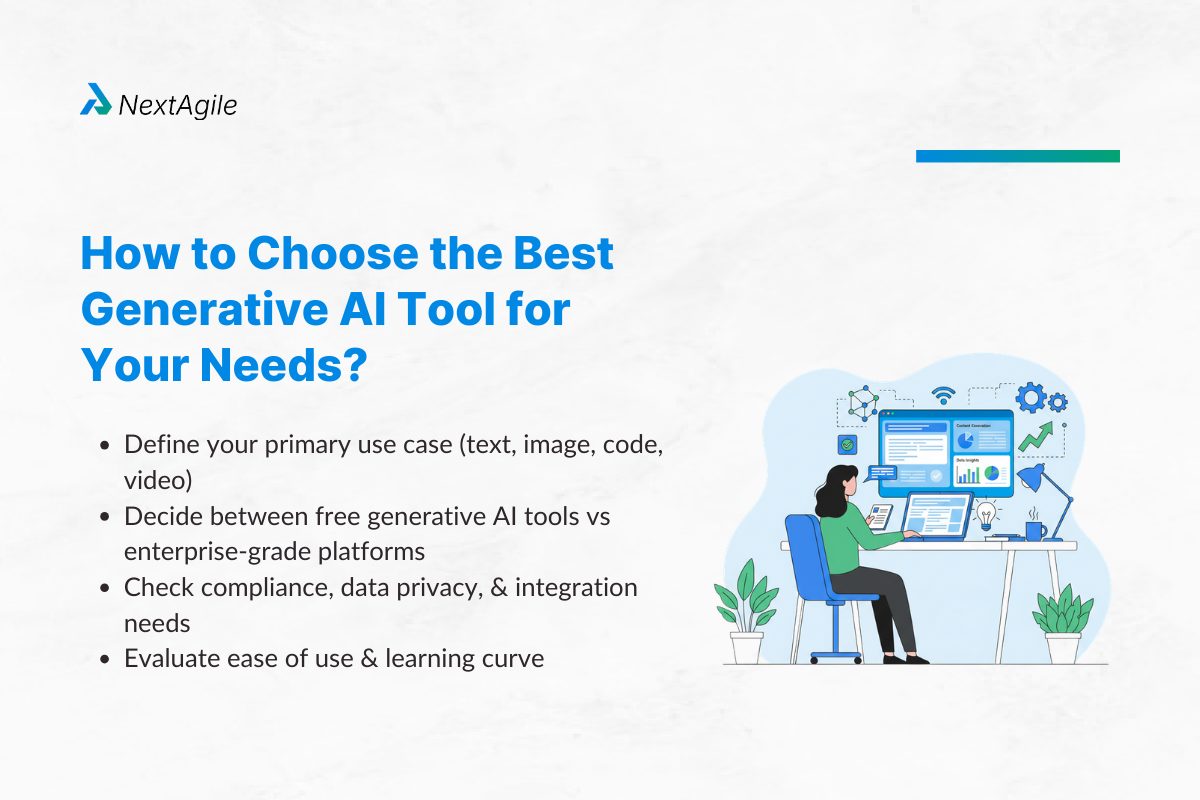
How to Choose the Best Generative AI Tool for Your Needs?
Define your primary use case (text, image, code, video) Decide between free generative AI tools vs enterprise-grade platforms Check compliance, data privacy, and integration needs Evaluate ease of use and learning curve A simple decision lens I use with leadership teams:
Individuals need ease of use. Teams need integration. Enterprises need governance. Choose tools accordingly.
Starting with enterprise platforms before teams build habits usually slows adoption.
For enterprise adoption, consider expert guidance like Generative AI Consulting Services or hands-on enablement via the Generative AI workshop by NextAgile .
Conclusion In 2026, generative AI tools are no longer optional; they are core productivity infrastructure. From content and design to coding and automation, the best generative AI tools help teams do more with less effort. The key is choosing the right mix of tools aligned to your goals, governance needs, and team maturity.
Start small, test outcomes, and scale responsibly. When used well, generative AI doesn’t replace humans; it amplifies them.
What this looks like inside real teams
Organizations getting meaningful value from generative AI in 2026 are embedding AI directly into everyday workflows and not just experimenting:
Marketing teams using AI to compress campaign planning cycles from weeks to days. Product teams accelerating discovery synthesis and roadmap alignment. Engineering teams reduce repetitive coding and documentation overhead. Operations teams automating reporting, knowledge retrieval, and internal support. The impact shows up as faster execution, clearer decisions, and reduced cognitive load across roles. Time to go beyond isolated productivity wins.
A practical way to get started
Instead of adopting multiple tools at once, successful teams follow a simple progression:
First, identify 2-3 high-friction activities consuming disproportionate time. Next, pilot AI against those workflows with clear success criteria (speed, quality, and effort reduction). Then, standardize what works and train teams on responsible usage patterns. Governance, security, and data boundaries should evolve alongside adoption. This keeps experimentation safe while allowing momentum to build.
Final perspective
Generative AI doesn’t create advantages on its own.
Advantage comes from teams that combine AI with strong operating discipline: clear ownership, outcome-focused workflows, and continuous learning loops.
In 2026, the differentiator will be who integrates it thoughtfully by turning everyday work into faster insight, sharper execution, and sustained business impact. It won’t be who uses AI.
By now, most organizations understand that generative AI is here to stay.
The real question is no longer whether to adopt but how deliberately.
Frequently Asked Questions 1. Are generative AI tools suitable for small businesses and startups? Yes. Many of the best free generative AI tools, like ChatGPT, Codeium, and Canva AI offer strong capabilities with minimal cost.
2. Which generative AI tools offer the best free plans? ChatGPT, Canva AI, Grammarly, Codeium, and Descript are among the top free generative AI tools.
3. Do generative AI tools require technical skills to use? Most don’t. Many tools are no-code or low-code, designed for non-technical users.
4. How accurate is the content produced by generative AI tools? Accuracy is high for general tasks but still requires human review for critical use cases.
5. Will generative AI tools replace human creativity in the future? No. They enhance creativity by removing repetitive work, not replacing human imagination, judgment, or strategic thinking.
6. How should enterprises govern generative AI usage? High-performing organizations define three things early: acceptable use policies, data boundaries, and human review expectations. Clear guidance builds confidence and accelerates adoption.
The most successful teams don’t treat generative AI as a tool category. They treat it as a capability. They redesign workflows, clarify ownership, and train people to collaborate with AI responsibly. Because productivity doesn’t come from prompts. It comes from disciplined execution amplified by intelligent systems.
7. What is the difference between Generative AI vs AI? Generative AI is a specialized branch of artificial intelligence designed to create original outputs rather than simply analyze or predict. It can produce text, images, audio, and even code by learning patterns and structures from vast training datasets. Unlike traditional AI, which focuses on decision-making or classification, generative AI synthesizes new data that resembles its training input.
 Skip to content