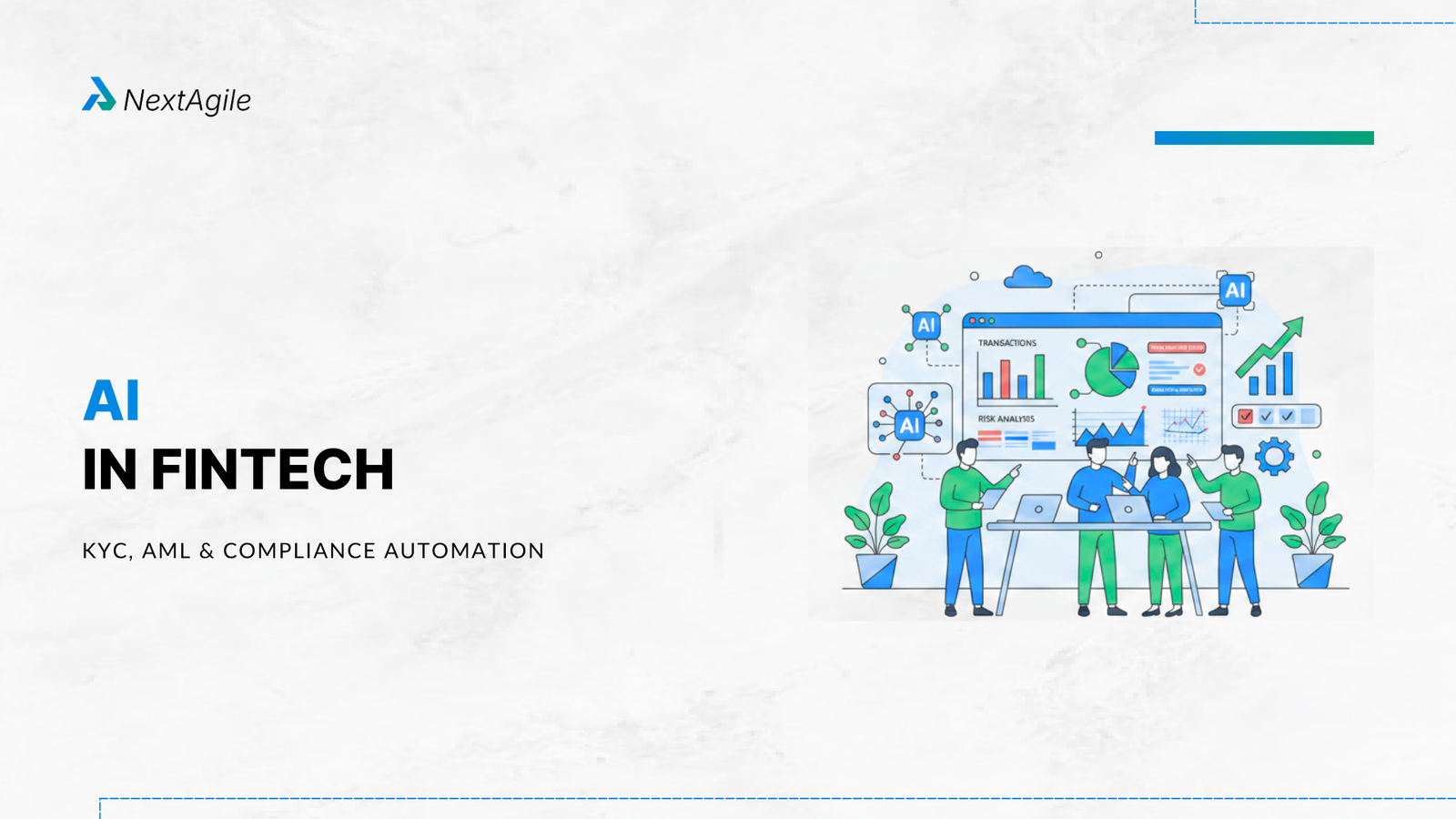
Key Takeaways of AI in Fintech
- AI in fintech is now essential for scaling KYC, AML, and compliance efficiently
- Machine learning reduces AML false positives by up to 50%+
- Generative AI accelerates regulatory reporting and AML investigations
- Explainable AI is mandatory for RBI-aligned compliance frameworks
- Agentic AI enables continuous, real-time compliance monitoring
- Agile delivery is critical for adapting to regulatory changes in India
- Fintechs that delay AI adoption risk higher fraud losses and slower growth
Introduction
In 2026, fintech companies that haven’t embedded AI into compliance workflows are already falling behind on onboarding speed, fraud detection, and regulatory responsiveness.
You’ve probably seen this firsthand.
Customers expect instant onboarding. Regulators expect airtight compliance. And fraudsters? They’re getting smarter by the day.
Traditional compliance systems simply weren’t built for this scale.
Here’s what’s changed: AI in fintech is no longer just about automation; it’s about decision intelligence at scale. The ability to interpret regulations, detect risk patterns, and act in real time.
And generative AI consulting services are accelerating that shift even further.
But (and this is where most companies struggle), adopting AI doesn’t guarantee results. Poor implementation, lack of governance, and siloed teams often derail even well-funded initiatives.
In our experience at NextAgile, the difference between success and failure isn’t the model; it’s how you design, deliver, and govern AI systems.
Let’s break down what actually works.
Why AI and Fintech Are a High-Stakes Combination
The Scale of the Problem: Why Traditional Compliance Methods Are Failing Indian Fintech
Compliance today isn’t just complex; it’s overloaded.
Think about the numbers:
- Millions of transactions daily
- Real-time payment systems
- Increasing fraud sophistication
Manual reviews and rule-based systems simply can’t keep up.
Worse, they create hidden inefficiencies:
- AML teams spend up to 70% of time on false positives
- KYC delays lead to 20-30% customer drop-offs
- Compliance backlogs increase regulatory risk
This is where AI in fintech changes the game. Instead of static rules, machine learning models continuously learn from transaction patterns, detect anomalies, and prioritize real risks.
One mid-sized Indian fintech we worked with at NextAgile reduced AML false positives by 52% in under 4 months, cutting the investigation workload nearly in half. That’s not incremental improvement. That’s operational transformation.
India’s Regulatory Landscape in 2026: RBI, SEBI, DPDP Act, and What They Mean for AI Deployment
Regulation in India is evolving fast, and it’s getting stricter.
You’re dealing with:
- RBI guidelines on digital lending and model governance
- SEBI’s push for advanced market surveillance
- The DPDP Act enforcing strict data privacy and consent
Here’s the critical shift: AI increases accountability, not reduces it.
Regulators now expect:
- Explainable decision-making
- Model auditability
- Transparent data usage
This makes AI model risk management in banking a top priority.
At NextAgile, we’ve seen that fintechs that bake compliance into AI architecture early move faster and avoid costly rework later.
Core AI Use Cases in Fintech Compliance and Regulatory Operations
1. AI-Powered KYC Automation: Faster Onboarding, Fewer Manual Errors
KYC is often the biggest friction point.
AI transforms onboarding by:
- Automating document verification
- Using facial recognition for identity matching
- Detecting tampered or synthetic identities
Result? Onboarding in minutes and not in days.
More importantly, it reduces drop-offs and ensures consistency.
2. AML Transaction Monitoring: Reducing False Positives with Machine Learning
Traditional AML systems generate noise.
Machine learning reduces it by:
- Learning behavioral patterns
- Identifying real anomalies
- Prioritizing high-risk alerts
In practice, this means fewer wasted hours and better risk coverage.
3. Regulatory Reporting Automation with NLP and Generative AI
Compliance reporting is repetitive and error-prone.
Generative AI solves this by:
- Auto-generating reports from structured data
- Standardizing regulatory language
- Tracking policy changes dynamically
This is one of the fastest ROI areas for gen AI in fintech.
4. Credit Risk Scoring: Beyond CIBIL
Traditional models exclude too many users.
AI enables machine learning credit scoring using:
- Transaction behavior
- Alternative data
- Digital footprints
This unlocks lending for thin-file customers, without increasing risk.
5. Fraud Detection and Market Surveillance
Fraud patterns are now adaptive, using mule accounts, synthetic identities, and cross-platform laundering that rule-based systems simply can’t catch.
AI detects:
- Real-time anomalies
- Suspicious trading patterns
- Insider signals
This is where AI fraud detection in fintech becomes mission-critical.
6. Explainable AI (XAI) for Audit and Regulatory Accountability
Black-box AI doesn’t work in finance.
Explainable AI ensures:
- Decisions are traceable
- Models are auditable
- Bias is detectable
In 2026, this isn’t optional; it’s regulatory baseline.
Generative AI in Fintech Compliance: What Actually Changes in 2026
This is where many blogs stay abstract. Let’s make it real.
Before vs After Generative AI
Before Gen AI:
- AML investigator spends 45 minutes reviewing one alert
- Regulatory updates require manual legal interpretation
- Reports take days to compile
After Gen AI:
- Alerts summarized in seconds with risk context
- Policy changes interpreted instantly
- Reports generated automatically
That’s a 10x productivity shift.
LLMs for Regulatory Policy Interpretation
LLMs can:
- Parse complex regulatory documents
- Highlight changes
- Suggest implementation steps
This reduces dependency on manual legal reviews.
Agentic AI for Continuous Compliance Monitoring
Agentic AI acts autonomously, which is why many fintech teams begin with an Agentic AI Workshop before scaling enterprise use cases:
- Monitors transactions
- Flags anomalies
- Triggers workflows
It’s like a 24/7 compliance engine.
Gen AI for AML Investigation Support
AI assists investigators by:
- Summarizing alerts
- Providing context
- Recommending next actions
This shifts focus from data gathering → decision-making.
The Delivery Challenge: Why AI in Fintech Compliance Fails Without Agile Teams
Here’s the uncomfortable truth: most AI compliance projects don’t fail because of technology. They fail because of delivery, which is why many fintech firms invest in agile consulting services to improve execution speed.
Compliance Is Not a One-Time Milestone
Regulations change constantly.
Treating compliance as a one-time project leads to:
- Outdated systems
- Increased risk
- Slow response times
How Agile Reduces Time-to-Compliance
Agile enables:
- Continuous updates
- Faster iterations
- Better alignment
Many fintech leaders are now combining compliance systems with AI and agile methodology to improve decision speed.
For example, regulatory changes that take 3-6 months to implement in traditional setups can be reduced to weeks.
Building Cross-Functional AI Teams
Successful fintech AI teams often emerge faster with structured leadership training programs and cross-functional enablement. Successful fintech AI teams include:
- Compliance experts
- Data scientists
- Engineers
- Risk analysts
At NextAgile, we treat AI compliance as a continuous delivery system, embedding regulatory updates into sprint cycles and not static releases.
AI Compliance Framework for Fintech (Practical Model)
To simplify implementation, think in layers:
- Data Layer – Customer, transaction, and behavioral data
- Model Layer – ML models for KYC, AML, fraud detection
- Explainability Layer – XAI tools for transparency
- Governance Layer – Audit, compliance, and monitoring
This layered approach ensures scalability and regulatory alignment, especially for firms preparing for enterprise growth through AI + Agile at Scale models.
Key Risks and Governance Considerations
Model Risk Management
AI models must be:
- Validated
- Monitored
- Documented
Data Privacy and DPDP Act
Ensure:
- Consent-driven data usage
- Transparency
- Security
Algorithmic Bias in Credit Scoring
Bias can lead to:
- Regulatory penalties
- Customer distrust
Fairness must be built into models.
Third-Party AI Vendor Risk
Using external tools? You’re still accountable.
The Cost of Inaction: Why Delaying AI Is Risky
This is where many fintech leaders underestimate the impact.
Delaying AI adoption leads to:
- 20-30% higher customer drop-offs due to slow KYC
- Increased fraud exposure
- Higher operational costs
- Slower regulatory response
In a competitive market, that’s not just inefficiency; it’s lost revenue.
How Indian Fintech Leaders Should Build AI + Compliance Capability
Step 1 – Assess Your Compliance Baseline
Map:
- KYC turnaround time
- AML false positive rates
- Audit backlog
Without this, you can’t measure impact. Many organizations use OKR consulting services to track AI compliance outcomes more effectively.
Step 2 – Prioritize High-ROI Use Cases
Start with:
- KYC automation
- Fraud detection
Step 3 – Design for Explainability
Don’t retrofit compliance. Build it in.
Step 4 – Adopt Agile Governance
Embed compliance into delivery cycles. At NextAgile, this approach consistently reduces time-to-compliance while improving system resilience.
Conclusion
AI in fintech isn’t just transforming compliance; it’s redefining it. From KYC automation to generative AI-driven reporting, intelligent systems are becoming the backbone of financial operations.
But success depends on execution. The fintech leaders who win in 2026 won’t just adopt AI, they’ll implement it with governance, explainability, and Agile delivery at the core.
Because the real question isn’t whether AI matters.
It’s whether your organization is ready to use it effectively. If your fintech teams are struggling with compliance bottlenecks, rising fraud risks, or slow regulatory response cycles, a structured AI-driven compliance approach becomes essential.
At NextAgile AI Consulting services, we help enterprises redesign their operating models to embed AI into decision systems, ensuring organizations move beyond delivery efficiency to decision intelligence at scale. You can reach us at consult@nextagile.ai to explore more.
Frequently Asked Questions
Q1: How is AI used in fintech compliance in India?
AI is used for KYC automation, AML monitoring, fraud detection, and regulatory reporting.
Q2: What are RBI guidelines on AI?
They focus on explainability, governance, and model risk management.
Q3: AI vs generative AI in fintech?
AI analyzes data; generative AI creates reports, summaries, and insights.
Q4: How to stay compliant with DPDP Act?
Ensure consent-based, transparent, and secure data usage.
Q5: Why do AI projects fail in fintech?
Poor delivery models and lack of Agile execution are the main reasons.