Skip to content



Introduction
Goal setting is the cornerstone of both personal and organizational success. Whether you’re leading a team, managing a business, or pursuing individual development, having clear objectives gives you direction, focus, and purpose. However, not all goals are created equal. Some goals inspire but lack clarity, while others are so structured that execution becomes effortless. This is where the concept of SMART goals enters the picture. At a practical level, the difference comes down to this: goals express intent, while SMART goals enable execution. One tells you where you’d like to go; the other shows you how you’ll actually get there.
In this blog, we’ll explore the difference between goals and SMART goals, why it matters, and how you can transition from vague aspirations to actionable objectives. We’ll also dive into practical examples, best practices, and tips for aligning goals with the SMART framework.
Why Goal Setting Matters in Business and Personal Growth?
Effective goal setting acts as a decision filter. It helps leaders prioritize investments, guides daily actions, and provides teams with clarity during competing demands. Imagine a company that says, “We want to be the best in our industry.” Sounds ambitious, right? But without a clear roadmap, this statement is nothing more than a wish. Goals give individuals and teams a reason to act and a benchmark to measure success. For businesses, goals influence everything—from strategy and resource allocation to employee motivation and customer satisfaction.
But here’s the catch: setting goals incorrectly can lead to frustration, misalignment, and wasted effort. This is where the SMART goal framework offers a proven methodology to make goals specific, measurable, achievable, relevant, and time-bound. In fast-moving organizations, this structure isn’t optional — it’s what turns strategy into coordinated action.
Overview of Traditional Goals vs SMART Goals
The distinction is subtle but powerful. Traditional goals define what you want. SMART goals define what success looks like and when you’ll reach it. Traditional goals are often broad and aspirational. For example, “Improve customer satisfaction” or “Get fit.” While they sound positive, they lack details on how success will be achieved or measured. SMART goals, on the other hand, transform these broad ideas into structured, actionable, and trackable objectives.
What Are Traditional Goals?
Definition and Characteristics
Traditional goals are general statements of what you want to achieve. They focus on the end result but rarely provide guidance on the how or when. These goals are:
- Broad and unspecific: “Increase revenue” or “Learn a new skill.”
- Unmeasurable: You can’t easily track progress.
- Open-ended: No clear deadlines.
- Lack accountability: Difficult to assign ownership.
These goals often serve as inspiration or direction-setting, but they rarely support operational planning on their own.
Examples of Vague or General Goals
- “Improve team performance.”
- “Get healthier.”
- “Enhance customer experience.”
- “Boost sales.”
Without added clarity, teams interpret these goals differently, leading to fragmented execution and inconsistent outcomes.
While these intentions are good starting points, they lack the clarity needed for execution and progress tracking.
What Are SMART Goals?
Definition of the SMART Acronym
SMART stands for:
- Specific: Clear and well-defined.
- Measurable: Quantifiable with metrics.
- Achievable: Realistic and attainable.
- Relevant: Aligned with broader objectives.
- Time-bound: Has a clear deadline.
Together, these five elements transform ambition into commitment and ideas into action.
Benefits of Using the SMART Framework
- Eliminates ambiguity.
- Provides measurable checkpoints.
- Enhances accountability within teams.
- Increases motivation by making success feel achievable.
- Facilitates progress tracking and performance evaluation.
More importantly, SMART goals create a shared understanding of success across individuals, teams, and leadership.
Simple vs SMART: How Clarity Improves Execution
Consider these two goals:
- Traditional Goal: “Improve employee engagement.”
- SMART Goal: “Increase employee engagement scores by 15% in the next six months through monthly team-building sessions and feedback surveys.”
Notice how the SMART version answers three critical questions immediately:
- What exactly will improve?
- By how much?
- By when?
The second goal removes guesswork, offers a metric for success, and sets a deadline.
Key Differences Between Goals and SMART Goals
While both have their place, they serve fundamentally different purposes in planning and execution.
Intent and Structure
- Traditional Goals: Broad statements about what you want to achieve.
- SMART Goals: Structured, detailed, and actionable objectives.
Outcome Predictability
- Goals: Provide direction but lack measurable indicators.
- SMART Goals: Offer clear outcomes with trackable progress.
Alignment and Accountability
- Goals: Hard to assign ownership and accountability.
- SMART Goals: Assignable to specific individuals or teams with defined responsibilities.
Use Cases
- Goals: Ideal for high-level vision setting or brainstorming.
- SMART Goals: Perfect for execution, tracking, and evaluation.
In practice, organizations use both: broad goals to set direction and SMART goals to drive delivery.
Comparison Table: Examples of Goals vs SMART Goals
| Aspect | Traditional Goal | SMART Goal |
| Team Performance | Improve team performance | Increase project delivery speed by 20% in Q3 using Agile methods |
| Fitness | Get fit | Lose 10 lbs in 3 months by exercising 5x/week & 1500-calorie diet |
| Customer Satisfaction | Enhance customer experience | Raise CSAT score from 75% to 90% in 2 quarters via faster responses |
| Sales | Boost sales | Increase quarterly revenue by 15% through 2 new market expansions |
| Learning | Learn a new skill | Complete an online Python course within 6 weeks |
This side-by-side view highlights how SMART goals convert intent into operational commitments.
Examples of Goals vs SMART Goals
Example 1
- Goal: “Improve team performance.”
- SMART Goal: “Increase project delivery speed by 20% in Q3 by implementing Agile methodologies and weekly sprints.”
Example 2
- Goal: “Get fit.”
- SMART Goal: “Lose 10 pounds in three months by exercising 5 times per week and following a 1,500-calorie diet.”
Example 3
- Goal: “Enhance customer satisfaction.”
- SMART Goal: “Raise customer satisfaction score from 75% to 90% within the next two quarters by improving response time and launching a loyalty program.”
Across every example, the pattern is consistent: SMART goals remove ambiguity, introduce metrics, and create timelines that teams can rally around. These examples show why SMART goals vs regular goals comparison is so important—SMART goals bring structure and clarity to execution.
Why SMART Goals Work Better in Organizations
SMART goals bring discipline to execution without limiting creativity by providing structure while leaving room for innovation.
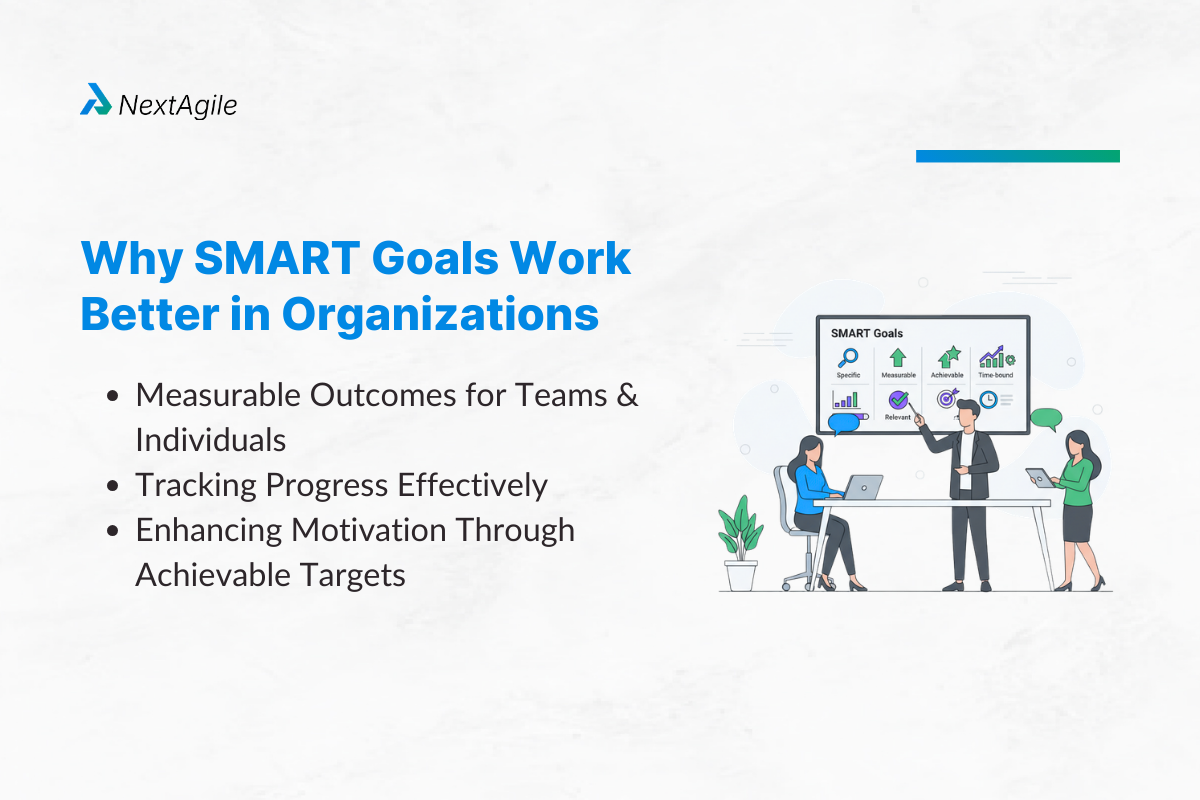
1. Measurable Outcomes for Teams and Individuals
SMART goals include metrics, which means progress can be objectively evaluated rather than relying on subjective judgment. This objectivity reduces bias and creates transparency across performance discussions.
2. Tracking Progress Effectively
With defined deadlines and measurable outcomes, tracking becomes systematic. Managers can use dashboards, scorecards, or spreadsheets for monitoring. Visibility into progress enables earlier interventions and smarter adjustments.
3. Enhancing Motivation Through Achievable Targets
When employees know exactly what success looks like and believe it’s attainable, they’re more motivated to achieve it. Small wins become visible, reinforcing momentum and confidence.
Common Pitfalls in Goal Setting (And How SMART Goals Solve Them)
Most goal-setting failures stem from lack of clarity, unrealistic expectations, or missing timelines, exactly what SMART goals are designed to address.
Pitfall 1: Ambiguity
- Example: “Increase revenue.”
- Solution: “Increase quarterly revenue by 10% by expanding into two new markets.”
Pitfall 2: Lack of Deadlines
- Example: “Start a blog.”
- Solution: “Publish 10 blog posts by the end of Q2.”
Pitfall 3: Unrealistic Ambitions
- Example: “Double sales in one month.”
- Solution: “Increase sales by 10% over the next three months.”
SMART goals provide clarity, focus, and realism, reducing frustration and confusion.
How to Transition from Vague Goals to SMART Goals?
You don’t need to start from scratch. Most SMART goals begin as general ideas and evolve through simple refinement.
Step-by-Step Method
- Start with a General Goal: “Improve website traffic.”
- Make It Specific: “Increase website traffic by 25%.”
- Add Measurability: Use Google Analytics to track visits.
- Ensure Achievability: Based on past trends, is 25% realistic?
- Check Relevance: Align with business growth strategy.
- Add a Time Frame: “…within the next 90 days.”
Repeating this exercise across key objectives quickly builds a SMART-thinking habit across teams.
This structure works equally well for individual development plans, team OKRs, and business initiatives.
- Your Generic Goal Goes Here:
Example – Improve website traffic
- SMART Goal:
- Make it Specific:
Example – Increase website traffic by 25%
- Add Measurability:
Example – Use Google Analytics to track visits
- Ensure Achievability:
Example – Based on past trends, is 25% realistic
- Check Relevance:
Example – Align with business growth strategy
- Add a Time Frame:
Example – Within the next 90 days
When to Use General Goals vs SMART Goals?
The key is knowing when to stay conceptual and when to become concrete.
Strategic Vision
- General goals are great for setting an overarching vision (e.g., “Become a market leader”).
Operational Execution
- SMART goals break down the vision into measurable, actionable steps (e.g., “Capture 15% market share in 18 months by launching 3 new products”).
Conclusion
The difference between goals and SMART goals is not just semantic—it’s practical and transformative. Traditional goals give you direction, but SMART goals give you a roadmap. They are specific, measurable, achievable, relevant, and time-bound, making execution easier and success more predictable. Organizations that consistently apply SMART goals experience stronger alignment, faster execution, and more predictable results.
If you want to turn ideas into results, start rewriting your general goals into SMART goals today. This approach works for both personal development and organizational growth. Start small. Pick one current goal and rewrite it using the SMART framework, you will immediately notice the difference in clarity.
Download Your Free SMART Goal-Setting Template and start setting clear, actionable objectives that drive results.
If you’re looking to implement smart goals in your organization, consider partnering with a trusted leadership training company like NextAgile that aligns contextual leadership training programs with executive coaching and overall organizational agility. Our team excels at aligning leadership development with organizational objectives.
Frequently Asked Questions
1. Are SMART goals always necessary?
Not always. For big-picture thinking and brainstorming, general goals work fine. SMART goals are essential for execution and accountability.
2. How do SMART goals impact team alignment?
They ensure everyone knows the expectations, metrics, and deadlines, reducing confusion.
3. Can SMART goals be flexible?
Yes. They should adapt to changing business priorities without losing their structure.
4. How often should goals be reviewed and revised?
Regular reviews—monthly or quarterly—are ideal to track progress and adjust targets.
5. What’s the best tool to track SMART goals?
Options include spreadsheets, OKR tools like Profit.co or Weekdone, and project management platforms like Asana and Trello.