Leadership Qualities: How to Develop the Skills That Inspire, Motivate, and Lead
Alok Dimri
Talk to Expert for Free
Table of Contents
Introduction
Why do some leaders inspire greatness while others struggle to get buy-in? The difference usually comes down to leadership qualities. Titles don’t create influence, skills, habits, and mindsets do. Leadership influence emerges long before authority does, often through everyday behaviors that signal trust, clarity, and intent.
In today’s workplace, leadership isn’t about commanding from the top. It’s about engaging people, inspiring action, and guiding teams toward shared success. Modern leadership success depends less on control and more on connection.
The good news? Leadership traits aren’t fixed. With awareness, feedback, and practice, anyone can strengthen them. In this blog, we will take a closer look at what defines true leadership today, the key qualities of a good leader, and how you can intentionally develop these skills. Developing leadership qualities is therefore not an abstract exercise, but a practical investment in daily effectiveness.
What defines true leadership in the workplace today?
Leadership has transformed. It’s not about the hierarchy anymore but connection and clarity. It’s about creating direction, inspiring action, and building resilience among teams. Clarity of intent and consistency of behavior now matter more than positional power.
Consider this: hybrid work, global teams, and accelerating change call for leaders who can adapt, empathize, and engage across contexts. Employees don’t merely want direction, they want meaning, recognition, and growth. Leadership today is experienced through moments, not mandates.
From our experience as a leadership coaching company, leaders who do best are the ones who listen deeply, respond quickly, and stay anchored under stress. Leadership is not a position you find yourself in; it’s a set of traits that you embody every day in how you connect, make decisions, and motivate. Sustainable leadership influence is built through repeated, observable actions.
The impact of strong leadership on organizational success
Strong leadership skills spread throughout an organization. Leadership behaviors cascade quickly, shaping norms far beyond formal authority.
A strong leader with integrity and vision enhances trust and alignment.
A clear communicator is a friction-reducing leader.
An empathetic and resilient leader maintains morale during times of uncertainty.
Studies consistently report that engaged leadership leads to higher employee retention, innovation, and productivity. In fact, when leaders show empathy and accountability, teams are almost twice as likely to surpass performance objectives. Performance outcomes often reflect leadership behavior more than strategy alone.
At NextAgile, we’ve seen organizations transform when leaders move beyond management tasks and embody leadership characteristics. They don’t just improve business results, they shape culture. The right leadership qualities elevate not only individuals but entire companies, creating workplaces where people thrive and businesses scale sustainably. Culture becomes a competitive advantage when leadership qualities are consistently modeled.
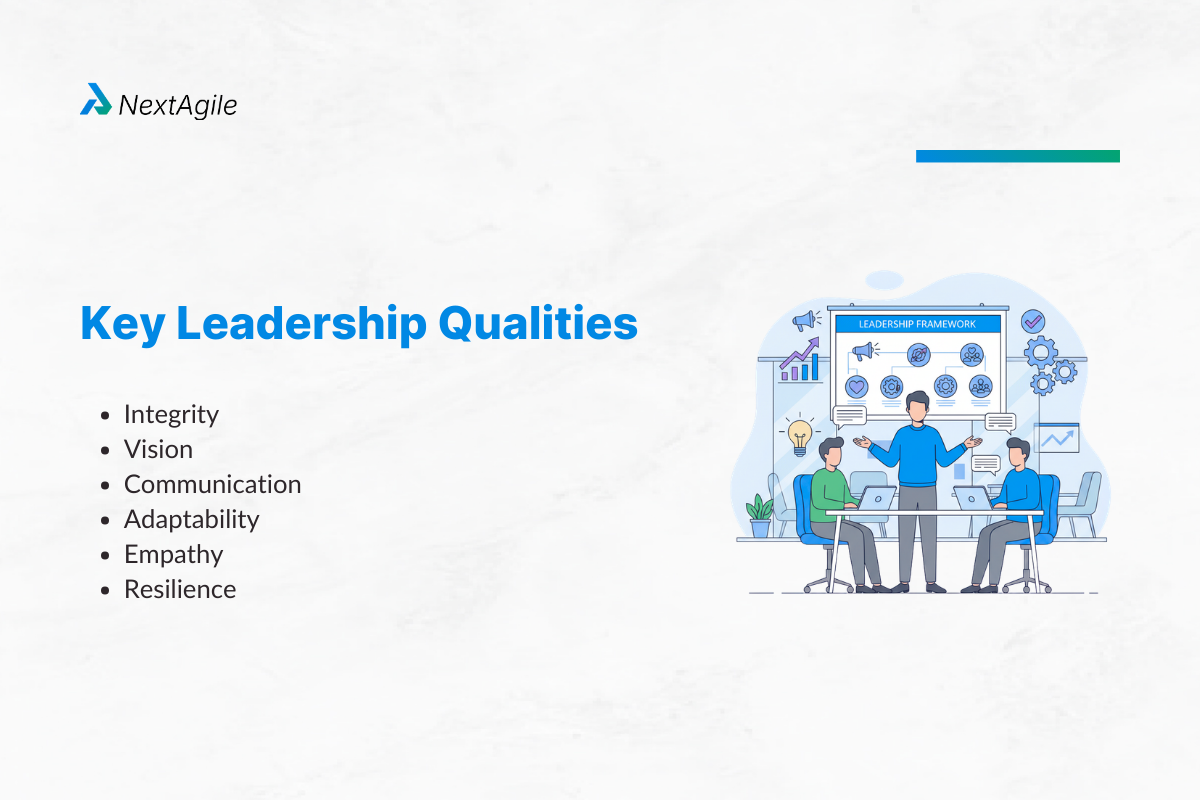
Key Leadership Qualities
Integrity
Integrity is the foundation of trust. Leaders who commit and act openly create credibility with their teams. Without integrity, influence disintegrates rapidly. In coaching sessions, I remind executives: every choice sends a message. When words and actions match, people follow you willingly, not because they must, but because they want to. Trust compounds over time when leaders act predictably and ethically.
Vision
Great leaders don’t just manage the present, they imagine the future. Vision means seeing possibilities others miss and rallying people toward them. A clear vision guides priorities and energizes teams. Whether you’re leading a small unit or a global enterprise, your ability to articulate “where we’re going and why” separates good managers from transformative leaders. Vision aligns effort by providing context, not just direction.
 Skip to content