
Introduction
In today’s dynamic business environment, organizations need structured goal setting frameworks to maintain focus, drive accountability, and achieve sustainable growth. Among the most widely used frameworks are OKRs (Objectives and Key Results) and KRAs (Key Result Areas). However, many leaders struggle to understand OKR vs KRA differences, how they complement each other, and when to apply each effectively.
KRAs are primarily focused on mastering routines, streamlining processes and ensuring that nothing should break i.e. business continuity is assured. KRAs enable us to focus on the fulfilment of core business objectives which are structurally defined and monitored using OKRs. Just like following gardening routines of watering plants, pruning, and fertilizing are KRAs to achieve the objective of winning a contract of routine supply of beautiful flowers & plants to premier hotels in the city. You could define the key results to monitor fulfilment of objectives like “increase ticket size by 30%”, “achieve a consistent branding across various online and offline platforms”, and “win the first overseas contract in 6 months”. In short, KRAs are the daily watering and weeding that keep the garden alive and healthy (business as usual), while OKRs are the bold targets like ‘supply flowers to 5-star hotels’ that push the garden to new levels of quality and reach.
Comparing OKRs and KRAs matters because both impact organizational alignment, employee motivation, and performance measurement. This blog will break down the difference between OKR and KRA, provide real world examples, and share implementation strategies to integrate them successfully.
Why Comparing OKRs and KRAs Matters for Performance Frameworks?
Choosing between OKRs and KRAs or using both can make or break your performance management system. The wrong approach often results in:
- Misaligned goals across teams
- Poor visibility of outcomes
- Confusion between responsibilities and measurable achievements
Understanding objectives key results vs key result areas helps you design a framework that balances strategic ambition and operational stability.
What Are OKRs vs KRAs?
Define OKRs: Objectives & Key Results
OKRs are a goal setting framework designed to align teams and individuals with measurable outcomes. They answer two critical questions:
- What do we want to achieve? (Objective)
- How will we measure success? (Key Results)
Example:
- Objective: Improve customer satisfaction
- Key Results:
- Increase NPS score from 40 to 55
- Reduce average response time from 12 hours to 4 hours
- Achieve 90% CSAT on all support tickets
OKRs are time bound, usually set quarterly, and encourage stretch goals.
Define KRAs: Key Result Areas
KRAs, on the other hand, represent responsibility areas tied to a role or function. They define what an employee is accountable for on an ongoing basis.
Example:
- KRA: Customer Support
- Performance Indicators:
- Maintain average ticket resolution within 6 hours
- Keep CSAT above 85%
Unlike OKRs, KRAs are continuous and role based, focusing on operational performance rather than aspirational objectives.
Core Differences Between OKRs and KRAs
Here’s a quick breakdown of OKR vs KRA differences:
| Aspect | OKR | KRA |
| Focus | Outcomes & impact | Responsibility & tasks |
| Nature | Aspirational & stretch oriented | Continuous & operational |
| Timeframe | Quarterly or annually | Ongoing |
| Measurement Style | Outcome focused (what changed?) | Output/consistency focused (did we maintain standards?) |
| Purpose | Drive change & innovation | Maintain role clarity |
| Risk & Ambition | Embraces stretch (70% achievement often = success) | Focuses on reliability (aim for 90–100% consistency) |
| Link to Compensation | Rarely direct (to avoid sandbagging) | Often tied (suitable for role accountability and bonuses) |
Simply put, OKRs are about what to achieve and how to measure it, while KRAs define areas where employees must deliver consistently.
When to Use OKRs vs KRAs?
OKRs: Best for Growth, Innovation & Strategic Change
OKRs are ideal when you are:
- Entering a new market
- Launching strategic initiatives
- Driving innovation or digital transformation
- Needing alignment across cross functional teams
KRAs: For Operational Consistency & Role Clarity
KRAs work best when:
- Roles have ongoing responsibilities
- Performance needs to be stable and measurable
- Focus is on efficiency and compliance
Combining OKRs and KRAs for Comprehensive Performance Management
Many organizations adopt both frameworks for a balanced approach:
- Use OKRs for strategic, time bound objectives
- Use KRAs for day to day operational accountability
Example:
- KRA: Financial Reporting Accuracy
- OKR: Reduce month end close process from 10 days to 5 days this quarter
Strategic Ambition + Operational Stability
OKRs drive growth; KRAs ensure compliance, organizations blending both report better alignment and fewer operational breakdowns.
Clear Accountability
Everyone knows their responsibilities (KRAs) and their contribution to big picture goals (OKRs), recent benchmarks show teams with linked frameworks achieve higher execution rates.
Balanced Performance
Encourages both innovation (OKRs) and efficiency (KRAs), leading to sustained results without burnout.
Implementation Strategies
How do you roll out OKRs and KRAs together without overwhelming teams? Here’s a roadmap:
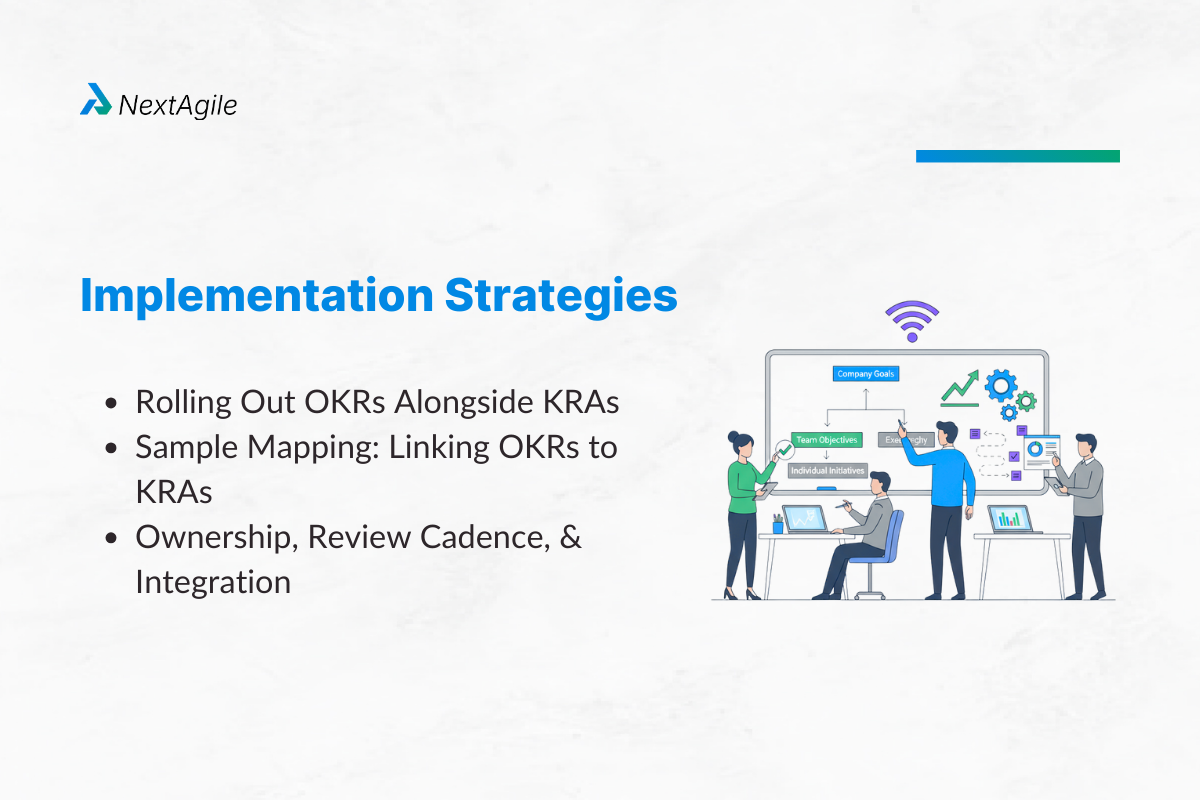
1. Rolling Out OKRs Alongside KRAs
- Start with mapping organizational objectives to OKRs
- Be mindful to maintain role based KRAs for job clarity
- Avoid duplication (to avoid confusion) – OKRs should not repeat KRAs
2. Sample Mapping: Linking OKRs to KRAs
Example for a Sales Manager:
- KRA: Customer Acquisition
- OKR: Close 50 new enterprise accounts in Q1 with 90% renewal probability
3. Ownership, Review Cadence, and Integration
- OKRs: Reviewed quarterly
- KRAs: Evaluated annually or semi annually. Our recommendation would be to make it more continuous i.e. quarterly & continuous performance management could be done through regular 1 on 1s.
- Integration: Use dashboards that visualize both frameworks
Benefits of Using Both Frameworks Together
- Strategic Ambition + Operational Stability: OKRs drive growth; KRAs ensure compliance
- Clear Accountability: Everyone knows their responsibilities and their contribution to big picture goals
- Balanced Performance: Encourages both innovation and efficiency
Common Challenges & How to Address Them?
Challenge 1: Misalignment Between OKRs and KRAs
Solution: Clearly define the purpose of each and avoid overlap.
Challenge 2: Overlapping or Conflicting Ownership
Solution: Assign single point accountability for each OKR and KRA.
Challenge 3: Goal Fatigue
Solution: Limit the number of OKRs per team to 3 to 5 maximum.
Challenge 4: Treating OKRs as “extra work” on top of KRAs (leading to overload)
Solution: Explicitly map OKRs as accelerators within KRAs (e.g., a KRA for “Customer Support” spawns an OKR to innovate response times). Limit total OKRs to 3–5 per quarter/person to prevent dilution.
Tools & Templates for Managing OKRs and KRAs
- Spreadsheet based templates: Great for small teams. Use Excel or Google Sheets to build a goal setting framework.
- OKR platforms with KRA support:
- Lattice
- Profit.co
- Gtmhub
- Emerging AI assisted ones (e.g., for auto suggesting mappings or progress predictions).
- Dashboards: Combine OKR tracking with KRA indicators for a unified view, look for tools that visualize both in real time to spot gaps early.e
Example: Simple OKR + KRA Tracking Layout
| Objective | Key Results | KRA | Owner | Status |
| Improve product adoption | Increase active users by 25% | Product adoption strategy | Product Manager | On track |
| Strengthen customer engagement and satisfaction | Grow NPS from 60 to 75 by Q2. Increase repeat clients by 20% | Customer Relationship Management | CRM Manager | Needs Focus |
| Expand qualified sales pipeline by 40% | Add 30 new qualified leads/month. Raise conversion to 18%. | Sales Pipeline Development | Sales Team | Automated Tracking |
Conclusion
When it comes to OKR vs KRA, there’s no one size fits all answer. Both frameworks play unique roles:
- OKRs: Drive strategic ambition, innovation, and measurable impact.
- KRAs: Maintain operational stability, compliance, and clarity of responsibilities.
For the best results:
- Use OKRs for forward looking goals.
- Use KRAs for sustaining role specific accountability.
- Combine them with the right tools and governance for holistic performance management.
Final thought: Use OKRs for ambition; KRAs for accountability. In 2026’s fast changing world where stability meets rapid innovation, together they form a strong, resilient foundation for organizational success.
Ready to get started? Download NextAgile free OKR template, map your goals, and build a performance driven culture today! Explore more NextAgile OKR Consulting services to structure and implement OKRs across your business or start with NextAgile OKR Training to introduce your teams to OKRs.
FAQs
1. Can KRAs replace OKRs?
No. KRAs are about responsibility, OKRs about outcomes and growth. They serve different purposes.
2. How many KRAs should one employee have?
Typically 4 to 6 KRAs, depending on the role.
3. Should KRAs be included in bonus/comp cycles?
Yes. KRAs are linked to job accountability, making them suitable for performance reviews.
4. How often should OKRs and KRAs be reviewed together?
- OKRs: Quarterly
- KRAs: Semi annual or annual
- Combined review during performance appraisal cycles
5. Can small teams use both successfully?
Yes. Start with lightweight tools like Google Sheets for OKRs and simple KRA checklists.
6. What’s a common mistake when combining OKRs and KRAs?
Overlapping them (e.g., turning a KRA into an OKR) or treating OKRs as annual like KRAs. Fix by keeping KRAs ongoing/role based and OKRs quarterly/outcome driven. Many teams see 65%+ better alignment when they clearly separate but link them.
OKR vs KPI vs KRA
- OKR: Framework for strategic objectives and measurable results
- KPI: Metrics used within both OKRs (as Key Results) and KRAs (as indicators) to measure performance & precise tracking.
KRA: Areas of responsibility tied to roles