Introduction The industry has seen a lot of traditional goal setting frameworks. Different companies use different frameworks based on their needs. However, there has been a shift in all organizations trying to adapt to a robust milestone driven goal setting framework. What generally happens with traditional frameworks is that the goals become diluted with respect to seriousness and priority without a structured way of looking at it. Imagine if you are building a house, without proper milestones, review points and destination to reach, even the brightest of the architects may build something which you do not want. The same thing applies to organizations navigating today’s complex business environment.
This is where Objectives and Key Results (OKRs) come into picture. OKR is a strong and structured framework that brings in clarity in terms of:
Where do we want to reach? / What do we want to achieve? What are the measurable results we are looking for? / What changes when we achieve those outcomes? When do I want to achieve it? In this blog, we aim at exploring more about OKRs from an implementation perspective of course by understanding:
What are OKRs? With some examples How to implement OKR methodology? Why do we need OKR methodology and why are they popular? What is the OKR Methodology? Objectives and Key Results (OKR) is a simple yet powerful goal setting framework that brings in alignment between individuals, teams and the organization. It is a bridge that connects the strategic “What we want to achieve” with the tactical “How will we know we have achieved it”. Two main characteristics of OKR methodology are:
Define ambitious objectives Measure progress through specific, quantifiable key results Unlike traditional annual goal setting that gets diluted, OKRs remain visible, tracked and adjusted regularly. Objectives and Key results methodology creates a living system that adapts to changes but focuses on achieving goals.
A typical OKR consists of two main parts:
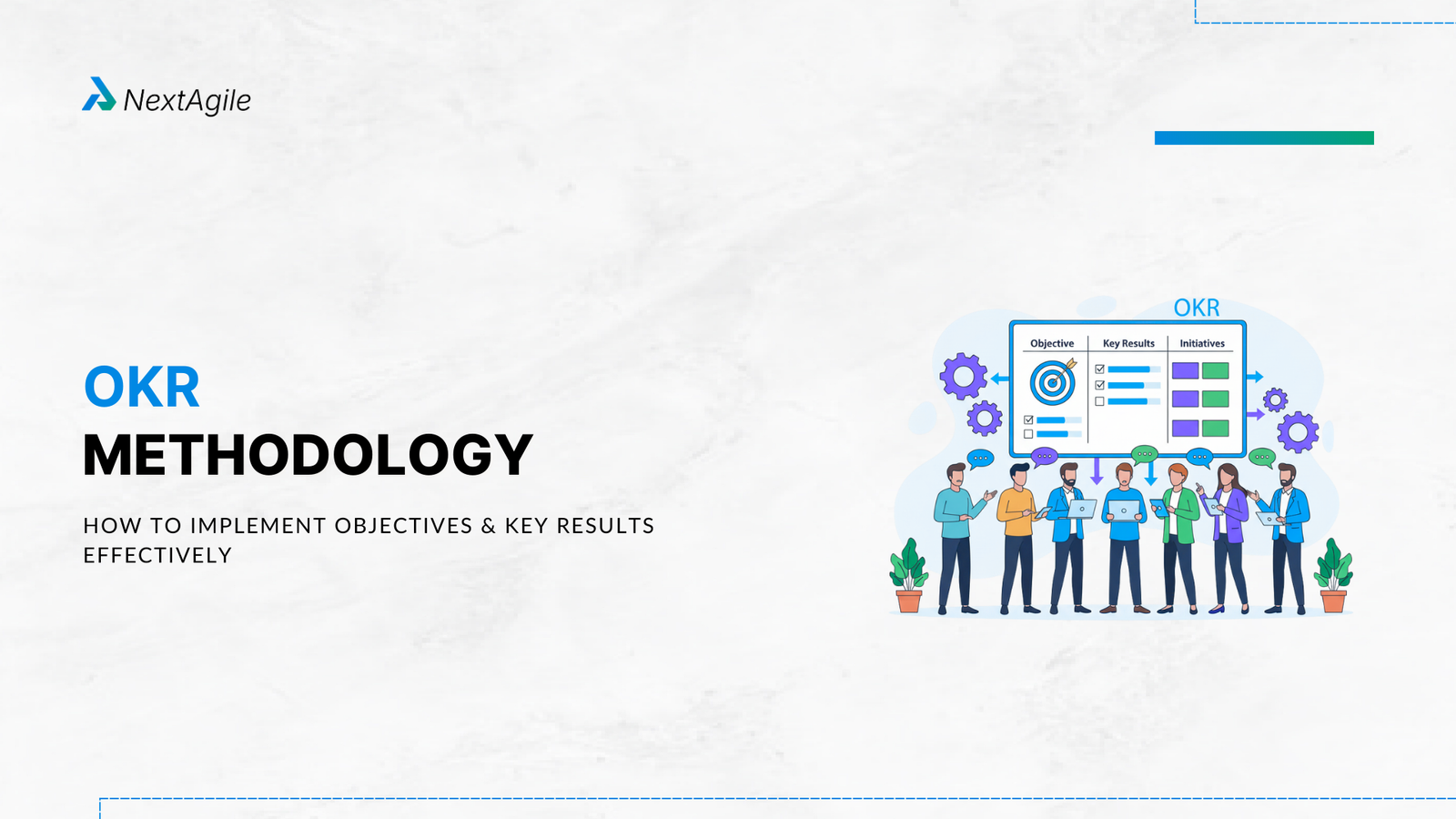
Objectives – A clear, high level goal that tells an individual, team or an organization what they want to achieve in simple englishKey Results – Specific, measurable outcomes that showcase the progress towards the objective Once aligned on theory, follow steps on how to implement OKRs .
OKR Methodology Example As discussed above, there are two important things to consider while writing an OKR. A simple statement which tells us what to achieve – Objectives and specific, measurable outcomes to track the progress of the objective – Key results. Now let’s take a look at some examples of OKRs in different domains and understand how it is defined.
Organizational OKR Example
Objective – Reduce operation cost by improving efficiencyKey Result 1 – Automate 50% of the manual tasks by Q3 2025Key Result 2 – Increase productivity by 25% with the help of tools by Q4 2025Key Result 3 – Reduce 50% of lead time by Q2 with new processes Engineering team OKR Example
Objective – Increase system quality and developer efficiencyKey Result 1 – Increase code coverage by 15%Key Result 2 – Automate 75% of the test suite by Q4Key Result 3 – Reduce 15% manual code reviews with SonarQube by Q1 2025 HR Team OKR Example Objective – Reduce Attrition rate by 25%Key Result 1 – Increase annual bonus by 10% to all engineersKey Result 2 – Host at least 5 employee engagement activities by Q4 2025Key Result 3 – Increase employee rewards by 15% Product Management OKR Example Objective – Improve customer satisfaction for Banking productsKey Result 1 – Increase NPS of the credit card products by 15 pointsKey Result 2 – Reduce customer complaints of net banking uses by 50%Key Result 3 – Conduct 5 design thinking sessions for forex teams and products Finance team OKR Example Objective – Bring in uniformity in the payroll process across the organisationKey Result 1 – Implement the new payroll systems in 3 offices by Q2Key Result 2 – Reduce Payroll errors to vendors and consultants by 30%Key Result 3 – Reduce payroll time to consultants from 24 hours to 12 hours Operations team OKR Example Objective – Centralise documentation process across the organizationKey Result 1 – Explore 3 best documentation tool in the world and finalise one by Q1 2025Key Result 2 – Pilot the finalised tool with 5 teams by Q2Key Result 3 – Normalize the tool across the organization by Q3 Please refer to our blog on OKR Examples for more such insights.
How to Implement the OKR Methodology? Global Annual Objective This is the first step and where it all starts. The company’s executive leadership, with the CEO and the board defines the general theme of global annual objectives for the year. These are high level strategic directions that everyone in the company will work towards.
Example: Become the market leader in healthcare training and coaching in Europe region.
Now this becomes your guiding star. Every individual, teams and departments in the organization will then align their objectives and prioritise activities and initiatives to achieve this. Without this charity at the top, the rest of the OKR tree is just a name sake implementation.
Objectives Once the annual objectives are set, the next step is for the portfolios, programs, teams and individuals to start defining their own objectives which are smaller and roll up to the annual objectives. Typically for a shorter cycle like a quarter. Some of the main characteristics of objectives include:
Objectives need to be ambitious yet achievable They should be qualitative and inspirational Must be time bound usually for a quarterly cycle Aligned with the annual, strategic and company objectives Example: A product’s team objectives for the annual objective mentioned above could be “Improve self learning program for nurses”
Structured OKR services help translate frameworks into measurable execution.
Key Results Once the objectives are defined, the next step is to define the measurable key results. There could be 3-4 key results for each objective. These would help everyone in the organization in monitoring the progress and tell you if you are making progress. Some of the main characteristics of key results include:
Key results must be specific and measurable. Generally tied with key metrics They should challenge the team but be within possibility They should measure the impact/outcome rather than the effort needed They must be verifiable, at the end of the cycle, you should be able to say whether you hit the target or not Example: For the object mentioned above, key results could be “Launch 3 products for self learning by Q3”, “Reduce nurse complaints by 40%”
Key Actions The last step where the actual doable work lies. While this is not a formal OKR definition, it is always recommended to link your key results with key actions or initiatives. These are the specific programs, initiatives, tasks or experiments the teams will complete to move the key results. Some of the main characteristics of key actions include:
Key actions should be actionable work items They should be assigned with ownership They can be flexible and can adapt as there is learning Example: For the key result of launching 3 products, key actions could include – Conducting a survey to understand the key pain points of nurses, developing and launching 3 level products for self learning.
Benchmark progress quickly with our OKR maturity assessment
Why does the OKR methodology work? OKR methodology is not just another jargon in the industry, they work because they bring in structure and taps the basic principle of human motivation and awareness.
It brings in clarity and focus by ensuring everyone in the company puts their energy and efforts into those 4-5 crucial things that will help them meet the goals rather than everyone putting their efforts all over When every team’s OKRs roll up to higher level objectives, it promotes alignment from top to bottom ensuring there is not silos and fosters even more better collaboration Everyone can see what everyone is working on, which improves transparency OKRs promotes setting ambitious goals which pushes the teams beyond their comfort zone which in turn leads to innovation and unexpected breakthroughs When teams are involved in setting their own objectives and key results they take even more ownership because they feel it is their baby. This leads to a higher level of autonomy and motivation within the teams The short quarterly cycles of OKR methodology ensures there are frequency check ins and adjustments. If a strategy is not working for you, discover it quickly and pivot rather than investing months or years down the wrong path. This makes the organization more agile Why is the OKR method so popular? OKR methodology became more popular and organizations started adopting it because of its ability to help organizations fit themselves to the realities of the modern business landscapes. It helps businesses in:
Becoming agile – Traditional annual goal settings can tend to be more rigid and cannot help organizations tackle changing markets. OKRs with their shorter cycles, help teams for quick adaptation and respond to market shiftsDecentralizing decision making and empowerment – As companies move away from command and control structures, OKRs provide a framework for distributed decision making while maintaining alignmentShifting towards outcomes – With OKRs, teams can not focus on what to achieve rather than just focusing on how much time and effort we put to deliver value continuouslyMore and more success stories – Companies like Google, Intel, Linkedin and others have publicly credited OKR methodology for their success. Which attracted other companiesRemote / Hybrid Work – In a distributed system, there is definite need for clear and transparent goals. OKRs provide that common shared goals and visibility without micromanaging Advantages of the OKR Methodology There are several advantages for an organization when they adapt OKR methodology. To mention a few:
It improves focus for the teams to prioritize the most important initiatives Ensures everyone in the organization is moving in the same direction with shared common goals and brings alignment Makes objectives and progress visible across the organization and improves transparency Clear ownership of the key results increases accountability Pushes teams out of their comfort zone with ambitious goals that ensures growth Quarterly OKR cycles allow for quick learning and pivot which enables faster iteration and adaptation Directs effort and investment towards high value areas which ensures better resource allocation Clear communication by providing a common language for progress and priorities Avoidable things, When Implementing the OKR Methodology When implemented correctly, OKR methodology provides benefits to individuals, teams and organizations at multiple levels. However, there are some common antipatterns which we usually notice teams go through, let’s have a look at few common ones:
Sandbag Trap – Setting easily achievable key results to guarantee success, defeats the purpose of OKRs. They should stretch capabilities and inspire innovative thinking. If you are achieving 100% of your key results, you are not being ambitiousConfusion between activity and Key results – Measuring tasks rather than outcomes achieved turns OKRs into a to do list. Focus on results and not activities. Launched new feature is an output versus increased user engagement by 25% is an outcomeMaking it Rigid – While alignment is important, running behind a perfect company to individual OKRs can create constraints. Let there be some degree of optimization and let new opportunities emerge out of itNo Reviews – OKRs without regular reviews are of no use. Schedule consistent and frequent check ins and treat them as a dedicated time for strategic discussions and not just a status update meetingPerfection entry barrier – Waiting for the perfect OKR before starting creates an entry barrier and reduces the opportunity to learn and improve. Begin with good enough OKRs and refine through practice Do OKR consultants help businesses to validate the success? Organizations use consultants and their expertise for awareness, implementation and coaching to build the capability in the system. They act as accelerators in their OKR methodology in any organisation having worked with multiple customers across domains.
Partnering with consulting firms like NextAgile OKR consulting firm brings several advantages. They would have worked with multiple customers and would have been through several implementation patterns and help enterprises avoid common mistakes. They also are experts in providing unbiased and neutral facilitation for difficult alignment discussions. In most of their implementation journeys, they concentrate on building internal capabilities rather than just creating dependencies.
OKR Consulting companies will –
Help in trainings and awareness sessions Initial framework setup Handhold everyone in the journey Observe and provide feedback for improvements Coaching internal champions Create support materials for knowledge transfer Consultants also help in setting up metrics and review processes, but the realisation of the success must come from the organizations. Are they achieving better outcomes, are the teams more aligned and engaged? Are they making faster progress on strategic goals are some of the questions that really matter against perfecting the OKR process or compliance.
Conclusion OKR methodology is more than just a goal setting framework. It is a system for businesses that enables them to focus and achieve. Like any other framework, its effectiveness depends on proper implementation and consistent practice along with the mindset of continuously improving. The businesses thriving in today’s VUCA world share common characteristics, clarity of purpose, alignment of effort and ability to adapt quickly. OKR methodology provides a structured framework for developing these capabilities.
OKR methodology implementation is a journey and will not be perfect from day one and that is a very valid point. Organizations truly enjoy the benefits of object and key results methodologies through iterations, learning, failing and continuous refinement. It is important to understand the fact that you should start with your most critical company objective, define clear team and individual objectives, derive clear measurable key results and then refine over time. The ultimate goal is not to perfect the OKR framework but better organizational performance. Remember to focus on outcomes, embrace failure, refine the framework according to your need and maintain the discipline of reviews and adjustment.
With this, our blog on “OKR Methodology: How to Implement Objectives and Key Results Effectively” comes to an end. We sincerely hope it has helped our readers. NextAgile is also an experienced, award winning OKR consulting firm , please write to us at consult@nextagile.ai for any suggestions or feedback or to even avail our services in your OKR implementation .
FAQs on OKR Methodology: How to Implement Objectives and Key Results Effectively? 1. Is OKR a framework or methodology? OKR is a goal setting methodology and not a framework. It provides a structured approach to align objectives with the key results. While frameworks offer detailed step by step process, OKRs focus more on clarity, alignment and measurable progress making them adaptable across teams and industries/domains.
2. What are the best practices for OKRs? Below are a few pointers on best practices when you are working with OKRs,
Set ambitious but realistic goals keep them achievable Limit the number of OKRs, probably 3-5 objectives Align the OKRs across teams and individuals Make the key results measurable by uring numbers and metrics Review regularly and adjust if needed 3. What is the secret ingredient of successful OKR initiatives? Commitment to continuous, transparent discussions and review with continuous refinement are the key secret ingredient of successful OKR initiative. It is the ongoing discussion about progress, challenges, and necessary pivots that really helps teams to convert goals into outcomes.
4. What are the three important elements of OKRs? The three main elements of OKRs are,
Objectives – A clear inspiring goal you want to achieveKey Results – 3-4 Measurable outcomes that show progress towards the objectiveInitiatives/Key Actions – Specific tasks or doable work item that helps achieve the key results 5. Why are OKRs better than SMART goals? OKRs are better than SMART goals because they push for ambitious, outcome focused growth rather than just achievable tasks. While SMART goals emphasize being specific and realistic, OKRs help teams to stretch beyond comfort zones. They also drive alignment, transparency and regular tracking making them even more effective.
Sujith G. is an agile practitioner with expertise in setting up the agile environment by coaching and training teams, individuals and stakeholders in the area of lean agile software principles. He has overall 12+ years of exp out of which 9+ years have been in Agile and Scrum implementation and adoption. Sujith has coached 70+ teams on agile practices & implementation techniques and has extensive experience in setting up metrics, JIRA & Azure DevOps. Experienced in identifying gaps in the system, creating scrum awareness, piloting and scaling scrum.
 Skip to content