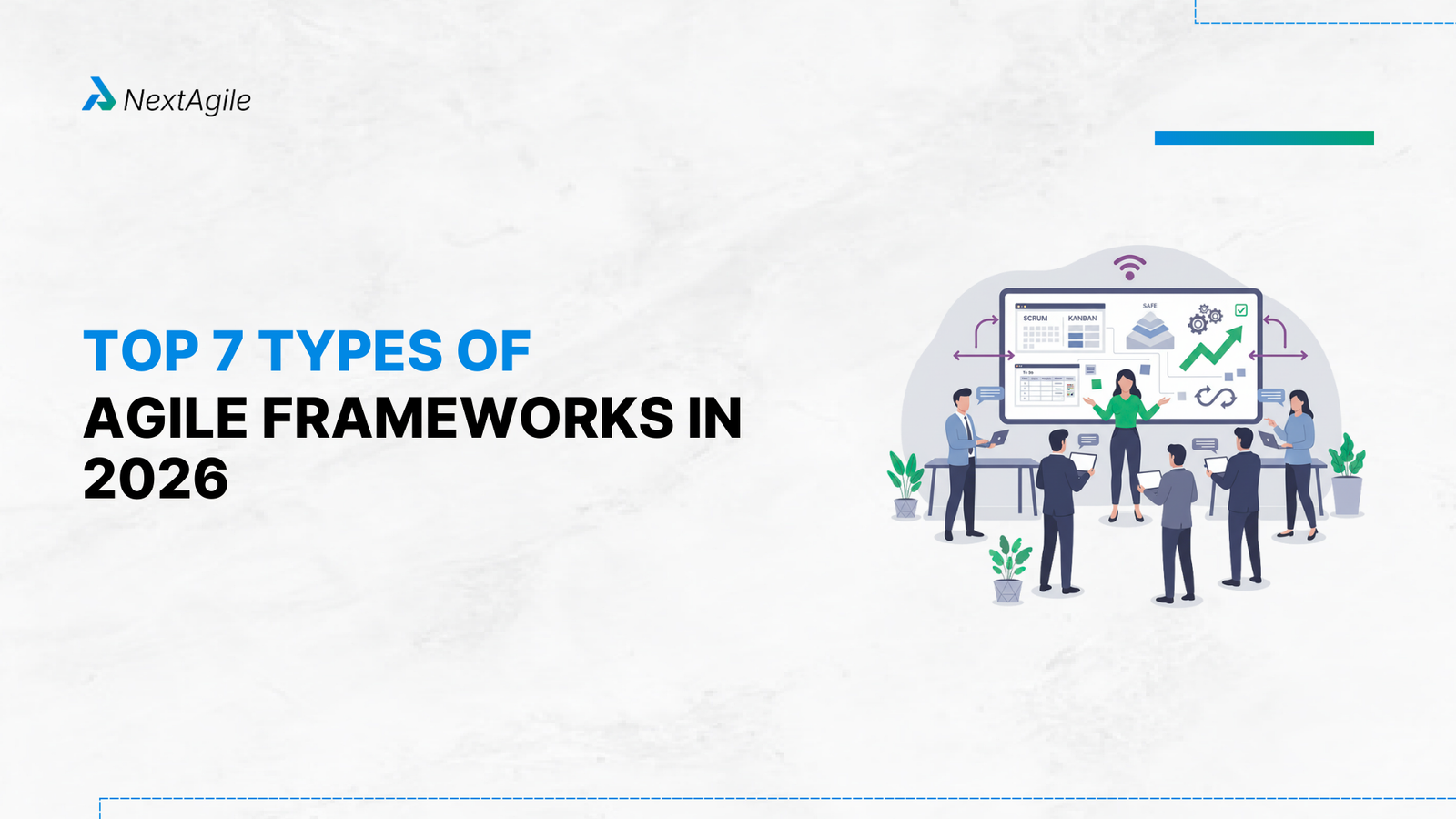
7 Types of Agile Frameworks Explained with Examples
Anuj Ojha
Talk to Expert for Free
Table of Contents
Introduction of Agile Frameworks
Before identifying any framework a common sensical question is ‘why whatever we are doing doesn’t work for us?’ and ‘what is that problem we want to get solved which will take us where we are supposed to reach?’. To implement Agile practically, several frameworks have emerged, each suited to different team sizes, industries, and business needs. Agile adoption begins with problem clarity, not framework selection.
This blog explains seven prominent types of Agile frameworks, comparing their features, roles, and use cases to help you decide the best fit for your team. Just a disclaimer there are many more frameworks and we will love to know if you want us to talk about those too. Frameworks act as enablers, not silver bullets likewise exploration is a sign of maturity, not indecision.
If you have ever been part of a software or product team, you’ve probably heard the term “Agile.” But Agile isn’t one thing, it’s many. It’s a mindset that guides teams to work smarter and faster, but how that happens can differ dramatically depending on the framework you pick. Agile defines how teams think before it defines how teams work.
The truth is, there are quite a few types of agile frameworks, and each has its own flavor and strengths. And it is quite important to choose the right one otherwise it might create unnecessary stress. Framework choice often determines whether Agile feels enabling or exhausting.
Let us explore top 7 types of agile frameworks which have made a mark in the industry in helping teams and organizations to bring agility and at the same time we should mention that there are many other frameworks also which may be suitable based on your context. Context, not popularity, should drive framework selection.
Key Highlights: Types of Agile Frameworks
‘Agile’ has become a buzzword from the past 2 decades but before that also there were frameworks which were popularly used by teams and organizations to improve agility. You might have heard that Kanban was applied to the Toyota Production system in the 1940s and the other frameworks like Scrum and XP were already there before the Agile manifesto popularised ‘Agile’ ways of working through 4 values and 12 principles. Agility existed long before it was formally named.
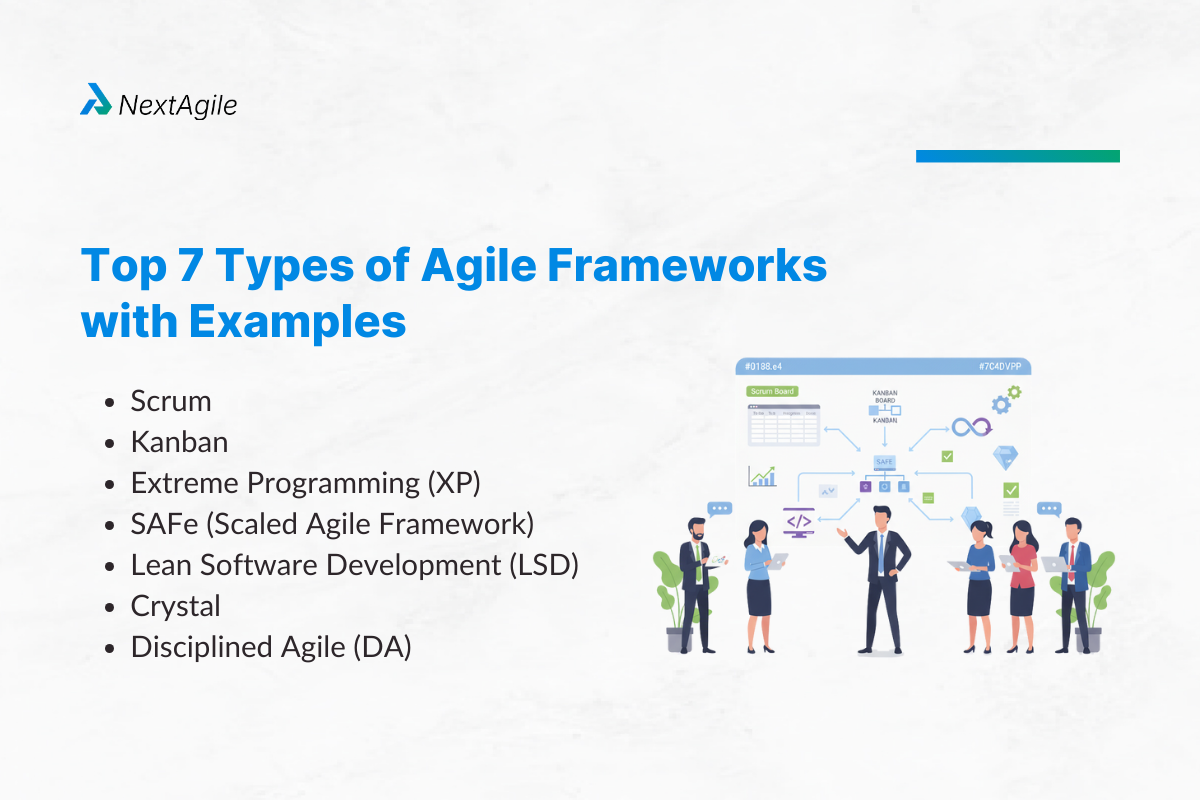
The most widely recognized is Scrum, known for its sprint based delivery and clear roles. But frameworks like Kanban, Extreme Programming (XP), SAFe, Lean Software Development, Crystal, and Disciplined Agile (DA) bring unique approaches suited to various environments. Knowing these frameworks makes it easier for teams to pick the right fit and succeed long term. Each framework solves a different problem, there is no universal best. Awareness of options prevents dogmatic Agile adoption.
Comparison Table: 7 Types of Agile Frameworks
The table below highlights how frameworks differ in structure, flexibility, and intent.
Framework
Iteration Style
Flexibility
Key Roles
Best Use Case
Scrum
Time boxed sprints
Medium
Scrum Master, Product Owner
Small to medium product teams
Kanban
Continuous flow
High
Service Delivery Manager
Operations, support teams
Extreme Programming (XP)
Short iterations
Medium
Coach, Customer
Software development requiring high quality and frequent releases
SAFe
Program increments
Lower (structured)
RTE, Agile Teams, Product Managers
Large enterprises scaling Agile
Lean Software Development
Flow based
High
Team Leads
Teams emphasizing waste reduction
Crystal
Varies (family of methods)
High
Sponsor, Team Members
Small teams with specific project sizes
Disciplined Agile (DA)
Hybrid, tailored
High
Process Owners
Organizations requiring hybrid agility
These distinctions help teams avoid force fitting Agile practices.
Top 7 Types of Agile Frameworks with Examples
1. Scrum – Scrum is an iterative and incremental framework, the most widely adopted Agile framework, primarily used by development teams, focusing on iterative delivery through fixed length sprints. It is applicable when the requirements are quite uncertain and in sprint or iteration you develop a just enough working software to inspect if we are on the right track of fulfilling customer or business expectations else we may need to pivot based on feedback. This way we fail faster by shortening the feedback loop.
Scrum framework contains roles, events and artifacts which revolves around the sprints which are sacrosanct. The emphasis is on collaboration, incremental delivery, and continuous improvement via ceremonies like daily standups and retrospectives. Scrum thrives on inspection, adaptation, and short feedback cycles.
Example: A software development team uses Scrum to deliver a new web application by breaking work into 2-week sprints with prioritized backlogs and they might not need to wait for complete application to finish and based on feedback could launch the application with just enough MVP features and then build it incrementally. Value is delivered early, not deferred to the end.
2. Kanban – Kanban is a visual workflow management method. It is very popular in an operations environment where there is a continuous inflow of demands and the supply also needs to be efficient. Kanban is run based on principles of visualising the work to bring transparency, limiting work in progress to increase the focus time, and maximising flow efficiency without prescriptive roles or iterations.
It also promotes the pull culture over push i.e. the work is not supposed to be assigned to people but the flow expects work to be picked as and when there is capacity at downstream columns. Flow efficiency becomes more important than timeboxing.
 Skip to content