Skip to content
Artificial intelligence is no longer science fiction it’s a boardroom requirement. From generative AI and predictive analytics to customer service based on machine learning and agentic AI, CXOs now face huge pressure to not only implement AI but also demonstrate its business value. Stakeholders require proof: Where is the ROI? How is AI driving growth? Can the firm address risks in data integrity, governance, compliance and ethics?
Here’s where most organizations falter. They spend money on pilots, demo sleek prototypes, and even adopt AI-first strategies, but they never tie these efforts to tangible and real outcomes. AI becomes another buzzword rather than an engine of transformation.
That’s where Objectives and Key Results (OKRs) come in. OKRs are not merely a performance management system; they are a vision-execution bridge. They compel leaders to break down large, aspirational AI plans into concrete goals with concrete, measurable key results. This ensures AI adoption leads directly to business growth, customer value, and operational efficiency.
For CXOs, AI strategy alignment with OKRs is not about merely monitoring performance. It’s about establishing strategic clarity, breaking down teams across silos, and establishing a system of governance that scales responsibly. Done right, OKRs convert AI from a game of technology into a driver of business transformation.
This blog “How CXOs Align OKRs with AI Strategy” lays out a step-by-step framework for CXOs to align AI strategy with OKRs. We will explore role-specific strategies for CEOs, CHROs, CTOs, and CFOs, dive into advanced optimization techniques powered by AI itself, and address the most common challenges leaders face in execution. Finally, we’ll look at how CXOs can measure success, evolve strategies over time, and balance innovation with cultural values.
Let’s dive in.
How CXOs Align OKRs with AI Strategy?
The Strategic Imperative for AI-OKR Integration
AI is a double-edged sword: it carries unparalleled growth potential but can also cause chaos if not structured properly. CXOs who treat AI as a sandbox to experiment upon tend to falter on scale. Projects are siloed, impact is uncertain, and employees remain aloof of the “why.”
Combining AI and OKRs instills discipline. Leadership doesn’t reward outputs such as “launched AI chatbot,” but instead rewards outcomes such as “cut customer resolution time by 30%.” This is particularly important at the C-suite level.
For instance, in retail, AI personalization has had obvious revenue effects but only when associated with quantifiable OKR examples like “Boost repeat purchase rate by 10%” or “Increase average cart size by 8%.” Without OKRs, the AI initiative would be no different from any other IT project.
By integrating OKRs into AI strategy, CXOs gain:
- Strategic alignment: AI projects are directly connected to company objectives.
- Cross-functional ownership: Business and technical leadership share responsibility.
- Sustainable scale: Accurate measurement leads to successful pilots becoming company-wide programs.
In short, OKRs give the terms to transform AI strategy into board-level influence.
Creating the Business Case
No AI project takes hold without executive sponsorship and board endorsement. Developing a credible business case is about showing not only technological promise, but also quantifiable business value.
Let us take an example of a bank considering fraud detection models. Without OKRs, the debate is model precision or false positives. With OKRs, it becomes the outcome such as “Decrease fraud-associated financial loss by 12% every year.” This does not only make the business case more robust but also assures investment.
The business case for AI-OKR integration usually entails:
- Financial clarity: All AI initiatives have ROI-based key results.
- Risk management: Governance-oriented OKRs handle compliance, bias, and ethics.
- Cultural shift: Staff know that AI improves, rather than eliminates, their work.
- Scale: Pilot to production, scaling AI needs measurable milestones.
CXOs who lead this convergence can show not just why AI is important, but how it will make a real difference quarter by quarter.
The AI-OKR Alignment Framework: A Step-by-Step Guide
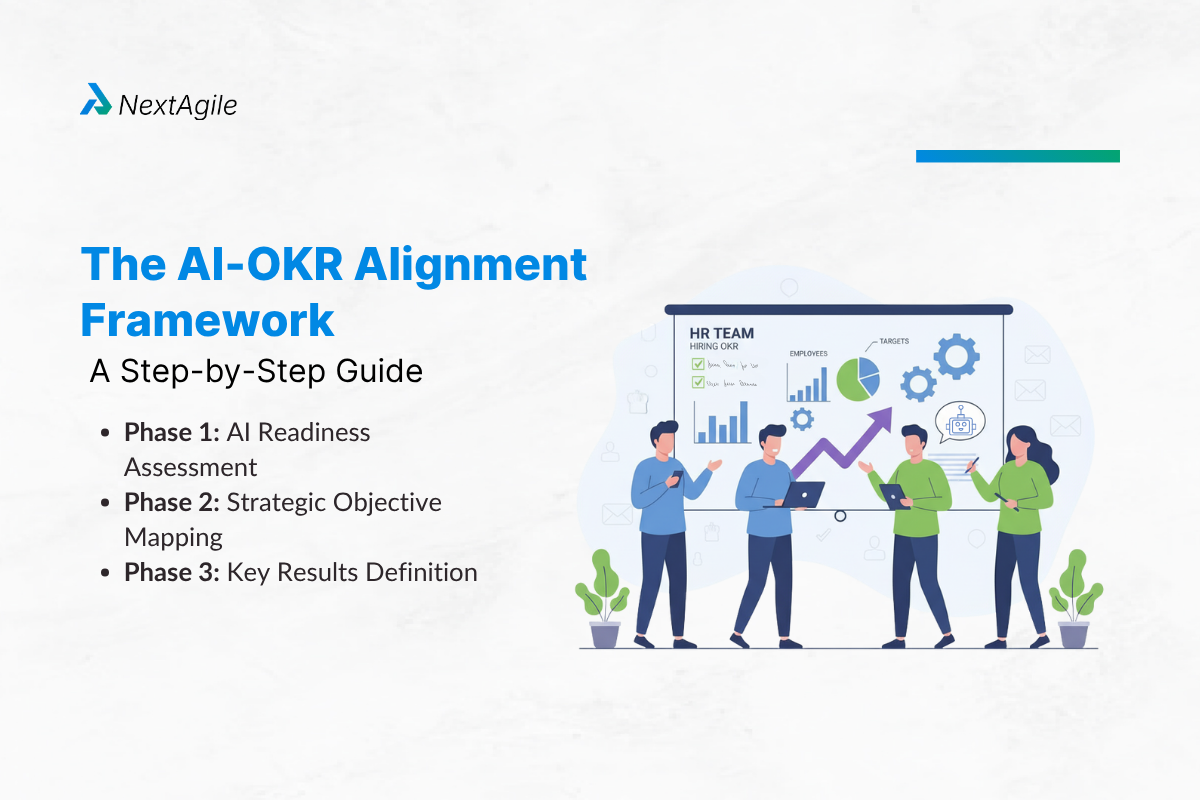
Phase 1: AI Readiness Assessment
Prior to setting ambitious AI goals, CXOs need to gauge readiness. That entails infrastructure, data, talent, and culture. Most companies leap into AI unaware that their data is fragmented or that their staff is not ready for adoption.
A comprehensive readiness evaluation entails:
- Data quality checks: Ensuring clean, available, and integrated data.
- Skill evaluation: Determining AI literacy levels in leadership and workforce.
- Cultural surveys: Measuring employee willingness to accept AI-induced changes.
- Technology audit: Auditing scalability of existing systems.
Example Objective: Evaluate and improve AI readiness throughout the enterprise.
Key Results:
- Achieve a comprehensive AI maturity audit in all departments by Q1.
- Identify and remediate top 5 infrastructure and data quality gaps by Q2.
- Host 3 company-wide workshops on AI readiness and ethics.
This phase establishes the foundation for realistic and effective OKRs in subsequent stages.
Phase 2: Strategic Objective Mapping
When readiness is established, AI should be directly connected to business strategic goals. This keeps AI from being viewed as an ancillary endeavor.
For instance, a healthcare company could relate AI goals to patient outcomes, and a logistics company could apply AI to supply chain optimization. The idea is to align AI implementation with what the business really cares about.
Example Objective: Improve customer experience through AI.
Key Results:
- Implement AI personalization on three customer channels by Q2 end.
- Improve NPS score by 15% in two quarters.
- Decrease average support resolution time by 25% with AI chat solutions.
By linking goals to the corporate strategy, CXOs create momentum around AI adoption that makes an impact on business-critical results.
Phase 3: Key Results Definition
Most AI teams are satisfied with technical KPIs accuracy, precision, or F1 scores. Although vital, these fail to represent business influence. CXOs require two-layer key results:
- Technical KRs: Guarantee reliability, accuracy, and bias decrease.
- Business KRs: Demonstrate ROI, customer value, and operation efficiency.
Example:
- Technical KR: Reach 96% accuracy of fraud detection models.
- Business KR: Decrease losses due to fraud by $5M per year.
The greatest key outcomes marry both universes. They comfort boards of business effect while providing technical teams with transparency regarding performance baselines. For inspiration, leaders can also explore practical OKR Examples that show how different industries approach AI-driven targets.
CXO Role-Specific Implementation Strategies
Executive Leadership Roles (CEO & CHRO)
CEO: Leadership for Vision & Culture
The CEO is the primary storyteller. In the absence of a strong AI story, employees view AI as invasive instead of transformative. CEOs need to integrate AI into the vision of the company and illustrate how it drives sustainable growth.
Objective: Make AI a central pillar of business growth.
Key Results:
- Embed AI priorities in 100% of quarter-by-quarter board reviews.
- Achieve 80% leadership alignment score on AI vision surveys.
- Implement AI-driven innovation pilots in a minimum of 2 new business units annually.
CHRO: Talent and Organizational Development
AI transforms the workforce. CHROs need to ensure employees are competent, engaged, and reassured. Talent development, reskilling, and ethical integration are essential.
Objective: Develop an AI-prepared, resilient workforce.
Key Results:
- Upskill 40% of staff in AI fundamentals by year-end.
- Integrate AI ethics into all leadership training modules.
- Boost employee trust in AI initiatives by 20% in yearly surveys.
Technical and Financial Leadership (CTO & CFO)
CTO: Technical Architecture Alignment
The CTO ensures technical scalability, data pipelines, and governance frameworks align with AI objectives. Without solid architecture, AI adoption grinds to a halt.
Objective: Establish resilient AI infrastructure aligned with enterprise growth.
Key Results:
- Move 80% of AI workloads to trusted cloud environments.
- Implement governance processes for all new AI projects.
- Ensure 99.9% uptime for mission-critical AI systems.
CFO: Financial Performance and ROI
The CFO converts AI adoption into monetary terms. They measure costs, efficiency improvements, and return on investment.
Objective: Ensure AI investments yield quantifiable ROI.
Key Results:
- Monitor ROI for 100% of AI projects by Q4.
- Lessen AI project cost overruns by 20% year-over-year.
- Achieve positive ROI on 60% of projects in 12 months.
Sophisticated AI-Driven OKR Optimization Methods
Smart Setting and Rebalancing of Goals
Static OKRs are the norm in a quarter. But with AI, OKRs can be dynamic and adaptive. Consider a system that evaluates progress on a weekly basis, forecasts KR probability of achievement, and makes mid-cycle recommendations.
For CXOs, that translates into quicker responsiveness to market changes. For instance, if customer adoption is slower than projected, AI can suggest shifting resources or reframing key results midway through a quarter.
AI can also spot trends between departments, and it will indicate which teams systematically fall short and propose interventions. That builds a living OKR system much more responsive than periodic reviews.
Real-Time Performance Intelligence
Organizations more often employ AI-powered dashboards that display real-time aggregated data. The dashboards bridge strategic targets with operational metrics.
For instance:
- Automatically updating customer NPS scores are displayed in OKR dashboards.
- Revenue increase as a result of AI personalization is displayed in real time.
- Warnings alert CXOs if AI models deviate below desired levels.
Lag between action and insight is minimized. CXOs no longer have to wait for quarterly reviews but instead obtain continuous feedback loops, enabling them to lead adaptively.
Conquering Typical Implementation Issues
Organizational and Cultural Roadblocks
Resistance is inevitable. Employees fear AI will displace jobs or undermine values. CXOs need to employ OKRs to communicate intent unequivocally. For instance:
Objective: Make ethical, people-focused AI adoption a reality.
Key Results:
- Achieve 90% employee engagement in AI upskilling.
- Sustain >70% employee trust in AI strategy.
- Hold quarterly feedback meetings.
Straightforward goals eliminate fear. When employees observe quantifiable investment in their own growth, doubt disappears.
Leaders must also promote transparency. Communication of AI results both success and failure fosters credibility and ensures cultural acceptance.
Technical and Measurement Challenges
Technically, bad data, biased models, and black box algorithms can erode trust. Measurement also becomes challenging when outputs from AI are probabilistic.
Here’s where OKRs act as guardrails. By defining governance objectives and measurable KRs such as “complete bias audits quarterly” or “ensure explainability features in 100% of customer-facing models” CXOs enforce accountability. Partnering with expert OKR consulting services like Nextagile can also help enterprises build robust governance frameworks tailored to their industry.
AI’s complexity becomes manageable when framed within OKR cycles.
Success Metrics and Continuous Improvement
For CXOs, mapping AI initiatives with OKRs is not a one-off exercise it’s an ongoing learning process of refinement and scaling. The real value comes in how well organizations can quantify success and maintain momentum year after year. Success metrics are the compass for this journey, and ongoing improvement assures flexibility in response to changing conditions.
Performance Measurement Framework
A successful AI-powered OKR measurement framework should have a balance of quantitative influence, qualitative uptake, and governance control.
On the numbers side, CXOs need to connect key results to business outcomes. Some examples include top-line growth generated by AI-based products, cost reduction through automation, decrease in error rates, or enhancement in customer satisfaction rates. For instance, the key result of an AI-based customer service chatbot could be decreasing average response time by 60% a goal that benefits both customer experience and business efficiency directly.
Qualitative metrics are equally important. Leaders must gauge how workers engage with AI tools, how trusting teams are of outputs, and whether AI projects resonate with organizational values. Surveys, feedback loops, and cultural audits capture this softer data, which can be every bit as informative as financial outcomes.
Governance metrics add a third layer, especially in regulated industries. Tracking compliance adherence, frequency of bias audits, or data security breach incidents ensures AI systems operate responsibly. A CFO, for instance, may pair ROI analysis with compliance indicators to provide a holistic view of AI’s performance.
Together, these three lenses create a 360-degree measurement framework, enabling CXOs to not just track outputs but also validate outcomes and safeguard trust.
Long-term Strategic Development
AI transformation is not quantified in quarters but rather over years. That’s why CXOs need to create OKRs that progress in size and aspiration in line with organizational maturity. Initial OKRs can be centered on creating basic AI literacy among the workforce or testing a few use cases. Gradually, the scale should grow towards scaling enterprise-wide use, infusing AI into essential value chains, and establishing industry-leading benchmarks.
There is ongoing improvement at center stage here. Lessons learned, surprise risks, and resistance areas must be part of quarterly OKR reviews. Did new AI implementation induce reliance on outside vendors? Did teams encounter gaps in training? By recording these problems, leaders can improve objectives for the next cycle.
Long-term evolution also demands resilience in strategy. AI markets shift constantly, with new models, governance needs, and ethical expectations arising on a regular basis. CXOs need to revisit strategic goals each year to make sure they’re future-proof. Inclusion of agility in OKRs for example, a key result of reviewing emerging AI tools every quarter keeps businesses agile.
In the end, success metrics and ongoing improvement help AI and OKRs feed into one another. The more rigorously performance is measured, the more confidently organizations can refine their strategy shifting AI from an experimental technology into a lasting competitive edge.
Conclusion
Alignment of AI strategies with OKRs is one of the most vital leadership tasks for CXOs in 2026. Enterprises have moved beyond piloting AI as isolated projects; the discussion is now about scaling, governance, and achieving measurable results. However, without a systematic framework, most enterprises find it challenging to close the gap between ambition and action. This is where OKRs come into the picture.
OKRs establish a common language throughout the enterprise. They enable CEOs, CTOs, CFOs, CHROs, and other executives to decompose the complexity of AI into a set of definite goals with quantifiable results. Rather than talking about AI in generalities, CXOs are able to concentrate on tangible outcomes: revenue increase, customer satisfaction, cost reduction, compliance success, and cultural change. This also enhances accountability while making the value of AI visible to boards, regulators, and staff.
A second benefit is in maintaining a balance between innovation and responsibility. AI holds enormous potential but also brings concerns regarding ethics, governance, and disruption of the workforce. By incorporating these issues into OKRs themselves like employee trust measurement, quarterly bias audits, or monitoring compliance certifications CXOs prevent innovation at the expense of reputation or trust. In doing so, OKRs act as the governance mechanism that keeps AI within organizational values.
Also critical, linking AI to OKRs forms a living strategy that can evolve. In contrast to immobile plans, OKRs are reviewed quarterly, enabling CXOs to change objectives as the market situation, technologies, and regulations shift. AI itself facilitates this further by making it possible to monitor in real time, predict what needs doing, and adjust goals accordingly. This forms a feedback mechanism where AI reinforces OKRs, and OKRs inform AI adoption, forming a self-sustaining loop of quality improvement.
In the future, companies that will dominate their markets are the ones that effectively scale AI with tangible value. CXOs that approach AI as a technology play will get left behind, whereas the ones that approach it as a strategic transformational journey centered around OKRs will set new industry benchmarks.
The message is clear: AI can bring unprecedented value, but only when combined with rigorous execution frameworks. For CXOs, combining AI with OKRs is not only a leadership approach; it is a competitive imperative. The firms that adopt such an integration will not only achieve their transformation objectives, but they will also lead the pace of innovation, resilience, and long-term growth. For teams just beginning, enrolling in an OKR Fundamental Workshop Program can accelerate alignment and give leaders the tools to drive AI strategy with confidence or you can even customize a program combining OKR and AI strategy for leadership to drive contextual AI Transformation with OKRs.