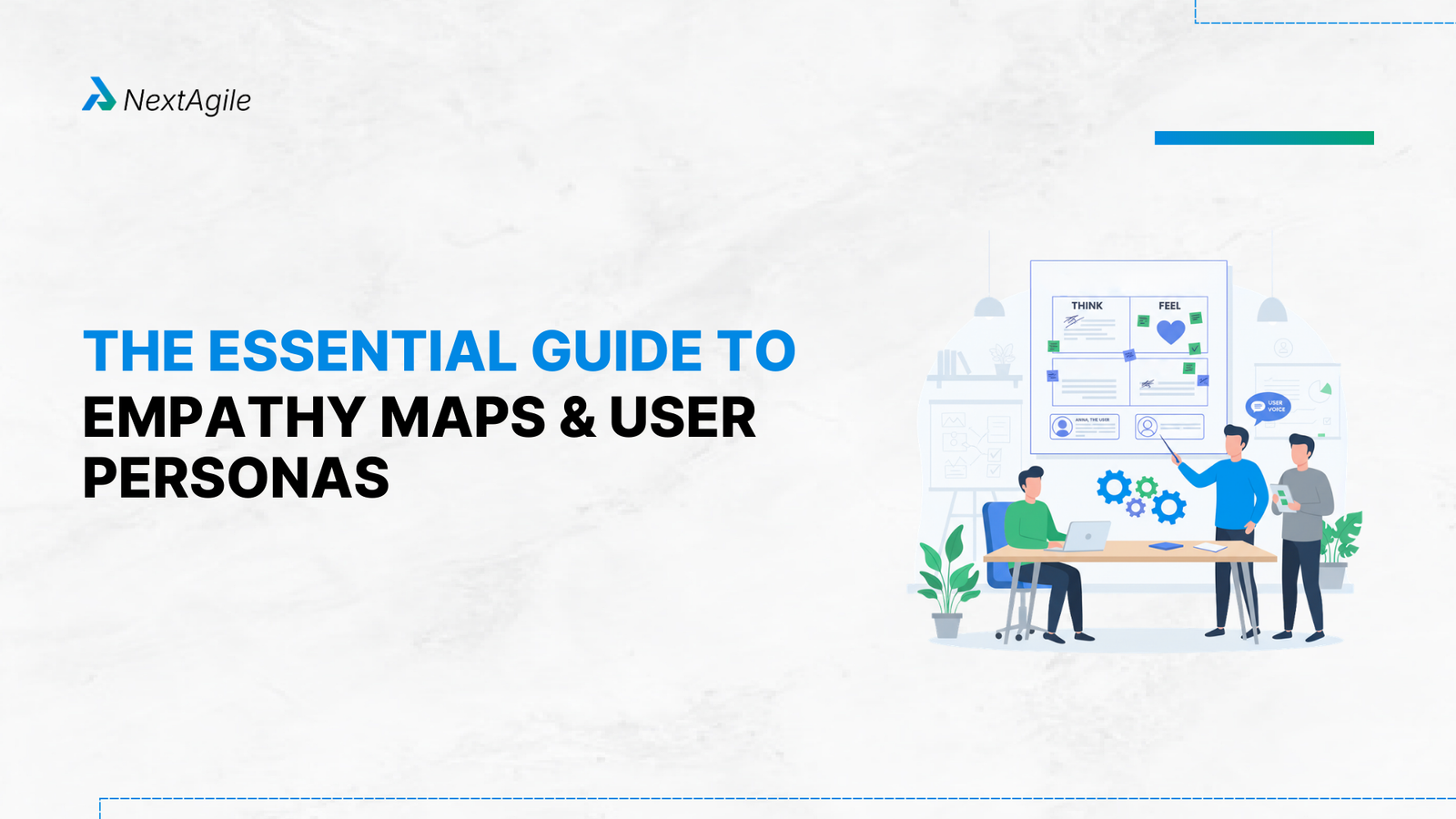
Introduction to Empathy maps and Persona Ever wonder why some products instantly resonate with users while others struggle to gain traction? The answer often comes down to understanding your users deeply. This is where empathy maps and user personas become invaluable tools. They allow design teams and business leaders to capture what users truly think, feel, say, and do, translating real human experiences into actionable insights.
In today’s competitive landscape, businesses that neglect user empathy risk launching products that miss the mark. Conversely, teams that leverage empathy maps and personas can align stakeholders, inform feature prioritization, and foster innovation. In this guide, we’ll explore how to create effective personas, build empathy maps, and integrate both into your product development process to drive meaningful results.
Why does empathy separate successful products from average ones? Products fail less often because of technology and more often because teams misunderstood the people they were building for. Empathy maps and personas reduce this risk by grounding decisions in lived user reality, not internal assumptions.
Empathy-based design practices prioritize human centered thinking, making sure product development is not done out of assumptions but based on actual user needs. Through blending empathy with rich personas, teams can predict pain points, discover latent desires, and create solutions that actually enhance user experience. Empathy is not intuition. Empathy-driven design does not rely on “gut feel.” It relies on observable behavior, direct quotes, and patterns validated across users. This distinction is what turns empathy into a repeatable capability rather than an abstract value.
Understanding User Personas What is a User Persona? A user persona is a fictional depiction of your ideal customer, rooted in actual data and research. It encapsulates demographics, behaviors, goals, pain points, and motivations and acts as a guiding document for design and marketing decisions. So what is a persona and what is not a Persona?
A persona is A persona is not Research-backed Fictional guesswork Behavior-focused Demographic-only Actionable A static slide artifact
Personas fail when treated as documentation instead of decision tools.
The Evolution of Persona Development Personas have grown from basic market segmentation tools to detailed stories that integrate qualitative findings and quantitative information. Contemporary personas are responsive and evolutionary, capturing changing user behavior over time. Modern personas must evolve. User behavior shifts faster than organizational roadmaps. Static personas quickly lose relevance unless refreshed with ongoing research and feedback loops.
Types of Personas Primary Personas: Primary users your product addresses.Secondary Personas: Secondary users with additional requirements or reduced product usage.Negative Personas: People you deliberately do not target in order to avoid misaligned design decisions. Why do negative personas matter? Negative personas prevent teams from optimizing for the wrong users by saving effort, cost, and strategic drift.
Benefits of Detailed User Personas Building strong personas enables teams to care about their users, productize features, and cut down on assumptions. They also improve cross-functional communication and align design, product, and marketing efforts around common user-centered objectives.
Beyond design, strong personas:
Improve stakeholder alignment Reduce feature creep Anchor prioritization discussions They act as a shared language across functions.
The Power of Empathy in Design Defining Empathy in User Experience Empathy in design is the capacity to recognize and sense the feelings, thoughts, and actions of your users. Empathy in design is more than observation it’s literally walking in the user’s shoes. Empathy goes beyond observation.
Seeing user behavior explains what happens. Empathy explains why it happens.
That distinction is where meaningful design decisions emerge.
Why Empathy Is Important in Product Development Empathy prevents products from being designed on assumptions. Empathetic design discovers hidden needs, foresees frustrations, and creates solutions that speak to a deeper emotional connection. Teams solve visible symptoms while root causes remain untouched leading to incremental improvements instead of real breakthroughs.
Widespread Empathy Gaps in Business Most teams neglect small user behaviors, only examine analytics, or neglect to relate qualitative insights to design choices. Such gaps can lead to misaligned features or opportunity loss. Analytics highlight where users struggle. Empathy reveals how it feels to struggle and what users need instead. Both are required for informed decisions.
Empathy as a Competitive Advantage Organizations that integrate empathy into their culture are strategically positioned. Teams with an understanding of users’ viewpoints create innovations quicker, minimize expensive redesigns, and build loyal customer relationships. Empathy compounds over time. Each insight reduces uncertainty in future decisions, accelerating innovation instead of slowing it down.
Empathy Maps Explained What is an Empathy Map? An empathy map is a collaborative visualization tool that captures user insights across four quadrants: Says, Thinks, Feels, and Does. It provides a holistic view of the user’s experience, helping teams make informed design decisions. Empathy maps externalize thinking. They make assumptions visible and therefore debatable.
Origins and Evolution Empathy mapping originated in design thinking workshops as a tool to synthesize qualitative data quickly. Over time, it has become a staple for UX designers, product managers, and innovation teams. Their strength lies in simplicity. They allow rapid synthesis without losing emotional nuance.
Core Elements of a Successful Empathy Map Says: Actual user quotes.Thinks: User thoughts and internal reasoning.Feels: Emotional feelings and underlying motivations.Does: Observable behavior and actions. If quadrants are filled with guesses instead of evidence, the map becomes decorative and not diagnostic.
Advantages to Teams and Organizations Empathy maps enhance alignment, speed up ideation, and reveal gaps in understanding. Teams can graphically communicate insights, rank features, and confirm the end product resonates with genuine user needs. Shared understanding emerges faster than with reports or dashboards, making them ideal for alignment-heavy initiatives.
Crafting Great User Personas: A Step-by-Step Guide Step 1: Carry Out User Research Interview Methods: Use semi-structured or structured interviews to reveal motivations, challenges, and experiences. Survey Design: Collect quantitative data to confirm qualitative findings. Observation Techniques: Follow users to observe true behaviors. Analytics Data Integration: Integrate product usage information with user feedback to enhance persona validity. A few deep interviews often surface richer insights than large, shallow datasets, especially in early discovery.
Step 2: Interpret Data Gathered Determining Patterns: Identify repeat behaviors, goals, and frustrations. Segmentation Methods: Segregate users by common characteristics or requirements. Prioritizing Needs: Emphasize the most effective user needs to lead product design. The value lies not in collecting data but in connecting insights across sources to reveal meaning.
Step 3: Develop User Personas Key Elements: Add name, photo, demographics, objectives, issues, and important behaviors. Templates and Formats: Utilize software such as UXPin or Miro for template-based persona development. Bringing Personas to Life: Storytelling makes personas tangible for stakeholders. Narratives help stakeholders remember, relate to, and advocate for users long after workshops end.
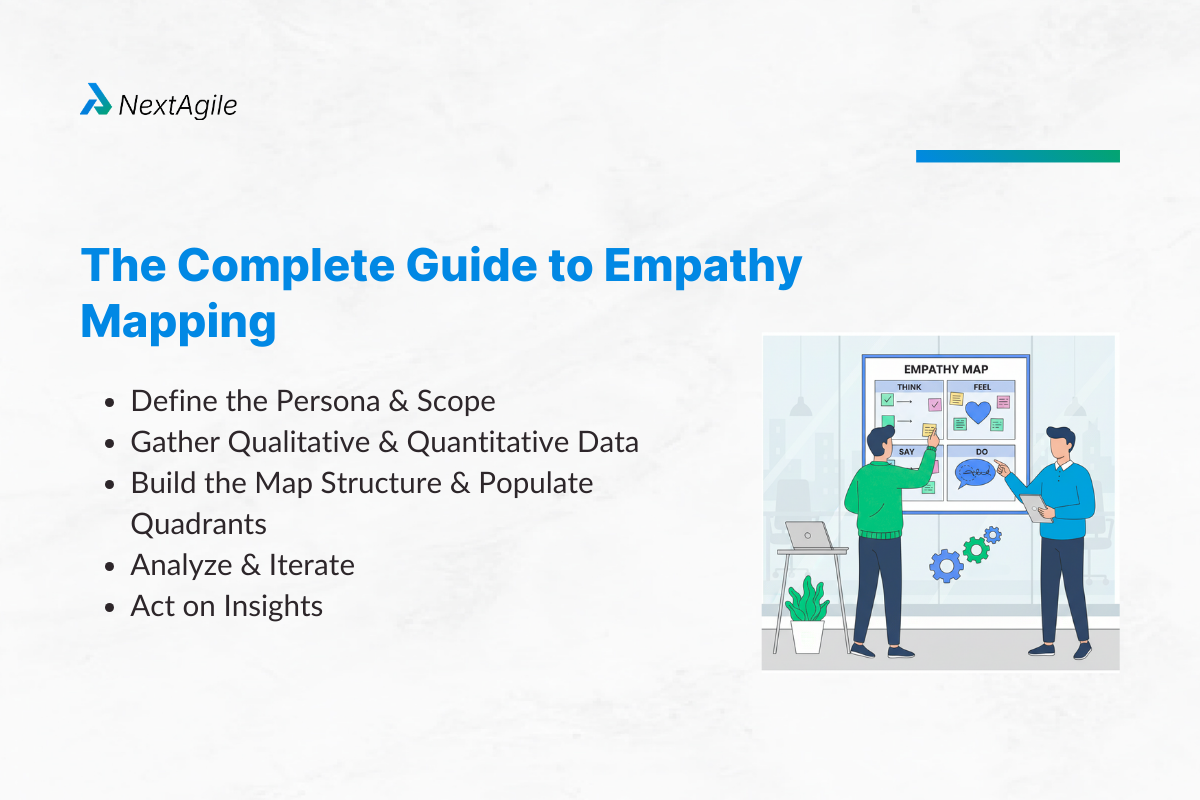
The Complete Guide to Empathy Mapping
Define the Persona and Scope Begin by choosing a user persona to target, with the empathy map showing particular user groups. Trying to represent everyone results in serving no one well. Focused empathy leads to sharper decisions.
Gather Qualitative and Quantitative Data Blend interviews, surveys, observations, and analytics for complete insight.
Build the Map Structure and Populate Quadrants Says: Record literal words from interviews or comments. Thinks: Record internal thoughts and motivations. Feels: Document feelings, frustrations, and wants. Does: View behaviors in context. Evidence hierarchy to follow:
Quotes >> Observed behavior >> Inferred thoughts
This order keeps empathy grounded in reality.
Analyze and Iterate Identify patterns, contradictions, and areas to research further. Refine the map as learnings change. Conflicting insights often reveal unmet needs or overlooked segments worth deeper exploration.
Act on Insights Translate insights into design choices, feature prioritization, or user journey refinement. Through ongoing empathy map refinement, teams stay focused on people throughout product development. Empathy without action is wasted.
Insights must influence:
Feature prioritization Experience flows Success metrics Otherwise, empathy remains theoretical.
Empathy Maps vs. User Personas: Understanding the Difference Key Similarities and Differences Both approaches target users’ understanding, but personas are fixed descriptions, while empathy maps are working visualizations of user experiences. Personas answer who .
Empathy maps answer why and how.
When to Use Each Tool Personas: For strategic alignment, feature planning, and user segmentation.
Empathy Maps: For workshops, rapid insight synthesis, and revealing emotional needs.
How They Complete Each Other Personas give context, empathy maps give depth. Both ensure designs are informed by both “who” the user is and “what” they experience. Personas without empathy lack depth. Empathy maps without personas lack continuity.
Integration for Maximum Impact Organizations that integrate personas and empathy maps yield more effective empathy-driven design, accelerated problem-solving, and improved product-market fit.
Putting Empathy-Driven Design to Work in Your Organization Building Empathy into Design Processes Integrate empathy checkpoints into design sprints, ideation meetings, and prototyping reviews. Get cross-functional teams engaged in user research and mapping activities. Displaying empathy maps and personas in shared spaces reinforces user-centered thinking daily & not just during workshops.
Training Teams to Think Empathetically Invest in design thinking training
Teams can learn to notice, ask questions, and synthesize learnings together through facilitation workshops. Guided sessions help teams unlearn assumption-driven habits faster than self-study alone.
Measuring the Impact Monitor user satisfaction, engagement, and feature usage. Empathy-based measures prove ROI in product success and innovation effectiveness.
What to measure early?
Signal Why it matters User feedback depth Indicates empathy quality Rework reduction Shows insight accuracy Alignment speed Reflects shared understanding
Conclusion Empathy tools succeed when treated as living assets not workshop outputs. Empathy maps and user personas are more than design tools they are critical strategies for building useful, user focused products. Used in combination, personas establish “who” your users are, while empathy maps reveal “what” they think, feel, and do. Together, they enable design and product teams to prioritize features, cut back on expensive misfires, and develop innovation that actually resonates with users. The more frequently teams practice empathy mapping and persona refinement, the faster and more confidently they make decisions.
Incorporating empathy into your company culture means that each and every decision, from ideation to launch, is informed by actual human experience. Teams that continually refresh personas and empathy maps gain real time insights, allowing them to iterate more quickly and have better product-market fit. Empathy-driven organizations don’t guess less, they learn faster. That learning advantage is what ultimately drives sustainable product success.
Ultimately, organizations that adopt empathy driven design develop a competitive advantage, delivering solutions that users love. For businesses looking to integrate these practices at scale, a Design thinking consulting company like NextAgile can provide structured support and expert facilitation. Start building empathy driven solutions and watch your products succeed more consistently. If you’re looking to build an organizational culture based on customer centricity using empathy, consider partnering with a trusted leadership training company like NextAgile that aligns contextual leadership training programs with executive coaching and overall organizational agility. Our team excels at aligning leadership development with organizational objectives.
Frequently Asked Questions 1. How frequently should user personas and empathy maps be updated? User personas and empathy maps must be revisited on a regular basis, at least quarterly or following significant product launches. Regular updates guarantee insights that represent present user habits, market trends, and changing requirements, ensuring design choices remain precise and user-centered over the course of time.
2. Are personas applicable in B2B and enterprise settings? Yes, personas are very effective in B2B and enterprise environments. They enable teams to know about various roles of stakeholders, the decision-making process, and organization requirements and use that as a guide for design, feature development, and communication strategy so that solutions address intricate business demands.
3. How do I check the validity of my user personas? Validation requires the integration of qualitative interviews, quantitative questionnaires, and analytics. By contrasting personas with actual user behavior and user feedback, teams can iterate on assumptions, enhance accuracy, and make personas a reliable resource for product development and strategic decision-making.
4. Can stereotyping occur in persona creation? There is a danger if personas are assumption-driven, not based on actual research. Steer clear of stereotypes by implementing various data sources, including actual user quotes, and updating personas on a regular basis. Approach personas as dynamic instruments that keep changing with new information to keep them relevant.
Alok Dimri is the co-founder and leads the overall business at NextAgile, where he is responsible for strategy, client and consultant partnerships, and a whole lot of other core business activities like solutioning, branding, and customer engagement.
Over the past 16 years, he has worked extensively in business strategy, new business development, and key account management initiatives across process consulting and training domains.
 Skip to content