Skip to content
Introduction
As Agile adoption matures in 2026, organizations are no longer asking whether to measure performance but what to measure and why. Agile Metrics and KPIs have evolved from basic delivery indicators into strategic instruments that shape decision-making, investment prioritization, and enterprise agility. In mature Agile environments, metrics act as organizational mirrors. They reveal not only how fast teams deliver but how effectively the system converts ideas into customer value. The purpose of this guide is not to promote measurement for reporting, but measurement for learning.
At NextAgile, we consistently observe that high-performing Agile organizations do not track more metrics—they track the right ones. Agile metrics must illuminate flow, quality, predictability, and team health without becoming weapons of control. When used correctly, Agile performance metrics create alignment between leadership intent and team execution.
This guide presents 12 essential Agile Metrics and KPIs for 2026, curated from our experience as an Agile consulting company. It combines delivery metrics, flow efficiency indicators, quality measures, and Agile team metrics into a practical, consulting-grade framework. You will also learn how to select, implement, and govern metrics sustainably—without falling into common traps that undermine agility.
Agile Metrics and KPIs: 12 Essential Indicators to Track in 2026
The table below summarizes all 12 Agile KPI examples covered in this guide. These indicators collectively represent delivery speed, flow efficiency, quality, and team health.
| Metric | Formula | Best For | Tool Example | Alert Threshold |
| Sprint Velocity | Total Story Points Completed / Sprint | Capacity forecasting | Jira, Azure DevOps | ±30% variance |
| Sprint Burndown | Remaining Work vs Time | Sprint predictability | Jira Sprint Burndown Chart | Late-sprint spike |
| Capacity Utilization | Actual Effort / Available Capacity | Load balancing | Jira, Tempo | >85% sustained |
| Cycle Time | Work Start → Work Done | Flow efficiency | Jira, Kanbanize | Increasing trend |
| Lead Time | Request → Delivery | Customer responsiveness | Jira, Linear | SLA breach |
| Throughput | Items Delivered / Time | Delivery consistency | Jira, Flow tools | Declining trend |
| Defect Escape Rate | Production Defects / Total Defects | Quality assurance | TestRail, Jira | >5–8% |
| Deployment Frequency | Deployments / Time | DevOps maturity | GitHub, GitLab | Weekly or less |
| Customer Satisfaction | CSAT / NPS Score | Outcome validation | Qualtrics, SurveyMonkey | <70% CSAT |
| Team Happiness Index | Survey Score Avg | Team health | Officevibe, CultureAmp | <3.5/5 |
| Cumulative Flow Diagram | WIP by State | Bottleneck detection | Jira CFD | WIP expansion |
| Work in Progress (WIP) | Active Items | Flow control | Jira, Kanban | WIP limit breach |
These 12 metrics are intentionally balanced across execution, flow, quality, and people. Tracking only delivery speed creates local optimization. Tracking only team health lacks operational rigor. High-performing organizations instrument all four dimensions together.
Velocity & Sprint Metrics
1. Sprint Velocity
Velocity in Agile measures the amount of work a team completes during a sprint, typically expressed in story points. Velocity is best used for forecasting, not comparison. Stable velocity enables more reliable release planning and dependency management. Used correctly, velocity provides probabilistic forecasting confidence. Used incorrectly, it becomes a performance weapon. The difference lies in leadership intent.
Consulting insight: At NextAgile, we discourage cross-team velocity benchmarking. Instead, we use velocity trends to identify systemic blockers impacting Agile team performance indicators.
2. Sprint Burndown
The Sprint burndown chart visualizes remaining work over time within a sprint. It highlights scope creep, estimation gaps, and execution risks early.
A healthy burndown shows gradual, consistent progress. Sudden drops or flat lines signal late testing or unplanned work injection, common patterns in scaling environments. In scaled Agile environments, persistent late-sprint movement usually points to upstream planning gaps rather than team execution issues.
3. Capacity Utilization
Capacity utilization compares actual effort to available capacity. While useful, it must be interpreted cautiously. High utilization often correlates with burnout and reduced innovation.
Alert: Sustained utilization above 85% usually degrades flow efficiency. Operational excellence comes from balancing utilization with recovery capacity. Sustainable agility requires space for refactoring, learning, and innovation, not continuous saturation.
Flow Efficiency Metrics
1. Cycle Time
The cycle time metric measures how long work items take from “in progress” to “done.” It is one of the most powerful Agile delivery metrics for identifying waste.
Reduced cycle time correlates strongly with faster feedback, higher quality, and improved customer outcomes. Cycle time improvement typically delivers faster ROI than adding capacity. It exposes waiting states, approval delays, and multitasking overhead that remain invisible in sprint metrics alone.
2. Lead Time
Lead time extends cycle time by measuring from request to delivery. This metric matters most to customers and business stakeholders, making it a core KPI for value streams.
Consulting practice: We map lead time across portfolio layers to uncover approval bottlenecks and governance delays. For executives, lead time represents strategic responsiveness, the organization’s ability to convert opportunity into outcome.
3. Throughput
Throughput in Agile tracks how many work items are completed per unit of time. Unlike velocity, throughput works across Scrum, Kanban, and hybrid models. Throughput stability matters more than throughput peaks. Predictability enables confident commitments.
Stable throughput enables probabilistic forecasting and Monte Carlo simulations for delivery confidence.
Quality & Delivery Metrics
1. Defect Escape Rate
This metric measures defects discovered in production relative to total defects. A rising defect escape rate indicates weak testing, rushed delivery, or technical debt accumulation.
In regulated industries, this KPI is often a leading risk indicator. Organizations that pair defect metrics with cycle time improvements consistently achieve better quality without slowing delivery.
2. Deployment Frequency
Deployment frequency reflects DevOps maturity and organizational trust in automation. High-performing teams deploy multiple times per day, while low performers deploy monthly or less.
Key insight: Deployment frequency improves only when testing, architecture, and culture evolve together. Technology alone does not drive deployment frequency. Organisational trust and product ownership models matter just as much.
3. Customer Satisfaction
Customer satisfaction (CSAT or NPS) validates whether Agile delivery translates into real value. It is one of the most underused Agile team metrics.
Outcome-focused organizations integrate CSAT reviews into sprint reviews and quarterly OKRs. Customer metrics close the loop between output and outcome. Without them, Agile becomes delivery-focused rather than value-driven.
Team Health Indicators
1. Team Happiness Index
High-performing Agile teams are sustainable teams. Happiness surveys provide early warnings of burnout, psychological safety issues, or leadership misalignment.
At NextAgile, we treat team happiness as a leading indicator—not a morale vanity metric. Burnout rarely appears suddenly. Happiness trends surface months earlier.
2. Cumulative Flow Diagram
The cumulative flow diagram (CFD) visualizes work across workflow states. Expanding bands signal bottlenecks, while parallel bands indicate smooth flow.
CFDs are indispensable for Kanban and scaled Agile environments.
3. Work in Progress (WIP)
WIP limits control multitasking and exposes systemic overload. Excessive WIP is one of the most common root causes of long cycle times.
Reducing WIP often improves delivery speed without adding resources. Flow-based organizations treat WIP limits as governance mechanisms.
Benefits of Tracking Agile Metrics and KPIs
When implemented correctly, Agile Metrics and KPIs deliver tangible benefits:
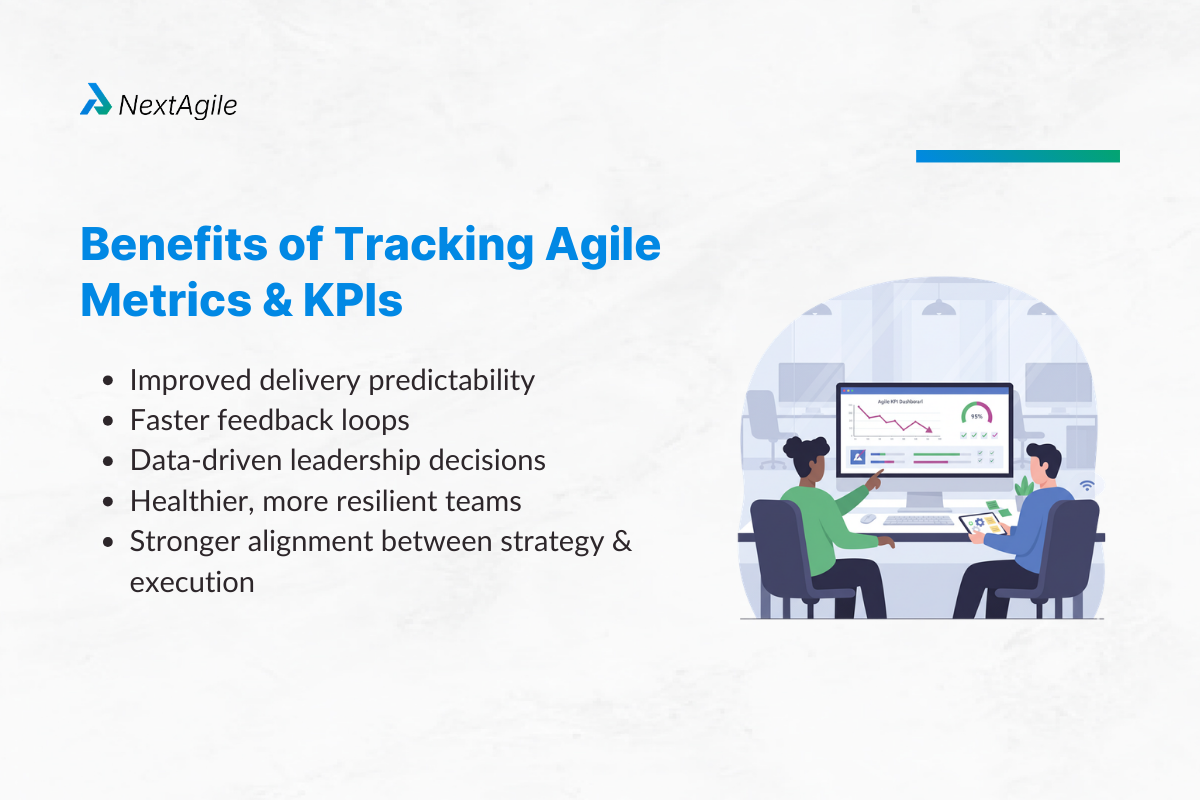
- Improved delivery predictability
- Faster feedback loops
- Data-driven leadership decisions
- Healthier, more resilient teams
- Stronger alignment between strategy and execution
When embedded into regular ceremonies and leadership reviews, metrics become continuous improvement accelerators rather than reporting artifacts.
Metrics also provide the empirical foundation required for successful Agile consulting and transformation services.
How to Choose The 3-Tier Selection Framework?
Tier 1: The Health Pulse (Start Here)
Begin with a minimal set of indicators that reflect system health:
- Cycle time
- Throughput
- Defect escape rate
- Team happiness
These metrics establish baseline visibility without overwhelming teams.
Tier 2: Match Your Process
Select metrics aligned to your delivery model:
- Scrum → Velocity, Sprint Burndown
- Kanban → WIP, CFD, Cycle Time
- DevOps → Deployment Frequency, Lead Time
Avoid forcing Scrum metrics onto Kanban systems.
Tier 3: Drive Strategic Goals
Link metrics to outcomes such as customer satisfaction, OKRs, and business value. This is where Agile metrics transition into executive-level KPIs. This tier creates the bridge between delivery execution and enterprise strategy where Agile shifts from operational practice to business capability.
At NextAgile, we integrate this tier with OKR design in our OKR Consulting engagements.
5 Common Metric Selection Mistakes to Avoid
Every failed metrics initiative we have seen traces back to one of these five patterns.

1. The Velocity Weapon
Using velocity to pressure teams destroys trust and predictability.
2. The 100% Utilization Trap
Maximum utilization minimizes learning, innovation, and resilience.
3. Measuring Outputs, Not Outcomes
Story points delivered do not equal customer value created.
4. Tool-Driven Metrics
Just because a tool can generate a metric doesn’t mean it matters.
5. Lack of Context
Metrics without narrative lead to misinterpretation and poor decisions.
Implementing Agile Metrics: Our 4-Week Action Plan
| Week | Focus | Deliverable | Owner |
| Week 1 | Baseline Assessment | Metrics inventory & data audit | NextAgile Consultant |
| Week 2 | Metric Selection | Tier-based KPI framework | NextAgile Agile Coach |
| Week 3 | Tool Alignment | Dashboards & reporting cadence | NextAgile Transformation Lead |
| Week 4 | Enablement | Leadership review & governance model | NextAgile Principal Consultant |
Implementing Agile Metrics: Your 4-Week Action Plan
| Week | Focus | Deliverable | Owner |
| Week 1 | Establish Baseline & Purpose | • Current-state metrics inventory • Data sources identified (Jira, CI/CD, surveys) • Clear metric intent (learning vs reporting) | Scrum Master |
| Week 2 | Metric Selection & Alignment | • Selected Tier 1 and Tier 2 metrics • Defined formulas and thresholds • Alignment with team goals and sprint objectives | Product Owner |
| Week 3 | Visualization & Cadence | • Team-level dashboards (velocity, cycle time, WIP, quality) • Review cadence defined (Sprint Review, Retro) • Metric ownership clarified | Agile Coach |
| Week 4 | Review, Learn & Adjust | • First metric review session completed • Insights documented with actions • Guardrails established to prevent metric misuse | Scrum Master & Team Lead |
Why does this structure work?
- Scrum Master drives transparency, flow, and healthy use of metrics
- Product Owner ensures metrics reinforce value and outcomes
- Agile Coach enables systemic thinking and avoids local optimization
- Team Lead / Development Lead ensures execution-level realism
Clear ownership prevents metrics from drifting into centralized dashboards detached from real improvement.
This keeps Agile Metrics and KPIs team-owned, improvement-focused, and aligned with Agile principles—rather than turning them into management-only reporting artifacts.
Agile Metrics Success: Real-World Examples
- A fintech client reduced lead time by 42% by enforcing WIP limits and tracking CFD trends.
- A global enterprise improved deployment frequency 5× by aligning DevOps metrics with business OKRs.
- A product organization reversed burnout by pairing throughput targets with team happiness thresholds.
Across industries, successful transformations share one trait: metrics are treated as learning instruments, not performance scorecards.
For deeper insights, explore our perspective on Agile Transformation Metrics.
Conclusion
In 2026, Agile Metrics and KPIs are no longer optional—they are strategic assets. However, metrics must serve learning and improvement, not control. The most effective organizations balance delivery speed, quality, flow efficiency, and human sustainability. Agility matures when organizations stop asking “Are teams delivering?” and start asking “Is the system improving?”
At NextAgile, we view metrics as instruments of clarity in our agile consulting engagements. When thoughtfully selected and responsibly governed, they accelerate agility at scale. Are you looking to implement agile metrics for your organization and struggling in implementing the right fit? Do reach out to us at consult@nextagile.ai and we would be happy to explore more.
Frequently Asked Questions
1. What is the difference between Agile metrics and KPIs?
Agile metrics are operational indicators used by teams, while KPIs are outcome-focused measures aligned with strategic goals.
2. Which Agile metrics should beginners track first?
Start with cycle time, throughput, defect escape rate, and team happiness.
3. How do you calculate velocity in Agile metrics and KPIs?
Velocity is calculated as the total number of story points completed in a sprint.
4. Can you track too many Agile metrics?
Yes you can but excessive metrics create noise, reduce focus, and undermine agility.