Skip to content

Introduction to Transactional Leadership
Why do some leaders excel at delivering quick results while others struggle to maintain their team’s performance? The difference often, may, stem from their approach, particularly whether they use transactional leadership. What is transactional leadership, it is a leadership style that focuses on results through clear expectations, rewards for good performance, and consequences for underperformance. Unlike transformational leadership, which inspires through vision and influence, transactional leadership relies on discipline, organization, and accountability. In such environments, leadership effectiveness is judged less by intent and more by outcomes like deadlines met, quality maintained, and deviations corrected quickly.
Our experience as a leadership enablement training firm with leadership coaching has shown that blending transactional approaches with modern leadership strategies can drive measurable outcomes, especially when paired with frameworks like OKRs to align business strategy with execution. This blog will break down transactional leadership, its components, practical applications, and when it works best — all while offering actionable insights you can apply immediately. When applied deliberately, transactional leadership does not restrict modern leadership, it stabilizes it, allowing innovation to occur within clear boundaries.
What is Transactional Leadership?
Transactional leadership, also known as managerial leadership, is a style focused on structure, clear roles, and reward-punishment mechanisms. Leaders who adopt this style concentrate on completing tasks, following rules, and achieving measurable outcomes. It operates like a system where clear expectations are communicated and compliance is closely monitored. This clarity creates a low-ambiguity environment where performance discussions are factual, not emotional.
In today’s fast-paced business world, grasping the concept of transactional leadership is not just theoretical; it’s practical. Teams frequently work under tight deadlines or high-pressure situations, requiring efficiency and predictability. Leaders skilled in transactional techniques can ensure that tasks are completed reliably while providing clarity and consistency to their teams. Transactional leadership provides the operational backbone teams rely on when predictability and execution discipline matter more than experimentation.
This approach runs on a simple principle: reward performance, correct mistakes, and oversee actions. For example, it may involve setting daily production targets, tracking progress, and providing immediate feedback based on results. It’s practical, predictable, and very effective in settings where efficiency and standardization are key. Such systems reduce variability in execution, making performance easier to track, correct, and improve.
In simple words, transactional leadership is leadership through structured transactions which is a clear contract of expectations and outcomes between the leader and the team. Leaders may not inspire a long-term cultural shift or spark creativity, but they excel at getting things done, meeting deadlines, and maintaining operational stability. Its strength lies in operational dependability rather than emotional inspiration.
Why Understanding Transactional Leadership Matters Today?
Not every situation in modern organizations requires visionary or transformational leadership. Sometimes the pressing need is for reliability, compliance, and measurable results. This is where transactional leadership excels. Execution gaps often emerge not from lack of vision, but from unclear expectations and weak accountability.
Consider high-pressure projects, crisis situations, or companies with strict operational protocols. Leaders capable of setting clear goals, defining consequences, and ensuring accountability can often avoid mistakes and maintain consistent output. In today’s hybrid and remote work landscapes, transactional methods provide the structure needed for teams to stay organized and productive. In distributed teams, transactional structures act as anchors, preventing drift in priorities and performance.
Understanding transactional leadership offers executives the flexibility to change styles based on the situation. It’s not about replacing visionary leadership; it complements it. At NextAgile, we’ve noticed that executives blending transactional principles with adaptive strategies often achieve both efficiency and engagement, maximizing team performance without losing accountability. This balance allows leaders to scale execution without losing control or clarity.
Core Components of Transactional Leadership
Transactional leadership is based on several key components that guide its practical application:
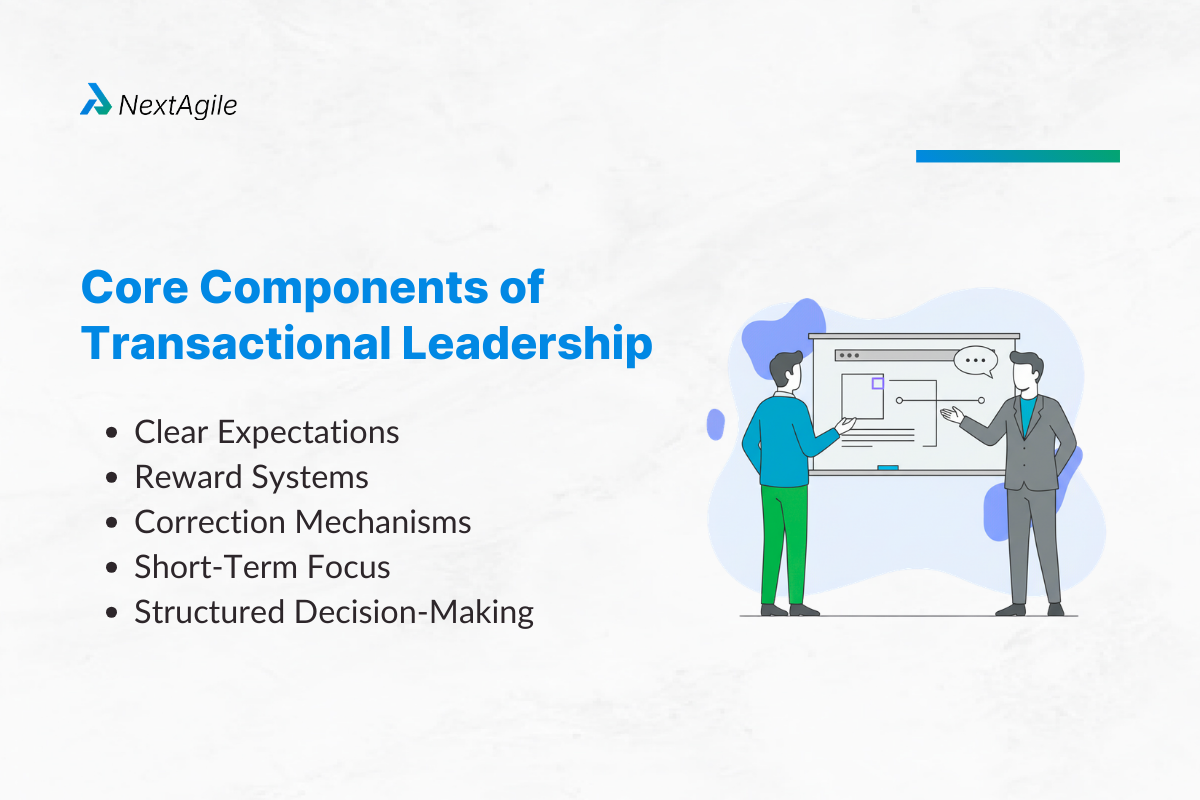
- Clear Expectations – Leaders set specific goals and responsibilities.
- Reward Systems – Performance is acknowledged, often through bonuses, promotions, or recognition.
- Correction Mechanisms – Mistakes are addressed promptly, ensuring accountability.
- Short-Term Focus – The approach prioritizes immediate results over long-term vision.
- Structured Decision-Making – Leaders use established protocols and traditional methods instead of experimentation.
Together, these elements create an execution system where accountability is explicit and performance conversations are objective. These components create a predictable, disciplined environment where team members understand exactly what is expected of them. When applied correctly, transactional leadership drives measurable results while reducing confusion and misalignment.
Key Characteristics of Transactional Leadership
Clear Expectations and Structure
Transactional leaders excel at clarifying roles, responsibilities, and outcomes. Teams know the hierarchy, reporting lines, and performance standards. This clarity reduces uncertainty and ensures everyone is aware of what to deliver, a vital aspect in organizations where consistency is crucial. This reduces dependency on constant supervision by replacing assumptions with shared understanding.
Extrinsic Motivation and Reward Systems
Rewards, whether monetary, recognition-based, or career-related, are central to this leadership style. Leaders connect performance to tangible outcomes, motivating team members to meet or exceed expectations. These external motivators are particularly effective in short-term projects or roles with clear metrics. Well-designed reward systems reinforce desired behaviors without ambiguity or favoritism.
Supervision and Control Mechanisms
Monitoring and oversight are key features of transactional leadership. Regular check-ins, tracking progress, and following protocols help prevent mistakes. While some may view this as micromanagement, in structured settings it ensures quality and reliability. In regulated or risk-sensitive environments, this oversight protects both quality and compliance.
Short-Term Focus
Transactional leaders focus on immediate deliveries and operational efficiency. Long-term vision takes a back seat to short-term objectives. This emphasis makes sure deadlines are met and projects stay on course but may call for additional leadership methods for strategic innovation. This focus ensures momentum, especially when delivery speed outweighs exploratory thinking.
Practicality and Conventional Decision-Making
Decisions rely on proven methods, best practices, and established policies. Leaders prioritize reliability over experimentation. This approach is effective in regulated industries or high-stakes environments where mistakes can have serious consequences. By relying on proven approaches, leaders minimize risk while maximizing consistency.
How Transactional Leadership Works?
At its core, transactional leadership converts expectations into observable, measurable action.
Setting Goals and Objectives
Leaders create clear, measurable goals. These objectives remove ambiguity and serve as a guide for team performance. For instance, setting sales targets or production benchmarks ensures everyone understands what success entails. Clear goals eliminate interpretation gaps and create a shared definition of success.
Establishing Reward and Consequence Structures
Performance is connected to rewards, while non-compliance leads to corrective actions. Bonuses, promotions, or recognition incentivize high performance, while feedback and interventions address performance gaps. This cause-and-effect linkage reinforces accountability across teams.
Providing Feedback and Recognition
Immediate feedback reinforces desired behaviors. Recognition, whether public or private, keeps teams motivated. Transactional leaders prioritize regular check-ins and performance reviews to maintain accountability. Timely feedback ensures performance adjustments happen before issues escalate.
Implementing Corrective Action
When expectations are not met, transactional leaders take quick, structured action. This might involve performance improvement plans, coaching sessions, or adjustments to workflows, all aimed at restoring alignment and preventing repeated mistakes. Structured intervention prevents recurring errors and restores execution discipline.
When Transactional Leadership Is Most Effective?
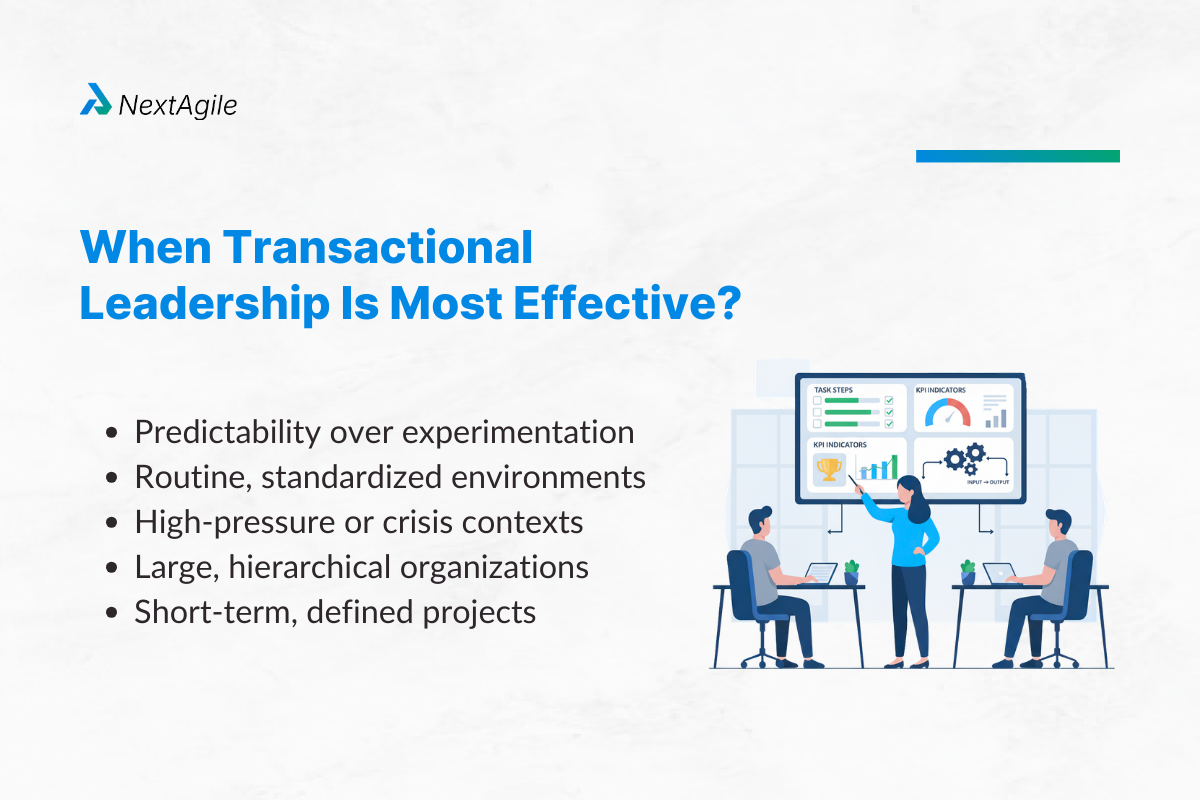
Transactional leadership performs best when predictability outweighs experimentation.
Routine and Standardized Work Environments
In predictable workflows, transactional leadership promotes efficiency and reduces errors. Teams benefit from structure and clear guidance, while leaders maintain control over operational results. Standardization enables scale without sacrificing quality.
High-Pressure and Crisis Situations
During emergencies or tight timelines, transactional leadership clarifies decisions and prompts quick actions. By focusing on structure and accountability, leaders navigate high-stakes scenarios effectively. Clear authority and rules accelerate response when time is critical.
Large Organizations with Clear Hierarchies
Transactional approaches thrive in large companies with multiple management levels. Well-defined roles, responsibilities, and reporting lines ensure alignment across teams, preventing operational chaos. Hierarchy and structure reduce coordination overhead across complex systems.
Short-Term Projects with Defined Deliverables
For tight timelines, this leadership style enhances focus and measurable outcomes. By clarifying expectations and linking performance to rewards, leaders can deliver reliable results. Defined rewards sharpen focus and delivery discipline.
Limitations and Challenges of Transactional leadership
Understanding these limitations is essential to applying transactional leadership responsibly.
Effects on Motivation and Engagement
While transactional leadership encourages compliance, it may lessen intrinsic motivation. Teams focused solely on rewards might miss chances for creativity or personal development. Without complementary approaches, engagement may plateau over time.
Constraints on Innovation and Creativity
Structured methods can hinder experimentation. Leaders relying too much on transactional approaches may find it hard to encourage innovative solutions or out-of-the-box thinking. Creativity often requires psychological safety, which rigid systems may unintentionally suppress.
Reactivity Rather Than Proactivity
Transactional leadership tends to be reactive, addressing issues after they arise instead of anticipating them. This can limit long-term growth unless paired with forward-looking strategies. Long-term resilience requires pairing correction with anticipation.
Over-reliance on External Rewards
Motivating exclusively through external incentives can create dependency. Employees may only perform when rewarded, undermining their autonomy and engagement over time. Sustainable performance depends on gradually strengthening intrinsic motivation.
Implementing Transactional Leadership Successfully
Effectiveness depends less on the model and more on situational judgment.
Assessing Situational Appropriateness
Transactional leadership works best in structured, short-term, or high-pressure contexts. Leaders must examine the situation before applying this style to avoid disengagement or stagnation. Misapplied transactional leadership can solve short-term issues while creating long-term disengagement.
Integration with Other Leadership Approaches
Combining transactional and transformational strategies often yields the best results. For example, pairing structured oversight with visionary guidance can create both discipline and inspiration. Blended leadership models offer both stability and adaptability.
Best Practices for Implementation
Set clear goals, communicate expectations, recognize achievements, and address underperformance quickly. Encourage accountability while balancing short-term focus with long-term planning. Consistency in application builds trust, even in highly structured environments.
Measuring Effectiveness
Monitor KPIs, team performance metrics, and engagement indicators. Feedback loops can refine reward systems and ensure that transactional practices remain effective without dampening morale. Measurement ensures transactional systems evolve rather than stagnate.
Transactional vs. Transformational Leadership
High-performing leaders shift fluidly between both styles based on context.
|
Conclusion
Transactional leadership is an effective tool for achieving measurable outcomes, maintaining accountability, and ensuring operational efficiency. Its structured, reward-driven approach fits well in high-pressure, routine, and short-term environments, providing clarity and discipline when teams need it most. Transactional leadership anchors execution when uncertainty or complexity threatens delivery.
While it has limitations, particularly regarding innovation and intrinsic motivation, blending transactional principles with transformational techniques or creative frameworks helps leaders achieve both reliability and engagement. Used intentionally, it becomes a stabilizing force rather than a limiting one.
Knowing when and how to use transactional leadership is essential for today’s executives. By mastering its components, applying key characteristics, and integrating it with complementary methods, leaders can deliver results without compromising team morale or long-term growth.
If you’re looking to help leaders grow through customized leadership journeys, from executive coaching to curated, business outcome driven learning programs,, consider partnering with a trusted leadership training company like NextAgile that aligns contextual leadership training programs with executive coaching and overall organizational agility. Our team excels at aligning leadership development with organizational objectives.
Frequently Asked Questions about Transactional Leadership
1. Is transactional leadership effective in modern workplaces?
Yes. It offers structure, accountability, and measurable results, especially in routine, high-pressure, or hierarchical settings. Combining it with motivational strategies ensures long-term engagement, productivity, and alignment with organizational goals. Its effectiveness increases significantly when paired with trust-based leadership behaviors.
2. How do transactional leaders handle conflict?
Transactional leaders manage conflict with clear rules, structured feedback, and corrective actions. They prioritize efficiency and compliance, resolving issues without disrupting team performance while reinforcing accountability and maintaining operational discipline. Clear rules reduce emotional escalation during conflict resolution.
3. Is transactional leadership suitable for remote teams?
Yes. Structured goals, clear expectations, regular feedback, and reward systems maintain alignment, productivity, and accountability among remote teams. Consistent communication and performance monitoring help ensure team cohesion and operational effectiveness. Structure replaces proximity as the primary coordination mechanism.
4. How does transactional leadership affect team morale in the long term?
It fosters consistency and accountability but may decrease intrinsic motivation and creativity over time. Merging transactional methods with motivational and transformational practices keeps engagement, team satisfaction, and a high-performance culture. Balanced leadership prevents consistency from turning into complacency.