Skip to content
Introduction
Leadership in the rapidly changing business world today is more daunting than ever before. Companies are confronted with skill shortages, changing workforce needs, and increasing pressure to perform. In reality, research shows that more than 60% of employees believe leadership ineffectiveness exists and is affecting engagement and productivity. Leadership gaps often surface not during stability, but under pressure, when ambiguity, pace, and competing priorities expose limitations in decision-making, influence, and resilience.
This guide will walk you through what leadership coaching is, how leadership coaching works, the measurable benefits for individuals and organizations, and how to choose the right coach. Organizations looking to curate their leadership coaching program can also explore leadership enablement services of NextAgile. Leadership coaching creates a structured pause for reflection and recalibration, enabling leaders to operate with clarity rather than reacting under constant pressure.
What is a Leadership Coach?
A leadership coach is a professional who has undergone training to work alongside leaders to help them become more effective, confident, and influential. While mentors tend to provide advice based on experience, leadership coaches utilize systematic approaches, research-based tools, and assessments to determine strengths, deficiencies, and areas for growth.
Here’s the thing: leadership is not innate, it can be developed. That’s where a professional leadership coach comes in. Through tailored coaching, leaders at all levels, from emerging managers to C-suite executives gain the insights, tools, and strategies they need to perform at their best.
Good coaches possess qualifications including executive or leadership coaching certifications, a wealth of business acumen, and sound awareness of organizational dynamics. They operate in various industries, guiding leaders in communication, decision-making, and strategic thinking.
In practice, a professional leadership coach might help a senior executive navigate complex organizational changes, guide mid-level managers in team performance improvement, or provide emerging leaders with skills to lead confidently. Their expertise ensures coaching sessions are goal-focused, actionable, and measurable, fostering tangible leadership growth. The true value of a leadership coach lies not in giving answers, but in sharpening judgment, that way helping leaders think better, decide faster, and act with intent.
What is Leadership Coaching?
Leadership coaching is a systematic development process in which a coach collaborates with leaders in order to improve their skills, attitude, and performance. It integrates assessment, feedback, goal-setting, and pragmatic strategies to drive individual and organizational outcomes.
- Core values encompass active listening, accountability, and behavioral intervention.
- Methodologies frequently borrow from transformational leadership, emotional intelligence, and evidence-based organizational psychology.
Leadership coaching developed from casual mentoring to an advanced practice combining psychology, business strategy, and performance metrics over the years.
Professional leadership coaches today pay attention not only to skill building but also to building self-awareness, staying resilient, and strategic thinking. Leaders are provided personalized guidance to overcome challenges, engage stakeholders, and deliver measurable results, all while connecting personal development with organizational outcomes. Unlike one-size-fits-all training, leadership coaching adapts to context, ensuring development is relevant to real business challenges rather than abstract models.
Roles and Responsibilities of a Leadership Coach
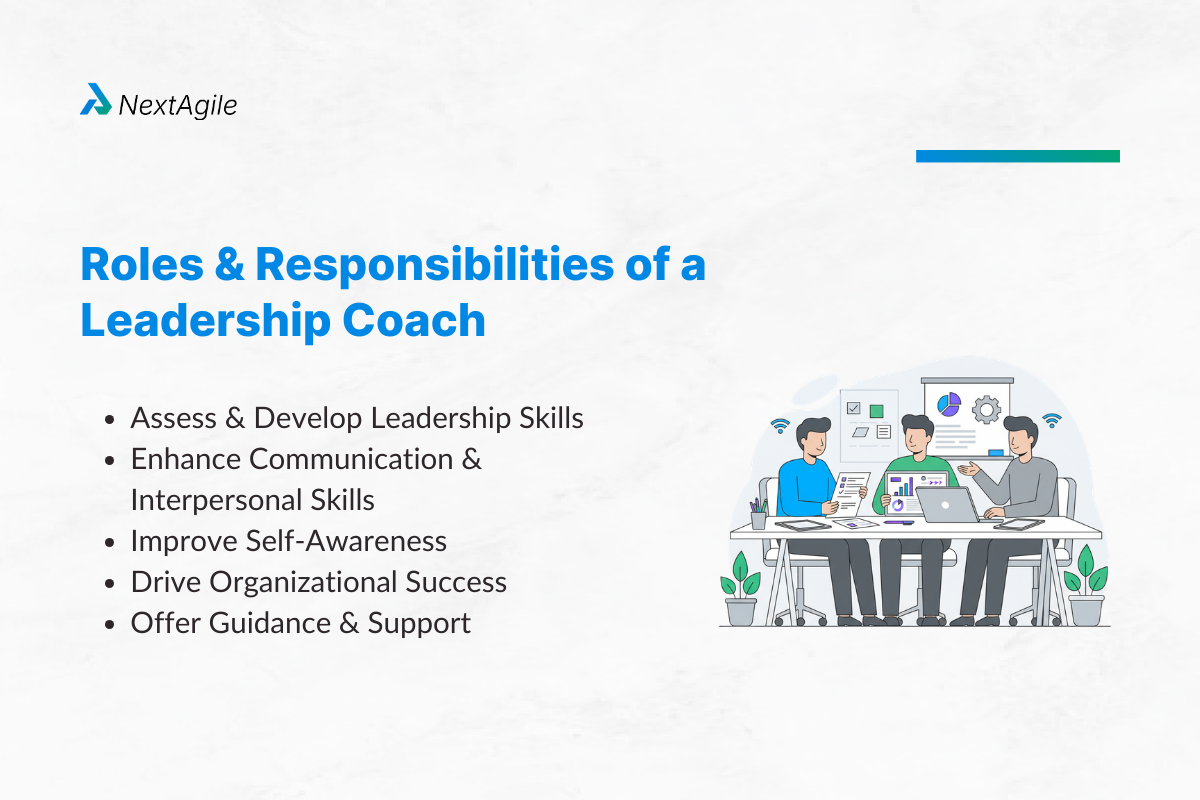
Assess and Develop Leadership Skills
Coaches assess skills such as communication, decision-making, and vision-setting. Through assessments, feedback, and observation, they uncover gaps and create development plans. Leaders receive focused strategies to build influence, confidence, and strategic competence. Structured assessments convert intuition into insight, allowing leaders to focus effort on the few behaviors that create disproportionate impact.
Enhance Communication and Interpersonal Skills
Strong leadership relies on effective communication. Coaches assist leaders in sharpening messaging, active listening, and stakeholder communication. With practice of these skills in real situations, leaders build stronger relationships, drive collaboration, and reduce conflict. When leaders communicate with clarity and empathy, alignment improves and execution friction drops across teams.
Improve Self-Awareness
Coaches expand leaders’ self-awareness through reflection and feedback. Having insights about emotional triggers, strengths, and blind spots enables leaders to make conscious choices and react flexibly in challenging situations. Self-awareness acts as a leadership accelerator, leaders who understand themselves adapt faster, recover quicker, and lead more intentionally.
Drive Organizational Success
By linking individual leadership development to organizational goals, coaches enable higher-performing teams, better culture, and strategic execution, ultimately driving tangible business outcomes. Leadership coaching delivers maximum value when individual growth is explicitly linked to enterprise priorities and measurable outcomes.
Offer Guidance and Support
Trusted partners, coaches provide confidential guidance and insight. Leaders test challenges, try new tactics, and get ongoing coaching to continue making progress. The confidentiality of coaching creates a rare space where leaders can test ideas, surface doubts, and refine decisions without organizational noise.
Leadership Coaching Types
Selecting the right coaching format ensures development effort matches leadership scope, complexity, and organizational influence.
Executive Coaching
Positioned at the senior leader level, executive coaching tackles strategic decision making, organizational impact, and executive presence. It’s very bespoke, commonly focused on specific business results in addition to personal growth. At senior levels, coaching shifts focus from operational effectiveness to systemic influence and long-term organizational impact.
Team Coaching
Team coaching strengthens teamwork, communication, and collaboration. Coaches engage with whole teams to synchronize goals, enhance problem-solving, and develop high-performing accountability culture. Team coaching transforms collective performance by addressing dynamics that individual development alone cannot resolve.
Individual Coaching
Individual coaching is for developing emerging leaders or mid-level managers. Sessions are for skill building, confidence development, and overcoming performance issues, enabling leaders to advance in their jobs effectively. For emerging leaders, coaching accelerates readiness by building confidence before habits solidify.
Benefits of Leadership Coaching
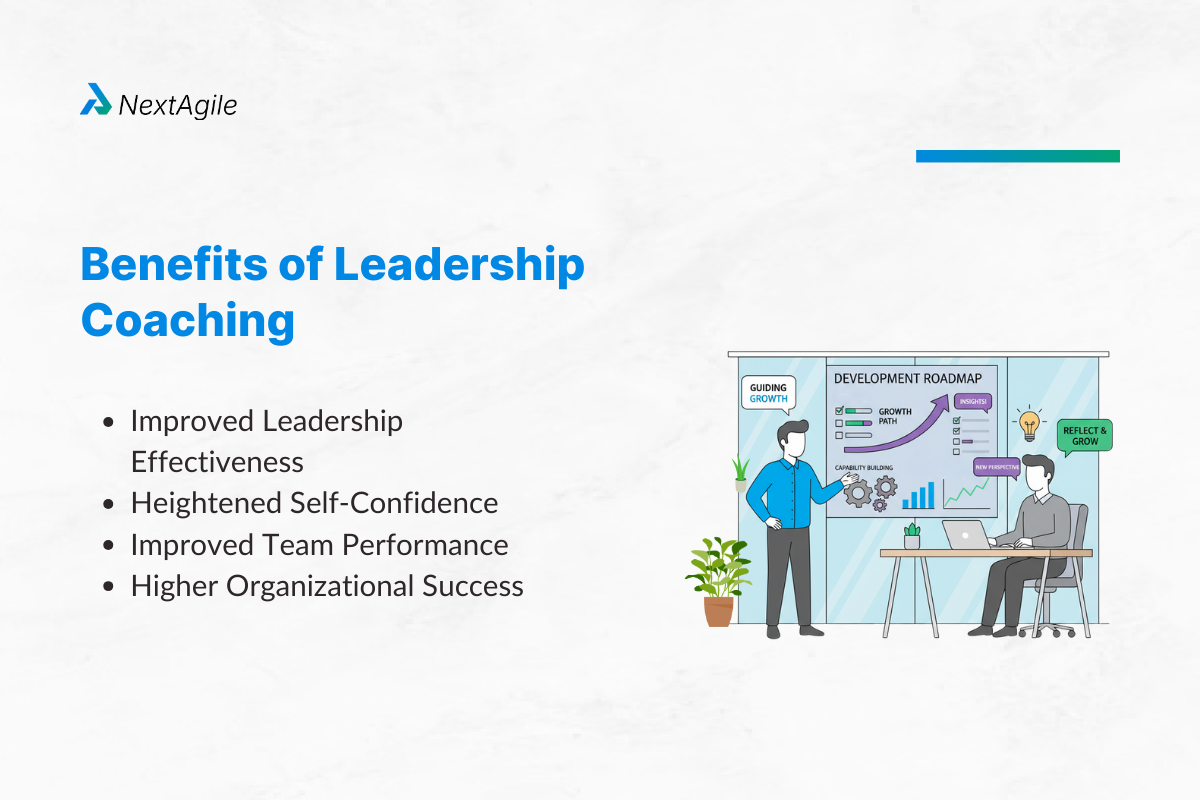
Improved Leadership Effectiveness
Coaching empowers leaders with techniques to inspire, influence, and guide staff. They are more effective in making decisions, setting clearer visions, and implementing change, leading to more performing teams and better organizational alignment. Effective coaching sharpens a leader’s ability to translate intent into consistent action across teams.
Heightened Self-Confidence
Leaders become clearer about strengths and developmental opportunities. Coaching enhances resilience, decision-making ability, and self-confidence, allowing leaders to make sense of challenging situations without fear or self-doubt. Confidence developed through coaching is grounded in competence, not bravado, enabling leaders to act decisively without defensiveness.
Improved Team Performance
As leaders become better, teams perform better. Coaching equates to better collaboration, communication, and employee engagement. Teams enjoy clearer objectives, fewer disagreements, and increased productivity. As leadership clarity improves, teams spend less energy on interpretation and more on delivery.
Higher Organizational Success
Leadership coaching affects culture and outcomes. Organizations gain from better staff retention, creativity, and strategic implementation. By investing in leadership improvement initiatives, organizations realize quantifiable ROI and long-term viability. Leadership coaching compounds over time, embedding better decisions, behaviors, and outcomes deep into the organization.
How Does Leadership Coaching Help Leaders Do a Better Job?
Research indicates that coached leaders at all levels see measurable gains in decision-making, emotional intelligence, and strategic thinking. They acquire the ability to manage their stress, delegate efficiently, and solve complex issues with confidence.
Principal performance gains are:
- Decision-making: Leaders make well-informed, timely decisions consistent with organizational strategy.
- Emotional intelligence: Greater self-awareness strengthens team relationships and influence.
- Communication: Clarity in messaging drives engagement and alignment.
- Accountability: Leaders establish goals and achieve them consistently.
In our experience as a Leadership enablement company, we have seen that these gains are sustained because coaching focuses on behavior change, not temporary motivation. By working with a professional leadership coach, leaders not only grow personally but also create ripple effects that elevate team performance and drive business success.
How Does Leadership Coaching Benefit Businesses?
In addition to individual development, leadership coaching provides tangible organizational returns. Organizations experience higher employee engagement, improved culture, and better retention levels. Coaching-trained leaders drive performance, innovation, and strategy alignment.
ROI is real: studies indicate companies that invest in executive coaching realize 5–7 times return on leadership development investments. Coaching also quickens succession planning and builds leadership pipelines for long-term stability.
Cultural change happens as coaching embeds cooperation, accountability, and strategic thinking. Leaders set examples that cascade through the teams, instilling performance-oriented mindsets and enabling employees to make impactful contributions. Finally, leadership coaching aligns individual and organizational development, producing a lasting competitive edge. Organizations that systematize leadership coaching reduce dependency on individual heroics and increase execution reliability.
What is Cohort-Based Leadership Training?
Cohort-based leadership training entails small cohorts of leaders advancing through development programs in tandem. It focuses on peer learning, collaboration, and mutual accountability.
Participants enjoy immediate feedback, multiple viewpoints, and guided reflection. Professional leadership coaches lead sessions, guiding discussion, challenging assumptions, and encouraging skill application in practical contexts.
Incorporating coaching with cohort programs speeds up the learning process. Leaders learn skills, get constructive criticism, and develop networks larger than the program. Through this method, there is a community of leaders that can change as a group. Cohort learning reinforces accountability, as leaders grow together rather than in isolation.
Leadership Coach vs. Executive Coach: Understanding the Differences
While both emphasize leadership development, their scope and approach vary. Executive coaches are mostly aimed at senior leaders, targeting strategic impact, organizational performance, and executive presence. Leadership coaches operate at all levels, targeting skill building, confidence, and team leadership.
The selection depends on goals: senior executives are most benefited by executive coaching for high-stakes decisions, whereas managers or up-and-coming leaders benefit from more comprehensive leadership coaching for building competencies and performance. Clarifying coaching intent upfront ensures investment aligns with leadership maturity and business risk.
How to Select a Good Leadership Coach?
Assess a coach’s qualifications, experience, and coaching philosophy. Request information about expereince, methods, and success stories. Important questions:
- What are the results I can anticipate?
- How do you adapt coaching to my position and organization?
- Can you share references or case studies?
Red flags are no measurable outcomes, unclear methodology, or sparse experience in executive leadership. A professional coaching leader should instill confidence, give practical advice, and share your development goals. The best coaching relationships are built on trust, challenge, and measurable progress, not comfort alone.
Conclusion
Leadership coaching is no longer a choice—it’s a necessity for organizations that want to sustain growth. With shifting workforce expectations, remote work challenges, and growing complexity, leaders require tailored guidance to lead successful change. Leadership coaching shifts leadership from reactive problem-solving to deliberate, strategic influence.
Investing in a professional leadership coach equips leaders to change themselves, their teams, and their organizations. As coaching moves into the mainstream, the future holds smarter, more effective leadership development programs. Organizations that get on the coaching bandwagon today set themselves up for better culture, greater engagement, and quantifiable performance gains tomorrow. When coaching is treated as a capability rather than an intervention, organizations build leadership depth that endures beyond individual tenures.
If you’re looking to curate leadership coaching programs for your organization, consider partnering with a trusted leadership coaching company like NextAgile that aligns contextual leadership coaching programs with executive coaching and overall organizational agility. Our team excels at aligning leadership development with organizational objectives. You can also reach us at consult@nextagile.ai
Frequently Asked Questions About Leadership Coach
1. Is leadership coaching appropriate for new managers?
Absolutely. Leadership coaching equips beginning managers with key skills such as communication, decision-making, and team guidance early on. It enhances confidence, promotes accountability, and speeds up leadership development, providing a solid foundation for long-term managerial success. Early coaching prevents ineffective leadership habits from becoming entrenched.
2. What is the ROI of investing in leadership coaching?
Investment in leadership coaching provides measurable ROI in the form of enhanced employee engagement, productivity, and retention. Leaders make more informed decisions, motivate teams, and deliver business outcomes. Companies usually experience tangible performance improvements and culture shifts in months following coaching programs. The strongest ROI appears when coaching outcomes are tracked against business metrics, not sentiment alone.
3. Can leadership coaching be done remotely?
Yes. Virtual leadership coaching is very effective, employing video calls, online assessments, and interactive tools. It provides flexibility, accessibility, and continuity without compromising confidentiality and personalized guidance, thus enabling executive development for geographically dispersed teams. Virtual coaching increases reach while preserving depth through intentional structure and cadence.
4. How is leadership coaching different from mentoring?
Leadership coaching is performance-focused, goal-oriented, and structured, aimed at specific behaviors and skills. Mentoring is generally experience-based, relationship-oriented, and broader in scope, providing guidance and career development insights as opposed to systematically building measurable leadership competencies. Coaching emphasizes future behavior change, while mentoring reflects on past experience, both serve different development needs.