Skip to content
Introduction to Future of Enterprise Agility
NextAgile has designed and implemented multiple enterprises through successful agile transformations in the last six+ years. With the rapid adoption of AI across all industries and the disruption that comes along with it, we realised that it is time to pivot our strategy and approach to transform completely. This blog is an attempt to put a few thoughts together on the future of Enterprise Agility. Change is the only constant.
Ever ask yourself how some organizations transition smoothly into disruption and others struggle and fall behind? The reason often lies in enterprise agility and as we enter 2026, the future of enterprise agility is inextricably linked to one of the most revolutionary forces driving business today Artificial Intelligence (AI).
Business agility has always existed to pre-empt change, to respond rapidly, and to deliver value effectively. But here lies the catch: conventional agile methodologies by themselves are not enough anymore. The emergence of AI is redefining agility, the way decisions are being made, the way teams work, and the way businesses compete in a fast-paced market.
Consider this. Modern businesses are coping with complex and evolving customer demands, humongous amount of data and AI backed simulation models that predicts needs before they occur. Agility is no longer only about responding quicker; it now includes anticipating and defining the future. Businesses that don’t pay attention to this shift will be at risk of lagging behind, but companies that seize this opportunity will unlock unprecedented levels of innovation, velocity, and resilience.
In our experience guiding Fortune 500 companies through Agile transformations, We have noticed a clear pattern: enterprises that successfully combine AI with agile practices don’t just adapt to change they stay ahead of it. Product cycles shrink, decisions become data-informed and faster, and teams operate with a level of alignment that previously seemed impossible.
In this guide, we will cover the future of enterprise agility in an AI era, including fundamental foundations, AI as a game-changer, key drivers, challenges, working roadmap, future trends, and real-world case studies. If you’re a leader, Scrum Master, or Agile Coach, the information here will facilitate your journey through AI-enabled transformation, making uncertainty an opportunity.
By the end, you will understand how to future-proof your enterprise not just survive disruption, but thrive in it.
The Future of Enterprise Agility: Core Foundations
Enterprise agility is not a fad; it’s the organizational strength that allows enterprises to respond at scale. While team-level agility (Scrum, Kanban, SAFe teams) enabled organizations to deliver quicker in the past decade, the future requires a larger shift agility at business models, decision-making, and cultural DNA.
From Team Agility to Enterprise Agility
We have achieved a 30% reduction in planning-cycle time by dismantling silos and introducing cross-functional PI planning, implementing Lean Portfolio Management (LPM) for strategic decision making & 100% alignment to enterprise strategic themes.
You have probably seen organizations succeed at team-level agility but struggle to deliver enterprise-wide outcomes. That’s because scaling agility requires more than Scrum ceremonies, Kanban boards, or SAFe program increments. Enterprise agility is about linking strategy to execution, ensuring that every department from HR to finance to IT can sense change and adapt in unison.
In the real world, this transformation means silo-busting. Marketing departments deploying real-time campaigns need to synchronize with finance departments dynamically updating budgets and HR departments redeploying talent in a flash. If this does not happen, business houses stand to lose out on disjointed delivery, wasteful duplication, and lost opportunities.
For instance, in a recent project with a global retailer, the organization had effective agile pilots within IT but not so in product launch timelines. By linking cross-functional teams through enterprise-level planning, coordinating KPIs against customer value, and incorporating AI-based analytics into planning processes, we achieved 25% time-to-market reduction while improving stakeholder satisfaction.
Future-proof businesses also reimagine hierarchies. Old top-down decision-making is replaced by networked environments of cross-functional teams that are given the autonomy to make local, goal-aligned decisions. Information moves laterally as much as it does vertically, allowing speed and agility in course correction and learning. This is where agility converges with intelligence: decisions are made based on real-time data, AI forecasts, and human insight, giving rise to a responsive, adaptive organization.
Unlike most consulting companies, we integrate agile maturity models and our in-house curated pattern recognition framework to customize each client roadmap – many clients say that that’s our secret sauce.
Why Future of Enterprise Agility is Non-Negotiable?
The velocity of disruption today renders agility imperative. Customers require hyper-personalization, competitors test AI-based models, and global events radiate instantly across markets. Here, agility isn’t a choice; it’s survival.
Take the banking industry, for example. Digital banks that adopted enterprise agility during the pandemic not only survived but flourished, gaining market share and customer interaction. Why? Because they were able to quickly pivot, roll out AI-powered chatbots, and adjust services in real time, whereas traditional banks were unable to respond to even slight changes.
Likewise, in production, businesses using predictive analytics and agile processes evaded supply chain disruptions and optimized production calendars, whereas opponents experienced costly delays. Agility here is not only speed; it’s resilience and foresight.
The future of business agility is all about embracing uncertainty positively. It’s leaders predicting market change, using AI insights to act, and empowering teams to make independent decisions in line with strategic goals. Without this, businesses are poised for stagnation, inefficiency, and lost opportunities.
Enterprise agility also spurs innovation. As teams are encouraged to experiment, fail quickly, and learn, they unlock new business models and sources of revenue. AI amplifies this ability by leveraging predictive insights, patterns, and unseen opportunities. Together, agility and AI turn enterprises into learning, adaptive organizations that can excel in complexity.
AI as the Game-Changer for Enterprise Agility
A global telco cut customer complaints by 35% after embedding AI-powered triage into its agile incident management framework.
AI is not just a supporting mechanism for agility; it’s a force multiplier that facilitates predictive decision-making, boosts workflows, and increases enterprise responsiveness. Organizations incorporating AI into agile practices achieve a notable competitive edge.
AI-Powered Decision Making
Historically, business decisions entailed lengthy loops of data gathering, analysis, and sign-off. AI compresses that loop, allowing for near-real-time, predictive decision-making. Supply chain executives, for instance, can now anticipate disruptions weeks ahead, anticipate inventory adjustments proactively, and dynamically optimize distribution. That is not merely agility it’s predictive agility.
Imagine a Product Owner using AI-driven backlog prioritization. Instead of relying solely on subjective stakeholder input, AI analyzes customer behavior, market trends, and operational constraints to recommend prioritized features. This ensures teams focus on work that maximizes value while minimizing waste.
AI can also be used to improve risk management. For example, banks leverage AI to identify anomalies in real-time so that agile teams can shift strategies before slight issues snowball. Marketing teams tap AI to forecast campaign performance, making creative or targeting changes mid-campaign. AI minimizes guesswork, speeds up feedback loops, and enhances decision confidence in all instances.
Human-AI Collaboration in Agile Workflows
AI will not replace humans, that is a myth; it will complement humans. In other words, the future of enterprise agility lives on human-AI partnership. AI supplements human intelligence by automating humdrum activities and putting forward insights that enable humans to focus on judgment, imagination, and leadership.
Agile ceremonies might look a bit different with the help of AI: sprint planning can include predictive analytics to estimate velocity, retrospectives show collaboration patterns or bottlenecks, and project dashboards dynamically visualize risks. AI acts like a co-pilot, providing insights but not taking away human decision-making power.
For instance, AI-based diagnosis in medicine, together with flexible work processes, will reduce patient evaluation times drastically. Clinicians depended on AI to sift through enormous volumes of data while focusing on high-order thinking and patient interaction. What they did was arrive at quicker and more exact decisions with no compromise in human experience.
Human-AI collaboration also fosters continuous learning. Teams receive real-time feedback from AI models; these, in turn, facilitate fast experimentation and adjustment. Companies adopting this model experience far greater responsiveness, employee happiness, and speed of innovation.
Key Drivers of Future Enterprise Agility
The future of enterprise agility in the AI age is driven by customer-centricity, predictive foresight, and adaptive cultures.
Customer-Centricity in the AI Era
Agility has always revolved around customer value. In the AI era, customer-centricity is about predicting at scale and anticipating their needs and preferences. AI allows companies to process behavioral data, do sentiment analysis, and use prediction models to offer proactive personalized experiences to the end customer.
For instance, online retailers use AI to predict shopping behavior, dynamically reprice, and optimize stock. Quick-to-react agile teams immediately respond to such insights by initiating targeted campaigns and changing product offerings in almost real-time. AI and enterprise agility together guarantee customer satisfaction with enhanced efficiency of operations.
Incorporating customer intelligence into agile planning also speeds up feedback loops. Organizations can react to trending patterns, modify backlogs, and shift strategies on the basis of predictive insights instead of reactive assumptions. This not only improves speed but also relevance, which is a key driver of customer retention and competitive edge.
Predictive Agility with Data & Analytics
Traditional reactive agility is no longer enough. Artificial Intelligence and data analytics-driven predictive agility allow business organizations to anticipate change and steer their course accordingly.
For instance, in banking and financial enterprises, predictive analytics identify potential customer churn and trigger retention programs that can reach the right customers. Or, in manufacturing, digital twins model production environments, enabling teams to optimize schedules and resources in real time. Retailers predict demand and manage supply chains dynamically to cut costs and enhance responsiveness.
To realize predictive agility, organizations need to make data literacy a reality across teams. Agile leaders, Scrum Masters, and Product Owners need to interpret AI insights and provide actionable strategies. Predictive insights also facilitate scenario planning, which allows enterprises to work with uncertainty and move forward confidently.
By integrating predictive analytics into agile practices, enterprises can evolve from reactive firefighting to proactive planning, guaranteeing sustained adaptability and competitive edge.
Challenges Enterprises Face in AI-Enabled Agility
Despite its potential, achieving AI-enabled enterprise agility is challenging. Common hurdles include resistance to change, organizational silos, and talent gaps.
Resistance to Change & Silos
Most agile initiatives fail not because of frameworks but because of cultural mindsets. Change resistance, departmental silos, and legacy processes get in the way of transformation. Integration of AI increases these difficulties: workers will feel job threats, managers will oppose losing control, and executives will fear ethical and compliance risks.
Overcoming these obstacles demands open communication, inclusive change management, and visible quick wins. Leadership should communicate the value of AI-facilitated agility, engage employees in design and development, and acknowledge small wins to create momentum.
Structural and cultural interventions also call for breaking down silos. Cross-functional teams need to share metrics, data, and insights seamlessly. AI can facilitate this by presenting single-pane-of-glass dashboards, predictive insights, and automated reporting, but adoption is ultimately driven by culture.
Talent & Skills Gap for AI-Agile Leaders
One major impediment is the absence of leaders who are both agile experts and AI literate. Conducting a retrospective is one ability; decoding machine learning results and steering strategic turns is another. Enterprises frequently fail to identify leaders conversant in both languages.
Upskilling initiatives, mentorship, and ongoing education are essential. Agile leaders need to know AI basics, data ethics, and adaptive decision-making. Organizations that prioritize leadership development today will leave competitors behind who make AI skills voluntary.
Furthermore, reskilling the workforce ensures that teams can work effectively with AI systems, correctly interpret insights, and drive changes without hesitation. AI-fueled agility isn’t about tools it’s about people and enabling them to adapt.
Roadmap to Achieving AI-Driven Enterprise Agility
Below is a five-step roadmap to implement AI and enterprise agility successfully.
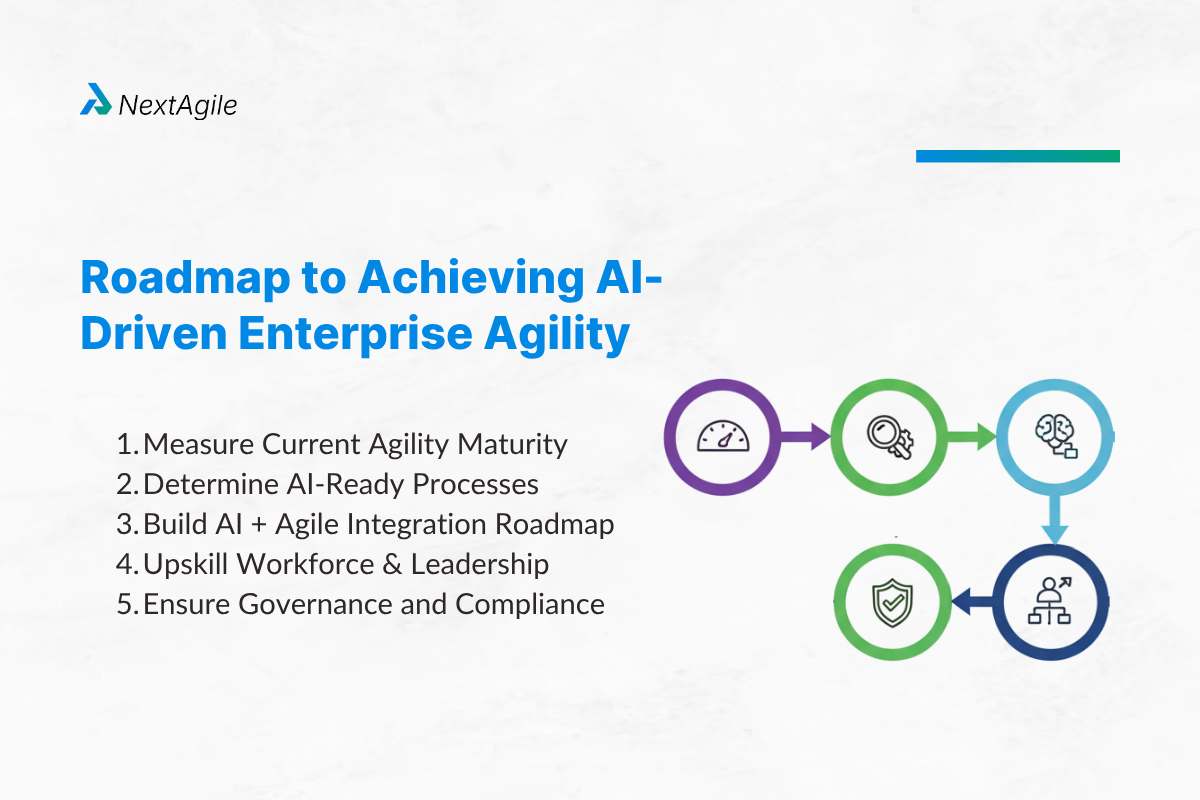
- Step 1 – Measure Current Agility Maturity
Measure cultural, structural, and process readiness with enterprise agility maturity models. Determine bottlenecks and gaps that restrict AI adoption. This measure establishes a baseline for specific interventions.
- Step 2 – Determine AI-Ready Processes
Prioritize high-impact, data-driven workflows such as supply chains, product analytics, and customer service. Quick wins create momentum, exhibit value, and set the organization up for wider AI integration.
- Step 3 – Build AI + Agile Integration Roadmap
Create a roadmap that ties AI capabilities with agile frameworks such as SAFe or LeSS. Map AI initiatives to strategic outcomes, integrate predictive insights into backlog management, and govern in such a way that structures support rapid experimentation.
- Step 4 – Upskill Workforce & Leadership
Invest in data literacy, AI capabilities, and adaptive leadership competencies. Support experimentation, failure, and iterative learning. Allow teams to make decision-making based on AI insights while maintaining human judgment. For organizations seeking structured guidance, the AI for Agility Workshop provides hands-on frameworks and best practices to accelerate workforce and leadership upskilling.
- Step 5 – Ensure Governance and Compliance
AI brings ethical, data integrity, regulatory, and compliance challenges. Governance is needed now to imbue transparency and explainability with data security to make sure that innovations are not produced at the expense of trust.
Future Enterprise Agility Trends (2026–2030)
Autonomous AI-Powered Enterprises
By 2030, AI will drive autonomous workflows, resources, and customer relationships on behalf of enterprises. Supply chains will self-optimize, IT infrastructures will self-heal, and operational decisions will take place in near real time. People will need to focus on ethics, strategy, and culture, while AI executes at scale.
Evolution of Agile Leadership in the AI Era
Leadership will shift from directive management to enabling human-AI ecosystems. Emotional intelligence, moral judgment, and AI literacy will characterize great leaders. They will develop adaptive cultures, empower cross-functional teams, and use predictive insights to make proactive, data-driven decisions.
Case Studies: Future of Enterprise Agility in Action
- ING: Increased speed-to-market by 30%, with a 20+ point NPS jump through an AI-centric agile operating model.
- Bosch: Achieved 40% shorter medical device cycles regulatory compliance maintained through agile-compliance hybrid squads.
- LEGO: Enabled rapid, cross-department product launches Agile and AI as the backbone of their turnaround.
Technology Sector (Google, Microsoft)
Google integrates AI into agile product development, accelerating feature iterations. Microsoft applies AI to DevOps pipelines, enabling predictive testing and faster releases. Both illustrate how AI supercharges enterprise agility, enhancing responsiveness, efficiency, and innovation velocity.
Healthcare Transformation (AI + Agility)
Hospitals embracing AI-based diagnostics and flexible workflows cut diagnosis times by 30% and enhanced patient satisfaction. AI analyzed intricate medical data, while clinicians concentrated on high-stakes care. Such a hybrid setup is the best example of AI-fostered agility in high-stakes settings.
Conclusion
The future of corporate agility is now, no longer a thought in the future. Organizations using agile principles together with AI potential are breaking away from reactive strategy to predictive, autonomous, and human-centric operations.
Agility alone isn’t enough. AI alone isn’t enough. The magic happens when they work together. AI amplifies human decision-making, accelerates workflows, and uncovers insights that were previously invisible. Agile practices provide the structure, culture, and processes needed to act on those insights effectively.
Culture is the glue. An adaptive, resilient culture fosters experimentation, accepts failure, and celebrates learning. Without it, the most sophisticated AI tools fail to make a lasting impact. Leaders have to create a culture where teams feel empowered to apply AI insights, take control, and learn continuously.
Leadership, too, is evolving. Tomorrow’s leaders are facilitators of human-AI ecosystems. They balance ethical considerations with data-driven decisions, support cross-functional collaboration, and focus on creating value at every level of the enterprise. Emotional intelligence, adaptability, and AI literacy will define leadership effectiveness in the years ahead.
Customer value creation still remains the ultimate success criterion. Companies that will be able to anticipate customer demand, use predictive analytics, and pivot quickly will lead their industries. Agility makes sure that AI-based insights translate into swift action and transform data into concrete business outcomes.
The roadmap is clear: assess your current agility, identify AI-ready processes, integrate AI into agile frameworks, upskill your workforce, and ensure governance and compliance. Follow these steps, and you will create an enterprise that does not just react to change; it shapes it.
Ultimately, the organizations that succeed are those that can accept human and machine intelligence alike, commit to culture and leadership, and stay single-mindedly dedicated to delivering value. Enterprise agility in the future is not just a strategy it’s a differentiator.
It is now time to act. Start introducing AI into your agile processes, foster an adaptive culture, and empower teams and leaders to own the transformation. In doing so, position your enterprise not only to survive the disruption but to thrive in 2026 and beyond in an AI-driven world.