Skip to content


“You can’t build a digital future with analog leadership.”
— Hunter Muller, HMG Strategy
Ever notice how leadership conversations these days sound very different from a decade ago? Back then, strategy cycles lasted years, organizations could afford slow pivots, and digital was often considered a “support function.” Today, we’re living in the age of transformation, where digital disruption, economic volatility, and societal shifts converge at unprecedented speed. This new reality defines the critical challenge of Leadership in the Age of Transformation.
For today’s leaders, the problem is not merely a matter of adapting tactics it’s a matter of reframing leadership. Executives must lead organizations through turmoil, adopt technologies they never knew, orchestrate multigenerational workforces, and preserve organizational culture while revamping business models. It’s a delicate act to perform, and antiquated command-and-control approaches simply won’t cut it in this setting.
Transformation reveals gaps in leadership immediately and outwardly. Executives who hold on to old models threaten to destroy trust and lose talent, whereas the ones that lead through adaptability, vision, and digital fluency build resilience and possibility. It is not necessarily the people with the highest technical expertise who are successful but rather those who can inspire teams, exhibit change, and make intelligent decisions in the moment.
This handbook is intended to provide you with a complete roadmap for leadership in today’s age. We’ll cover the five pillars of transformational leadership, delve into leading through digital change, touch on crisis leadership techniques, and identify competencies that future-fit executives must develop. You’ll also receive a down-to-earth 180-day roadmap to begin implementing these principles right away.
If you ever wondered: “How do I lead when the ground keeps shifting?” this guide is for you. By its conclusion, you’ll have a clear sense of what it takes to lead in times of transformation and practical steps to position yourself and your organization for long-term success.
Leadership in the Age of Transformation: Core Principles & Modern Context
“Every successful organization has to make the transition from a world defined primarily by repetition to one primarily defined by change. This is the biggest transformation in the structure of how humans work together since the Agricultural Revolution.”
— Bill Drayton, Social entrepreneur
Defining Transformational Leadership
Transformational leadership is sometimes called the gold standard of contemporary leadership models. In contrast to transactional leadership which focuses on rules, rewards, and punishments transformational leadership shoots for something higher: it encourages people to transcend self-interest and unite behind a common purpose.
A transformational leader articulates a bold vision, models the behaviors needed to reach it, and empowers people to innovate and take ownership. Think of it as the difference between a boss who tells you what to do versus a leader who helps you imagine what’s possible and supports you in getting there.
Research repeatedly demonstrates that transformational leaders increase employee engagement, generate innovation, and maintain greater organizational performance over the long term.
The Convergence of Disruption: Digital, Social, and Economic Forces
Why is this approach so important today? Because transformation isn’t a choice anymore it’s the operating landscape.
Digital disruption: AI, automation, and cloud platforms are redefining the rules of every business. Leaders lacking digital fluency risk making decisions based on incomplete information.
Social transformation: Workers crave flexibility, inclusion, and purpose. Gen Z, now entering the workforce in large numbers, prioritizes purpose-driven organizations over prestige.
Economic volatility: Global crises, inflation, supply chain failures, and geopolitical tensions produce environments where uncertainty is constant.
In these conditions, leaders can’t just maintain stability. Success depends on navigating teams through turmoil, fostering resilience, and keeping organizational focus even as strategy evolves.
Modern leaders must balance paradoxes: stability and flexibility, tech and humanity, profit and social mission. Mastering these tensions is the art of leadership in the transformation era and why getting it right has become a professional proving ground.
The Five Pillars Every Disruption-Ready Leader Needs
Master these pillars and turn uncertainty into your organization’s competitive edge-
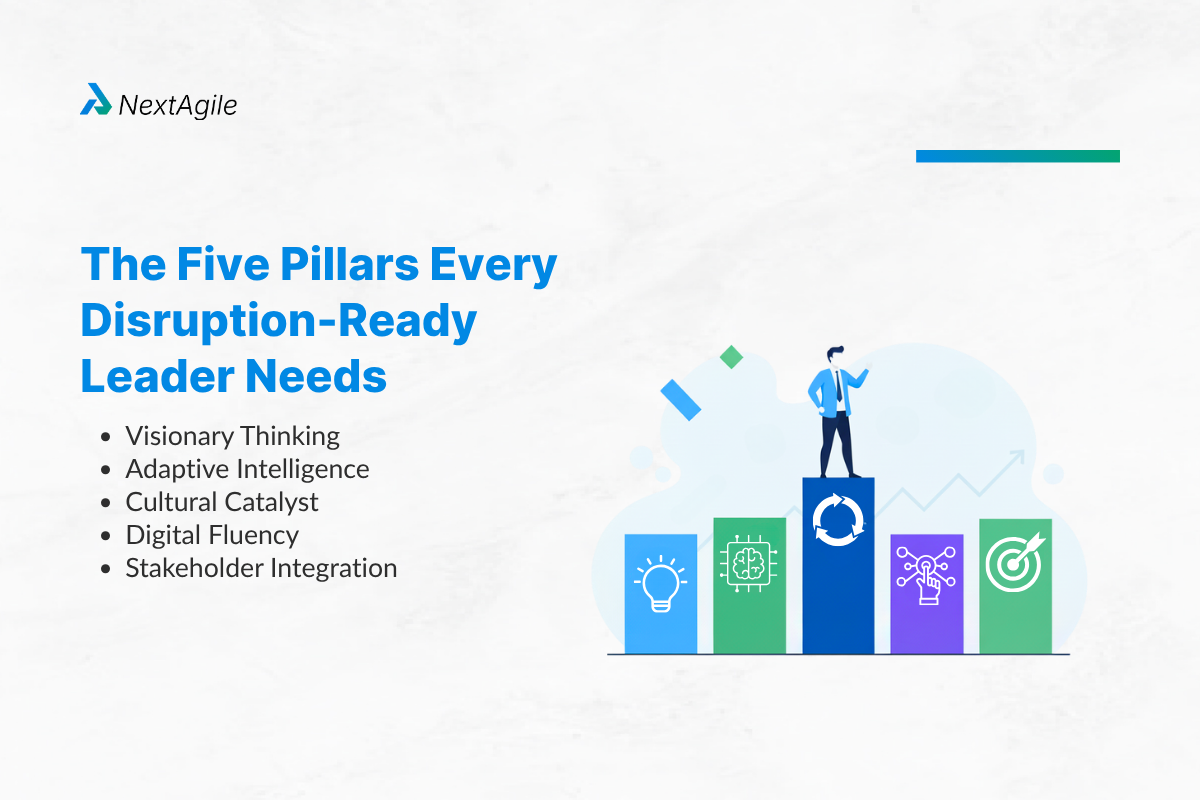
Visionary Thinking
Vision is the anchor during a storm. Leaders who paint a clear, compelling north star provide teams something to hold on to when everything else changes. Visionary thinking isn’t predicting every market move; it’s creating a collective sense of direction and allowing people to fail. Ambitious, values-based visionary leaders motivate people even in uncertainty.
Adaptive Intelligence
Inflexibility kills momentum, especially in the fast-paced environment of today’s world. Adaptive intelligence is being able to learn fast, react to feedback, and pivot strategy. It requires humility, curiosity, and courage. Adaptive leaders don’t cling to yesterday’s playbook; they embrace ambiguity and act decisively.
Cultural Catalyst
Culture is the soil in which change either thrives or dies, and leaders must be cultural catalysts that shape the norms of psychological safety, collaboration, and experimentation. Otherwise, even the best strategies will fail. Success isn’t all about technology all the time; it’s about embedding the growth mindset throughout the organization.
Digital Fluency
Leaders don’t have to be technologists, but they do need to be digitally fluent: understand AI, big data, and emerging tech. It allows them to ask the right questions, make smart bets, and drive adoption. Digital fluency will bridge technology’s potential with business outcomes, avoiding fear-driven resistance and unchecked hype.
Stakeholder Integration
Today, leadership goes beyond employees. The modern executive operates within ecosystems comprised of partners, regulators, investors, customers, and communities. To integrate stakeholders means balancing interests, transparency, and ethics. Leaders who engage in the strategic involvement of stakeholders build trust, while those leaders who do not risk backlash.
Put all five together, and you have a leadership operating system for the era of transformation. Master them, and you are prepared to lead organizations through current and future disruption.
Navigating Digital Transformation as a Strategic Leader
Digital Adoption Leadership
Technology fails without leadership that truly champions adoption. Great digital leaders don’t just write checks they live the mission. They clarify the “why,” tie every tool to purpose, and show the way by example. Because when leaders lead authentically, employees follow with engagement and passion.
Cultivating Digital-First Mindsets
It is a mindset revolution, not just a tech upgrade. It’s about driving decisions with data, sparking curiosity about automation, and celebrating every step forward big or small. Digital fluency becomes the cornerstone of career growth, fueling a culture where experimentation thrives and evolution is constant.
Case Studies: Leaders Who Successfully Drove Digital Transformation
- Satya Nadella (Microsoft): Shifted Microsoft to cloud-first, mobile-first thinking, combining empathy with digital strategy. Result: one of the century’s most remarkable corporate turnarounds.
- Mary Barra (GM): Guided GM to electric vehicles with bold digital bets and cultural inclusivity.
- Ajay Banga (Mastercard): Drove Mastercard into a digital payments leader by integrating financial innovation with global inclusion.
These examples show that digital transformation isn’t just about tech it’s about leaders reshaping mindsets, culture, and strategy.
For more structured guidance on digital adoption, see our Agile Leadership Masterclass and Agile Transformation Roadmap.
Leading Through Crisis and Market Disruption
Crisis Leadership Frameworks
In times of crisis, decisive, empathetic leaders who communicate transparently and empower their teams turn disruption into opportunity and build resilience that lasts beyond the storm.
In emergencies, it is dangerous to wait for perfect data. Effective leaders stabilize, communicate, and adapt:
- Stabilize: The focus is on mission-critical operations.
- Communicate: Use radical transparency to avoid fear and rumor.
- Adapt: Continuously change strategies as required by real-world feedback.
This approach instills confidence even when outcomes are not certain.
Creating Resilient Organizations
Resilient organizations turn disruption into opportunity. Leaders institutionalize the processes of scenario planning, redundancy, and flexibility. Human resilience is key, too: teams need to feel supported, enabled, and valued through any crisis.
Example: Airbnb’s response to COVID-19-its rapid cost-cutting, transparency in communication, and renewed focus on core competencies-laid the bedrock for them not only to survive but also to emerge stronger. Through stories, resilient leaders transform disruption into renewal.
Building Future-Ready Leadership Skills
Emotional Intelligence in Automation
Machines perform routine tasks, while humans do the job with empathy, conflict management, and trust-building. Emotional intelligence is central in the hybrid and virtual workspaces where chances of miscommunication are high.
Continuous Learning and Adaptive Mindsets
Skills depreciate fast, especially digital capabilities. Leaders model lifelong learning; they participate in executive education and openly experiment. Teams emulate this behavior to create adaptive organizations.
Ethical Decision-Making
Emergent technologies-from AI bias to data privacy-present complex ethical dilemmas. Ethical leadership balances the bottom line with a concern for long-term societal consequences. Transparency strengthens trust, making ethics a cornerstone for sustainable transformation.
Building and Sustaining High-Performance Transformational Culture
High-performance cultures aren’t accidental they are built on inspired leadership, empowered teams, and relentless commitment to growth, innovation, and shared purpose that sustains success through any challenge.
Creating Psychological Safety
Culture either fuels or blocks transformation. Leaders must ensure psychological safety, allowing employees to question, suggest, and fail safely. Safety fosters innovation without compromising standards.
Implementing Feedback Loops and Continuous Improvement Systems
Change endures through iteration. Establish feedback loops surveys, retrospectives, cross-functional debriefs. Acting visibly on feedback builds trust. Over time, these habits create a self-correcting, adaptive organization.
Strong cultures arise from daily leadership habits accountability, curiosity, and resilience not slogans or perks. These behaviors compound to produce an organization that thrives amid disruption.
Learn more about cultivating a high-performance culture with Agile Corporate Training
Practical Implementation: Your 180-Day Transformation Roadmap
Change can be daunting. The key is breaking it down into bite-sized actions. NextAgile’s structured NextConsulting framework gives leaders a clear roadmap to begin generating traction immediately.
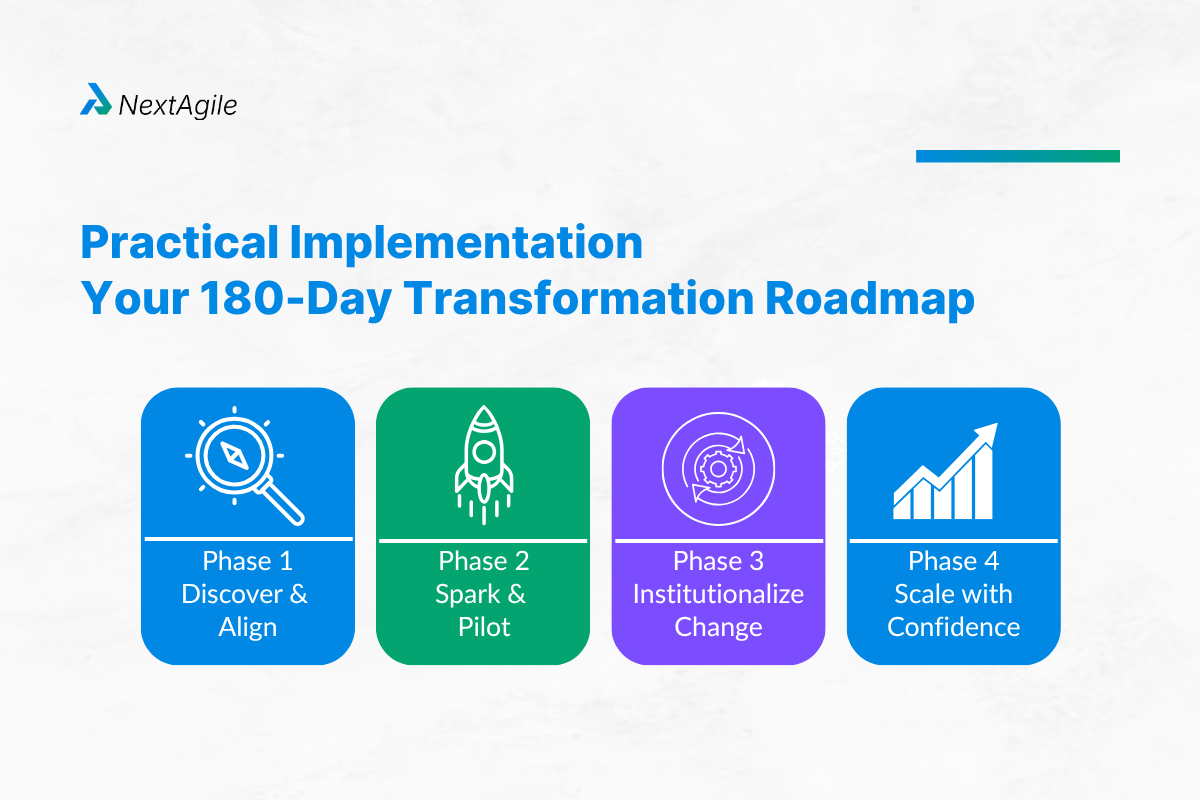
Phase 1: Discover and Align
Start with discovery. Understand your current leadership effectiveness, team readiness, and organizational culture. Use tools such as 360° feedback, employee surveys, and stakeholder interviews. These diagnostics reveal gaps and opportunities that need immediate attention.
Next, identify 2–3 transformation priorities. Clarity is crucial. Whether it’s digital adoption, process redesign, or culture evolution, a focused approach prevents teams from feeling overwhelmed.
Communicate these priorities transparently. Explaining the “why” behind changes builds early buy-in and trust. When people understand the purpose, they are more likely to engage proactively.
At the same time, establish your foundational structures. Identify transformation champions across functions, set up a transformation office or task force, and clarify governance. These steps create the scaffolding for effective implementation.
Phase 2: Spark and Pilot
Move from planning to execution. Launch pilot projects that produce tangible results. Quick wins build confidence in your leadership and the transformation initiative.
Align pilot teams with the broader vision. Clearly articulate how their daily work contributes to organizational goals. Use short, frequent check-ins instead of relying solely on town halls. Small interactions reinforce alignment and sustain momentum.
Phase 2 is also about skill development. Identify gaps in digital fluency, collaboration, and decision-making. Offer targeted training, mentoring, or coaching sessions to empower individuals to grow as leaders in their own roles.
Phase 3: Institutionalize Change
Transformation sticks when behaviors stick. Coach teams to embed new practices, sustain momentum, and avoid falling back into old habits. This phase ensures your organization develops the muscle to self-organize and continuously improve.
Slowly increase the scope of the pilot, get more teams. Create cross-functional squads to break silos. Encourage experimentation, provide autonomy, and celebrate learning from mistakes. Leaders should model adaptability and openness demonstrating that calculated risks are valued.
Track key performance indicators such as adoption rates, team engagement, and project outcomes. Collect qualitative feedback through retrospectives and pulse surveys.
Use these insights to optimize strategies. Adjust workflows, fine-tune communication plans, and address emerging resistance promptly. Visibility and responsiveness build trust and reinforce that transformation is ongoing and inclusive.
Celebrate victories both big and small. Recognition motivates teams and strengthens belief in the change journey. Symbolic wins, like rolling out a new digital tool or improving cross-team collaboration, send strong signals of progress.
Phase 4: Scale with Confidence
Finally, embed changes into organizational systems. Update governance structures, revise policies, and adjust incentives to reinforce new behaviors. By the end of 180 days, transformation is no longer just a plan it’s visible in culture, processes, and performance.
A phased, deliberate approach ensures sustainable transformation momentum. The first 180 days are about building confidence, aligning teams, and creating repeatable patterns that lead to long-term success.
Conclusion
Leading in times of transformation is a skill that requires continuous practice, and a mindset and behavior that must evolve along with technology, markets, stakeholders, and organizational expectations. The five pillars we have reviewed-visionary thinking, adaptive intelligence, cultural stewardship, digital fluency, and stakeholder integration-provide the foundation for leaders who want not just to navigate disruption but to shape it.
Transformation is never truly linear. New digital technologies emerge well before policy and regulation can keep up, crises strike with little to no warning, and employee expectations continue to shift daily. The strongest leaders are the first to lean into uncertainty, embracing adaptability while remaining moored to long-term purpose as short-term results ebb and flow. This looks practically like leading with clarity, listening deeply, and making decisions with strategy and empathy.
Culture is critical. Leaders who create psychological safety, continuous learning, and feedback loops build strong organizations that last. Culture is the engine for the change to translate the vision into the day-to-day behaviors of the team, departments, and stakeholders.
Finally, the leadership of change concerns humans. Technology can accelerate processes, but trust, influence, and emotional intelligence remain irreplaceable. Leaders who invest in people through coaching, mentoring, and genuinely listening ensure that people embrace, rather than resist, change.
As you begin your journey of transformation, consider this: Are you building systems, mindset, and practices that will thrive in uncertainty? Are you deliberately designing a culture that will take your organization toward its future? Nail these, and rather than responding to disruption, you will lead the future of transformation with confidence, clarity, and impact.