Skip to content

Introduction
Enterprise SAFe adoption is never just about training teams. It’s about coordination at scale.
When organizations move toward the Scaled Agile Framework (SAFe), complexity multiplies. Multiple Agile Release Trains. Cross-portfolio dependencies. PI planning across time zones. Executive visibility. Governance requirements.
And that’s where the right Scaled Agile Framework tools make or break execution.
Over the past few years, we have seen enterprises attempt SAFe transformations using tools designed for single Scrum teams. It rarely works. Because SAFe is not just scaled Scrum – it’s an operating model. And operating models require infrastructure.
You are not running SAFe. You are running distributed chaos if you are-
- Thinking about PI planning alone
- Not able to visualize cross-team dependencies
- Not tying portfolio epics to strategic themes
- Not sharing real-time visibility with lacks with the leadership
In this guide, we’ll compare the top SAFe tools and Scaled Agile tools used by enterprises in 2026. We’ll break down features, pricing, limitations, and practical considerations so you can choose the right system for your transformation journey.
Whether you are launching your first Agile Release Train or scaling to a portfolio-level rollout, this comparison will help you identify the best tools for Scaled Agile Framework implementation.
Over the last several years, as an SAFe consulting company, we have supported SAFe rollouts ranging from first ART pilots to multi-portfolio enterprise implementations. One pattern is consistent: tooling decisions made too early almost always slow adoption later.
Teams try to solve coordination problems with configuration. Leaders expect dashboards to compensate for unclear ownership. Neither works.
SAFe tools only create value when the operating model is already understood by ensuring that value streams are identified, decision rights clarified, and leadership aligned on outcomes.
Without that foundation, even the most advanced platforms become expensive reporting systems.
Let’s start with the comparison.
11 Scaled Agile Framework Tools Comparison (Features, Pricing & Limitations)
These platforms solve very different layers of the SAFe stack. Some focus on portfolio governance (like Jira Align and Rally Software). Others strengthen PI execution and dependency visibility (such as Digital.ai Agility). Tools like Miro support facilitation but are not systems of record.
Most enterprises end up running a layered ecosystem which includes execution in DevOps tools, collaboration in visual boards, and governance in portfolio platforms.
The goal is not consolidation. It’s coherence.
Below is a structured comparison of leading tools that support Scaled Agile Framework implementations at enterprise scale.
| Tool | Best For | Key Features | SAFe Support | Starting Price (Annual) | Key Limitation |
| SpiraPlan | End-to-end ALM with SAFe alignment | Requirements traceability, release planning, test management dashboards | Portfolio & program level support | ~₹1,25,000/year (team license) | UI feels dated; adoption curve can be slow |
| Jira Align | Full enterprise SAFe alignment | Portfolio management, PI planning, value stream mapping | Native SAFe configurations | Enterprise pricing (custom) | High cost & steep learning curve |
| Rally Software | Enterprise Agile governance | Portfolio dashboards, capacity planning, reporting | Strong portfolio & program support | Enterprise pricing (custom) | Can be heavy for smaller ARTs |
| ServiceNow | ITSM + Agile integration | Demand management, workflow automation | Portfolio & investment tracking | Enterprise tier | Requires significant configuration |
| Digital.ai Agility | Large distributed SAFe environments | PI planning boards, dependency visualization | Built-in SAFe constructs | Enterprise pricing (custom) | Steep learning curve |
| Planview AgilePlace | Portfolio Kanban & Lean governance | Visual boards, Lean budgeting, risk views | Portfolio level SAFe | ~$20/user/month (₹18,000/yr) | Limited deep PI planning features |
| Targetprocess | Flexible SAFe configurations | Highly configurable views, portfolio alignment | Highly configurable SAFe support | Enterprise pricing | Needs experienced admin setup |
| Azure DevOps | DevOps-integrated SAFe teams | Boards, repos, pipelines | Custom SAFe configuration | ~$6/user/month (₹5,400/yr) | Not SAFe-native |
| Monday.com | Hybrid Agile enterprises | Visual dashboards, collaboration tools | Limited portfolio depth | ~$9/user/month (₹8,100/yr) | Not purpose-built for SAFe |
| Miro | Collaborative PI planning | Visual boards, real-time collaboration | Supports PI planning events | ~$10/user/month (₹9,000/yr) | Not a system of record |
| Agile Hive | SAFe on Jira | SAFe artifacts layered on Jira | Built for SAFe on Jira | Custom pricing | Dependent on Jira ecosystem |
Quick Highlights (How to Read This Table?)
SAFe Support:
- Native – Designed specifically for Scaled Agile Framework constructs (e.g., Jira Align, Digital.ai Agility).
- Configurable/Custom – Requires setup or extensions to fully support SAFe workflows (e.g., Azure DevOps, Monday.com).
Pricing Notes:
- Enterprise tools typically do not publish fixed annual pricing, costs vary by usage, scale, and support contracts. Where possible, equivalent annual pricing or typical entry points are included.
Key Limitations:
- These help you weigh trade-offs-because the best tool is not always the right tool for your context.
Overview of the Top Scaled Agile Framework Tools
Not all Scaled Agile Framework tools serve the same enterprise maturity level.
Early-stage SAFe implementations often start with Azure DevOps or Jira + plugins. These setups work for 1-2 ARTs but struggle at portfolio scale.
Mid-sized enterprises often adopt Planview AgilePlace or Targetprocess for better portfolio visibility. These tools balance flexibility with governance.
Large enterprises typically invest in Jira Align, Rally Software, or Digital.ai Agility. Why? Because at scale, leadership visibility becomes critical. CFOs want investment traceability. CTOs want cross-value-stream insights. PMOs want dependency tracking.
Here’s what we have learned: tool selection should mirror SAFe maturity. If you are early in the journey, over-investing in heavy enterprise agile tools may create resistance. But under-investing in tooling at scale? That creates blind spots. We have seen organizations with two ARTs purchase enterprise-grade platforms designed for twenty. Adoption suffered. We have also seen enterprises attempt portfolio SAFe using spreadsheets and basic boards. Visibility collapsed.
Right-sizing tooling to maturity is one of the most overlooked success factors in SAFe transformations.
If you are evaluating this alongside enterprise rollout planning, aligning tool strategy with your SAFe implementation roadmap is essential. Many organizations complement tooling decisions with structured SAFe consulting services to ensure alignment between operating model and platform capabilities.
Key Capabilities for Enterprise Scaled Agile Framework Tools
Core Capabilities Required for SAFe at Scale
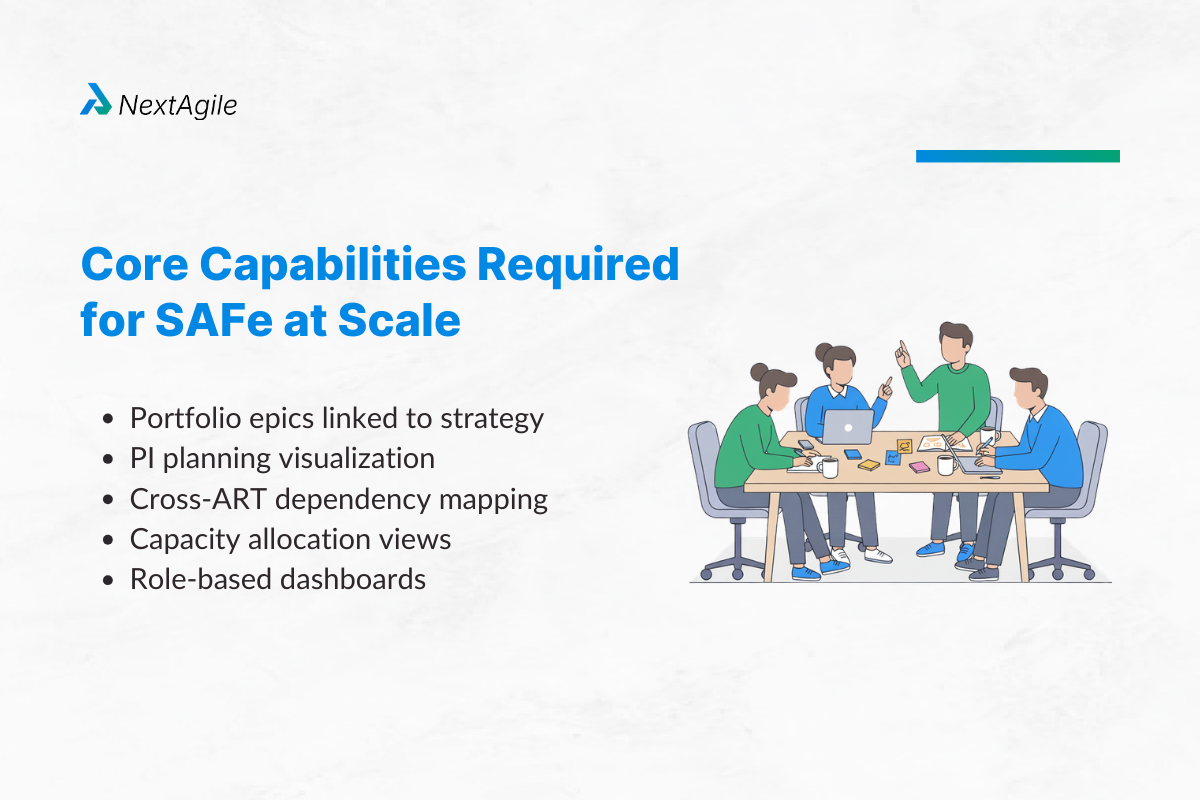
Every enterprise-grade SAFe agile tool must support:
- Portfolio epics linked to strategy
- PI planning visualization
- Cross-ART dependency mapping
- Capacity allocation views
- Role-based dashboards
Without these, coordination breaks down. In large implementations, dependency visibility alone can reduce PI spillover by double digits. When teams see upstream risks early, they adjust scope before commitments break instead of discovering conflicts halfway through the increment.
Transparency changes behavior. Especially in distributed environments, dependency transparency prevents late surprises during PI execution.
Another must-have? Real-time reporting. Manual Excel exports do not scale.
If you are running a scaled agile for enterprise rollout, ensure your tool supports Lean Portfolio Management constructs natively.
Advanced Capabilities That Differentiate Enterprise SAFe Tools
Advanced platforms provide:
- Predictive analytics on delivery risk
- Investment tracking across value streams
- Scenario modeling
- Integrated OKR alignment
- Compliance-ready audit logs
These differentiate lightweight scaled agile framework safe tools from enterprise-grade systems.
Enterprises running multi-ART environments benefit most from scenario modeling during PI planning.
If you are preparing for large-scale PI events, combining enterprise tools with structured facilitation such as a SAFe PI planning workshop significantly improves adoption and clarity. One important distinction: advanced analytics only help when leadership is willing to act on signals. If delivery risk shows red but priorities don’t change, analytics become theater. High-performing enterprises treat forecasts as decision inputs and should be limited to view as reporting artifacts.
Because tools do not replace alignment conversations, they enable them.
How to Choose the Right Scaled Agile Framework Tool for Your Enterprise?
Choosing the right Scaled Agile Framework tools requires clarity on five dimensions:
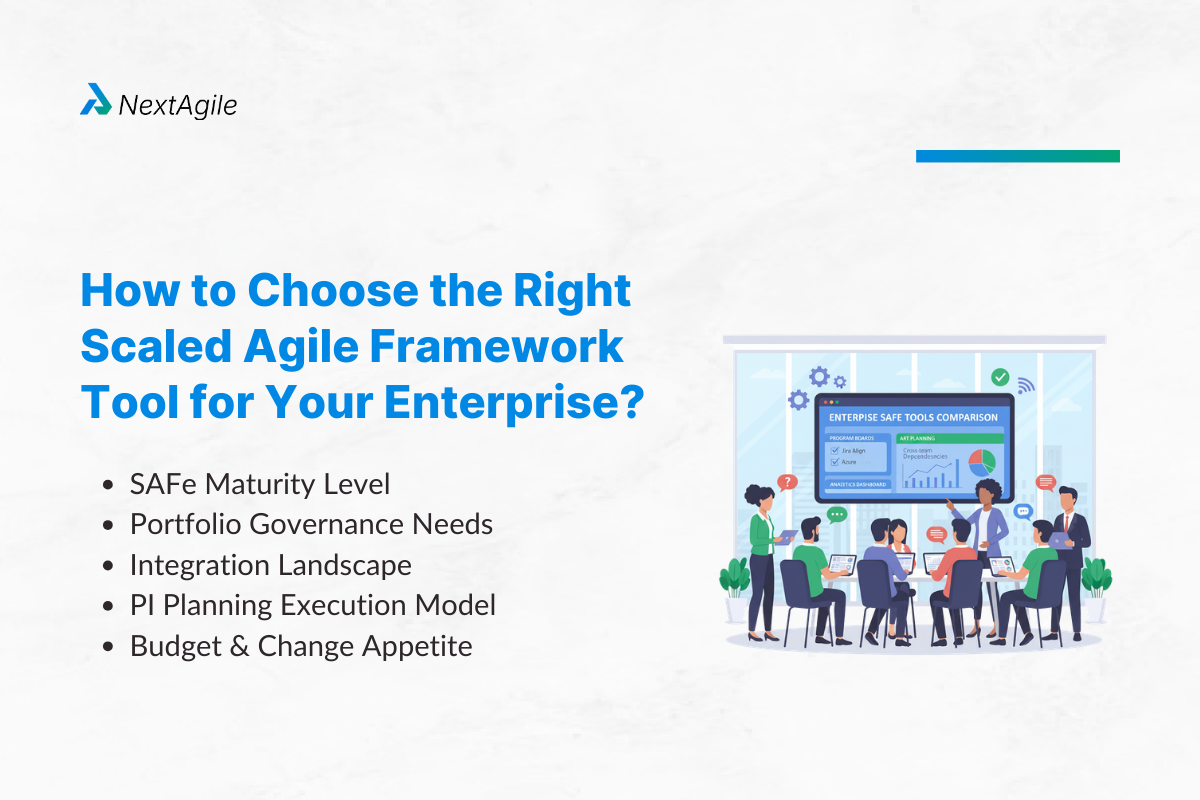
1. SAFe Maturity Level – Are you piloting 1 ART or running 15+? Tool complexity should match scale.
2. Portfolio Governance Needs – Regulated industries need auditability. Startups typically do not.
3. Integration Landscape – Does the tool integrate with DevOps pipelines, ERP systems, or finance platforms?
4. PI Planning Execution Model – Are you remote, hybrid, or co-located?
Miro + enterprise platforms often complement each other.
5. Budget & Change Appetite – Enterprise SAFe tools range from modest annual subscriptions to six-figure investments. A simple rule I use with executives:
- Early SAFe needs coordination
- Mid-scale SAFe needs visibility
- Enterprise SAFe needs governance
Choosing tools ahead of organizational readiness almost always creates friction instead of flow.
In our experience, enterprises should never choose tooling in isolation. Align it with transformation design, value stream identification, and leadership readiness.
If you are evaluating full scaled agile framework safe tools implementation, consider reviewing case studies of scaled agile for enterprise transformations before locking your decision.
Because the tool amplifies your transformation maturity – it does not create it.
Common Challenges When Implementing Scaled Agile Framework Tools
Even the best Enterprise agile tools fail when:
- Configuration precedes operating model clarity
- ART roles are not trained properly
- Data governance is undefined
- Executive dashboards do not reflect business metrics
One recurring mistake? Migrating legacy project data directly into SAFe tools without rationalization. It creates noise.
Another? Treating PI planning tools as long-term tracking systems. Remember, tools like Miro enable collaboration. Your enterprise system of record must capture commitments. I have watched PI boards remain untouched for months after planning, while delivery moved elsewhere. When teams don’t trust the system of record, shadow tracking emerges and leadership loses a single source of truth.
Adoption is not a training problem. It’s a trust problem.
Implementation typically takes 3-6 months depending on scale. Change management, admin capability building, and governance design are critical success factors.
And honestly, the biggest risk is not cost. It’s poor adoption.
By the time enterprises reach portfolio SAFe, tooling is no longer optional infrastructure. It becomes part of how strategy flows to execution.
But tooling only amplifies what already exists which is clarity or confusion.
Conclusion
Selecting the right Scaled Agile Framework tools is a strategic enterprise decision.
At small scale, lightweight configurations may work. At enterprise scale, governance, visibility, and alignment become non-negotiable.
The best SAFe tools:
- Support Lean Portfolio Management
- Enable effective PI planning
- Provide cross ART visibility
- Offer leadership dashboards tied to outcomes
But here’s the truth.
- No platform fixes unclear strategy
- No dashboard replaces executive commitment
- No automation substitutes alignment
Choose tools that reinforce your operating model, maturity level, and enterprise constraints.
Because SAFe is not implemented through software. It’s implemented through disciplined coordination enabled by the right system. The most successful SAFe implementations we have seen don’t start with platforms. They start with leadership alignment, value stream clarity, and explicit decision ownership.
Tools come later to reinforce cadence, surface constraints, and enable coordinated delivery at scale.
If your SAFe tooling feels complex, that’s usually a signal to revisit operating model assumptions first. Because SAFe doesn’t fail from lack of features. It fails from lack of alignment. Business agility is achievable but only with deliberate design. NextAgile consulting can help you co‑create and adopt a practical SAFe implementation roadmap with the right set of tools. Do reach out to us at consult@nextagile.ai and we would be happy to explore more.
Frequently Asked Questions
1. What are the best Scaled Agile Framework tools for enterprises?
Jira Align, Rally Software, Digital.ai Agility, and Planview AgilePlace are commonly adopted enterprise SAFe tools.
2. Are Scaled Agile Framework tools mandatory for SAFe?
Not mandatory at small scale. But for multi-ART enterprise rollouts, tooling becomes essential for coordination and visibility.
3. Can Jira be used as a SAFe tool?
Yes, especially with plugins like Agile Hive or custom configurations. However, it may require additional portfolio-level extensions.
4. How much do enterprise SAFe tools cost?
Costs range from ~$6/user/month for basic platforms to enterprise licensing models exceeding six figures annually. In large enterprises, implementation timelines extend when governance models, portfolio ownership, and ART role clarity are still evolving. Organizations that sequence operating model design before tooling consistently achieve faster adoption and higher ROI.
5. How long does SAFe tool implementation take?
Typically 3-6 months depending on scale, integrations, governance design, and training efforts.