Introduction Here is a sobering number: only 22% of organisations that attempt a waterfall to agile transformation achieve the business outcomes they originally targeted, according to McKinsey’s 2023 Technology Transformation survey. Yet agile adoption continues to accelerate. The 17th State of Agile Report (Digital.ai, 2023) shows that 71% of organisations now use agile in some form, up from just 37% a decade ago.
What Is Waterfall to Agile Transformation? Waterfall to Agile transformation is the process of shifting an organization from a sequential project delivery model to an iterative, value-driven product delivery model.
In a traditional Waterfall model, projects follow fixed stages such as requirements, design, development, testing, and deployment. In contrast, Agile transformation introduces iterative delivery, where teams deliver working product increments in short cycles while continuously adapting to feedback.
Key elements of a successful transformation include:
Cross-functional product teams Iterative sprint-based delivery Continuous stakeholder feedback Adaptive planning and prioritisation Cultural shift toward experimentation and learning For most enterprises, a full transformation takes 12-36 months and requires changes across leadership, governance, funding models, and team structures.
Most organisations stall not at adoption but at value realisation. Teams run standups. Sprints get planned. Retrospectives happen. Yet delivery speed doesn’t improve, leadership still asks for Gantt charts, and the transformation quietly loses momentum after the first pilot. The gap between adoption and genuine value realisation is where most companies silently stall, and it is precisely where the right agile consulting services partner can make a positive difference and curate a transformation journey that sticks.
This guide gives you a practitioner-tested, 7-phase migration path drawn from 40+ transformation engagements across Indian IT, BFSI and manufacturing so you know exactly where your transformation stands and what to do next.
Waterfall vs Agile: Why the Difference Matters in 2026 The core tension between waterfall and agile is not about speed; it is about how organizations respond to uncertainty. Waterfall assumes requirements are fully knowable upfront. Agile assumes they are not.
Understanding the structural differences is essential before planning any transition:
Dimension Waterfall Agile (Scrum/SAFe) Delivery cycle 6-24 month project phases 2-4 week sprints Requirements Fixed upfront (BRD/SRS) Evolving product backlog Customer involvement At handover / UAT only Every sprint review Risk management Identified in planning phase Continuously re-assessed Value delivery End of project Every sprint increment Failure cost High (late discovery) Low (fast feedback loops) Team structure Functional silos Cross-functional squads Governance Stage-gate milestones OKRs + sprint cadences
Benefits of a Successful Waterfall to Agile Transformation When executed correctly, agile transformation delivers measurable improvements across delivery performance, customer outcomes, and organizational culture.
Typical benefits include the following:
Faster TTM (Time-to-Market) Teams deliver working features every 2-4 weeks instead of waiting for long release cycles.
Continuous testing and feedback reduce defect escape rates.
Higher Customer Alignment Frequent reviews ensure the product evolves based on real user feedback.
Cross-functional collaboration increases ownership and accountability.
Greater Organizational Adaptability Companies respond faster to market changes and regulatory requirements.
For Indian enterprises facing rapid digital competition, these capabilities are becoming strategic rather than optional .
For Indian IT and BFSI organisations specifically, the waterfall model creates a particularly painful mismatch: regulatory environments change frequently, customer expectations shift with digital-native competition, and offshore delivery models require tighter feedback loops all of which agile is designed to handle.
Why Organizations Move From Waterfall to Agile?
Organizations transition from waterfall to agile primarily to improve delivery speed, adaptability, and customer alignment .
Traditional waterfall delivery often struggles in modern digital environments because requirements change faster than long project cycles can accommodate.
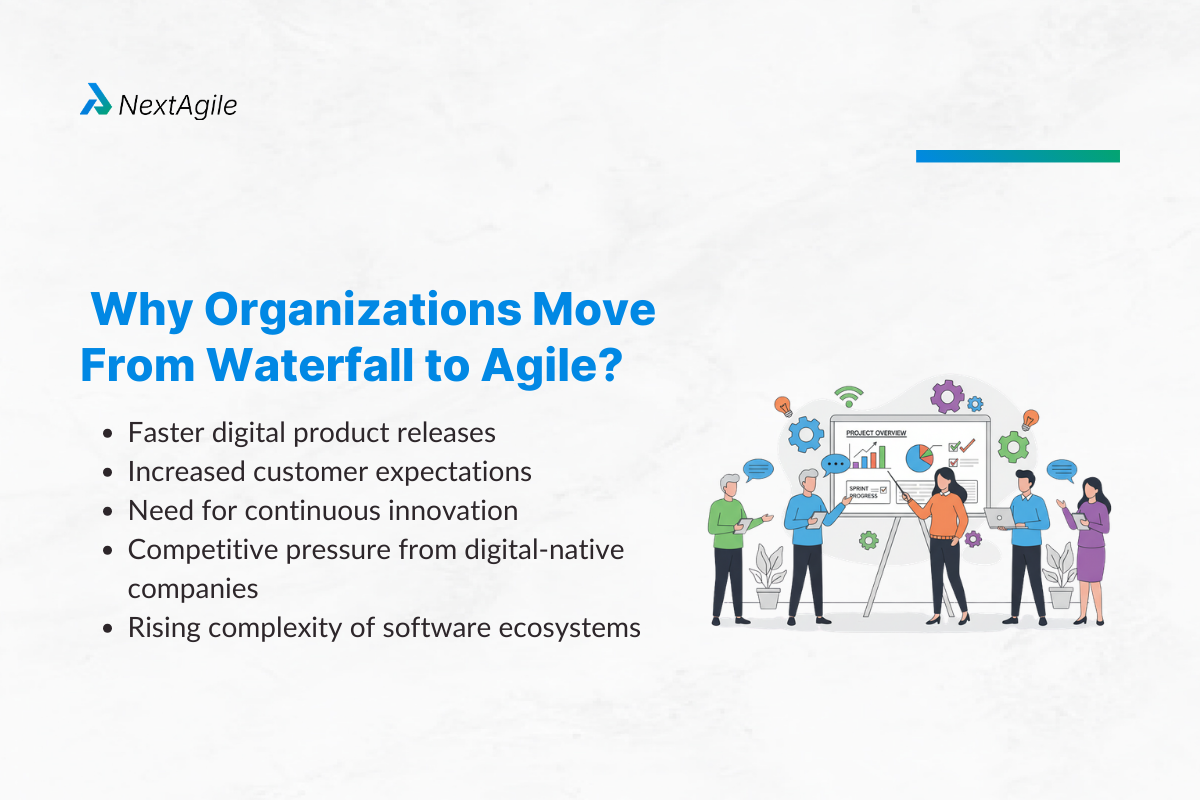
The most common drivers of agile transformation include:
Faster digital product releases Increased customer expectations Need for continuous innovation Competitive pressure from digital-native companies Rising complexity of software ecosystems Enterprises that successfully adopt agile often report improvements in time-to-market, product quality, and team engagement .
Why Do Most Waterfall to Agile Transformations Fail? Gartner’s research identifies that 75% of agile transformations fail to deliver the expected ROI within the first two years. The reasons are consistent across industries:
Leadership misalignment: Senior leaders approve agile but continue demanding Gantt charts and stage-gate updates. This mixed messaging destroys team confidence.Methodology cargo-culting: Teams adopt Scrum ceremonies (standups, sprints, retrospectives) without changing planning, budgeting, or governance. This is agile theatre, not agile.Big-bang transformation: Attempting to flip the entire organisation simultaneously instead of running structured pilot teams and scaling learnings.Ignoring the backlog problem: Teams switch to sprints but maintain a requirements backlog written in waterfall-style BRD language. Sprint planning becomes chaos.Underinvesting in coaching: Appointing a Scrum Master who is also a project manager or business analyst, rather than a dedicated change agent.No definition of done : Without clear DoD criteria, teams mark stories complete but carry forward hidden technical debt each sprint. The Scrum Alliance’s 2022 survey found that 53% of agile practitioners cite organisational culture as the single greatest impediment to agile success, outranking tooling, training, and resourcing combined.
What Are the Phases of a Waterfall to Agile Transformation? A structured agile transformation typically progresses through several stages. The most widely used agile transformation roadmap includes:
Diagnostic and readiness assessment Leadership alignment and agile education Pilot team setup Sprint execution and agile coaching Continuous retrospective improvement Scaling agile to additional teams Sustaining and optimizing agile practices This phased approach allows organizations to validate agile practices through pilot teams before scaling across the enterprise.
See how enterprises succeeded in this Waterfall to Agile Transition Case Study
The 7-Phase Waterfall to Agile Transformation Plan This migration framework is drawn from Nextagile’s implementation work across 40+ Indian enterprises in IT services, BFSI, and manufacturing. It blends elements of SAFe (Scaled Agile Framework), ICAgile’s team and agile coaching tracks, and Scrum Alliance practitioner guidance.
Phase 1: Diagnostic and Readiness Assessment (Weeks 1-4) Before committing to a transformation roadmap, conduct an honest current-state audit. This is not a box-ticking exercise; it should surface your actual delivery pain points.
Map your current delivery value stream : identify all phases from business request to production deployment Conduct agile maturity assessment Identify transformation champions (mid-level leaders with credibility and change appetite) Audit your technology estate: CI/CD capability, test automation coverage, deployment frequency Baseline your key metrics: lead time, cycle time, defect escape rate, customer satisfaction (NPS) Output: A documented transformation charter with business case, risk register, and a 90-day pilot plan.
Phase 2: Leadership Alignment and Agile Education (Weeks 3-6) Agile transformation without senior leadership buy-in is a guaranteed failure. This phase is not a one-day workshop; it is a sustained education and mindset shift programme.
Run an executive agile simulation workshop to build visceral understanding of iterative delivery Reframe success metrics : shift from ‘on-budget, on-time’ to ‘customer outcomes delivered per quarter’. Define the governance model : how will portfolio steering committees, budget cycles, and risk reviews adapt? Align on agile funding models, moving from project-based funding to product-team funding India-specific note: In many Indian IT organisations, senior leadership carries strong waterfall conditioning from CMMI and ISO processes. The transition to outcome-based governance requires explicit retraining, not just awareness.
Phase 3: Pilot Team Selection and Environment Setup (Weeks 5-10) Select 1-3 pilot teams based on these criteria:
A willing and capable Product Owner who understands business domain deeply Work that has genuine iterability avoid regulatory compliance or infrastructure migration for the first pilot Leadership sponsorship: a direct senior leader who will protect the team from waterfall pull-back Reasonable technical foundation: some CI/CD capability is helpful, though not mandatory Set up the physical or virtual environment for agile: team collaboration spaces, digital kanban boards (Jira, Azure DevOps), Definition of Ready and Definition of Done documents.
Phase 4: Pilot Sprint Execution and Coaching (Weeks 8-20) This is where transformation theory meets reality. Every sprint will surface both progress and impediments, and that is the point.
Sprint 0: Team kickoff, backlog creation, technical spike work, initial sprint planningSprints 1-3: Focus purely on getting the Scrum ceremonies right. Daily Standup , sprint planning , review, sprint retrospective etc, cadence matters more than velocity at this stageSprints 4-6: Begin tracking velocity. Use retrospectives to systematically remove impediments. Coach the Product Owner on backlog refinement Sprints 7+: Begin stakeholder showcase of working software. Demonstrate tangible business value to build executive confidence An experienced agile coach embedded in the team during this phase accelerates learning by 2-3x versus self-guided adoption.
Phase 5: Retrospective, Measure, and Adapt (Ongoing) The retrospective is agile’s most undervalued ceremony. Teams that treat it as a formality plateau quickly. Structure your retrospectives to generate actionable improvements, not just sentiment output.
Use data: bring velocity trends, defect rates, and team health metrics into the retrospective Run the ‘Sailboat’ or ‘DAKI’ (Drop, Add, Keep, Improve) formats to create structured improvement backlog Track retrospective action items with the same rigour as sprint stories Conduct quarterly agile health checks against your baseline from Phase 1 Phase 6: Scaling to Additional Teams (Months 6-18) Once pilot teams have demonstrated consistent delivery for 4-6 sprints, begin the structured scale-out. The choice of scaling framework matters:
Framework Best Suited For Complexity Scrum of Scrums 2-5 teams, simple dependencies Low SAFe (Scaled Agile Framework) 10+ teams, enterprise portfolio High LeSS (Large-Scale Scrum) Product-centric orgs, simpler structure Medium Spotify Model (squads/tribes)Tech-first product companies Medium Nexus 3-9 Scrum teams, single product Low-Medium
For Indian IT services firms operating in a multi-client delivery model, SAFe or LeSS typically provides the governance structure required to manage cross-team dependencies without reverting to waterfall stage-gates.
Phase 7: Sustain and Optimise (Month 18+) Many transformations plateau after the initial excitement fades. Sustaining agility requires the following:
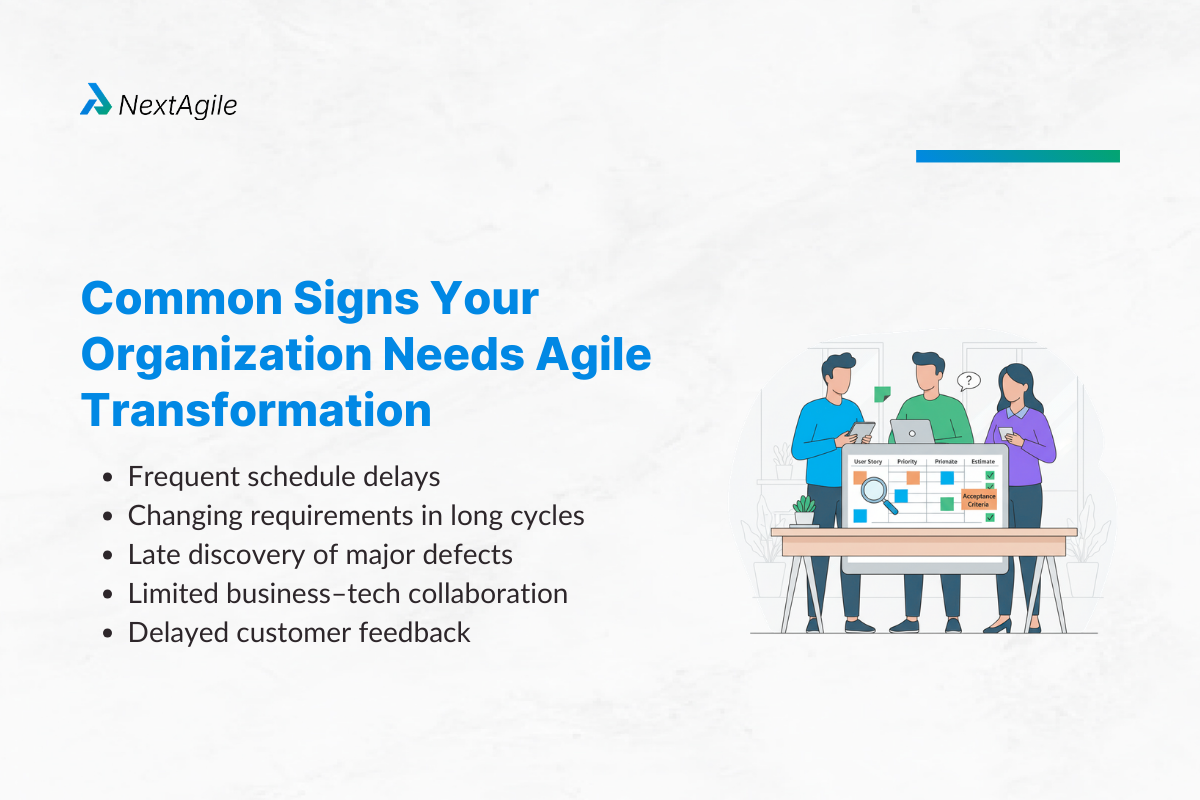
Embedding agile metrics into executive dashboards (flow metrics, deployment frequency, MTTR) Building internal coaching capability, train Scrum Masters and agile leads from within Continuously updating the Definition of Done as technical practices mature Running annual agile health assessments to prevent regression Common Signs Your Organization Needs Agile Transformation Many organizations consider agile transformation only after delivery problems become visible. Common warning signs include:
Projects consistently running months behind schedule Requirements changing frequently during long project cyclesLarge batches of defects discovered late in the release process Limited collaboration between business and technology teamsCustomer feedback arriving only after full product release Agile transformation helps address these problems by introducing short feedback loops and continuous delivery practices.
Agile Transformation Case Study: Real-World Examples Understanding how other organisations have navigated the transition provides both inspiration and practical lessons. Here are three agile transformation examples spanning different industries.
Case Study 1: ING Bank Rewriting the Banking Operating Model ING Bank’s agile transformation, initiated in the Netherlands in 2015, is one of the most cited agile transformation examples in financial services. The bank reorganised approximately 3,500 employees into 350 autonomous squads grouped into tribes, drawing heavily on the Spotify model.
Key outcomes reported by ING include a 60% reduction in time-to-market for new features, significant improvement in employee engagement scores, and faster response to regulatory changes. Critically, ING’s transformation succeeded because it was driven by the CEO with full board alignment, not delegated to IT.
Lesson for Indian BFSI: Regulatory compliance (RBI, SEBI, IRDAI) can coexist with agile delivery. The key is separating compliance checkpoints from delivery cadences. Agile does not mean skipping controls; it means building them into the product backlog.
Case Study 2: Spotify – The Product-Squad Model at Scale Spotify’s engineering organisation pioneered the squad-tribe-chapter-guild model that has influenced virtually every enterprise agile transformation since 2012. While Spotify’s context (a digital-native product company) is different from a traditional IT services firm, the core insight is transferable: autonomous teams with clear missions outperform centralised command-and-control structures
What is often missed in “doing Spotify” is that Spotify themselves have explicitly stated they do not rigidly follow their own model; they adapt continuously. The model is a philosophy, not a prescription.
Lesson for Indian IT: Do not copy the Spotify org chart. Copy the underlying principle: give teams a clear product mission, remove dependencies, and trust them to self-organise.
Case Study 3: Anonymised Indian BFSI Client (Nextagile Engagement) A mid-sized private sector bank in India (revenue: ~₹8,000 Cr) had a digital transformation programme stalled after 18 months of waterfall delivery. The core banking modernisation project was 40% over budget and 8 months behind schedule.
Nextagile’s engagement involved:
A 4-week diagnostic that identified 23 distinct impediments, clustered into leadership, process, and technology categories Three pilot squads formed around highest-priority customer journeys (account opening, loan processing, mobile payments) SAFe Program Increment (PI) planning introduced to coordinate cross-squad dependencies Executive coaching for the CTO and CDO over 6 months Results after 12 months: time-to-market for new features reduced from 9 months to 6 weeks, mobile app NPS improved by 24 points, and the core banking programme was brought back on track within two PIs.
How Nextagile Accelerates Your Agile Transformation? Many organizations begin agile transformation with enthusiasm but struggle to sustain momentum beyond the first few pilot teams. The difference between short-lived adoption and long-term transformation lies in structured diagnostics, leadership alignment, and sustained coaching.
As an agile consulting company with more than 20 transformations, Nextagile works with enterprise organizations across India to design and execute agile transformation programs that deliver measurable business outcomes.
If you are evaluating how to move from waterfall to agile delivery, our practitioners can help you identify the right starting point for your organization.
Our enterprise agile transformation practice covers the full transformation lifecycle from diagnostic and pilot design through to scaled programme management and sustained coaching. We bring certified SAFe Programme Consultants (SPCs), Certified Coaches, and Certified Scrum Masters who have led transformations in BFSI, IT services, manufacturing, and government.
Our engagements are structured around your context, not a generic playbook:
Agile Diagnostic and Roadmap: A 4-week current-state assessment producing a prioritised, costed transformation roadmapPilot Team Coaching: Embedded coaching for your first 1-3 agile squads, with knowledge transfer to internal leadsLeadership Agile Coaching : Executive coaching and simulation programmes for CXO and senior leadership teamsSAFe Implementation : Full SAFe programme design, PI planning facilitation, and Release Train Engineer coachingAgile Training Pathways: Contextual training programs in Scrum, SAFe, Kanban, and agile product ownership for teams and individuals If your organisation is evaluating how to begin or accelerate its transformation, explore our agile consulting services or contact us for a no-obligation diagnostic conversation.
Conclusion: Waterfall to Agile Transformation Is a Journey, Not a Switch A successful waterfall to agile transformation is the result of sustained leadership will, disciplined methodology, and genuine commitment to cultural change. It does not happen because teams attend a two-day Scrum training. It happens when organisations are willing to redesign how they budget, plan, govern, and measure, not just how they run standups.
The 7-phase migration framework in this guide, the agile transformation case studies from ING and Nextagile’s client work, and the responses above collectively offer a tested, honest, and actionable path forward. Start with a rigorous diagnostic. Pick your pilot teams carefully. Invest in coaching, not just training. Measure outcomes, not ceremonies.
For Indian enterprises navigating this shift, the opportunity is significant: organisations that successfully complete their agile transformation deliver features 5x faster, reduce delivery costs by 20-30%, and see measurable improvement in employee and customer satisfaction, according to McKinsey’s 2023 analysis of mature agile adopters.
Ready to begin? Speak to a Nextagile consultant today and get a clear picture of where your organisation stands and what the path forward looks like. Do reach out to us at consult@nextagile.ai and we would be happy to explore more.
FAQs About Waterfall to Agile Transformation 1. How long does a waterfall to agile transformation take? A genuine waterfall to agile transformation typically takes 12 to 36 months depending on organisational size, leadership alignment, and technical readiness. Small teams (under 50 people) can achieve meaningful agile maturity in 12-18 months. Large enterprises with hundreds of delivery teams and complex governance structures realistically require 2-3 years for sustainable transformation. Avoid any vendor promising full enterprise agility in under 6 months; that is a training programme, not a transformation.
2. What is the biggest challenge in agile transformation? The most consistent challenge is cultural and organisational not technical. The Scrum Alliance and multiple McKinsey studies identify leadership mindset, middle management resistance, and organisational silos as the primary blockers. Teams can learn Scrum in weeks; changing how a 10,000-person organisation budgets, plans, and governs its work takes years of deliberate effort. Technical challenges (CI/CD, test automation) are significant but solvable faster than cultural ones.
3. Can waterfall and agile be used together? Yes this is often called a hybrid or bimodal model. Some organisations run agile for product and software delivery while retaining waterfall-style governance for capital projects, infrastructure, or regulatory initiatives. SAFe explicitly accommodates hybrid delivery with its ‘large solution’ and ‘portfolio’ configurations. The risk of a permanent hybrid is that it can legitimise reverting to waterfall under pressure. The goal should be progressive agility, not indefinite compromise.
4. What is a Scrum sprint in the context of agile transformation? A sprint is a fixed-length iteration, typically 2 weeks, during which a cross-functional team selects items from the product backlog and commits to delivering a working, tested increment of software by the sprint’s end. In a waterfall-to-agile transformation context, the sprint is the fundamental unit of change: it creates the feedback loop that allows teams and stakeholders to inspect progress, reprioritize the backlog, and adapt the plan, replacing the waterfall’s rigid phase structure with a rhythm of continuous delivery and learning.
5. How do you measure success in agile transformation? The most reliable metrics combine delivery performance, business outcomes, and team health. Key indicators include cycle time (how long from idea to production), deployment frequency (per the DORA metrics framework), defect escape rate, team velocity stability (not raw velocity), and customer NPS or satisfaction scores. Avoid measuring purely on whether teams are ‘doing Scrum correctly’; that is, process compliance, not value creation. McKinsey recommends tying agile transformation KPIs directly to business outcomes like revenue per sprint or cost-to-serve reduction.
6. What is the difference between agile coaching and agile training? Agile training delivers knowledge frameworks, ceremonies, roles, and principles typically in a classroom or workshop format over 1-3 days. Agile coaching is the sustained, in-context support that turns knowledge into practice. A coach works alongside teams and leaders, observing real work, surfacing dysfunctions, and facilitating change over weeks or months. ICAgile distinguishes between agile team coaches (working with delivery teams) and enterprise agile coaches (working at organizational and leadership levels). For most transformations, training without coaching produces short-lived results.
7. What Is the First Step in Agile Transformation? The first step is conducting a diagnostic assessment of current delivery practices. This includes mapping value streams, assessing agile maturity, and identifying leadership alignment gaps.
8. What Is the Difference Between Agile Adoption and Agile Transformation? Agile adoption refers to teams using agile frameworks such as Scrum. Agile transformation is broader and includes changes to leadership behavior, governance, budgeting models, and organizational culture.
9. Which Industries Benefit Most From Agile Transformation? Agile transformation is widely used in industries with fast-changing customer expectations, including banking, fintech, IT services, e-commerce, telecommunications, and digital product companies.
10. What Role Does Leadership Play in Agile Transformation? Leadership alignment is one of the most critical success factors. Executives must shift from traditional project oversight to outcome-driven governance and empower teams to make delivery decisions.
11. Can Agile Work in Highly Regulated Industries? Yes. Agile is widely used in regulated sectors such as banking, insurance, and healthcare. Compliance requirements are incorporated into the backlog and built into the delivery process rather than handled at the end of a project.
12. What Is the ROI of Agile Transformation? Organizations that successfully complete agile transformation often report:
Faster product releases Reduced operational costs Higher employee engagement Increased customer satisfaction However, ROI depends heavily on leadership commitment and organizational alignment.
Alok Dimri is the co-founder and leads the overall business at NextAgile, where he is responsible for strategy, client and consultant partnerships, and a whole lot of other core business activities like solutioning, branding, and customer engagement.
Over the past 16 years, he has worked extensively in business strategy, new business development, and key account management initiatives across process consulting and training domains.
 Skip to content