Introduction In 2026, enterprises are not failing because they lack strategy. They are failing because they cannot adapt fast enough to continuous change.
Markets shift in real time. Customer expectations evolve instantly. Competitors respond faster than ever.
This is why Agile transformation has moved from a delivery improvement initiative to a business survival capability.
But here’s the critical insight most organizations miss:
Agile transformation is not about running faster sprints; it is about redesigning how organizations make decisions, deliver value, and adapt at scale.
The real value of Agile is not speed alone.
It is decision quality + adaptability at scale.
This blog breaks down the 11 most important benefits of Agile transformation for enterprises in 2026, with real business impact and not theory. At the enterprise level, the benefits of Agile transformation compound over time where incremental delivery improvements evolve into systemic advantages across decision-making, capital allocation, and organizational responsiveness. All this makes Agile a long-term performance multiplier rather than a short-term efficiency gain.
Why Agile Transformation Is Really About Decision Systems? Most organizations adopt Agile practices. Few achieve Agile transformation . Why?
Because they focus on:
Ceremonies Frameworks Tools Instead of the real shift: Moving from execution-centric systems to decision-centric organizations .
In high-performing enterprises:
Decisions are faster Priorities are dynamic Feedback is continuous Agile transformation succeeds when organizations redesign:
How decisions are made? How is value prioritized? How do systems adapt? This is the foundation of business agility Agile maturity is not defined by how work is executed, but by how quickly and effectively the organization can sense change, decide priorities, and realign execution. Enterprises that internalize this shift outperform those that remain execution-focused.
While these benefits are often discussed individually, their real impact emerges when they operate as an interconnected system. Improvements in speed, quality, and alignment reinforce each other hence creating a compounding effect on overall business performance.
11 Key Benefits of Agile Transformation for Enterprises
Faster Time-to-Market Agile enables iterative delivery , allowing enterprises to release smaller increments faster.
Instead of waiting months, teams deliver in weeks or even days.
Enterprise Example:
A large product organization reduced release cycles by 40% by shifting to incremental delivery and continuous feedback.
Impact:
Faster innovation cycles Early market validation Competitive advantage At scale, faster time-to-market is less about accelerating delivery and more about reducing decision latency across the lifecycle from idea to release. Organizations that achieve this shift consistently outperform competitors in capturing emerging opportunities.
Improved Cross-Functional Collaboration Agile replaces silos with cross-functional teams aligned around outcomes.
Business, technology, and operations collaborate continuously.
Impact:
Faster decisions Reduced handoffs Stronger alignment True collaboration at this level is decision-oriented. Cross-functional teams reduce the need for escalations, enabling faster resolution of trade-offs and more localized, context-aware decision-making.
Higher Product Quality Agile integrates quality into the process through:
Continuous testing Early feedback Incremental improvements Enterprise Impact:
Organizations often see a 30-50% reduction in defects due to early validation. Over time, this leads to a shift from reactive quality assurance to built-in quality systems, where defects are prevented through design and feedback loops rather than detected late in the lifecycle.
Large enterprises often require enterprise agile transformation services
Greater Flexibility and Adaptability Agile allows enterprises to respond to change dynamically.
Instead of rigid plans, priorities evolve continuously.
Impact:
Faster response to disruption Reduced strategic risk Increased innovation Adaptability at this level is a function of how quickly priorities can be re-evaluated and execution redirected. Agile enables this by shortening feedback loops and embedding continuous decision checkpoints across delivery.
Stronger Customer Satisfaction Agile embeds customer feedback into delivery.
Products evolve based on real user needs, not assumptions.
Impact:
Higher retention Better product-market fit Increased loyalty Enterprises that excel here move beyond feedback collection to feedback integration where customer insights directly influence prioritization decisions in near real time.
Smarter Cost Efficiency Agile eliminates waste by focusing on value.
Teams stop building low-impact features and prioritize outcomes.
Enterprise Example:
Organizations reduce unnecessary feature development by aligning the backlog with business impact.
Impact:
Improved Agile transformation ROI Optimized resource utilization Leaner operations This represents a shift from cost reduction to value optimization. Instead of doing more with less, organizations focus on doing the right things with the right level of investment by maximizing return on engineering effort.
Reduced Project Risk Agile reduces risk through continuous validation.
Problems are identified early and not after full-scale delivery.
Impact:
Lower failure rates Reduced financial exposure Better predictability Risk, in Agile environments, becomes continuously managed rather than periodically assessed. This reduces the likelihood of large-scale failures and enables proactive mitigation of emerging issues.
Higher Employee Engagement Agile empowers teams with:
Ownership Autonomy Purpose It promotes servant leadership agile principles , where leaders enable teams instead of controlling them.
Impact:
Higher morale Increased productivity Better retention Engagement improves not just because of autonomy, but because teams gain clarity on purpose and impact hence understanding how their work contributes to broader business outcomes.
Predictable Delivery and Visibility Agile improves transparency through:
Real-time metrics Backlog visibility Continuous tracking Impact:
Improved planning Better stakeholder trust More predictable outcomes Predictability here is not derived from rigid planning, but from transparency and data-driven insights that allow for more informed and adaptive commitments.
Stronger Organisational Resilience Agile enables enterprises to withstand disruption.
Organizations can adapt quickly to:
Market shifts Operational challenges External shocks Impact:
Faster recovery Sustainable growth Long-term stability Resilience, in this context, is the ability to absorb disruption without losing momentum, enabled by decentralized decision-making and flexible operating structures.
A Culture of Continuous Innovation Agile embeds continuous improvement into daily workflows, enabling teams to experiment, learn, and optimize outcomes in real time.
Impact:
Innovation at scale Faster idea-to-value cycles Competitive differentiation Sustainable innovation emerges when experimentation is embedded into the system, not treated as a separate initiative and that way making learning and adaptation part of everyday execution.
Many organizations validate the value through real agile transformation examples
How to Measure the Benefits of Agile Transformation? Measurement is where most transformations lose credibility. Without a clear linkage between Agile metrics and business outcomes, organizations struggle to justify continued investment and fail to demonstrate tangible impact. Measuring Agile transformation benefits is essential to validate outcomes, track progress, improve decision-making, and ensure alignment with strategic business goals.
To measure how agile transformation improves performance , track:
Lead time and cycle time Deployment frequency Defect rates Customer satisfaction (CSAT, NPS) Business value delivered Leading vs Lagging Indicators Explained Most organizations track Agile metrics but very few connect them to business outcomes. This is where transformations fail.
Leading Indicators Sprint predictability Velocity trends Work-in-progress limits Lagging Indicators Revenue growth Customer retention Market share Leading indicators guide improvement. Lagging indicators validate success. High-performing enterprises integrate these indicators into a unified measurement system, where leading signals inform immediate decisions and lagging indicators validate long-term strategic outcomes.
How OKRs and SAFe Multiply Agile Transformation Benefits at Scale? Scaling Agile requires alignment and structure.
Why Are OKRs the Missing Link in Agile Strategy? OKR and agile transformation
Clear strategic alignment Outcome-driven execution Better prioritization Organizations can leverage OKR Consulting Services SAFe create a dual system of alignment and execution ensuring that scaled Agile efforts remain tightly connected to strategic intent and measurable business value.
How SAFe Scales Agile Benefits Across the Enterprise? The benefits of SAFe implementation
Enterprise-wide alignment Lean portfolio management Coordinated delivery SAFe helps large organizations scale Agile beyond teams to portfolios.
Agile Transformation Benefits by Industry: FinTech, GCCs and Healthcare Agile transformation impact varies by industry, but the outcomes are significant.
Agile Benefits in Financial Services and GCCs In FinTech and GCCs:
Faster regulatory adaptation Improved compliance workflows Accelerated product delivery Impact:
Reduced risk Faster innovation Improved cost efficiency Healthcare and Manufacturing: Agile Beyond Software Teams In healthcare and manufacturing:
Faster operational improvements Better process efficiency Improved service outcomes Impact:
Enhanced customer experience Increased operational agility Agile is no longer a delivery model; it is a business operating system. While implementation approaches vary by industry, the underlying principle remains consistent: Agile enhances the organization’s ability to respond to complexity, regulatory demands, and evolving customer expectations.
Agile Transformation Benefits in 2026: AI and What’s Next Agile is evolving with AI, creating a new era of enterprise delivery.
AI enhances Agile through:
Predictive analytics Real-time decision-making Intelligent prioritization This amplifies Agile transformation benefits for enterprises .
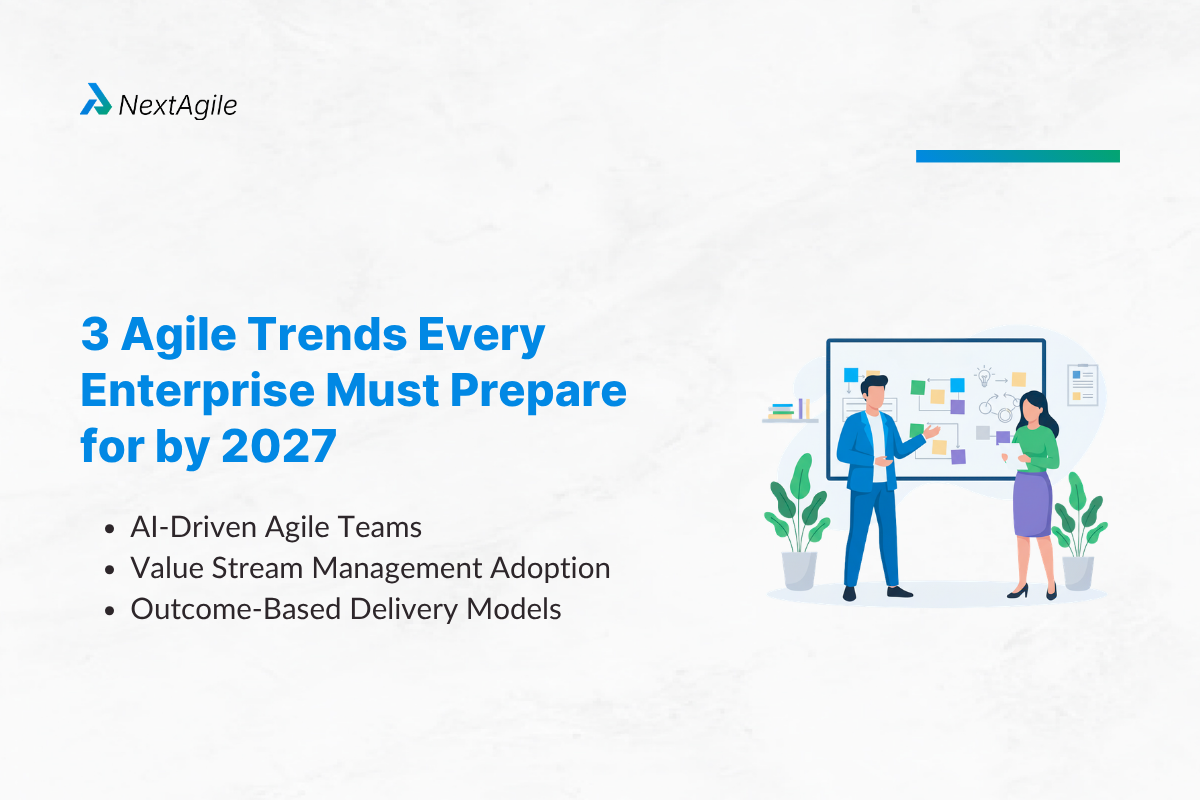
3 Agile Trends Every Enterprise Must Prepare for by 2027
1. AI-Driven Agile Teams Decision-making becomes continuous and data-driven
Organizations optimize end-to-end value delivery
3. Outcome-Based Delivery Models Success is measured by business impact not output
AI is accelerating Agile maturity by augmenting decision-making rather than replacing it. Enterprises that combine human judgment with AI-driven insights will unlock the next level of performance and adaptability.
Agile Transformation vs Digital Transformation Many organizations confuse these two.
Digital transformation focuses on technology adoptionAgile transformation focuses on how organizations operate Digital transformation without Agile leads to faster execution of the wrong priorities.
Agile ensures:
Better decision-making Continuous alignment Sustainable transformation For enterprise leaders, the distinction is strategic: digital transformation changes what the organization uses, while Agile transformation changes how the organization operates. Sustainable success requires both, but Agile determines whether digital investments deliver real value.
The cumulative effect of these benefits is not incremental, it is transformational. As organizations mature, these advantages reinforce each other, creating a system that continuously improves performance, alignment, and responsiveness.
Conclusion The benefits of Agile transformation go far beyond faster delivery.
They redefine how enterprises operate.
Organizations that succeed do not just:
Deliver faster Implement frameworks Track metrics They:
Make better decisions Adapt continuously Align strategy with execution The real power of Agile lies in this:
It transforms organizations into adaptive, intelligent systems that continuously improve and evolve.
As an agile transformation consulting company , we help enterprises move beyond Agile adoption to true transformation, aligning strategy, delivery, and decision-making to drive measurable business outcomes. Do reach out to us at consult@nextagile.ai and we would be happy to explore more.
Frequently Asked Questions 1. Is agile transformation only for IT and software teams? No, Agile applies across business functions, including operations, HR, and finance.
2. How does agile transformation impact company culture? It creates a culture of collaboration, ownership, and continuous improvement.
3. Can small enterprises benefit from agile transformation? Yes. Agile improves efficiency and adaptability regardless of organization size.
4. What is the cost of an agile transformation programme? Costs vary, but ROI comes from improved efficiency, faster delivery, and reduced waste.
5. How does agile transformation improve employee retention? By empowering teams and improving work culture, Agile significantly boosts engagement and retention.
6. What is the most measurable benefit of Agile transformation for enterprises? Time-to-market and value delivery are typically the most measurable benefits, as they directly impact revenue generation, customer satisfaction, and competitive positioning.
7. Why do some Agile transformations fail to deliver expected benefits? Most failures occur when organizations adopt Agile practices without evolving decision-making, governance, and leadership behaviors resulting in limited business impact.
8. How quickly can enterprises start seeing benefits from Agile transformation? Initial benefits such as improved collaboration and faster delivery can be seen within months, while full enterprise-level impact typically takes 12-24 months depending on maturity progression.
9. How do you sustain Agile transformation benefits over time? Sustainability comes from embedding Agile into operating models, aligning performance metrics with outcomes, and continuously evolving based on feedback and data.
10. Which benefit of Agile transformation has the highest long-term impact? Improved decision-making and adaptability have the highest long-term impact, as they influence all other benefits and enable sustained competitive advantage.
Alok Dimri is the co-founder and leads the overall business at NextAgile, where he is responsible for strategy, client and consultant partnerships, and a whole lot of other core business activities like solutioning, branding, and customer engagement.
Over the past 16 years, he has worked extensively in business strategy, new business development, and key account management initiatives across process consulting and training domains.
 Skip to content