Skip to content

Introduction
Generative AI has become one of the most transformative technologies of the 21st century, powering tools like ChatGPT, DALL·E, and MidJourney that create text, images, music, and even code. Businesses are adopting these models for content generation, product design, healthcare diagnostics, and more. However, as their influence grows, so does the concern around interpretability the ability to understand how these systems make decisions.
One major challenge related to the interpretability of generative AI models is the black-box problem. These models rely on high-dimensional neural networks and latent representations that make it difficult to understand how specific inputs lead to specific outputs. The inner workings of these models and the correlation between the input and generative output is something even their creators cannot fully explain. Because the reasoning process is not directly observable, organizations struggle with transparency, auditability, and risk management when deploying generative AI in production environments.
This blog explores what interpretability means, why generative AI models are particularly opaque, and what makes this a pressing issue for enterprises and regulators worldwide?
What Is Interpretability in AI Models?
Interpretability refers to how easily humans can understand the internal workings of an AI model and explain why it produced a specific output. Explainability is closely related but focuses more on communicating those reasons effectively to end users.
In generative AI systems, interpretability is critical for:
- Building trust: Users must know why an AI generated a particular response or image.
- Compliance and safety: Regulations increasingly demand explainable AI, especially in finance and healthcare.
- Debugging and improvement: Developers need insight to fix errors or reduce bias.
Unlike simpler models like decision trees, generative AI systems rely on deep neural networks with millions or billions of parameters, making interpretation far more complex. Features are stored in latent spaces, which are abstract and unintuitive for humans to understand.
This complexity creates a unique generative AI interpretability challenge, making it hard to audit or justify outputs.
Understanding the Black-Box Problem
The black-box problem in generative AI refers to the opacity of models like Transformers, GANs, and VAEs, which process vast datasets and learn intricate patterns without explicit human rules.
Why Are They Black Boxes?
- Latent Space Complexity: Generative models encode patterns in high-dimensional latent spaces, making feature relationships non-obvious.
- Non-linear Interactions: Millions of parameters interact in ways that defy simple explanation.
- Stochastic Outputs: Generative AI introduces randomness, meaning the same prompt can produce different outputs.
Example
Transformer-based models like GPT-4 can produce hallucinated facts, even though the input seems straightforward. Understanding why a model chose one token over another is nearly impossible without specialized interpretability tools.
This lack of clarity leads to the core issue: generative model black boxes limit accountability.
Interpretability Challenges in Large Language Models (LLMs)
Large Language Models (LLMs) such as GPT-based systems introduce additional interpretability challenges due to their scale and architectural complexity. With billions of parameters distributed across transformer layers, understanding how attention mechanisms, token embeddings, and latent representations interact becomes extremely difficult.
Unlike traditional models, LLMs generate outputs token-by-token using probabilistic sampling. By its very nature of these being stochastic rather than deterministic makes it nearly impossible to trace a single decision path responsible for a final response. As enterprises increasingly deploy LLMs in regulated industries, LLM interpretability has become a central governance concern.
Why Is the Black-Box Nature a Problem?
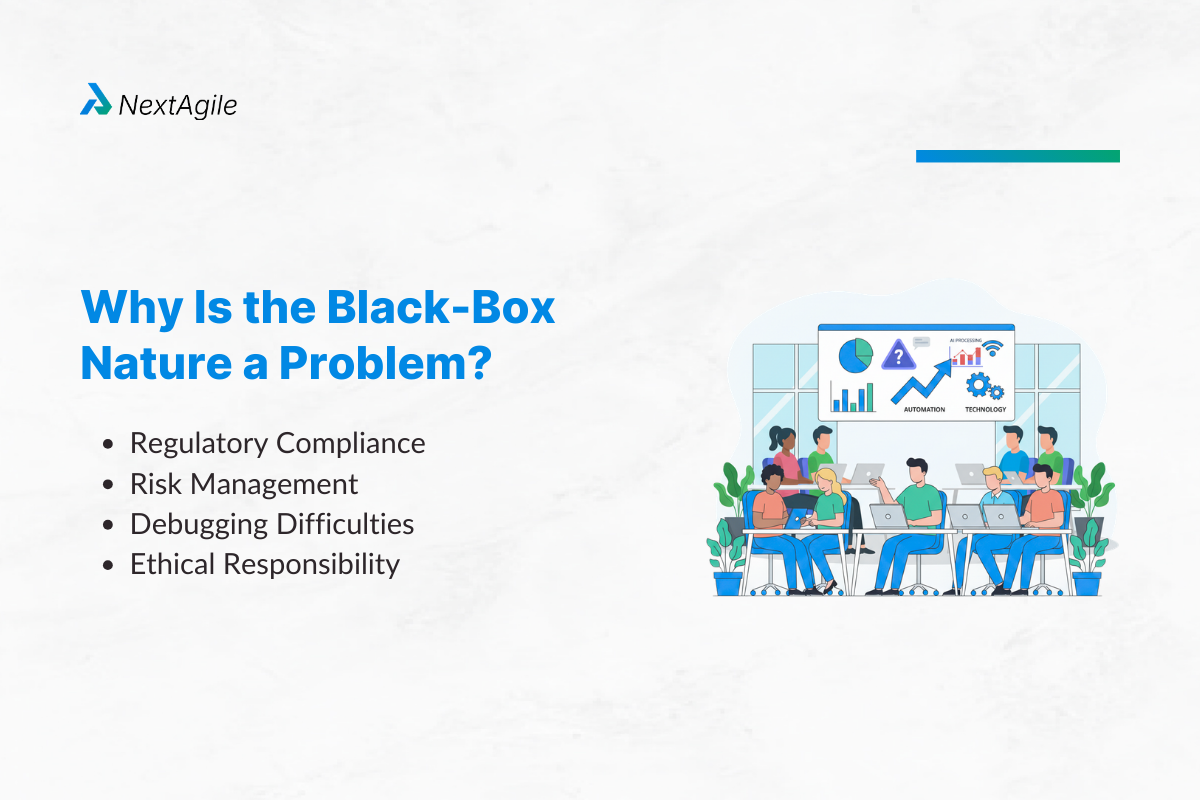
The lack of interpretability is more than an academic concern it introduces practical, ethical, and legal risks:
- Regulatory Compliance: Financial and healthcare sectors require explainability under laws like the EU AI Act.
- Risk Management: Companies cannot fully predict or control outputs, creating legal liabilities and reputational damage.
- Debugging Difficulties: Without transparency, addressing bias in generative AI or preventing harmful content is extremely challenging.
- Ethical Responsibility: A black-box system making decisions that affect people’s lives (credit approval, hiring) raises serious concerns.
Simply put, why generative AI is hard to explain becomes a barrier to responsible deployment.
Why Enterprises Struggle with Generative AI Transparency?
For enterprises, the interpretability challenge is not purely technical it is operational and regulatory. Organizations deploying generative AI systems must demonstrate model accountability, bias mitigation, and audit readiness.
Without transparency into model reasoning, enterprises face the following:
- Difficulty in conducting AI risk assessments
- Challenges in documenting model decisions for compliance
- Increased exposure to legal and reputational risk
- Barriers to meeting AI governance standards such as NIST AI RMF or the EU AI Act
This lack of model transparency slows enterprise adoption and increases the cost of responsible AI deployment.
Practical Applications Affected by This Challenge
Interpretability is crucial in sectors where safety, fairness, and accountability matter most:
- Healthcare: Misinterpretation of a generative model’s medical advice can lead to patient harm.
- Finance: Black-box credit scoring algorithms could embed bias without detection.
- Autonomous Systems: Self-driving cars using generative models for decision-making must justify every move for safety audits.
- Content Creation: AI-generated misinformation or content hallucinations in AI can mislead audiences and damage trust.
Case Examples
- ChatGPT Hallucinations: Producing incorrect legal advice has already led to lawsuits.
- Deepfake Misuse: Generative AI has created fake political videos, raising security concerns.
Industries deploying generative AI need interpretable AI systems to ensure ethical and legal compliance.
Comparison with Interpretable AI Models
Traditional models like decision trees, linear regression, and rule based systems offer clear interpretability because their decision paths are traceable. In contrast:
- Generative AI models rely on deep learning interpretability, which is inherently difficult due to high dimensionality and non-linear feature interactions.
- There is a trade-off between accuracy and interpretability: deep models achieve higher accuracy but at the cost of transparency.
- Some interpretable AI systems exist for simpler tasks, but scaling them to multi-billion parameter generative models remains a challenge.
This is why AI model interpretability issues are so prominent in today’s AI discourse.
Common Challenges & Proposed Solutions
- High Dimensionality and Complexity
Generative AI models operate in massive parameter spaces and latent dimensions, making outputs difficult to trace or explain.
- Stochastic Behavior
These models produce probabilistic outputs, meaning even identical prompts can generate different results, reducing predictability.
- Abstract Representations in Latent Space
Features are compressed into abstract vectors, which are hard to map back to human-understandable concepts.
- Mechanistic Interpretability Efforts
Researchers attempt neuron-level tracing to decode model behavior. Recent research also explores activation patching, circuit-level analysis, and probing classifiers to understand how internal neurons contribute to specific behaviors. However, these techniques are computationally intensive and still in the experimental phase and not yet standardized for enterprise deployment.
- Tool Limitations (SHAP, LIME, Feature Attribution)
While these explainability tools work for structured models, they struggle with deep generative models that lack clear input-output mappings.
Proposed Solutions
- Hybrid Models: Combine interpretable components with generative systems.
- Explainability Layers: Add post-hoc explanation methods like attention visualization.
- Human-in-the-Loop Reviews: Involve experts for validation and bias detection.
- Transparent Documentation: Provide model cards, risk assessments, and audit logs for governance.
Best Practices to Improve Interpretability
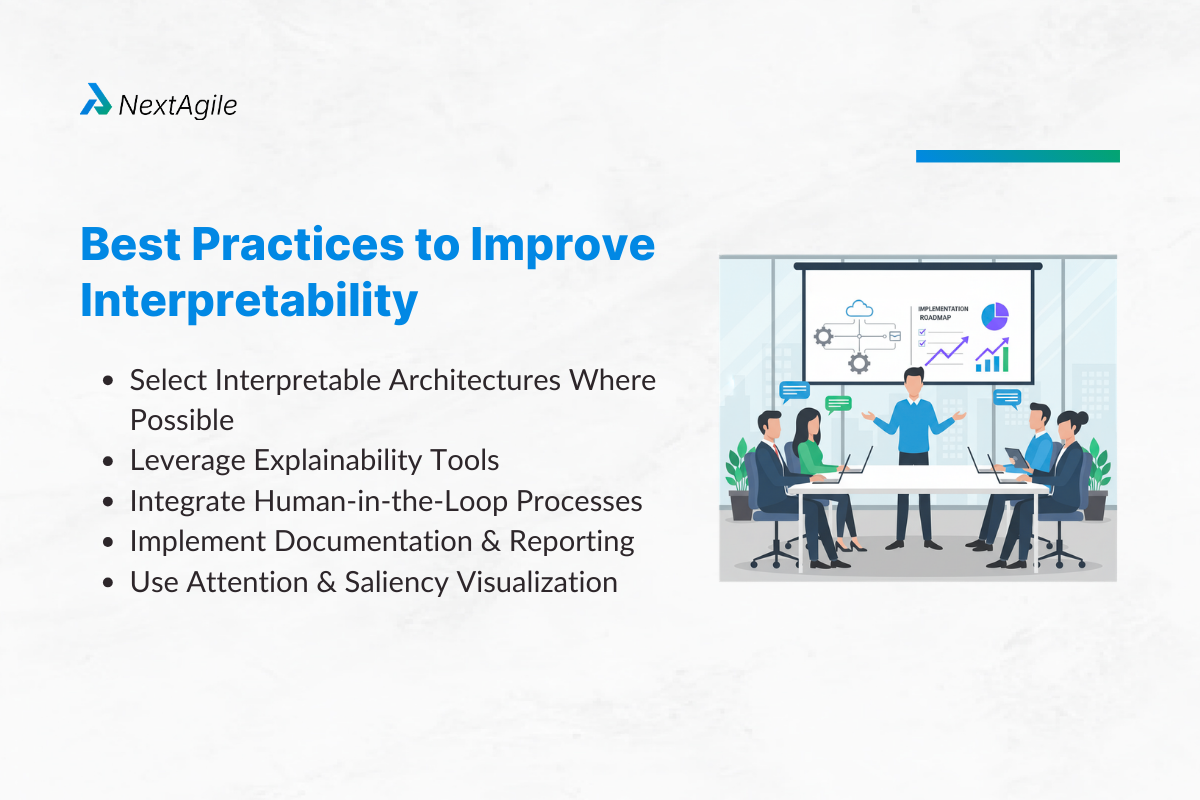
- Select Interpretable Architectures Where Possible
Use simpler models or hybrid approaches for use cases where transparency is critical (e.g., healthcare, finance). - Leverage Explainability Tools
Apply frameworks like LIME, SHAP, and Captum to generate post-hoc explanations of model predictions and decisions. - Integrate Human-in-the-Loop Processes
Include expert reviews to validate outputs, detect biases, and ensure contextual accuracy before deployment. - Implement Documentation and Reporting
Maintain model cards, data sheets, and decision logs to track inputs, training data, and performance metrics. - Use Attention and Saliency Visualization
Visualize attention weights or saliency maps to understand what the model focuses on during generation. - Regular Model Auditing and Testing
Conduct routine interpretability audits, bias detection, and adversarial testing to identify risks early. - Build for Transparency by Design
Incorporate interpretability as a design principle, not an afterthought ensuring governance and ethical compliance.
These steps help mitigate the generative AI interpretability challenge while maintaining performance.
Tools and Resources for Interpreting Generative AI
- LIME (Local Interpretable Model-Agnostic Explanations)
Breaks down model predictions into interpretable chunks by approximating local decision boundaries. Useful for explaining individual outputs but limited for complex generative sequences. - SHAP (SHapley Additive ExPlanations)
Provides a game-theoretic approach to attribute importance scores to input features. Highly effective for structured models, but computationally expensive for large generative models. - Captum
A PyTorch-based library for model interpretability that offers saliency maps and attribution methods. Ideal for developers using neural networks for text and image generation. - Attention Visualization Tools
Tools that highlight attention weights in Transformer models, helping understand which tokens or features influence the generated output. - Explainability Dashboards
Platforms like Weights & Biases or MLflow provide visualization and tracking for interpretability experiments and model audits. - Research Initiatives and Labs
OpenAI Interpretability Team, Anthropic, and DeepMind lead research on mechanistic interpretability and safer generative systems. - Industry Whitepapers and Standards
Access resources from organizations like NIST and OECD on responsible AI and explainability frameworks. - Benchmark Datasets
Datasets designed for interpretability research (e.g., ERASER, e-SNLI) provide test environments for explainability methods.
These tools aim to reduce AI model interpretability issues by making generative systems more accountable.
Conclusion
Generative AI has revolutionized creativity, automation, and problem-solving across industries, but its interpretability remains one of the most pressing challenges. Unlike traditional models, generative systems operate as complex “black boxes,” making it difficult to understand how decisions are formed or why specific outputs are generated. This lack of transparency raises concerns around trust, accountability, and compliance especially in sensitive sectors like healthcare, finance, and law.
The black-box problem is more than a technical limitation; it’s a barrier to responsible and ethical AI deployment. Without clarity, organizations risk misinformation, bias, and legal repercussions, undermining user confidence and brand integrity.
To move forward, businesses and developers must adopt hybrid models that balance performance with interpretability, design systems with explainability at their core, and incorporate responsible AI practices such as continuous monitoring and human-in-the-loop validation. Staying informed about emerging research, open-source interpretability tools, and global AI governance standards is crucial for mitigating risks.
Interpretability isn’t optional it’s fundamental to scaling AI responsibly. By prioritizing transparency and accountability, organizations can unlock the true potential of generative AI without compromising safety or trust.
Is your organization looking to integrate AI into your development and operational processes? Start with an AI readiness assessment first and see what the gap is between the As-Is and the desired To-be state. Reach out to NextAgile AI Consulting group for an in-depth contextual discussion with our AI experts. You can write to us consult@nextagile.ai or leave a message on our website. You can also explore NextAgile AI Training enablement programs for your teams and leadership for ramping up your Gen AI capabilities.
Frequently Asked Questions
1. What makes generative AI models hard to interpret?
Generative models use complex neural networks operating in high-dimensional latent spaces, making decision pathways opaque. Their non-linear structure and stochastic outputs add further complexity.
Additionally, these models operate in abstract latent spaces where learned features do not correspond to clearly defined human concepts. This disconnect between mathematical representation and human reasoning makes interpretability significantly more complex than in traditional machine learning models.
2. How is interpretability different from explainability?
Interpretability is understanding a model’s internal mechanics; explainability communicates these insights in a human-friendly way.
3. What industries are most affected by this black-box issue?
Healthcare, finance, legal, and autonomous systems face the highest risk due to compliance, safety, and fairness concerns.
4. Are there any fully interpretable generative models?
Currently, no large-scale generative models are fully interpretable, though research in interpretable AI systems is growing.
Most current large-scale generative models prioritize performance and scalability over transparency. While research into mechanistic interpretability and sparse modeling continues, fully interpretable large generative systems remain an open research problem.
5. How do explainability tools like SHAP or LIME help?
They approximate feature influence on outputs, offering partial insights but not full transparency for large generative models.
6. What are future directions for solving the black-box challenge?
Mechanistic interpretability research, hybrid models combining rules and deep learning, and regulatory-driven transparency standards.