Skip to content
![What is Lean Agile Mindset 5-Step Framework [2026]](https://nextagile.ai/blogs/wp-content/uploads/2026/03/What-is-Lean-Agile-Mindset-5-Step-Framework-2026.png "What is Lean Agile Mindset? Definition, Principles & 5-Step Framework 1")
Introduction
Organizations don’t struggle with Agile because they lack frameworks. They struggle because leadership thinking hasn’t evolved.
You can implement Scrum.
You can scale using SAFe.
You can train teams on the values of the Agile Manifesto.
But if decisions remain centralized, learning is penalized, and outcomes are secondary to activity, Agility remains superficial.
That is why the Lean Agile Mindset is the foundation of sustainable transformation.
This guide explains:
- What is lean agile mindset (clear, concise definition)?
- How lean and agile thinking combine?
- Why it matters beyond IT?
- A practical 5-step development framework
- How it applies in SAFe and enterprise environments?
- Common mistakes and how to fix them?
- Frequently asked questions
If you want predictable transformation outcomes, this is where to begin.
Why the Lean Agile Mindset Matters in Modern Enterprises
Many organizations attempt Agile adoption by introducing frameworks, ceremonies, and tools. While these practices can improve coordination, they rarely deliver sustained agility without a corresponding shift in leadership thinking.
The Lean Agile Mindset changes how organizations approach decision-making, learning and experimentation, prioritization of work, allocation of resources and measurement of success.
When leaders adopt this mindset, Agile stops being a delivery methodology and becomes an organizational capability for continuous adaptation.
What is Lean Agile Mindset? Definition and Core Components
Before exploring frameworks and development approaches, it is important to clarify what the Lean Agile Mindset actually represents and why it serves as the foundation for modern Agile operating models.
Lean Agile Mindset is a way of thinking that combines lean principles (eliminating waste, optimizing flow) with agile principles (adaptability, collaboration, iterative learning) to help organizations deliver continuous customer value in uncertain environments.
It influences:
- How leaders make decisions
- How teams prioritize work
- How organizations allocate funding
- How performance is measured
It is not a framework.
It is the cognitive foundation behind frameworks.
Core Components of Lean Agile Mindset
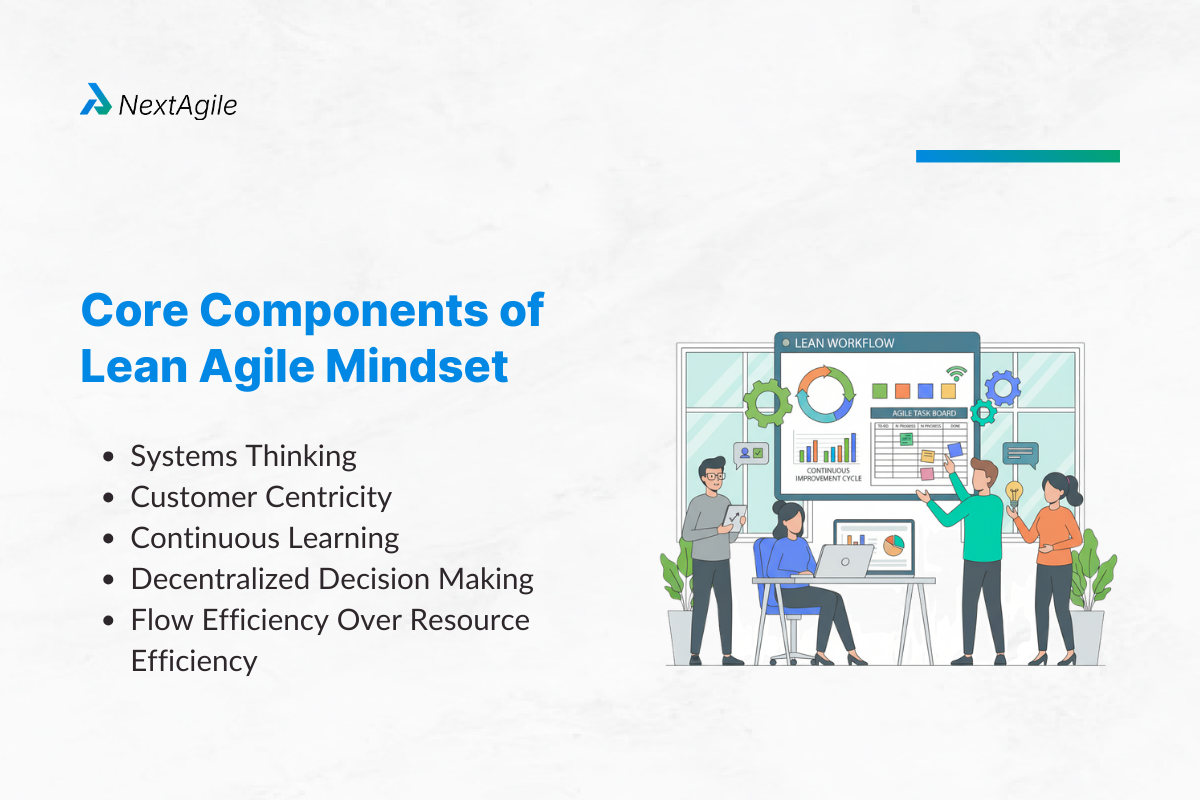
- Systems Thinking – Optimize the whole, not just individual teams.
- Customer Centricity – Value is defined externally, not internally.
- Continuous Learning – Every iteration produces insight.
- Decentralized Decision Making – Empower those closest to the work.
- Flow Efficiency Over Resource Efficiency – Reduce delays and handoffs.
These components create resilience in fast-changing markets.
How Do These Components Work Together?
The Lean Agile Mindset is powerful because its components reinforce one another.
For example:
- Systems thinking prevents local optimization
- Customer centricity aligns teams to real value
- Decentralized decision making reduces delays
- Continuous learning accelerates improvement
When these principles operate together, organizations shift from managing tasks to optimizing value flow across the entire system.
Comparison Table: Lean vs Agile vs Lean-Agile Mindset
| Dimension | Lean | Agile | Lean-Agile Mindset |
| Origin | Manufacturing systems | Software development | Enterprise transformation |
| Focus | Eliminate waste | Adapt to change | Optimize value flow + adaptability |
| Risk Approach | Reduce inefficiency | Experiment frequently | Accelerate validated learning |
| Leadership Style | Systems optimization | Servant leadership | Lean-Agile leadership |
| Metrics | Throughput, efficiency | Velocity, iteration outcomes | Business impact, flow, learning speed |
| Scope | Process improvement | Team-level adaptability | Organization-wide thinking |
Key Takeaway for Leaders
While Lean and Agile originated in different industries, modern organizations increasingly integrate both approaches.
- Lean provides the economic lens for optimizing systems, while
- Agile provides the execution model for adapting quickly to change
The Lean Agile Mindset combines these perspectives to help enterprises operate effectively in environments characterized by uncertainty, rapid innovation, and evolving customer expectations.
Remember –
- Lean optimizes systems. Agile improves responsiveness
- Lean-Agile integrates both for enterprise-level performance.
The Lean Thinking Principles Behind the Mindset
Understanding the Lean Agile Mindset requires exploring the principles that shaped modern lean thinking and how those ideas influence leadership behavior in complex organizations.
Lean thinking is built on five core principles:
- Define value from the customer’s perspective
- Map the value stream
- Create flow
- Establish pull
- Pursue perfection
Lean principles originally emerged in manufacturing environments, but they translate effectively into modern knowledge work. In modern – product development and digital environments, waste typically appears as:
- Delayed decisions and long handoff between teams
- Excess approvals and unnecessary governance
- Context switching
- Rework from unclear priorities and delayed feedback cycles
- Overloaded portfolios
- Unclear ownership of customer outcomes
Lean thinking shifts the question from “Are people busy?” to “Is value flowing smoothly?”
That shift changes leadership behavior.
How the Agile Manifesto Shapes the Mindset?
The Agile Manifesto introduced four core values:
- Individuals and interactions over processes and tools
- Working solutions over excessive documentation
- Customer collaboration over contract negotiation
- Responding to change over following a rigid plan
These values assume:
- Trust
- Transparency
- Rapid feedback
- Shared accountability
The Lean Agile Mindset integrates these principles with economic thinking, and ensuring experimentation aligns with business outcomes.
Why Do Agile Values Require a Mindset Shift?
The values described in the Agile Manifesto assume a level of trust and collaboration that traditional management models often struggle to support.
For example:
- Teams must be trusted to make local decisions
- Learning from failure must be accepted
- Feedback must influence priorities quickly
Without these cultural conditions, Agile practices become mechanical rather than adaptive.
The Lean Agile Mindset creates the organizational environment where Agile values can actually work.
Why the Lean Agile Mindset Matters for Teams and Organizations?
Once organizations understand the principles behind the mindset, the next question leaders often ask is what practical impact does this mindset create inside real teams and organizations? Below are a few direct impact areas –
- Decision Latency – In many organizations, delays occur between Idea → Approval, Development → Review, Feedback → Implementation. A lean agile mindset reduces decision latency by empowering teams within clear boundaries.
- Employee Engagement – Autonomy without alignment creates chaos, Alignment without autonomy creates disengagement. The Lean Agile mindset balances both. When teams understand purpose, influence decisions and see customer impact, engagement increases.
- Faster Learning Cycles – This reduces risk compared to large, fixed plans. Organizations with a lean agile mindset test assumptions early, release in small increments and adjust strategy quarterly.
- Strategic Adaptability – In volatile markets, especially across digital, AI, and global capability centers, strategy must evolve continuously. A lean agile mindset allows:
- Dynamic prioritization
- Funding reallocation
- Outcome-based governance
Organizational Capabilities Enabled by the Mindset
Organizations that successfully develop a Lean Agile Mindset often experience improvements in several strategic capabilities:
- Faster innovation cycles
- Improved product-market alignment
- Stronger collaboration between business and technology teams
- Better risk management through early validation
- Increased transparency in decision-making
These capabilities help enterprises remain competitive in environments where speed of learning determines long-term success.
How to Develop a Lean Agile Mindset: 5-Step Framework
Although mindset shifts are often described abstractly, organizations can develop Lean Agile thinking through structured capability-building approaches.
The following framework provides a practical path for cultivating this mindset across leaders and teams.
-
Start with Awareness: Spot Fixed Thinking Patterns
Transformation begins by identifying limiting beliefs such as:
- “We must finalize requirements before starting.”
- “Failure damages credibility.”
- “Senior leaders must approve all changes.”
And instead asking:
- Where do delays occur?
- Who makes decisions today?
- What assumptions go unquestioned?
Awareness creates the foundation for change.
-
Embrace Continuous Improvement as a Daily Habit
Continuous improvement means:
- Retrospectives influence real change
- Metrics drive learning, not blame
- Small experiments are encouraged
Teams should ask weekly:
- What slowed us down?
- What created unnecessary rework?
- What can we improve immediately?
Improvement must move from event-based to habit-based.
-
Adopt Value-Focused Thinking in Every Decision
Every initiative should answer:
- Who is the customer?
- What measurable value will this deliver?
- How soon can we validate impact?
Shift conversations from “How busy are we?” to “What outcomes did we create?”
This changes prioritization quality.
-
Build Psychological Safety So People Can Speak Up
Psychological safety enables:
- Honest retrospectives
- Early risk identification
- Constructive disagreement
Without psychological safety:
- Problems stay hidden
- Innovation declines
- Learning slows
Leaders must model vulnerability and openness.
-
Lead by Example at Every Level
Mindset change fails when leaders:
- Demand predictability during uncertainty
- Penalize experimentation
- Override team decisions reflexively
Lean-Agile leadership requires:
- Transparency
- Consistency
- Economic reasoning
- Trust in empowered teams
Culture follows leadership behavior.
The Role of Leadership Modeling
Mindsets rarely change through training alone.
Employees observe how leaders make trade-off decisions, respond to failure, prioritize customer outcomes and reward experimentation.
When leadership behavior aligns with Lean Agile principles, cultural change accelerates across the organization.
Lean Agile Mindset in Practice: Teams, Leaders, and SAFe
Many organizations encounter the Lean Agile Mindset through enterprise scaling frameworks that emphasize leadership behavior as a critical success factor.
Within SAFe, the Lean-Agile Mindset is foundational.
However, organizations often:
- Adopt ceremonies
- Add reporting layers
- Increase governance overhead
Without changing decision logic.
In practice:
- Teams operate in short increments
- Leaders use flow metrics
- Portfolio funding becomes flexible
- Strategy reviews become iterative
Lean-Agile in SAFe is not about scaling events it is about scaling thinking.
Indicators That the Mindset Is Taking Hold
Organizations beginning to adopt a Lean Agile Mindset often observe several early signals:
- Teams challenge assumptions earlier in planning
- Leaders request outcome metrics rather than activity reports
- Decisions move closer to the teams doing the work
- Retrospectives generate real process improvements
These signals indicate that Agile practices are evolving into deeper organizational thinking patterns.
Common Mistakes When Building a Lean Agile Mindset (And How to Fix Them)
Despite the benefits, developing a Lean Agile Mindset can be challenging because it requires both behavioral and structural change across the organization.
Mistake 1: Treating Lean as Cost Cutting
Fix: Focus on value creation and flow efficiency, not headcount reduction.
Mistake 2: Implementing Frameworks Before Changing Incentives
Fix: Align performance metrics with outcomes and learning speed.
Mistake 3: Confusing Autonomy with Lack of Governance
Fix: Define decision guardrails and economic constraints clearly.
Mistake 4: Ignoring Leadership Development
Fix: Invest in executive education like leadership capability programs before scaling practices.
Mistake 5: Expecting Instant Culture Change
Fix: View mindset evolution as a multi-quarter journey.
Conclusion
Signs Your Organization Is Developing a Lean Agile Mindset
Leaders often look for indicators that mindset change is progressing.
Positive signals include:
- Faster decision cycles
- Improved cross-team collaboration
- Increased experimentation and learning
- Greater transparency around outcomes
- Stronger alignment between strategy and execution
These changes typically emerge gradually as teams and leaders practice Lean Agile principles consistently.
Lean Agile Mindset is not about tools or ceremonies.
It is about how leaders think.
It determines:
- How quickly organizations learn
- How effectively teams collaborate
- How confidently strategy adapts
In uncertain environments, speed of learning becomes a competitive advantage. Lean provides flow. Agile provides adaptability. Lean-Agile integrates both into strategic capability.
Transformation begins with mindset.
If your enterprise is struggling to implement the Lean Agile mindset, to deliver continuous value, adapt faster to change and build resilient teams capable of sustained innovation, consider collaborating with an external agile consulting company, which can bring an outside-in perspective and help you curate a practical implementation roadmap. At NextAgile consulting, we have worked with businesses across multiple domains and geographies to co‑create and implement a practical Lean Agile Mindset framework. Do reach out to us at consult@nextagile.ai and we would be happy to explore more.
Frequently Asked Questions
1. What is the Lean Agile Mindset in SAFe?
In SAFe, the Lean-Agile Mindset refers to leadership principles that combine lean thinking (flow, waste reduction, systems optimization) with agile values (adaptability, collaboration, iteration). It forms the foundation for effective scaling across portfolios and programs.
2. What is the difference between a Lean mindset and an Agile mindset?
A lean mindset focuses on eliminating waste and optimizing systems for efficient value flow.
An agile mindset emphasizes adaptability, experimentation, and collaboration in uncertain environments.
The lean-agile mindset integrates both to balance efficiency with responsiveness.
3. Can someone develop a Lean Agile Mindset without a company-wide transformation?
Yes. Individuals and teams can adopt lean agile principles locally by:
- Improving flow
- Running experiments
- Focusing on outcomes
However, enterprise-level benefits require leadership alignment and systemic change.
4. How long does it take to develop a Lean Agile Mindset?
Individual mindset shifts can begin within weeks.
Organizational transformation typically takes 6-18 months depending on leadership commitment and cultural readiness.
5. Does the Lean Agile Mindset apply outside of IT teams?
Yes, it applies to
- HR
- Finance
- Marketing
- Operations
- Manufacturing
- Product Management.
Any function delivering value under uncertainty benefits from iterative learning and flow optimization.
6. Why is the Lean Agile Mindset important for leadership?
The Lean Agile Mindset is important for leadership because it shifts decision-making from centralized control to empowered teams guided by clear strategic boundaries. This approach reduces delays, improves learning cycles, and enables organizations to respond quickly to changing market conditions.
7. How does the Lean Agile Mindset improve product development?
The Lean Agile Mindset improves product development by encouraging small experiments, continuous feedback, and rapid iteration. Teams validate ideas early, reduce large upfront planning, and focus on delivering incremental value that can be improved through learning.
8. What behaviors demonstrate a Lean Agile Mindset?
Behaviors that demonstrate a Lean Agile Mindset include questioning assumptions, prioritizing customer outcomes, encouraging experimentation, making data-informed decisions, and continuously improving processes based on feedback.
9. Can traditional organizations adopt the Lean Agile Mindset?
Yes. Traditional organizations can gradually develop a Lean Agile Mindset by introducing decentralized decision-making, improving feedback loops, and aligning incentives with customer value rather than internal activity metrics.
10. What metrics support a Lean Agile Mindset?
Common metrics include flow efficiency, cycle time, lead time, customer value delivered, learning velocity, and outcome-based business indicators. These metrics help organizations measure value creation rather than simply tracking activity levels.
11. What is a Lean Agile Mindset in simple terms?
A Lean Agile Mindset is a way of thinking that combines lean principles such as eliminating waste and improving flow with agile principles like adaptability, collaboration, and iterative learning. It helps organizations continuously deliver customer value while adapting quickly to change..
12. Why is the Lean Agile Mindset important?
The Lean Agile Mindset is important because it enables organizations to operate effectively in uncertain and fast-changing environments. By focusing on value delivery, rapid learning, and decentralized decision-making, companies can innovate faster and respond quickly to customer needs.
13. What are the key principles of a Lean Agile Mindset?
The key principles of a Lean Agile Mindset include systems thinking, customer-centricity, continuous improvement, decentralized decision-making, and optimizing value flow. These principles help organizations reduce delays, improve collaboration, and deliver outcomes more effectively.
14. What is the difference between Lean thinking and Agile thinking?
Lean thinking focuses on optimizing systems by eliminating waste and improving value flow, while Agile thinking emphasizes adaptability, iterative delivery, and collaboration in uncertain environments. The Lean Agile Mindset integrates both approaches to balance efficiency with responsiveness.
15. How does the Lean Agile Mindset improve decision-making?
The Lean Agile Mindset builds on the values introduced in the Agile Manifesto by emphasizing collaboration, adaptability, and customer value. It expands these ideas with lean economic thinking to guide leadership decisions and organizational design.
16. What is the Lean Agile Mindset in SAFe?
In Scaled Agile Framework, the Lean-Agile Mindset refers to a set of leadership principles combining lean thinking and agile values. It guides leaders in empowering teams, improving flow, and aligning strategy with continuous value delivery.
17. What behaviors demonstrate a Lean Agile Mindset?
Common behaviors include encouraging experimentation, making decisions based on data and customer feedback, empowering teams to solve problems, and continuously improving processes. Leaders with a Lean Agile Mindset focus on outcomes rather than activity metrics.
18. How does a Lean Agile Mindset improve decision-making?
A Lean Agile Mindset improves decision-making by pushing authority closer to the teams performing the work. This reduces delays caused by hierarchical approvals and enables faster responses to new information, risks, or customer feedback.
19. How does Lean Agile thinking improve innovation?
Lean Agile thinking improves innovation by encouraging small experiments, rapid feedback cycles, and learning through iteration. Instead of committing to large plans upfront, teams validate ideas quickly and refine them based on real customer insights.
20.Can non-technical teams adopt a Lean Agile Mindset?
Yes. The Lean Agile Mindset applies to functions such as marketing, HR, finance, operations, and product management. Any team that works in uncertain environments can benefit from iterative learning, improved collaboration, and faster feedback loops.
21. How does the Lean Agile Mindset reduce organizational waste?
The Lean Agile Mindset reduces waste by identifying delays, unnecessary approvals, excessive documentation, and inefficient workflows. By optimizing the entire value stream, organizations improve delivery speed and focus resources on activities that create real customer value.
22. What role does leadership play in developing a Lean Agile Mindset?
Leadership plays a critical role because organizational culture reflects leadership behavior. Leaders must model transparency, support experimentation, empower teams to make decisions, and align incentives with customer outcomes rather than internal activity metrics.
23. How long does it take to develop a Lean Agile Mindset?
Individual mindset shifts can begin within weeks through training and practice. However, developing a Lean Agile Mindset across an entire organization typically takes 6-18 months as leadership behaviors, governance structures, and team practices evolve.
24. What challenges do organizations face when adopting a Lean Agile Mindset?
Common challenges include resistance to cultural change, centralized decision-making structures, misaligned performance metrics, and lack of leadership commitment. Addressing these barriers requires leadership development and changes in organizational incentives.
25. How does Lean Agile thinking improve customer value?
Lean Agile thinking improves customer value by prioritizing continuous feedback, incremental delivery, and outcome-based decision-making. Teams validate assumptions early and adjust product direction based on real customer needs.
26. What metrics support a Lean Agile Mindset?
Metrics that support a Lean Agile Mindset include cycle time, lead time, flow efficiency, customer satisfaction, business outcomes, and learning velocity. These metrics focus on value creation rather than measuring activity levels.
27. How does Lean Agile thinking support business agility?
Lean Agile thinking supports business agility by enabling organizations to adapt strategies quickly, allocate resources dynamically, and respond to changing market conditions without lengthy planning cycles.
28. Can a Lean Agile Mindset exist without Agile frameworks?
Yes. A Lean Agile Mindset can exist independently of frameworks. While frameworks provide structure for implementation, the mindset itself focuses on leadership thinking, decision-making patterns, and organizational learning behaviors.
29. What industries benefit from a Lean Agile Mindset?
Industries experiencing rapid change benefit the most, including technology, fintech, healthcare, e-commerce, telecommunications, and product-driven organizations where innovation speed and adaptability are critical for competitiveness.
30. How does psychological safety support the Lean Agile Mindset?
Psychological safety allows teams to share ideas, identify risks early, and learn from mistakes without fear of blame. This environment is essential for continuous improvement and experimentation, which are central to the Lean Agile Mindset.
31. What is decentralized decision-making in a Lean Agile Mindset?
Decentralized decision-making means empowering teams closest to the work to make operational decisions within clearly defined boundaries. This approach reduces delays and enables faster responses to customer needs or emerging opportunities.
32. How does the Lean Agile Mindset improve team collaboration?
The Lean Agile Mindset encourages cross-functional collaboration by aligning teams around shared outcomes and customer value. This reduces silos between departments and improves communication across product development processes.
33. How does Lean Agile thinking improve organizational learning?
Lean Agile thinking promotes continuous learning through short feedback loops, retrospectives, and experimentation. Teams analyze outcomes, adjust processes, and apply insights to future work cycles.
34. What is the relationship between Lean Agile Mindset and business outcomes?
The Lean Agile Mindset links decision-making directly to measurable business outcomes such as customer satisfaction, revenue impact, product adoption, and innovation speed. This ensures teams focus on value creation rather than internal efficiency alone.
35. What is the ultimate goal of a Lean Agile Mindset?
The ultimate goal of a Lean Agile Mindset is to create organizations capable of continuous learning, rapid adaptation, and sustainable value delivery. By integrating lean efficiency with agile adaptability, companies can thrive in complex and uncertain environments.