Skip to content

Introduction
A global payment company we know spent $500k on an agile transformation over 18 months. Velocity didn’t budge. Transparency and Execution Certainty didn’t improve. The consultants aligned themselves to the existing org culture, and within 90 days, many teams had quietly reverted to waterfall. The only lasting output? A very expensive slide deck.
This isn’t a horror story. It’s Tuesday.
Research by McKinsey found that 70% of large-scale transformation programs fail to achieve their goals and failed Agile rollouts typically cost enterprises between $500K and $3M when you factor in lost productivity, rehiring, and the political fallout that follows. The market for agile consulting companies exploded in the last decade, which means there are now more firms happy to take your money than there are firms capable of earning it.
So before you sign anything: this checklist on how to choose an agile consulting firm, exists to change the odds in your favor.
We’ve watched dozens of engagements, successful ones we led, failed ones we inherited, and a few mid-transformation rescues that taught us more than any success ever did. What separates firms that drive real, lasting change from those who deliver a framework and disappear comes down to ten things. Use this. Share it with your procurement team (most important). Run every shortlisted firm through it before a proposal is signed.
The 10-Point Checklist to Choose the Right Agile Consulting Firm
Use this as your evaluation scorecard. Print it. Run every firm through it.
| # | Checklist Point | What to Look For | Green Flag | Red Flag |
| 1 | Agile Assessment Process | Structured discovery before recommending a framework | Agile maturity model assessment in week one | One-size-fits-all framework proposal before any discovery |
| 2 | Industry Experience | Relevant hands-on case studies, not just tech specs & tools | Enterprise clients use cases with measurable outcomes | Only generic case studies, no industry validation |
| 3 | Framework Flexibility | SAFe, LeSS, Scrum, Kanban & others – picks based on context | Recommends the right framework for your scale and culture | Pushes one framework regardless of your situation |
| 4 | Knowledge Transfer | Coaching your internal teams to be self-sufficient | Explicit knowledge transfer plan with milestone checkpoints | No plan for reducing dependency; keeps renewing contracts |
| 5 | Measurable ROI Commitment | Quantifiable KPIs tied to business outcomes | Pre-agreed success metrics & milestones | Refuses to commit to measurable outcomes |
| 6 | Engagement Model Options | Fixed-scope, retainer, or milestone-based options | Flexible models that fit your budget and goals | Only long-term retainer with no exit provisions |
| 7 | Change Management Support | Handles resistance from managers and leadership | Dedicated change management track alongside Agile implementation | Ignores cultural resistance and org change complexity |
| 8 | Verifiable References | 2–3 reachable past clients in similar contexts | Enthusiastic references who describe specific business results | Only written testimonials; no live references available |
| 9 | Cultural & Communication Fit | Aligns with your team culture and communication style | Transparent, responsive, adapts to distributed or India-based teams | Overpromises in sales, disappears post-signing |
| 10 | Hands-on Practitioners | Hands-on Experience over assorted certifications | People who have on-the-job experience over theoretical validations | Assorted agile certifications platter |
Now let’s unpack the five checklist points where organizations most commonly get burned, and what to actually listen for.
- Hands-on Practitioners over assorted certifications
Certifications matter, but they’re a starting point not a finish line. What you’re looking for is a firm with hands-on practitioners. People who have been on the ground, have worked in multiple organizations, multiple domains, multiple geographies and who know what it takes to drive an agile transformation – Buy in from all levels in the organization, from leadership to middle management to teams and what it takes to create that buy in in a diverse set of stakeholders with seemingly conflicting interests.
Remember that agile consultants should not be evangelists pushing a particular framework as the panacea for all organizational bottlenecks but at the same time they should be well versed in all the approaches. The idea is to solve the business problem and not implement a great framework.
- Agile Assessment Process – Discovery Before Prescription
Would you trust a doctor who prescribes medication before running a single test? The best agile consulting firms run a structured agile maturity model assessment before recommending anything. They map where your teams are across delivery, collaboration, leadership, and tooling, then prescribe.
At NextAgile, our discovery process kicks off in week one with leadership and team level interviews, workflow audits, and a full maturity baseline. We don’t recommend SAFe vs. LeSS vs. Scrum until we understand your actual organizational DNA.
3 & 4. Industry Experience + Framework Flexibility
Halfway through, here’s a pattern worth noticing: every failed engagement we’ve seen shares one of two traits. Either the firm had no relevant industry experience and treated a regulated bank like a SaaS startup. Or they had a hammer, and your transformation became their nail.
Ask for 2, 3 detailed industry case studies with before/after metrics, not “We’ve worked with Fortune 500 companies.” Specifics or nothing.
On framework flexibility: firms that only know SAFe will only sell you SAFe. Real experts are framework-agnostic by default. Please read that again. They’ll recommend SAFe for a 200-person engineering org, LeSS for product-centric teams, and Kanban for operations, and they’ll tell you why they’re NOT recommending the alternatives.
- Knowledge Transfer – Are They Building Your Capability?
The goal of any agile transformation engagement should be to make it unnecessary. If your teams can’t sustain the change without the agile consulting firm after 12-18 months, that’s not a transformation. That’s a dependency.
Knowledge transfer needs to be a named, structured component of the engagement plan, internal Agile coach development, Scrum Master competency, and explicit handoff milestones. We plan our own exit from day one. Every NextAgile engagement includes a capability-building track so your internal champions can carry it forward without us.
Not sure how your current vendor stacks up against this checklist? Take NextAgile’s free 5-minute Agile Maturity Assessment and get a score you can actually act on.
5 Warning Signs to Watch When Evaluating Agile Consulting Companies
Even with a solid checklist, subtler signals get missed during evaluation. These five are the ones that hurt the most because they only become obvious after you’ve signed.
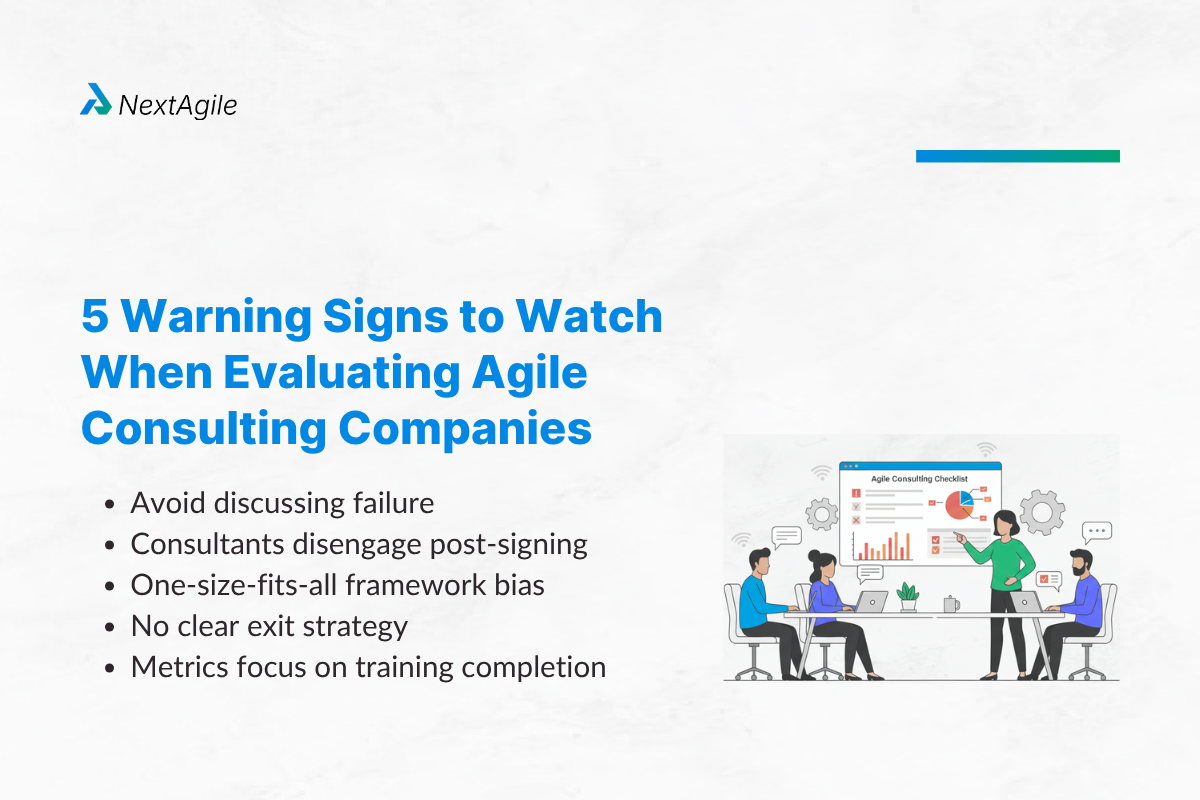
- They avoid the word ‘failure.’ Every firm has had engagements that were harder than expected. A firm that can’t talk honestly about what went wrong and what they learned hasn’t built the self-awareness to guide your transformation.
- Their senior consultant disappears after you sign. The person who impressed you in the sales process becomes unavailable. You’re suddenly working with a junior team. Ask explicitly: Who will be on-site with us? What’s your team continuity policy?
- They can’t explain why NOT to use their preferred framework. Real experts can articulate the limitations of their own approach. If a SAFe consultant can’t tell you when SAFe isn’t the right choice, that’s not expertise. That’s a sales script.
- There’s no exit plan. If the engagement scope keeps expanding with no clear path to internal ownership, you’re being set up for dependency. Ask for a written transition plan before you sign.
- Their success metrics are all about training completion. Workshops delivered are not transformation achieved. If the firm’s success report is a list of certifications issued and sessions run, they’re measuring activity, not impact.
10 Questions to Ask Any Firm Before Signing a Contract
Run every shortlisted firm through these. They’re not gotcha questions; they surface how a firm thinks, not just what they know.
- What does your agile maturity model assessment look like for a team our size?
- Can you share a case study with a problem statement, journey and clear outcomes?
- How do your Agile coaches handle resistance from middle management?
- Which framework would you recommend for us, and why not the others?
- How do you ensure knowledge transfer to build internal competency so we’re not dependent on you after the engagement?
- What does your engagement model look like: fixed, retainer, or milestone-based?
- Can we speak directly with 2–3 of your past clients?
- How do you handle communication for India-based or distributed teams?
- What happens if we’re not satisfied mid-engagement?
- How do you define and measure success at the end of this project?
Listen for specificity, not fluency. A firm that answers Q4 without naming a framework they’d rule out and why is giving you a rehearsed answer, not an honest one.
Top 10 Agile Consulting Firms Compared
The table below reflects our direct industry experience with firms we’ve trained alongside, competed against, or inherited projects from. Use it as a starting point, not a final verdict. Your context changes everything.
| Firm | Best For | Frameworks | Standout Feature | India Presence |
| NextAgile * | Enterprises & SMBs | SAFe, Scrum, LeSS, Kanban | End-to-end transformation + knowledge transfer guarantee | Yes |
| Scaled Agile | Large enterprise SAFe rollouts | SAFe | Framework creator; deepest SAFe bench | Limited |
| Scrum Alliance | Team-level Scrum coaching | Scrum | Largest certified Scrum network globally | Moderate |
| Accenture Agile | Fortune 500 digital transformation | SAFe, Scrum, Kanban | Enterprise scale + tech integration | Yes |
| ThoughtWorks | Tech-forward teams & DevOps | XP, Scrum, Kanban | Engineering culture + Agile coaching combined | Yes |
| Cprime | Mid-to-large enterprises | SAFe, Kanban, Scrum | Metrics-driven engagements with clear ROI | No |
| Rally/Broadcom | Enterprise tooling + coaching | SAFe | Agile toolchain + transformation bundle | Limited |
| Agile Six | Government & public sector | Scrum, Kanban | Federal Agile compliance expertise | No |
| LeadingAgile | Org-wide transformations | SAFe, Disciplined Agile | Transformation roadmap with executive alignment | No |
| Nimble Agility | SMBs & growing startups | Scrum, Kanban | Affordable, results-focused engagements | Yes |
* NextAgile leads this list not because we wrote it, but because we’ve built our model around making transformations measurable and client-independent. We’ve walked away from engagements where the conditions weren’t right. We’ll tell you upfront if we’re not the right fit.
How to Measure ROI from Agile Consulting?
If you can’t measure it, you can’t defend the investment to leadership. Measuring ROI from agile transformation consulting requires one non-negotiable step: set a baseline before the engagement starts.
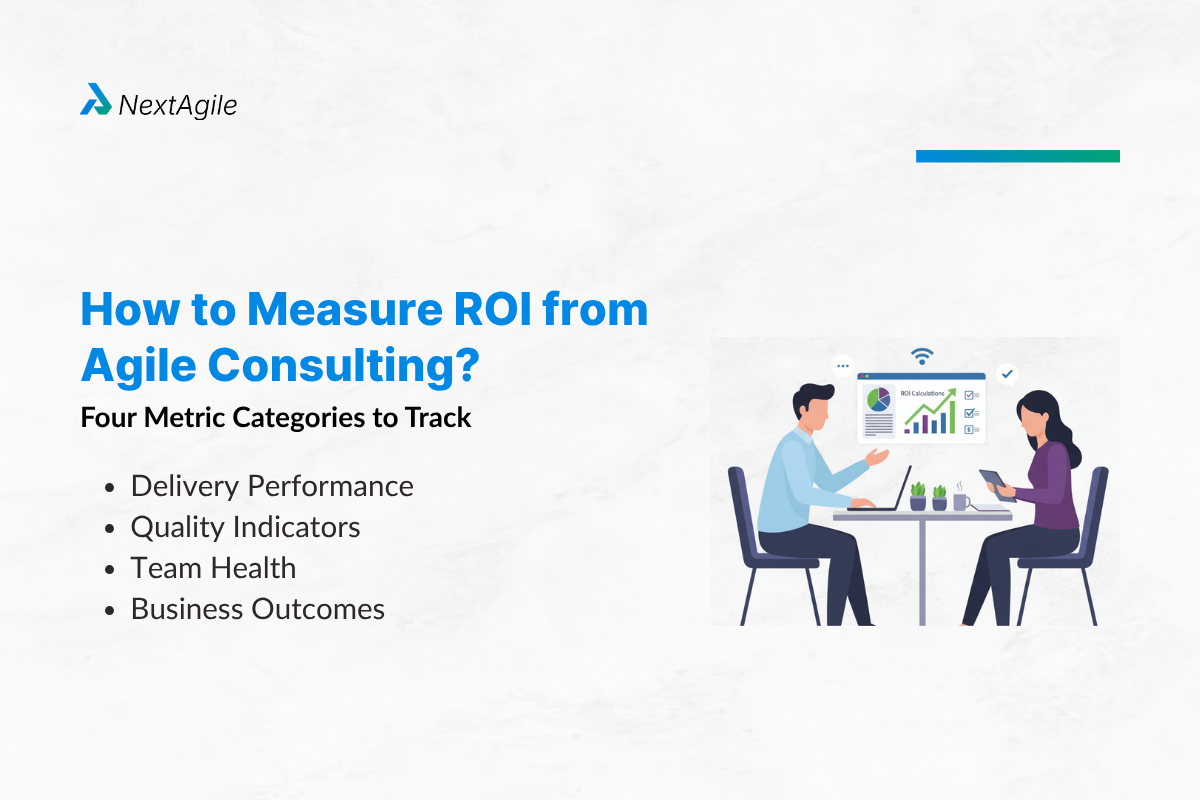
Four Metric Categories to Track
- Delivery Performance: Sprint predictability, cycle time, deployment frequency, lead time for changes.
- Quality Indicators: Defect escape rate, change failure rate, mean time to restore (MTTR).
- Team Health: eNPS, retrospective sentiment, and retention on Agile teams vs. non-Agile teams.
- Business Outcomes: Time to market, customer NPS, revenue attributable to faster delivery capability.
At NextAgile, we build the ROI measurement framework into week two of every engagement. Baseline together, define success collaboratively, and review at 30-60-90 day intervals.
When building your internal business case; lead with the cost of delay, the business value you’re losing right now because your delivery process is too slow. That number tends to be far more persuasive to leadership than the consulting fee itself.
Conclusion
The payment company we mentioned at the start? They came to us 18 months after that failed engagement. We ran the maturity assessment, identified the real blockers (stakeholders who’d never bought into the change and a framework that was never right for their scale), and built an internal Agile coaching bench before we started any team-level work.
Twelve months later, cycle time was down 34%. Sprint predictability crossed 80% for the first time. And when we handed over to their internal coaches as planned, the transformation held.
That’s what a right agile consulting firm looks like. Not the one with the most impressive proposal. The one with the most honest conversation before you sign.
Use this checklist. Ask the ten questions. Watch for the warning signs. And if you want a firm that measures success exactly the way you do with data, not decks, we’d like to start with a conversation.
Book a free 30-minute discovery call to explore how we can help curate a contextual agile transformation roadmap for your organisation. You can also reach out to us at consult@nextagile.ai
Download our Agile Metrics Scorecard to know you current agile adoption health.
Frequently Asked Questions
1. What is the difference between an agile consulting firm and an agile coach?
An agile coach works at the team or program level, improving specific squads’ Scrum practices, sprint planning, and retrospectives. An agile consulting firm operates at the organizational level: designing the transformation roadmap, aligning leadership, and driving systemic change across multiple teams and business units. An agile coach is embedded in your delivery. An agile consulting firm redesigns how your whole organization delivers.
2. How long does a typical agile transformation engagement take?
For teams of 50-200 people, expect 6–9 months for meaningful results. Enterprise-wide transformations across multiple business units typically run 18-36 months. That said, a well-structured engagement delivers measurable improvement within the first 90 days well before the full transformation is complete.
3. Can small businesses benefit from agile consulting companies?
Yes, and often faster than enterprises, because there’s less organizational inertia. Agile consulting firms for small businesses typically offer focused, time-boxed engagements rather than multi-year retainers. Look for firms that scale their approach and pricing to your actual size, rather than selling you an enterprise framework you don’t need.
4. How do I build an internal business case to hire an agile consulting firm?
Start with the cost of your current delivery dysfunction: missed deadlines, rework cycles, slow time-to-market, and high attrition on engineering teams. Quantify it honestly. Then position agile transformation as a cost-reduction and revenue-acceleration investment, not an overhead expense. Add projected outcomes grounded in the firm’s case studies in your industry, and include a risk mitigation angle that shows you’ve done your due diligence on knowledge transfer and measurable outcomes. Position the agile consulting firm as an outside-in intervention which can leverage their industry and domain expertise to bring in a new perspective to solve your business problems.