Key Highlights of Defect Management Defect management goes beyond simple bug tracking and acts as a quality intelligence system, helping teams identify patterns, root causes, and process gaps instead of just fixing issues. A structured defect management process, from identification to verification, ensures faster resolution, better prioritization, and significantly fewer production incidents. In Agile environments, continuous testing and faster feedback loops help teams detect and resolve defects early, reducing the chances of issues reaching production. Tracking key metrics like defect leakage, mean time to resolution, and defect density enables teams to continuously improve software quality and optimize their development and testing practices. Introduction Modern software products operate in complex environments with continuous releases, multiple integrations, and high user expectations. In such conditions, defect management becomes a critical discipline for ensuring product reliability and delivery stability.
In large engineering programs, 30-40% of production incidents can often be traced to defects that were previously identified but poorly tracked, prioritized, or resolved. This highlights why structured defect management processes are essential for maintaining software quality.
Defect management is not just about logging bugs. It involves systematically identifying, prioritizing, tracking, resolving, and analyzing defects throughout the software development lifecycle.
Organizations that implement structured defect management practices can:
Improve software quality Reduce production incidents Accelerate release cycles Strengthen collaboration between development and testing teams In this guide, we will explore the defect management process, commonly used tools, best practices, and how Agile teams manage defects effectively.
In many engineering teams, defects are seen as isolated issues to be fixed. In reality, they are signals. When viewed collectively, they reveal patterns about system design, testing effectiveness, and even team coordination. Organizations that pay attention to these patterns improve much faster than those that simply fix and move on.
What Is Defect Management? Defect management refers to the process of identifying, documenting, tracking, prioritizing, resolving, and preventing defects in software systems.
A defect is any deviation from expected system behavior or requirements.
Effective defect management helps teams:
Track issues systematically Ensure defects are resolved before release Analyze patterns that lead to recurring issues Improve development and testing practices Modern engineering teams treat defect management as a quality intelligence system rather than simply a bug tracking activity.
Instead of only recording issues, mature teams analyze defect trends to understand:
Root causes System weaknesses Testing gaps Process improvements A simple way to understand this is to see defect management as a feedback system for engineering quality. Each defect carries information about what went wrong and why. The real value comes from learning from that information, not just resolving the issue.agile consulting approach
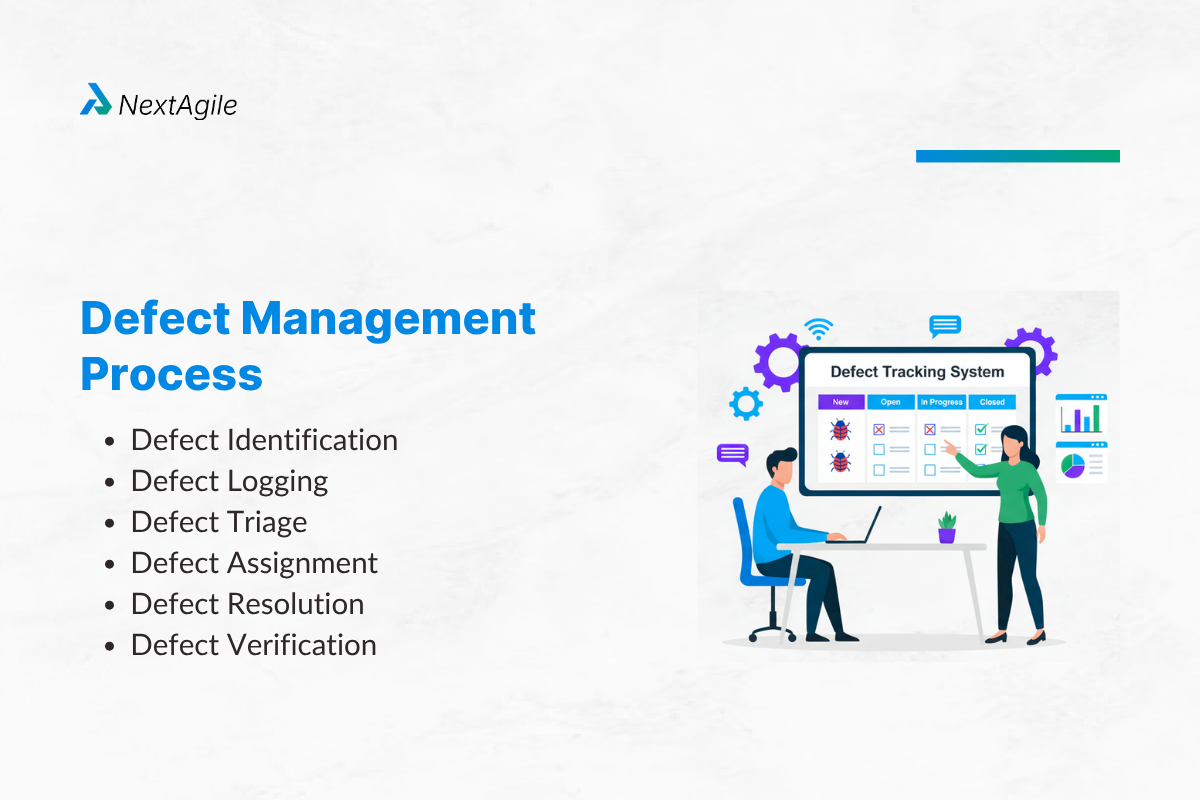
Defect Management Process A typical defect management process includes several structured stages. While the stages are well defined, the effectiveness of this process depends on how consistently teams follow it. Small gaps in logging, triage, or verification often lead to larger quality issues later.
1. Defect Identification Defects are identified through:
Manual testing Automated testing Exploratory testing Production monitoring User feedback Once discovered, the defect is documented with detailed information. Teams that invest in diverse detection methods tend to uncover defects earlier. Relying on a single approach, such as only manual testing, often leaves blind spots.
2. Defect Logging Testers log defects in a defect tracking system with details such as:
Defect description Steps to reproduce Expected result Actual result Environment details Screenshots or logs Accurate logging improves the efficiency of defect resolution. Clear and detailed defect reports save significant time during resolution. When developers can quickly understand and reproduce an issue, the turnaround time improves noticeably.
3. Defect Triage In the triage stage, teams evaluate defects and decide:
Severity level Priority level Responsible team Resolution timeline This ensures that critical defects are resolved first . Triage discussions are often where alignment happens. When done well, they bring product, engineering, and QA teams together to make informed decisions about impact and urgency.agile team roles
Defect Severity vs Priority Framework Many teams confuse defect severity and defect priority , but they represent different concepts.
Severity Meaning Example Critical System crash or data loss Payment processing fails Major Key functionality broken Checkout cannot complete Minor Limited impact issue Search results incorrect Trivial Cosmetic issue Typo in UI
Priority determines how quickly the defect should be fixed . In practice, this distinction becomes clearer when teams ask two simple questions. How severe is the impact on the system? How urgent is it to fix from a business perspective? Keeping both in mind helps avoid confusion.
Priority Meaning Expedite Fix immediately High Fix in current sprint Medium Fix soon Low Add to backlog
A defect can be low severity but high priority (for example, a typo on a homepage before launch).
4. Defect Assignment Once prioritized, defects are assigned to developers or teams responsible for fixing them.
Clear ownership helps prevent defects from remaining unresolved. Ownership is critical here. When responsibility is unclear, defects tend to remain open longer or get passed between teams, slowing down resolution.
5. Defect Resolution Developers analyze the issue, identify the root cause, and implement fixes.
After resolving the issue, the defect status is updated. Teams that focus on understanding the root cause, not just fixing the symptom, reduce the chances of similar defects appearing again.
6. Defect Verification Testers verify the fix by re-running relevant tests.
If the issue is resolved, the defect is marked as closed.
If not, it may be reopened for further investigation .
Verification is not just about confirming the fix. It is also an opportunity to check if related areas might be affected, helping prevent regression issues.
Defect Lifecycle Overview A typical defect lifecycle includes the following states:
New Assigned In Progress Fixed Retest Closed Reopened This lifecycle ensures clear visibility of defect status across teams.
Categorization of Defects in Software Testing Defects in software testing are often categorized based on when they are identified during the development lifecycle. This categorization helps teams understand testing effectiveness, quality gaps, and process improvements.
During Sprint Defects discovered while a sprint is in progress are typically classified into two types:
In-Sprint Defects: These are identified by QA when a user story that is currently in progress is tested against its acceptance criteria and fails to meet the expected behavior. Since the sprint work is still active, developers usually fix these defects within the same sprint to ensure the story meets the defined requirements.Deferred Defects: Sometimes QA identifies a bug in a user story during the sprint, but the issue does not significantly affect the core functionality. In such cases, the Product Manager and technical leads may decide to close the story and defer the defect, moving it to the product backlog for future resolution. During Regression or Post-Implementation Escaped Defects: These defects are discovered later in the testing cycle, such as during sanity testing, regression testing, integration testing, or after the product is released to production. Escaped defects indicate that earlier testing phases did not detect the issue. In a typical defect management cycle, QA logs the defect in Jira, assigns it to a developer, and marks it as Open . After the developer fixes the issue, QA retests it and marks the defect Closed or Reopened if the issue persists.
This categorization helps teams reflect on where defects are being introduced and where they are being missed. Over time, this insight can guide improvements in both development and testing practices.
Defect Management Tools Software teams rely on defect tracking tools to manage issues efficiently.
These tools help teams:
Track defects Manage workflows Collaborate across teams Generate quality reports Tools make tracking easier, but they do not guarantee quality. The real impact comes from
how teams use these tools to collaborate, prioritize, and learn from defects.
Defect Management Tools Comparison Table Tool Best For Key Strength Jira Agile development teams Custom workflows and integrations Bugzilla Open-source projects Lightweight defect tracking Azure DevOps Microsoft ecosystem teams Integrated CI/CD and backlog management TestRail QA teams Test case and defect integration MantisBT Small teams Simple and easy defect tracking
Teams should choose defect management tools based on:
Integration with CI/CD pipelines Ability to link defects to test cases Scalability for large teams Reporting capabilities for quality analytics Defect Management in Software Construction Projects In complex software systems, defect management becomes even more critical.
Large systems often include:
Multiple teams Distributed development environments Frequent releases Microservices architectures Without centralized defect management, issues discovered by one team may remain invisible to others.
For example, in microservices architectures:
A defect in one service may affect several dependent services, making defect tracking and cross-team collaboration essential.
Structured defect management systems allow teams to:
Share defect visibility across teams Prioritize system-wide risks Prevent repeated failures across components In large systems, visibility becomes as important as resolution. When teams can see how defects impact other components, they make better decisions and avoid repeated issues. As organizations scale, defect management becomes a critical part of the broader agile transformation journey
Agile vs Traditional Defect Management Defect management practices differ between traditional development models and Agile teams .
Aspect Traditional Testing Agile Testing Testing phase After development Continuous Defect discovery Late in cycle Early and frequent Feedback loop Slow Rapid Collaboration Separate teams Cross-functional teams
In Agile environments:
Defects are identified earlier Teams resolve issues within the sprint Testing and development happen simultaneously This reduces defect leakage into production environments.
What teams often notice in Agile environments is that defects become part of the daily workflow rather than a separate phase. This shift helps reduce accumulation and keeps quality aligned with delivery.
Modern teams increasingly rely on an agile testing methodology
Key Defect Management Metrics High-performing engineering organizations track metrics to improve software quality.
Common defect management metrics include:
Number of defects per unit of code or feature.
Percentage of defects discovered after release.
Example:
Mature engineering teams aim to keep defect leakage below 5% , meaning fewer than 5% of defects escape to production.
Mean Time to Resolution (MTTR) Average time required to fix a defect.
Percentage of defects reopened after being marked fixed.
Tracking these metrics helps teams continuously improve quality and testing effectiveness.
Metrics are most useful when they lead to action. Tracking numbers alone does not improve quality. The value comes from using these insights to adjust practices and prevent future issues.
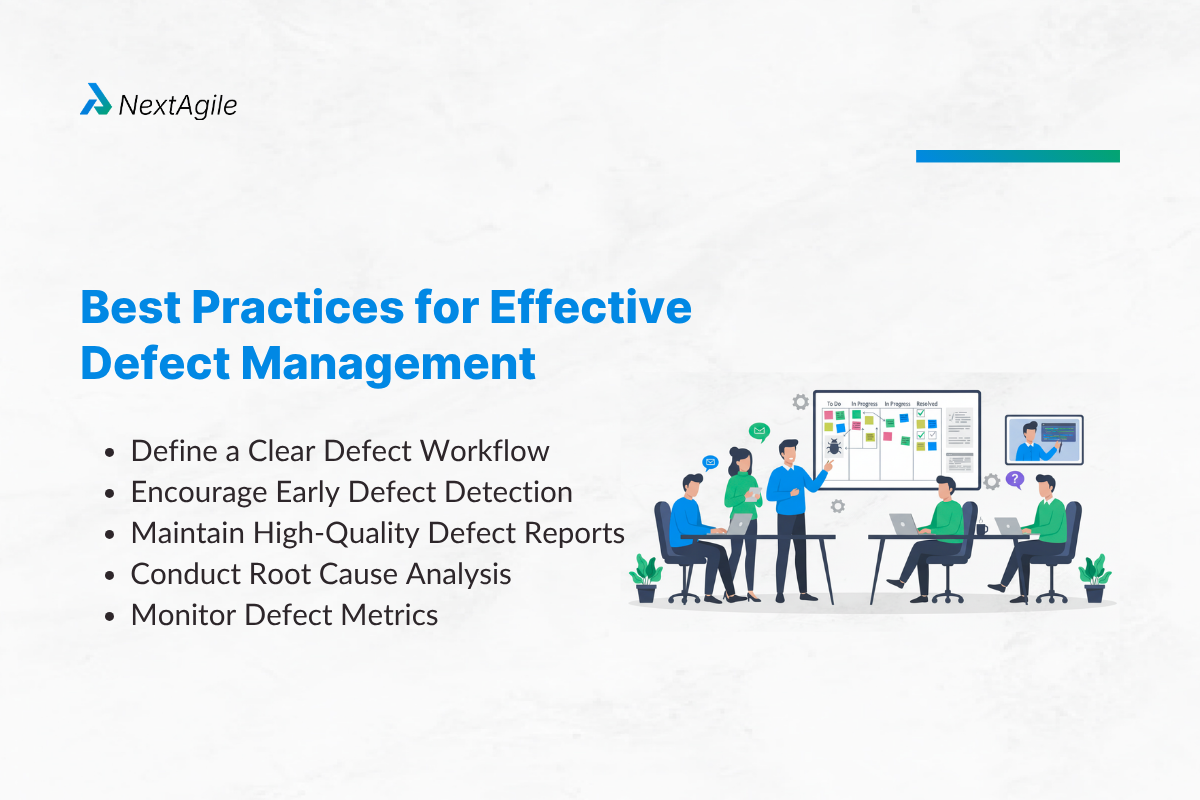
Best Practices for Effective Defect Management Successful defect management requires structured practices.
1. Define a Clear Defect Workflow Teams should establish clear workflows for defect reporting, triage, resolution, and verification.
2. Encourage Early Defect Detection The earlier defects are detected, the cheaper they are to fix.
Techniques include:
Automated testing Code reviews Continuous integration testing 3. Maintain High-Quality Defect Reports Poorly documented defects slow down resolution.
Effective defect reports include:
Reproducible steps Environment details Screenshots or logs 4. Conduct Root Cause Analysis Repeated defects often indicate underlying process issues.
Teams should analyze defects to identify:
Development gaps Test coverage gaps Design weaknesses 5. Monitor Defect Metrics Tracking quality metrics helps teams understand trends and improve processes.
These practices work best when they become habits rather than checklists. Consistency in applying them is what drives long term improvement in quality.
Conclusion For many organizations, the turning point comes when defect management shifts from reactive fixing to proactive improvement. This is where quality starts improving at a system level.
Effective defect management plays a vital role in delivering reliable software products.
However, successful organizations go beyond simply tracking bugs.
They treat defect management as a strategic engineering capability that provides insights into product quality, development practices, and testing effectiveness.
Teams that implement structured defect management processes can:
Reduce production incidents Improve product stability Accelerate delivery cycles Enhance collaboration across engineering teams By combining clear processes, modern tools, quality metrics, and Agile practices, organizations can build robust defect management systems that support high-quality software delivery . Teams that mature in this area begin to see fewer recurring issues, smoother releases, and better collaboration. Over time, defect management becomes less about firefighting and more about building reliable systems.
If your teams struggle with recurring defects and slow releases, structured defect management becomes essential. NextAgile consulting can help you co‑create and implement a practical Business agility roadmap. Do reach out to us at consult@nextagile.ai and we would be happy to explore more.
Frequently Asked Questions 1. Why do the same defects keep recurring in many teams? Because the underlying causes are not addressed. Fixing individual issues without understanding why they occurred often leads to repetition.
2. How detailed should a defect report be? Detailed enough for someone else to reproduce the issue without additional clarification. Clear steps, environment details, and expected versus actual results make a big difference.
3. Should all defects be fixed immediately? Not necessarily. Teams need to balance severity and priority. Some defects can be deferred if they do not impact critical functionality.
4. How can teams reduce defect leakage into production? By improving early testing practices, increasing automation, and ensuring continuous feedback during development rather than waiting until the end.
5. What is a good indicator of an effective defect management process? Fewer recurring defects, faster resolution times, and improved stability in releases are strong indicators that the process is working well.
Anuj Ojha is Co-Founder & Consulting Head at NextAgile. Anuj has designed & led multiple turnkey transformation journeys across industries, domains & geographies and has 16+ years of experience as an agile practitioner. He has worked with CXOs, CTOs & Key Leaders to translate their business objectives on the ground, contextualizing org transformations and creating buy-in across level, leading a team of coaches/consultants to implement agility across 150+ teams & trained more than 12k team members. Anuj’s core area of interest is business agility & working with leaders & teams to achieve long term sustainable, Agile culture & mindset.
 Skip to content